June 16, 2026
The Quiet Race to Own the Next Industrial Era
Across global commodity markets, a structural tension has persisted for decades: the nations richest in natural resources often capture the least economic value from them. A country that exports raw lithium earns a fraction of what a country earns manufacturing the battery cell that lithium ultimately powers. This dynamic, long accepted as an economic reality of developing markets, is now the central target of a coordinated multilateral intervention reshaping how Asia-Pacific nations participate in the clean energy economy. The ADB critical minerals financing facility sits at the heart of this shift.
The logic is straightforward but the execution has historically been elusive. Building processing, refining, and manufacturing capacity requires capital, policy stability, technical expertise, and risk appetite that developing economies rarely possess simultaneously. The result has been chronic "value chain truncation," where mineral-rich nations remain locked in the lowest-margin segment of supply chains that increasingly underpin the global energy transition.
Furthermore, understanding critical minerals demand growth helps explain why this structural problem has become so urgent to address at scale.
That is the structural problem the Asian Development Bank's new financing mechanism is designed to address at scale.
When big ASX news breaks, our subscribers know first
What the ADB Critical Minerals Financing Facility Actually Is
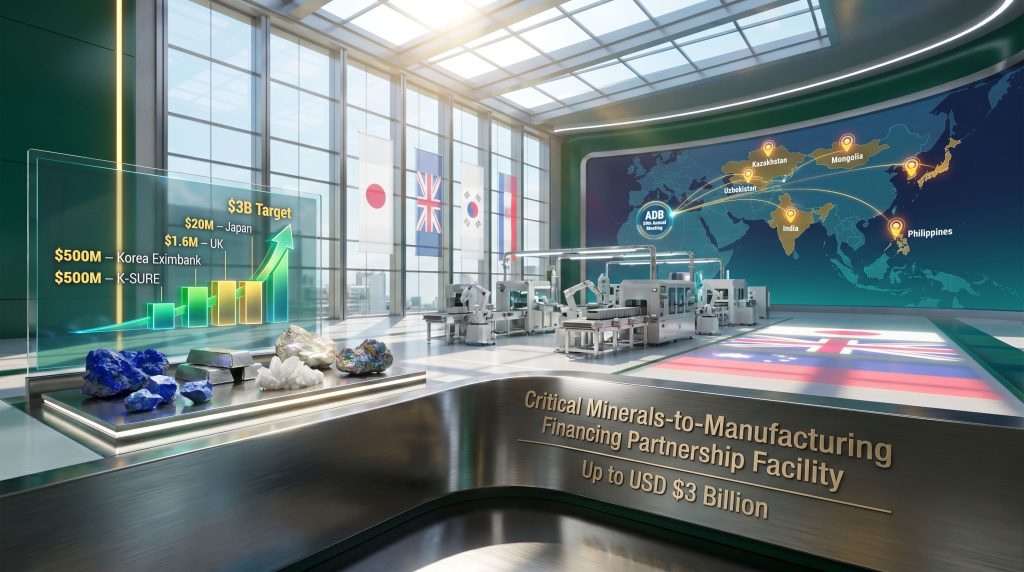
Launched on 4 May 2026, during the ADB's 59th Annual Meeting, the Critical Minerals-to-Manufacturing Financing Partnership Facility (CMMFPF) represents a significant escalation in multilateral development finance targeting the clean energy supply chain. Announced by ADB President Masato Kanda, the facility is explicitly designed to move Asia-Pacific developing economies beyond raw material export toward full-spectrum industrial participation, spanning geological exploration, mining, processing, advanced manufacturing, and circular economy recycling.
The ADB critical minerals financing facility is not a single grant programme or a targeted technical assistance initiative. It is a structured, dual-window financing architecture that coordinates grant capital, concessional finance, export credit guarantees, and commercial co-investment into a sequenced deployment model.
Kanda framed the facility's development thesis clearly at the 59th Annual Meeting. His core argument was that the Asia-Pacific region should not be confined to supplying the raw inputs for the next industrial era. Instead, the region should capture the jobs, technological capabilities, and economic value that those inputs ultimately generate downstream (ET EnergyWorld, May 4, 2026).
This is not a peripheral programme. It builds directly on ADB's 2025 strategy on regional value chain development and positions critical minerals as foundational to the bank's broader mandate of inclusive economic growth across its developing member countries.
The CMMFPF Definition: A Structural Snapshot
The Critical Minerals-to-Manufacturing Financing Partnership Facility is a multilateral financing mechanism established by the ADB to help Asia-Pacific developing economies build integrated critical minerals supply chains, covering everything from raw material extraction through to processing, advanced manufacturing, and recycling, in support of clean energy, electric vehicles, batteries, and digital technologies.
Three operational pillars underpin the facility:
- Project preparation: Feasibility studies, environmental and social impact assessments, and technical assistance for early-stage mineral projects
- Policy reform: Regulatory framework development, critical minerals strategy design, and governance capacity building across member nations
- Capital mobilisation: Coordinating public grant funding, export credit facilities, blended finance instruments, and private sector co-investment into viable mineral project pipelines
Critically, the ADB has stipulated that all projects supported through the facility must satisfy rigorous environmental and social governance requirements, including mandatory due diligence processes and impact assessments (ET EnergyWorld, May 4, 2026). This ESG baseline is not optional — it is embedded as a structural prerequisite for accessing the facility's financing windows.
How the Two-Window Financing Architecture Works
The facility's structural innovation lies in how it sequences different types of capital to progressively reduce project risk and attract increasingly commercial sources of funding. Understanding this architecture is essential for evaluating how the facility will function in practice.
| Feature | Grant Window | Catalytic Finance Window |
|---|---|---|
| Primary Purpose | Early-stage project de-risking | Commercial co-financing mobilisation |
| Activities Funded | Feasibility studies, environmental assessments, technical assistance, knowledge exchange | Blended finance, co-investment, export credit risk mitigation |
| Confirmed Commitments | Japan: USD $20M; UK: USD $1.6M | Korea Eximbank: USD $500M MOU; K-SURE: USD $500M MOU |
| Total Confirmed at Launch | USD $21.6 million | USD $1 billion (MOU basis) |
| Target Beneficiaries | Developing member countries at early project stages | Projects requiring scale capital and commercial risk coverage |
The sequencing logic is deliberate. Early-stage mineral projects in developing markets carry information risk (insufficient geological data), regulatory risk (unclear permitting frameworks), and political risk (sovereign and policy uncertainty). These compounding risks make such projects commercially unattractive to institutional investors and commercial banks without additional support.
The grant window addresses exactly these barriers. By funding feasibility studies, geological assessments, environmental impact evaluations, and regulatory alignment work, grant capital transforms speculative project concepts into bankable investment propositions. Once that de-risking work is complete, the catalytic finance window can then bring in export credit agencies, development finance institutions, and ultimately commercial co-investors on improved risk-return terms.
The Role of Export Credit Agencies in Bridging Development and Commercial Finance
Korea Eximbank and the Korean Trade Insurance Corporation (K-SURE) became the inaugural partners for the catalytic finance window, each committing to a USD $500 million memorandum of understanding (ET EnergyWorld, May 4, 2026). Their participation is significant beyond the headline figures.
Export credit agencies function differently from traditional development banks or commercial lenders. They provide structured trade finance, political risk insurance, and export credit guarantees — instruments that alter the risk-return profile of emerging market investment in ways that standard equity or debt financing cannot. Their presence signals to the broader commercial finance community that a project or programme has met a meaningful threshold of commercial credibility and sovereign risk assessment.
"The participation of Korea Eximbank and K-SURE as inaugural partners sends a demand signal to the private sector: critical minerals projects in Asia-Pacific are moving from speculative to structured investment territory."
It is worth noting that MOU commitments represent formal statements of intent rather than unconditional deployed capital. The actual deployment of the USD $1 billion in ECA commitments will depend on specific project eligibility, due diligence outcomes, and bilateral agreement terms. The battery metals investment landscape provides further context on why this structured approach to capital mobilisation is becoming increasingly important across the region.
Active Country Programmes: Where Capital Is Already Flowing
The CMMFPF launch is not a greenfield announcement without operational foundation. ADB has active critical minerals programmes running across five developing member countries, spanning upstream geological data infrastructure through to downstream recycling systems (ET EnergyWorld, May 4, 2026).
| Country | ADB Programme Focus |
|---|---|
| India | Battery manufacturing scale-up and industrial recycling infrastructure |
| Mongolia | Geological data mapping and resource characterisation |
| Uzbekistan | AI-integrated critical metals production and circular economy approaches |
| Kazakhstan | National critical minerals strategy development |
| Philippines | Regulatory reform and critical minerals roadmap design |
Examined collectively, these programmes reveal a deliberate sequencing philosophy rather than an ad hoc collection of initiatives. Mongolia's geological mapping work addresses the foundational information gap that prevents investment from flowing to underdeveloped mineral provinces. Kazakhstan's strategy development builds the policy architecture that investors require before committing capital. The Philippines' regulatory reform track reduces sovereign risk premiums by increasing policy predictability.
Meanwhile, India and Uzbekistan represent the more advanced industrial layer. India's battery manufacturing and recycling focus targets the midstream and downstream segments of the lithium-ion supply chain, while Uzbekistan's adoption of AI-driven production optimisation in critical metals extraction signals a shift toward digital-industrial convergence that few observers would typically associate with Central Asian mineral programmes.
The Uzbekistan AI Integration: A Less Visible Signal
The specific reference to artificial intelligence integration in Uzbekistan's critical metals production deserves attention. While the ADB's announcement does not elaborate on the technical scope, the deployment of machine learning or automation in mineral processing typically serves several distinct functions: optimising extraction yields, reducing reagent consumption in hydrometallurgical processing, improving quality control for refined output, and enhancing resource modelling for reserve estimation.
The fact that ADB is supporting AI-integrated production approaches in a Central Asian developing economy — rather than confining such technology to established mining jurisdictions — suggests the facility's broader ambition extends to technology leapfrogging. This enables developing nations to build competitive, digitally enabled industrial capability rather than replicating older capital-intensive models.
The Critical Minerals Database: Supply Chain Transparency as Infrastructure
Alongside the financing facility itself, ADB has established a Critical Minerals Database to centralise supply chain tracking and information (ET EnergyWorld, May 4, 2026). This data infrastructure component receives less attention than the headline financing commitments, but it may prove equally consequential over time.
Information asymmetry has historically been a significant barrier to private investment in developing-market mineral projects. Investors face elevated due diligence costs when geological data is fragmented, unpublished, or held in non-standardised formats across different government agencies. Regulatory timelines are harder to model when permitting processes lack transparency. Social and environmental risk assessments are more expensive when baseline data is absent.
A centralised, standardised critical minerals database reduces all of these friction costs simultaneously. It lowers the barrier to entry for investors considering unfamiliar jurisdictions, improves policy coordination among member governments, and provides the data infrastructure that international supply chain mapping initiatives increasingly require.
"Transparent, standardised supply chain data is increasingly a prerequisite for accessing Western clean energy financing mechanisms. ADB's database positions member countries to engage with allied-nation supply chain frameworks — a capability with significant long-term economic implications in an era of supply chain realignment."
This data governance dimension also aligns with broader global frameworks. Europe's critical raw materials facility and comparable supply chain traceability initiatives increasingly demand documented provenance and sustainability credentials for minerals entering advanced manufacturing supply chains.
Comparing the CMMFPF to Other Global Critical Minerals Financing Mechanisms
The ADB critical minerals financing facility does not operate in isolation. Multiple multilateral and geopolitical financing mechanisms are competing to shape critical minerals supply chains globally. Understanding where the CMMFPF fits within this landscape clarifies its unique strategic positioning.
| Mechanism | Operator | Geographic Focus | Financing Scale | Key Differentiator |
|---|---|---|---|---|
| CMMFPF | ADB | Asia-Pacific developing economies | Up to USD $3B mobilised | Full value chain: mining to recycling |
| Minerals Security Partnership (MSP) | US-led multilateral coalition | Global (allied nations) | Variable, project-by-project | Geopolitical supply chain alignment |
| EU Critical Raw Materials Act | European Commission | EU and partner countries | Multi-billion EUR | Regulatory benchmarking and strategic stockpiling |
| World Bank Minerals for Climate | World Bank Group | Global developing markets | Multi-billion USD | Poverty reduction and climate co-benefits |
Each of these mechanisms reflects a distinct primary objective. The Minerals Security Partnership prioritises geopolitical supply chain alignment among allied nations. The EU Critical Raw Materials Act establishes regulatory compliance benchmarks and targets strategic stockpile thresholds. The World Bank's minerals programmes are oriented around poverty reduction co-benefits as much as supply chain outcomes.
The CMMFPF's differentiating characteristic is its explicit integration of the manufacturing transition mandate. Rather than targeting resource extraction, supply security, or regulatory compliance as primary objectives, the facility is structured around the premise that value chain progression — from raw materials through to advanced manufacturing — is itself the development outcome. This positions it uniquely within the multilateral financing landscape as an industrialisation tool, not simply a resource mobilisation mechanism.
The next major ASX story will hit our subscribers first
Economic Development Implications: Beyond the Financing Headlines
The economic development logic of the CMMFPF rests on a well-documented but frequently underappreciated dynamic in commodity-dependent economies. Countries that export unprocessed or minimally processed critical minerals capture only a fraction of the total value generated across the supply chain. A tonne of lithium carbonate exported as a raw commodity commands a very different price than the same lithium content embodied in battery-grade precursor chemicals, cathode active materials, or finished battery cells.
Processing and manufacturing facilities also generate meaningfully different employment profiles compared to extraction operations. Upstream mining employment is concentrated in a relatively narrow range of operational roles and tends to be geographically isolated. Downstream processing and manufacturing creates broader skilled employment in engineering, quality assurance, logistics, and technical services, with stronger linkages to local economies and supply chains.
Technology transfer represents the third dimension of value that raw commodity export cannot capture. Advanced manufacturing partnerships bring engineering capability, industrial process knowledge, workforce development, and intellectual property that compound over time into broader industrial competitiveness. This is the dimension that Kanda's comments at the 59th Annual Meeting specifically targeted when articulating that the region should capture the jobs, technology, and value that critical minerals provide (ET EnergyWorld, May 4, 2026).
Geopolitical Context: Supply Chain Sovereignty in a Fragmented World
The CMMFPF arrives at a moment of pronounced global supply chain realignment. Post-pandemic supply chain concentration risks, combined with intensifying US-China technology competition and geopolitical fragmentation, have elevated supply chain sovereignty from a logistics concern to a strategic priority for governments across both advanced and emerging economies. The broader critical minerals and energy transition context makes this realignment especially consequential for Asia-Pacific nations.
ADB's multilateral, non-aligned institutional positioning gives it a distinctive convening capability in this environment. Unlike geopolitically oriented financing mechanisms that effectively require participating countries to align with specific strategic blocs, ADB can engage member states across diverse geopolitical relationships. This positions the CMMFPF as a mechanism that can potentially bridge supply chain development across politically heterogeneous member countries, including those whose mineral endowments are substantial but whose geopolitical alignment is complex.
Diversified, regionally anchored supply chains also carry structural resilience advantages. Geographic concentration of mineral processing in single jurisdictions creates systemic fragility, as supply disruptions from any single source propagate across entire technology supply chains. Regional diversification of processing capacity across multiple Asia-Pacific developing economies distributes that risk while simultaneously expanding the region's aggregate industrial capacity. This critical minerals strategy shift toward regional self-sufficiency is becoming a defining feature of how multilateral institutions are approaching the energy transition.
Frequently Asked Questions: ADB Critical Minerals Financing Facility
What is the ADB Critical Minerals-to-Manufacturing Financing Partnership Facility?
The Critical Minerals-to-Manufacturing Financing Partnership Facility (CMMFPF) is a multilateral financing mechanism launched by the Asian Development Bank on 4 May 2026, during the ADB's 59th Annual Meeting. It is designed to help Asia-Pacific developing economies build integrated critical minerals supply chains spanning geological exploration, mining, processing, advanced manufacturing, and recycling, in support of clean energy, electric vehicles, batteries, and digital technologies.
The facility operates through two financing windows: a grant window for early-stage project development and a catalytic finance window for commercial co-investment mobilisation. The ADB's initiative to build Asia's critical minerals supply chains provides the full institutional context for this facility's strategic rationale.
How much funding does the ADB critical minerals facility provide?
At launch, the grant window received confirmed commitments of USD $20 million from Japan and USD $1.6 million from the United Kingdom, totalling USD $21.6 million in initial grant capital. The catalytic finance window secured inaugural MOU commitments of USD $500 million from Korea Eximbank and USD $500 million from K-SURE, representing USD $1 billion in export credit agency commitments. The facility is structured to mobilise coordinated investment across both public and private sources.
Which countries will benefit from the ADB critical minerals facility?
Eligibility extends to ADB developing member countries across Asia and the Pacific. At the time of the facility's launch, ADB already had active critical minerals programmes running in India, Mongolia, Uzbekistan, Kazakhstan, and the Philippines, covering battery manufacturing, geological data mapping, AI-integrated production, strategy development, and regulatory reform respectively.
What minerals does the ADB facility cover?
The facility adopts a technology-neutral approach, targeting minerals required for clean energy technologies, electric vehicle batteries, and digital infrastructure. This includes transition minerals such as lithium, cobalt, nickel, rare earths, copper, and related critical inputs for battery manufacturing and advanced electronics.
How does the ADB critical minerals facility address environmental concerns?
All projects supported by the CMMFPF must satisfy mandatory environmental and social governance requirements. This includes rigorous due diligence processes and comprehensive impact assessments as a prerequisite for accessing facility financing. These requirements apply across both the grant and catalytic finance windows (ET EnergyWorld, May 4, 2026).
What is the difference between the grant window and the catalytic finance window?
The grant window funds early-stage project development activities, including feasibility studies, environmental assessments, and technical assistance, using concessional grant capital from sovereign donors. The catalytic finance window brings in larger-scale co-financing through export credit agencies, blended finance instruments, and commercial co-investors. For a detailed breakdown of how the Critical Minerals Manufacturing Financing Partnership Facility is structured, the ADB's official documentation provides comprehensive technical specifications.
Key Takeaways: What the CMMFPF Means for Asia-Pacific Industrial Development
| Metric | Value |
|---|---|
| Facility Launch Date | May 4, 2026 (ADB's 59th Annual Meeting) |
| Japan grant commitment | USD $20 million |
| UK grant commitment | USD $1.6 million |
| Korea Eximbank MOU commitment | USD $500 million |
| K-SURE MOU commitment | USD $500 million |
| Total confirmed ECA commitments (MOU) | USD $1 billion |
| Active country programmes at launch | 5 (India, Mongolia, Uzbekistan, Kazakhstan, Philippines) |
| ADB President (facility announcer) | Masato Kanda |
Three strategic shifts characterise what the CMMFPF represents for the broader trajectory of Asia-Pacific economic development:
-
From extraction to industrialisation: Multilateral development finance is now explicitly targeting manufacturing value capture as the primary development objective, not simply resource development or supply security assurance.
-
From bilateral to blended: The dual-window architecture demonstrates how grant capital and commercial finance can be systematically sequenced to unlock private investment at scale, addressing the structural barriers that have historically prevented developing economies from accessing capital for advanced industrial development.
-
From supply security to supply sovereignty: Asia-Pacific nations are being positioned as active industrial participants in the clean energy economy, not passive raw material exporters, with manufacturing capability, technology transfer, and skilled employment embedded as explicit programme outcomes alongside the financial returns.
Disclaimer: This article is intended for informational purposes only and does not constitute financial advice. Forward-looking statements regarding financing commitments, investment mobilisation targets, or economic development outcomes involve inherent uncertainty and should not be relied upon as guarantees of future results. MOU commitments referenced herein represent stated intentions and are subject to individual project due diligence, eligibility criteria, and bilateral agreement terms. Readers should consult primary ADB documentation and seek independent financial advice before making investment decisions. Further coverage of Asia-Pacific energy transition financing is available at energy.economictimes.indiatimes.com.
Want to Know Which ASX Miners Stand to Benefit From the Critical Minerals Boom?
As the ADB's Critical Minerals-to-Manufacturing Financing Partnership Facility accelerates investment across Asia-Pacific supply chains, the companies positioned at the exploration and discovery stage could represent the earliest — and most significant — opportunities for investors. Discovery Alert's proprietary Discovery IQ model delivers real-time alerts on significant ASX mineral discoveries the moment they are announced, transforming complex geological data into actionable insights — explore historic discovery returns on Discovery Alert's dedicated discoveries page and begin your 14-day free trial to position yourself ahead of the market.