June 16, 2026
The World's Most Pressurised Shipping Lane Is Back Open — But Don't Celebrate Yet
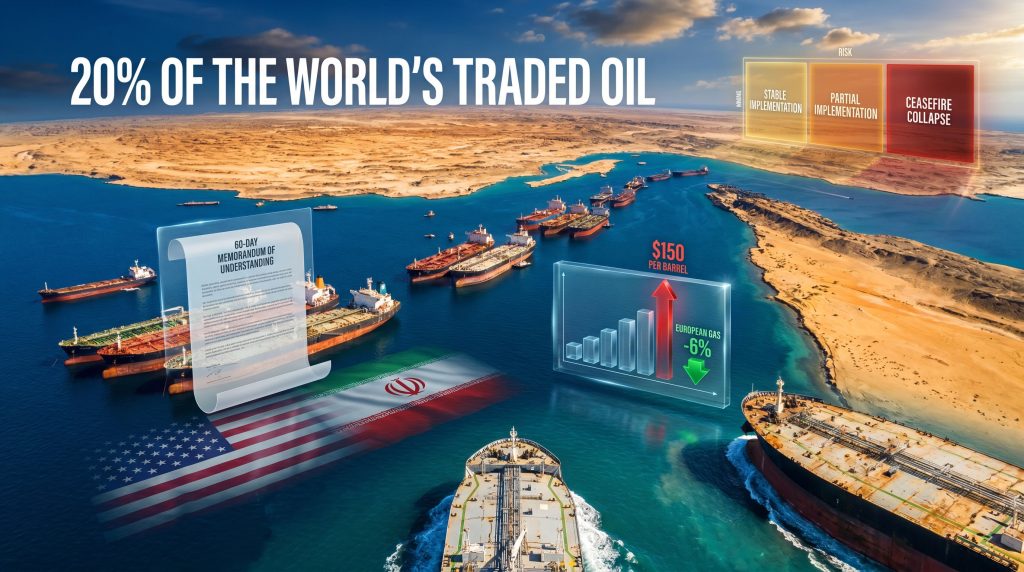
Every few decades, global energy markets are reminded of a brutal geographic truth: the entire industrial metabolism of Asia-Pacific runs through a narrow body of water just 33 kilometres wide at its most constricted point. The Strait of Hormuz is not merely a shipping lane. It is the arterial junction through which roughly 20% of the world's traded oil and a substantial share of global LNG transits every single day. When that artery closes, the downstream consequences cascade across continents within weeks.
The U.S.-Iran deal to reopen the Strait of Hormuz has now been announced, with a formal signing ceremony scheduled in Switzerland. Markets responded immediately. However, experienced energy analysts are not popping champagne. What has been agreed is a 60-day interim memorandum of understanding, not a peace treaty, not a nuclear settlement, and not a comprehensive resolution to the strategic conflict that triggered the Hormuz closure in the first place.
Understanding the gap between what has been announced and what has actually been resolved is the only lens through which the energy market implications of this deal can be accurately assessed. Consequently, the nuances of oil trade geopolitics become more critical than ever for investors and policymakers alike.
When big ASX news breaks, our subscribers know first
The Hormuz Arithmetic: Why This Chokepoint Has No Equal
The U.S. Energy Information Administration has consistently ranked the Strait of Hormuz as the single most critical maritime energy chokepoint on earth, and the arithmetic behind that designation is straightforward. The strait serves as the exclusive maritime exit route for crude exports from Saudi Arabia, the UAE, Kuwait, Iraq, and Iran. For a concentrated cluster of the world's largest oil exporters, there is no meaningful alternative routing that can handle equivalent volumes.
The nations most exposed to a Hormuz disruption are precisely those that have built their entire industrial energy infrastructure around Persian Gulf supply:
- Japan sources a substantial majority of its crude from the Persian Gulf and has no domestic oil production of consequence
- South Korea faces similar dependency and limited short-term diversification options
- India has been attempting to diversify but remains structurally reliant on Gulf crude for a significant share of its refinery inputs
- China, as Iran's primary pre-conflict crude customer, faces a dual challenge of supply disruption and a longer-term structural shift toward lower oil intensity in its domestic economy
During the blockade period, OPEC production fell to its lowest reported level since 2000. India was forced to cap domestic fuel sales to prevent shortages, flagged multiple tanker incidents off the Omani coast, and ultimately secured crude supply commitments through August via significantly increased UAE import volumes. Malaysia comprehensively overhauled its crude supply chain. Japan activated strategic petroleum reserves and pursued emergency supplier agreements across multiple continents.
The Hormuz closure demonstrated with clinical precision that a single maritime chokepoint, when disrupted for even a period of months, can push multiple sovereign economies toward fiscal stress simultaneously.
What the U.S.-Iran Deal Actually Contains — And What It Deliberately Avoids
The architecture of the agreement matters enormously for energy market analysis, and the details reveal a framework that is simultaneously more limited and more contested than headline coverage suggests. Furthermore, Trump's comments on the deal have added further complexity to an already fragile diplomatic situation.
The Confirmed Core Terms
The reported operational elements of the U.S.-Iran deal to reopen the Strait of Hormuz include the following:
- Reopening the Strait of Hormuz to commercial navigation
- Iranian commitment to mine removal operations within established shipping corridors
- Suspension of the U.S. naval blockade on Iranian ports once shipping resumes and is verified
- A formal signing ceremony in Switzerland, with the full agreement text described by the Trump administration as forthcoming
The Disputed and Deferred Elements
The table below illustrates the substantial gap between Washington's and Tehran's characterisations of what has actually been agreed:
| Deal Element | U.S. Position | Iranian Position |
|---|---|---|
| Strait of Hormuz reopening | Confirmed | Confirmed |
| Frozen asset release ($24B total) | Disputed / Denied | Claimed as agreed |
| $12B available before talks begin | Vice President Vance described reports as false | Iranian media reported as confirmed |
| Immediate sanctions relief | Explicitly rejected by Trump | Framed as beginning of economic reintegration |
| Nuclear program resolution | Deferred to future negotiating rounds | Deferred to future negotiating rounds |
| Lebanon military withdrawal | Not addressed | Viewed as implicit requirement |
Iranian media outlets and officials have publicly claimed that the framework provides access to $24 billion in frozen Iranian assets during the 60-day window, with $12 billion reportedly becoming accessible before formal negotiations begin. The Trump administration has pushed back firmly against this characterisation, with Vice President JD Vance stating publicly that reports of frozen asset releases were not accurate, while simultaneously acknowledging that asset discussions remained possible in principle.
This divergence is not a minor technical disagreement. It reflects fundamentally different narratives about what each side conceded — narratives that both governments need to manage for domestic political purposes. Tehran requires a story of economic reintegration. Washington requires a story of behavioural conditionality. Both narratives cannot be simultaneously true, which creates structural fragility before the ink on the signing ceremony has dried.
The nuclear weapons programme, which served as the original strategic rationale for the conflict, remains entirely unaddressed by the current MoU and deferred to subsequent negotiating rounds of indeterminate structure and timeline. In addition, the expected deal being signed in the coming days has done little to resolve these fundamental contradictions between the two sides' positions.
Three Scenarios for Oil Markets: From Stability to Shock
Energy market participants are now pricing across a distribution of outcomes rather than a single base case. The three primary scenarios carry materially different implications for crude pricing and global supply balances. Understanding the potential for oil market disruption is, therefore, essential for any credible near-term assessment.
Scenario 1: Stable Implementation
Under the base case, mines are progressively cleared, shipping corridors are established and verified, and commercial traffic resumes through June and July. Analysts estimate energy flows through Hormuz may recover to approximately 80% of pre-conflict levels by September, with full normalisation taking considerably longer.
Iranian crude exports, which were exceeding 1 million barrels per day before the conflict primarily directed to China, require a sequential pipeline of conditions before volumes recover meaningfully: buyer re-engagement, shipping normalisation, insurance recalibration, financing channel reopening, and refinery scheduling adjustments. JP Morgan has assessed that falling oil prices under this scenario represent a significant positive driver for global equity markets.
Scenario 2: Partial Implementation
Shipping technically resumes but war-risk insurance premiums remain elevated because mine clearance is incomplete and regional hostilities persist in Lebanon. Conflicting public statements from Washington and Tehran continue to erode market confidence in the deal's durability. Energy flows recover slowly, remaining below 60% of pre-conflict levels through Q3. Crude prices stay range-bound with elevated volatility as traders price in a meaningful probability of deal collapse.
Scenario 3: Ceasefire Collapse
Israeli military operations in Lebanon escalate to a point where Iranian officials declare the deal void and Hormuz is re-closed. Analysts have projected crude prices could reach $150 per barrel or above under this scenario, reflecting the full magnitude of the renewed supply shock. Global LNG markets, already severely disrupted, face a second wave of supply-side dislocation with significant consequences for the broader LNG supply outlook.
Scenario 3 is currently the most underpriced risk in the market. The Lebanon situation represents a structural fault line that neither the U.S. nor Iran has the authority to resolve bilaterally.
Why Normalisation Will Take Months, Not Weeks
One of the most important pieces of market intelligence embedded in analyst commentary on this situation is how long operational normalisation actually takes after a maritime chokepoint disruption of this duration. The temptation to treat the deal announcement as equivalent to restored supply is a pricing error that sophisticated traders are already exploiting.
The Vessel Backlog Problem
After approximately three months of Hormuz closure, a significant backlog of tankers has accumulated both inside and outside the Persian Gulf. Regional producers reduced output, restructured export schedules, and rerouted cargoes during the disruption. Reversing those logistics adjustments is not instantaneous. Hundreds of vessels require new scheduling, cargo assignments, and port coordination across multiple jurisdictions simultaneously.
The Insurance Market Barrier
War-risk insurance premiums represent one of the least-discussed but most commercially significant obstacles to rapid normalisation. Shipping insurers will not lower premiums until they have verified consistent, uninterrupted commercial traffic through established safe corridors over a sustained period. Mine clearance operations are expected to continue well beyond the formal signing ceremony, meaning the insurance market's threshold for premium normalisation will not be met for weeks at minimum.
Major Japanese shipping companies have publicly indicated they are holding back from resuming Hormuz transits despite the deal announcement, applying independent risk assessments rather than relying on diplomatic statements. This behaviour reflects a broader commercial reality: the shipping and energy trading industry does not price on headlines. It prices on verified operational safety data.
The Iranian Export Recovery Pipeline
Even in a scenario where sanctions relief eventually materialises, Iranian crude volumes cannot return to market instantaneously. The sequential requirements include:
- Sanctions waiver or removal from Washington
- Re-engagement by buyers, primarily Chinese state refiners
- Shipping and insurance normalisation across Iranian export routes
- Financing channel reopening through international trade banks
- Refinery scheduling adjustments to accommodate Iranian crude specifications
This pipeline means additional Iranian barrels would take several months to materially affect global supply balances, even under the most diplomatically favourable outcome. It was considerably easier to close Hormuz than it is proving to reopen it in any operationally meaningful sense.
The Lebanon Variable: The Fault Line Markets Are Not Pricing Correctly
The structural vulnerability that receives the least attention in market commentary is also the one most capable of destroying the agreement entirely before it is even formally signed.
The U.S.-Iran deal to reopen the Strait of Hormuz was negotiated bilaterally with Pakistani mediators playing a supporting role. Neither Israel nor Hezbollah participated in or consented to the framework. Iranian officials, Hezbollah leadership, and Pakistani intermediaries have characterised the deal as necessarily encompassing an end to Israeli military operations in Lebanon — a condition that Israel has explicitly and publicly rejected.
In the hours immediately preceding the deal announcement, Israeli aircraft conducted strikes on targets in Beirut. Israeli Defence Minister Israel Katz subsequently stated that Israel would not withdraw from territory currently under Israeli control in southern Lebanon. Prime Minister Benjamin Netanyahu reinforced this position, asserting that Israeli forces would remain in Lebanon, Gaza, and Syria for as long as necessary.
The implications for deal durability are severe:
- Any significant resumption of Israeli-Hezbollah hostilities gives Iran both a political justification and a domestic political imperative to declare the agreement void
- The 60-day window creates a compressed timeline within which Lebanon must either stabilise or be explicitly decoupled from the Hormuz framework through separate diplomatic architecture
- Current crude pricing does not fully reflect the probability distribution across these scenarios, creating asymmetric downside risk
The next major ASX story will hit our subscribers first
How Supply Chains Adapted: The Structural Shifts That May Persist
One of the less-examined dimensions of the Hormuz disruption is the degree to which it has already permanently altered some regional supply chain configurations — changes that will not fully reverse even after normalisation.
Canada's Trans Mountain Pipeline reached full operational capacity as Asian demand for non-Gulf crude surged during the disruption period. This demand shift toward Pacific-routed Canadian crude represents a structural realignment that may partially persist as Asian importers seek to permanently reduce their Hormuz concentration risk. The economics of supply chain diversification become considerably more compelling once the operational infrastructure to support it has been activated and tested.
In Europe, natural gas prices fell 6% immediately upon the U.S.-Iran deal announcement, illustrating how deeply the geopolitical risk premium had been embedded in European energy pricing during the disruption. The speed and magnitude of that repricing confirms that European markets had been holding substantial Hormuz closure risk in their forward curves.
Goldman Sachs has already revised its 2027 oil price estimates downward in response to demand uncertainty, signalling that the investment banking community is beginning to price in a more structurally oversupplied medium-term market as Iranian barrels potentially return. Furthermore, OPEC demand forecasts are being closely re-evaluated as Asian demand growth moderates and China's structural shift toward lower oil intensity, driven by electric vehicle adoption, adds a longer-term demand ceiling.
The Unresolved Architecture: What Comes Next
The 60-day MoU creates a window, not a resolution. The decisions made within that window will determine whether the current ceasefire becomes a durable diplomatic foundation or a pause before renewed confrontation. Moreover, OPEC market influence will be a critical factor in how production levels are managed as Hormuz flows eventually normalise.
Three unresolved issues will define the post-ceasefire landscape for energy markets:
The nuclear question remains entirely open. Future negotiating rounds will need to determine whether Washington pursues a verification-based agreement modelled on the 2015 JCPOA architecture, a containment strategy that accepts Iranian nuclear threshold status, or a more confrontational posture. Each pathway carries fundamentally different implications for long-term Persian Gulf stability and oil market risk premium.
The sanctions architecture is the central variable for Iranian crude supply. Three trajectories are possible: sanctions maintained with behavioural conditionality attached; targeted waivers granted to specific buyers, primarily Chinese state refiners; or comprehensive removal as part of a broader nuclear framework. Each scenario carries materially different consequences for global supply balances and OPEC+ strategic positioning.
OPEC+ production management faces a complex recalibration challenge. With production already at its lowest level since 2000 during the disruption period, the prospect of returning Iranian barrels creates a production management dilemma: how to absorb additional supply without triggering a price collapse that damages member state revenues and fiscal stability.
Disclaimer: This article is provided for informational purposes only and does not constitute financial or investment advice. All scenario projections, price forecasts, and market assessments involve inherent uncertainty and should not be relied upon as the basis for investment decisions. Readers should conduct independent research and consult qualified financial advisors before making any investment decisions related to energy markets or related securities.
Want To Stay Ahead of the Next Major Market-Moving Discovery?
While geopolitical shocks like the Hormuz crisis reshape energy supply chains overnight, Discovery Alert's proprietary Discovery IQ model scans ASX announcements in real time — delivering instant alerts on significant mineral discoveries so subscribers can act before the broader market catches on. Explore historic discoveries and their returns to see what's possible, then start your 14-day free trial at Discovery Alert to position yourself ahead of the next major opportunity.