July 5, 2026
The Carbon Compliance Trap: Why EU Carbon Tariff on China Steel Firms Is Reshaping Global Trade
The history of international trade policy is littered with instruments designed to solve one problem while quietly creating several others. Carbon border mechanisms sit squarely in that tradition. Positioned at the intersection of climate ambition and commercial realpolitik, the EU carbon tariff on China steel firms is doing something no conventional tariff has managed before: it is restructuring the economics of global steel trade not through price floors or volume quotas, but through the granular, technical accounting of atmospheric emissions embedded in every tonne of metal.
For China's steel sector, the world's largest by a considerable margin, this represents an entirely new category of trade friction, one that operates beneath the surface of headline tariff rates and strikes hardest at producers who lack the administrative infrastructure to defend themselves.
When big ASX news breaks, our subscribers know first
Understanding CBAM: A Policy Built on Carbon Arithmetic
What Makes CBAM Structurally Different from Traditional Tariffs?
Conventional trade tariffs are blunt instruments. They respond to price differentials, import volumes, or dumping margins, applying costs at the border based on commercial behaviour. CBAM operates on an entirely different logic. It responds to the carbon intensity of the manufacturing process itself, quantifying the greenhouse gas emissions embedded in a product and charging importers accordingly.
The mechanism was designed to address a specific and well-documented failure in carbon pricing systems: carbon leakage. When domestic manufacturers face a carbon price through the EU Emissions Trading System (ETS), but imported goods face no equivalent cost, production migrates toward lower-regulation jurisdictions, and total global emissions remain unchanged or worsen. CBAM closes this gap by applying a carbon cost to imports equivalent to what a European producer would have paid.
The implementation follows a structured timeline:
- October 2023 to December 2025: Transitional reporting phase, requiring data collection and submission without financial penalties
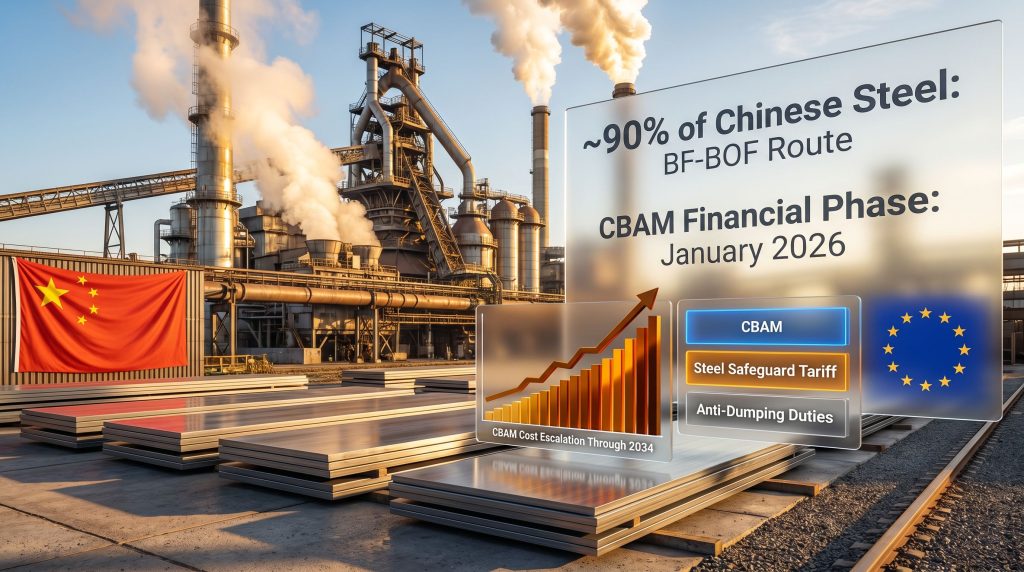
- January 2026 onward: Full financial obligation phase, during which importers must purchase carbon certificates corresponding to the embedded emissions of covered goods
Six sectors fall under CBAM's scope: steel and iron, aluminium, cement, fertilisers, electricity, and hydrogen. Steel sits at the centre of the policy's practical impact, both because of the volume involved and because steel production is among the most carbon-intensive industrial processes in global manufacturing.
Separating CBAM from the EU's Steel Safeguard Tariff
A source of persistent confusion in trade analysis is conflating CBAM with the EU's separate proposed steel safeguard tariff. These are distinct instruments with different legal bases, triggers, and objectives.
| Instrument | Basis | Trigger | Current Status |
|---|---|---|---|
| CBAM | Embedded carbon emissions | Emissions intensity per tonne | Fee collection from January 2026 |
| Steel Safeguard Tariff | Import volume and price | Quota breach above threshold | Proposed at 50% above quota limits |
| Anti-Dumping Duties | Below-market pricing | Measured dumping margin | Subject to separate proceedings |
The safeguard tariff, proposed at 50% above quota thresholds, is a volume-based instrument responding to market disruption concerns. CBAM, however, is an emissions-based instrument responding to climate policy integrity. A Chinese steel producer could be subject to both simultaneously, facing tariff pressure on volume and cost pressure on carbon, creating a compounding exposure that neither mechanism alone was designed to impose. For further context on the iron ore tariff impacts that compound these pressures, the picture becomes even more complex.
The Compliance Architecture: What Chinese Exporters Are Actually Being Asked to Do
A Documentation Burden That Goes Far Deeper Than Customs Forms
The practical experience of Chinese exporters encountering CBAM compliance requirements for the first time has been, by multiple accounts, disorienting. The data demands go well beyond standard customs documentation. Exporters are required to provide:
- Precise geolocation coordinates of the production facility
- Direct and indirect emissions intensity per tonne of finished product
- Upstream raw material emissions traceability, including iron ore sourcing and coking coal inputs
- Production route classification, specifically whether output derives from blast furnace-basic oxygen furnace (BF-BOF) processes or electric arc furnace (EAF) methods
For large, well-resourced steel mills with dedicated environmental compliance departments, these requirements are demanding but manageable. For smaller and mid-sized producers, particularly those concentrated in provinces like Hebei, the combination of technical complexity and audit cost creates what amounts to a structural barrier to EU market access.
The mechanism places legal responsibility for carbon certificate purchases on the EU importer, but the practical burden of generating, verifying, and submitting accurate emissions data rests entirely with the Chinese producer. This asymmetry means that the party with the greatest compliance obligation has the least regulatory leverage.
The Default Value Trap: When Greener Producers Pay More
One of the more counterintuitive outcomes embedded in CBAM's design involves the treatment of producers who cannot supply verified emissions data. When third-party audited figures are unavailable, EU importers apply default carbon intensity values established by the European Commission. These defaults are calibrated at high-emission benchmarks, reflecting worst-case production scenarios rather than average or verified performance.
The perverse result is that a smaller electric arc furnace producer, using a fundamentally lower-carbon production method, may end up assessed at a higher effective carbon cost than a large blast-furnace operator. This occurs simply because the smaller firm lacks the resources to commission the third-party audit that would confirm its actual emissions profile.
Critical structural paradox: Under CBAM's current default value methodology, compliance capacity determines assessed carbon liability more than actual carbon performance. This inverts the policy's intended incentive structure.
This is not a marginal edge case. EAF production generates roughly 0.4 to 0.6 tonnes of CO2 per tonne of steel, compared to approximately 1.8 to 2.2 tonnes per tonne for BF-BOF routes. The gap is enormous. However, without ISO 14064-compliant third-party verification, that gap is invisible to the CBAM calculation. Research published on ResearchGate examining CBAM's impact on China's steel export industry highlights precisely this tension between policy intent and practical outcomes.
China's Steel Sector: Scale, Structure, and Carbon Exposure
Why the Production Profile Creates Systemic Vulnerability
China accounts for approximately 50 to 55% of global crude steel output, a level of market dominance with no parallel in any other major industrial commodity. This scale reflects decades of state-directed capacity expansion, but it also embeds a structural emissions challenge that CBAM is specifically designed to price. The global crude steel outlook reinforces just how central China's position remains to global production dynamics.
The critical figure is the production route split. Approximately 90% of Chinese steel is produced via blast furnace-basic oxygen furnace processes, which rely on coking coal as a primary energy and chemical input. This makes Chinese steel structurally more carbon-intensive than steel produced in economies with higher EAF penetration, such as the United States, where EAF accounts for roughly 70% of output, or Turkey, where the figure exceeds 65%.
China's power grid carbon intensity compounds the problem further. Even EAF production, which relies on electricity rather than coking coal, carries elevated indirect emissions in the Chinese context because the national grid remains heavily coal-dependent.
The Multi-Dimensional Cost Squeeze Arriving Simultaneously
The EU carbon tariff on China steel firms is arriving at a particularly difficult moment for Chinese steel producers. The sector is already experiencing pressure from several converging directions, as highlighted by analysts tracking China steel market challenges in 2025:
| Cost Pressure Factor | Impact on Margins |
|---|---|
| CBAM carbon certificate obligations from 2026 | Per-tonne cost tied to EU ETS carbon price |
| EU ETS free allocation phase-out through 2034 | Rising benchmark carbon price over time |
| Elevated iron ore and metallurgical coal costs | Compressing raw material margins in Q1 2026 |
| Chronic domestic overcapacity | Suppressing domestic steel prices |
| Proposed 50% safeguard tariff above quota | Additional volume-based export barrier |
The convergence of these pressures does not represent a single policy shock. It represents a structural realignment of Chinese steel's cost competitiveness in European markets, one that will intensify rather than stabilise as EU ETS free allocations are progressively withdrawn through 2034.
Does CBAM Actually Reduce Carbon Emissions?
The Policy Effectiveness Question That Trade Economists Keep Raising
CBAM's environmental credentials depend entirely on the quality of the emissions data it processes. A mechanism that applies default high-carbon values to producers who cannot verify their actual performance does not necessarily incentivise decarbonisation. It may simply function as a revenue instrument for the EU budget while doing little to distinguish genuinely cleaner production from genuinely dirtier alternatives.
Three structural paradoxes undermine the mechanism's environmental integrity in its current form:
-
The Green Producer Penalty: Lower-emission EAF producers without audit infrastructure face default carbon charges that do not reflect their real emissions profile, removing the financial reward that CBAM is designed to provide for genuine decarbonisation.
-
The Documentation Asymmetry: EU importers hold legal liability for CBAM compliance but depend entirely on data supplied by Chinese producers. This creates misaligned incentives and no clear mechanism to resolve disputes over emissions accuracy.
-
The Competitive Displacement Risk: If Chinese steel becomes uneconomical in EU markets, importation may shift toward producers in jurisdictions with no equivalent carbon pricing, including parts of Southeast Asia and the Middle East, potentially producing higher global emissions despite lower EU-bound volumes.
The environmental credibility of any carbon border mechanism is only as robust as the verification infrastructure that underpins it. Where that infrastructure is underdeveloped or inaccessible due to cost, the mechanism risks functioning as a trade barrier dressed in climate language.
Furthermore, the broader trajectory of green steel pricing trends suggests that the competitive landscape will reward verified low-carbon producers over time, making compliance investment increasingly consequential.
Strategic Responses Emerging from Chinese Producers
Two Diverging Paths: Compliance Investment vs. Market Diversification
Chinese steel producers are responding to CBAM pressure along two broadly divergent strategic trajectories, and the path each firm chooses will likely define its commercial position through the end of the decade.
The compliance pathway involves direct investment in the documentation and verification infrastructure that CBAM demands. This includes adopting ISO 14064-aligned carbon accounting systems, engaging EU-recognised third-party auditors, and co-developing data-sharing frameworks with European importers. For large, export-oriented mills with established EU relationships, this investment may be commercially justified by the volume of at-risk business.
The diversification pathway involves redirecting export volumes away from the EU toward markets where no equivalent carbon border mechanism currently applies. Southeast Asia, the Middle East, Africa, and Latin America are all absorbing increased Chinese steel volumes as producers reassess their geographic exposure. This pathway requires less compliance investment in the short term but represents a fundamental repositioning of China's steel export strategy.
Industry Coordination and the WTO Challenge
Chinese steelmaker associations have begun coordinating collective responses to CBAM's reporting requirements, seeking to develop shared methodologies and reduce the per-firm cost of compliance infrastructure. At the government level, Beijing has formally characterised CBAM as a non-tariff trade barrier inconsistent with World Trade Organization principles.
The WTO compatibility question remains unresolved. CBAM's defenders argue it qualifies as a legitimate environmental measure under existing trade law. Critics, however, contend it constitutes a disguised restriction on trade that disadvantages developing-world producers disproportionately. No definitive legal ruling had been issued as of mid-2026, and a formal dispute filing by China remains a significant risk scenario with potentially broad implications for EU-China trade relations beyond steel. Insight from Global Efficiency Intel on CBAM's global steel trade impact underscores precisely how far-reaching these legal and commercial tensions may become.
The next major ASX story will hit our subscribers first
Scenario Modelling: Three Trade Trajectories Through 2030
Scenario A: Managed Compliance Adaptation
Major Chinese mills invest in verified emissions reporting systems. CBAM costs are partially absorbed and partially passed through to EU buyers. Trade volumes stabilise at reduced but commercially viable levels. The bilateral relationship remains competitive but functional.
Scenario B: Accelerated Market Decoupling
Combined CBAM costs and safeguard tariff pressure render EU exports uneconomical for the majority of Chinese producers. Export volumes redirect decisively toward emerging markets. The EU sources steel from alternative suppliers with lower verified carbon intensity, including Korean, Japanese, or Indian producers with established EAF infrastructure.
Scenario C: Regulatory Escalation and WTO Dispute
China files a formal WTO challenge against CBAM. Retaliatory measures emerge across multiple product categories. EU-China trade relations deteriorate beyond steel into broader industrial and consumer goods sectors, echoing the pattern established by EU EV tariffs in 2024 and 2025.
The broader geopolitical context matters here. CBAM is not operating in isolation. The EU has simultaneously pursued anti-subsidy investigations into Chinese industrial goods and imposed electric vehicle tariffs, while China has responded with restrictions on European luxury goods and agricultural imports. Consequently, CBAM is both a climate instrument and a node in a much larger and increasingly stressed bilateral trade architecture.
Frequently Asked Questions: EU Carbon Tariff on China Steel Firms
What is CBAM and how does it affect Chinese steel exports to the EU?
CBAM is the EU's Carbon Border Adjustment Mechanism, requiring importers of steel and other carbon-intensive goods to purchase carbon certificates corresponding to the embedded emissions of those products. For Chinese steel exporters, this adds a carbon-based cost to every shipment entering the EU, scaled to the carbon intensity of the production process and the prevailing EU carbon price. Blast-furnace-produced steel, which dominates Chinese output, carries the highest exposure.
When does CBAM's financial obligation phase begin?
Financial payment obligations commenced in January 2026, following a transitional reporting-only phase that ran from October 2023 through December 2025.
Is CBAM the same as the EU's proposed 50% steel tariff?
No. CBAM is an emissions-based mechanism charging for carbon intensity. The proposed 50% safeguard tariff is a volume-based instrument triggered when import quantities breach established quota thresholds. Both can apply simultaneously, creating compounding cost exposure for Chinese exporters.
Which Chinese steel producers face the greatest CBAM risk?
Blast-furnace-dependent producers with limited environmental reporting infrastructure face the greatest financial exposure. Smaller EAF producers with genuinely lower emissions but no audit capacity also face elevated risk due to default value application. The China steel and iron ore outlook provides additional context on how these structural vulnerabilities are likely to evolve.
Can Chinese firms reduce their CBAM liability by lowering emissions?
Yes, but only where those reductions are verified through EU-recognised third-party auditing. Actual emissions improvements that are not independently verified provide no reduction in CBAM liability under the current framework.
What happens when verified data is unavailable?
EU default carbon intensity values are applied. These are set at high-emission benchmarks, meaning producers without verification capacity are assessed as if they were among the most carbon-intensive operations in the world, regardless of their actual performance.
Key Metrics at a Glance
| Metric | Data Point |
|---|---|
| China's share of global crude steel output | ~50 to 55% |
| Share of Chinese steel via BF-BOF route | ~90% |
| CBAM financial obligation phase start | January 2026 |
| EU safeguard tariff above quota (proposed) | 50% |
| EU ETS free allocation phase-out completion | 2034 |
| EAF emissions intensity (approx.) | 0.4 to 0.6 tCO2 per tonne of steel |
| BF-BOF emissions intensity (approx.) | 1.8 to 2.2 tCO2 per tonne of steel |
Three Converging Pressures on China's EU Steel Position
- Emissions-based cost escalation through CBAM certificate obligations tied to the EU ETS carbon price
- Volume-based trade barriers through the proposed safeguard tariff mechanism above quota thresholds
- Domestic margin compression from structural overcapacity, suppressed domestic prices, and elevated raw material input costs
What Industry Observers Should Monitor
- The trajectory of EU ETS carbon prices, which directly determine the magnitude of CBAM financial obligations
- Any formal WTO dispute filing by China, which would represent a major inflection point for EU-China trade relations broadly
- Investment in EAF production capacity by major Chinese mills, which would signal long-term strategic intent to compete under carbon-constrained trade conditions
- Potential revisions to CBAM's default value methodology, which could significantly alter the competitive impact on lower-carbon Chinese producers currently unable to access verified assessments
This article is intended for informational purposes only and does not constitute financial or investment advice. Forecasts, scenario projections, and cost estimates are based on publicly available information and analytical frameworks, and actual outcomes may differ materially from those described.
Want to Track the ASX Stocks Positioned to Benefit From Global Steel and Commodity Disruption?
As carbon border mechanisms reshape trade flows and redirect capital toward lower-emission materials and alternative supply chains, Discovery Alert's proprietary Discovery IQ model scans ASX announcements in real time to surface significant mineral discoveries before the broader market reacts — explore historic discovery returns on the Discovery Alert discoveries page and begin a 14-day free trial to position yourself ahead of the next major find.