June 30, 2026
How Strategic Petroleum Reserves Actually Work as a Policy Instrument
The architecture of modern energy security was not built in boardrooms or through market forces alone. It was forged in crisis. When the 1973 Arab oil embargo exposed the structural vulnerability of oil-importing nations, the developed world recognised that physical energy stockpiles were as strategically important as military readiness. That foundational insight created the framework still governing discussions around strategic petroleum reserve oil loans to Exxon and Chevron today, more than five decades later.
Understanding this history matters because the current SPR loan programme is not a deviation from original policy intent. It is, in many ways, its most sophisticated expression.
When big ASX news breaks, our subscribers know first
The IEA Mandate and the 90-Day Inventory Doctrine
The International Energy Agency was established in the direct aftermath of the 1973 oil shock, born from a coordinated recognition among developed nations that supply disruptions could destabilise entire economies. The IEA's founding mandate required all member states to maintain a minimum of 90 days of oil or refined product inventory at all times, creating a collective insurance mechanism against geopolitical supply interruptions.
This framework was conceived when the United States was still the world's largest net importer of crude oil. The SPR, established under the Energy Policy and Conservation Act of 1975, was the American expression of that commitment. It was designed as an emergency buffer, a last-resort physical reservoir intended to bridge supply gaps during acute crises.
What has changed dramatically is the underlying energy reality that justified that architecture. Fifteen years into the shale revolution, the United States has transformed from the world's largest crude importer into a net energy exporter. This structural shift raises a genuine policy question: does the U.S. still need a strategic petroleum reserve in the traditional sense? The answer, as current events demonstrate, is nuanced.
How SPR Loans Differ From Emergency Drawdowns
The public discourse around SPR activity frequently conflates two fundamentally different mechanisms. Conflating them leads to significant misunderstanding of what is actually happening with U.S. energy reserves.
| Mechanism | Definition | SPR Impact | Repayment Required? |
|---|---|---|---|
| Emergency Drawdown | Oil sold from SPR to market | Permanent reduction until refilled | No |
| SPR Exchange | Oil lent, same volume returned | Temporary reduction | Yes (same barrels) |
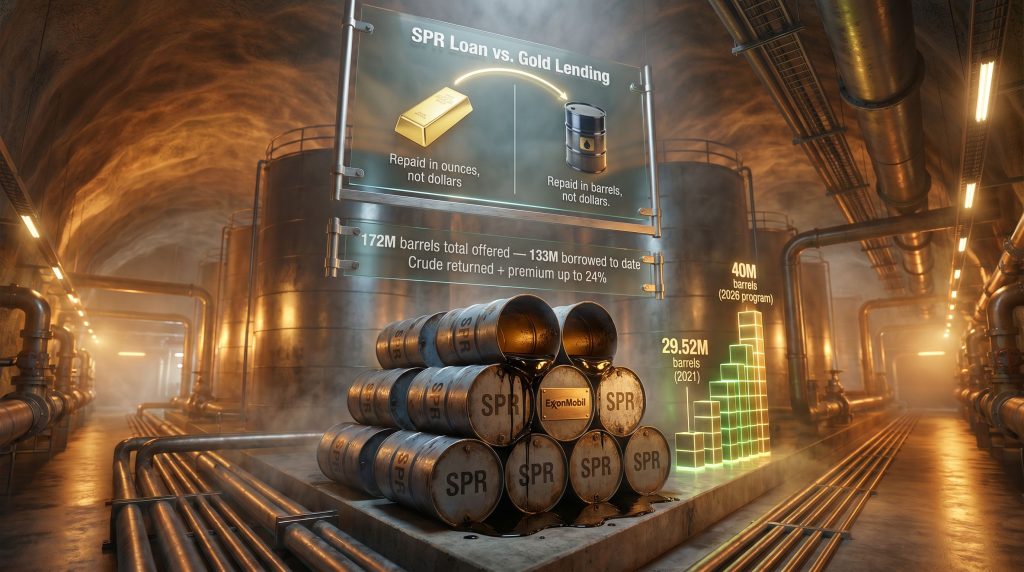
| SPR Loan | Oil lent, returned with premium | Temporary reduction | Yes (barrels + premium up to 24%) |
The critical distinction is that an SPR loan does not deplete the reserve. The borrowing company, whether Exxon, Marathon, BP, or Trafigura, is obligated to return the original volume of crude oil plus a premium of up to 24% in additional barrels. No dollars change hands. No congressional appropriation is required. The transaction is denominated entirely in physical barrels, which means the executive branch retains full operational authority over the programme without legislative oversight.
This structure is not a loophole. It is an intentional architectural feature. Because no funds are being appropriated and no market sale is occurring, the president and treasury and energy department can authorise these loans rapidly and without the delays inherent in congressional processes.
Why the Barrel-Premium Model Preserves Reserve Integrity
The repayment structure converts what might appear to be a drawdown into something closer to a yield-bearing commodity loan. The reserve is temporarily redistributed, not reduced. And the counterparties standing on the other side of these transactions, ExxonMobil and other investment-grade energy majors, carry corporate credit ratings that are arguably as reliable as U.S. Treasury obligations. The oil is still there. It has simply been redeployed into the supply chain in the form of future delivery commitments from some of the most creditworthy corporations on the planet.
SPR Loan Activity: Confirmed Participants and Programme Scale
The 2026 market-stabilisation programme was triggered by a fuel price spike linked to geopolitical conflict in the Middle East. Furthermore, the US-China oil tensions that have characterised recent years added further complexity to the supply picture. The following table summarises confirmed programme parameters and ExxonMobil's specific involvement.
| Aspect | ExxonMobil (2026) | Broader Programme |
|---|---|---|
| Loan Volume | 1 million barrels (Baton Rouge refinery) | Up to 40 million barrels offered to 9 companies |
| Primary Trigger | Offshore supply disruption to Baton Rouge facility | Geopolitical-driven fuel price spike |
| Repayment Terms | Crude returned + premium up to 24% | Crude returned + premium up to 24% |
| Historical Precedent (ExxonMobil) | 3M barrels (2021, Hurricane Ida); 0.5M barrels (2025 exchange) | 29.52M barrels distributed to 9 firms in 2021 COVID exchange |
| Total Programme Scope | Participant in broader initiative | 172M barrels offered; ~133M borrowed to date |
According to Reuters reporting on the programme, the U.S. offered to loan up to 40 million barrels to eligible companies, underscoring the significant scale of the intervention.
What About Chevron's Involvement?
Public framing of strategic petroleum reserve oil loans to Exxon and Chevron reflects a common pairing in energy market commentary, but the verified data tells a more precise story. Chevron's confirmed SPR participation is documented in the 2021 COVID-era global exchange, during which 29.52 million barrels were distributed to nine companies including ExxonMobil, Shell, and Chevron. However, Chevron's participation in the 2026 stabilisation programme is not confirmed in current public programme records. The 2026 active borrower list includes ExxonMobil, Marathon Petroleum, BP, and Trafigura.
This distinction matters for anyone analysing the programme's scope. While both companies have historical SPR relationships, their current programme status differs meaningfully based on available documentation.
The IEA's Coordinated Global Response
The U.S. SPR loan activity is not occurring in isolation. The IEA coordinated a 400 million barrel release across 32 member countries as part of a collective response to the supply disruption. This multilateral dimension places the U.S. programme within a broader framework of allied energy security cooperation, though it does not constitute country-specific project support or accelerated regulatory treatment for any individual company.
The SPR as Strategic Working Capital, Not a Static Stockpile
Perhaps the most intellectually significant reframing of the current programme is what it reveals about the evolution of energy security thinking. The traditional conception of the SPR as a static emergency stockpile — a vault of last resort to be cracked open only under the most extreme circumstances — has given way to a more dynamic model.
The SPR loan structure reframes government oil reserves as active strategic working capital: a dynamic buffer that can be deployed, managed, and replenished with a built-in yield. The premium repayment mechanism introduces something genuinely novel to sovereign resource management. It means the reserve can be operationally useful during a crisis without being diminished. In fact, when all loans are repaid, the reserve will be larger than before deployment.
This is a meaningful evolution. It transforms the cost accounting of strategic reserves. Historically, maintaining large oil inventories was viewed as an efficiency drag — capital tied up in stored barrels that generated no return. The loan structure changes that calculus entirely. Stored oil becomes an asset that can generate a barrel-denominated yield, creating what might be described as a resiliency premium that is realised across the entire supply chain when marginal price spikes are buffered. The oil price rally dynamics of recent years have only reinforced this logic.
Oil Loans and Gold Lending: A Parallel Reserve Asset Architecture
There is a striking structural parallel between SPR oil loans and the mechanics of gold lending that is rarely discussed in mainstream energy commentary, yet reveals something important about how physical commodity reserves can function as yield-bearing assets. In addition, understanding gold reserve dynamics provides useful context for appreciating how commodity-backed lending functions at a sovereign level.
| Attribute | Gold | Crude Oil (SPR) |
|---|---|---|
| Primary Function | Monetary reserve / store of value | Industrial consumable / energy input |
| Stock-to-Flow Ratio | Very high (decades of above-ground stock) | Very low (consumed rapidly) |
| Yield Mechanism | Gold lending (returned in ounces, not dollars) | SPR loans (returned in barrels, not dollars) |
| Crisis Utility | Monetary settlement, trade imbalance buffer | Physical energy supply continuity |
| Depletion Risk | Minimal (non-consumable) | High (consumed in use) |
The parallel is precise in one critical dimension: repayment is denominated in the commodity itself, not in currency. A gold borrower returns ounces. An SPR borrower returns barrels. In both cases, the real-asset character of the reserve is preserved. The lender is not exposed to currency depreciation or inflation between the loan date and the repayment date, because the unit of account never leaves the physical commodity domain.
This connection has its roots in history. When Nixon removed the U.S. from the gold window in 1971 and the Arab oil embargo followed in 1973, the twin crises of monetary and energy security emerged almost simultaneously. The IEA's 90-day mandate and the SPR were in many ways the energy world's answer to the collapse of Bretton Woods: a physical reserve system built to provide security in the absence of a fixed monetary anchor.
The next major ASX story will hit our subscribers first
The Western Hemisphere Oil Corridor: Refinery Strategy and Supply Logic
Why U.S. Refineries Need Heavy Crude
A structural feature of American refining capacity that receives insufficient attention in mainstream coverage is the configuration mismatch between domestic production and refinery design. Gulf Coast refineries were largely built and optimised to process heavy, sour crude grades with low API gravity, precisely the type of oil that Venezuela and Western Canada (Alberta) produce.
| Crude Type | Source | API Gravity | U.S. Refinery Compatibility |
|---|---|---|---|
| Heavy Sour | Venezuela, Western Canada | Low (~10-22°) | High, matches Gulf Coast refinery configurations |
| Light Sweet | Permian Basin, Eagle Ford | High (~40-55°) | Moderate, requires blending or export |
The shale revolution produced enormous volumes of light sweet crude from the Permian Basin and Eagle Ford. This is excellent oil, but it does not optimally match the configuration of heavy-crude-optimised refineries without blending or significant capital investment. The synergistic combination of Venezuelan or Canadian heavy crude with U.S. light crude creates an ideal refining slate for Gulf Coast facilities.
The Northeastern South American Energy Corridor
The strategic geography of the northeastern South American coastline has emerged as one of the most consequential oil production corridors in the world. The scale of what is potentially available across this relatively compact region is significant:
- Venezuela: Historical peak production of approximately 4 million barrels per day; recent output below 1 million barrels per day due to political and economic deterioration
- Guyana (ExxonMobil-led Stabroek Block): Scaled from zero to approximately 1 million barrels per day within less than a decade, representing one of the most significant single-block oil discoveries of the current generation
- Suriname: Emerging offshore production directly adjacent to Guyana's prolific blocks, with multiple major operators active
- Trinidad and Tobago: An established natural gas production hub with offshore infrastructure already in place
- Combined regional potential: Estimated at 5 to 6 million barrels per day across the corridor, with additional natural gas resources
The Guyana discovery by ExxonMobil is particularly noteworthy. Going from zero to one million barrels per day from essentially a single offshore block within a decade is, by historical standards, exceptional. The scale of natural gas associated with these discoveries compounds the strategic value of the corridor for U.S. energy planning.
China's Parallel Reserve Strategy: Oil and Gold
Energy Insulation Through Quiet Accumulation
China's primary energy story is often mischaracterised in Western commentary. The foundational reality is that coal accounts for approximately half of China's primary energy consumption, with hydro and nuclear making up substantial additional portions. Crude oil is important but not the dominant variable in China's domestic energy equation.
What makes China's crude oil position strategically significant is not its domestic consumption mix but its accumulation behaviour. Credible estimates suggest China has built strategic oil reserves in the range of 1.8 billion barrels, a stockpile that has effectively insulated the Chinese economy from the geopolitical weaponisation of Middle Eastern supply routes. Through a period of elevated global oil prices driven by conflict, China appears to have drawn on pre-accumulated inventory, limiting its exposure to the price spike that disrupted other economies.
The strategic logic is straightforward: accumulate during periods of price weakness, deploy during price spikes, then accumulate again when prices normalise. If crude prices decline toward the $50 to $65 per barrel range following geopolitical resolution, as some analysts project, China would be positioned to restock at significantly lower costs than its competitors. The trade war impact on oil markets has, consequently, reinforced China's motivation to maintain robust energy buffers.
The Gold Parallel and Post-2014 Reserve Architecture
China's approach to gold reserves follows a structurally similar logic. China's gold market dominance has grown considerably since the opening of the Shanghai physical gold exchange, and Russia's disposal of U.S. Treasury holdings both accelerated meaningfully after 2014, following the U.S. sanctions response to Russia's move on Crimea. The thesis, supported by the chronology of events, is that both China and Russia recognised the post-2014 period as a turning point for dollar-denominated reserve architecture and began building alternative frameworks centred on physical commodity possession rather than financial exposure.
China's gold strategy and oil strategy share a consistent underlying logic: hold the physical asset, not the financial claim on it. This prioritises insulation from geopolitical weaponisation over the liquidity efficiency of paper instruments.
The post-World War II architecture that established the United Nations Security Council veto as a protection against sanctions for P5 members was, from this perspective, fundamentally altered by the post-2014 sanctions regime against Russia. China and Russia, as co-P5 members, appear to have interpreted that development as evidence that the existing system could not protect their interests, accelerating their mutual coordination on alternative reserve frameworks.
Post-Crisis Reserve Restocking: The Coming Price Floor Mechanism
One underappreciated consequence of the current SPR loan cycle is its likely effect on the downside slope of any future oil price correction. As geopolitical tensions ease and supply normalises, crude prices may trend toward the $50 to $70 per barrel range. At those price levels, multiple structural buyers will likely emerge simultaneously:
- Nations that were caught with inadequate reserves (Australia's reported approximately 30-day supply buffer being a prominent example well below the IEA's 90-day mandate) will face renewed institutional pressure to restock
- The U.S. already has the legal mechanism in place for organic SPR refilling, and restocking at lower prices is both fiscally attractive and strategically straightforward
- Every country that experienced supply vulnerability during the 2025 to 2026 period now has a documented case study justifying reserve investment to domestic political audiences
- China, if projections of its accumulation strategy are accurate, represents a large and persistent buyer at lower price levels
This creates what can be conceptualised as a resiliency-driven demand floor: a collective willingness to buy oil for strategic storage rather than immediate consumption that buffers price declines beyond a certain threshold. The crisis does not just consume reserves; it creates the political and institutional mandate to rebuild them, which in turn supports prices on the way down.
Frequently Asked Questions: SPR Oil Loans and Energy Market Mechanics
What is an SPR oil loan and how does it differ from an emergency release?
An SPR loan is a temporary transfer of physical crude oil from the Strategic Petroleum Reserve to a private company, with a contractual obligation to return the original volume plus a barrel-denominated premium of up to 24%. An emergency drawdown, by contrast, involves selling oil from the SPR into the open market with no repayment requirement. The loan mechanism preserves reserve integrity; a drawdown reduces it until the government actively repurchases oil.
Does ExxonMobil have to repay the oil borrowed from the SPR?
Yes. Under the terms of the SPR loan programme, ExxonMobil and all other borrowing companies are required to return the borrowed crude oil plus a premium in barrels, not in dollars. The repayment is denominated in physical commodity, not currency, which is one reason these transactions can proceed without congressional appropriation authority.
Was Chevron part of the 2026 SPR loan programme?
Chevron's confirmed SPR participation is documented in the 2021 COVID-era exchange programme. Its involvement in the 2026 market-stabilisation round is not confirmed in current programme records, which list ExxonMobil, Marathon Petroleum, BP, and Trafigura as active participants. However, the broader framing of strategic petroleum reserve oil loans to Exxon and Chevron remains relevant when considering the full historical arc of the programme.
Why can the president authorise SPR loans without congressional approval?
Because the transactions involve no appropriation of funds. Only physical barrels change hands, and the repayment obligation is also in barrels. Without any dollar-denominated transfer, the standard congressional oversight mechanisms that apply to government spending are not triggered, allowing the executive branch to deploy the mechanism rapidly.
Will the SPR be refilled after these loans are repaid?
The repayment structure, which requires borrowers to return barrels plus a premium, means the SPR is not depleted under the loan model. It is temporarily redistributed. When loans are repaid, the reserve returns to at least its pre-loan level. The U.S. also has existing legal mechanisms for organic refilling at market prices, which become more cost-effective as crude prices decline.
Key Takeaways for Energy Policy and Market Analysis
- The SPR loan model converts a static emergency stockpile into active, yield-bearing strategic working capital, a structural evolution in energy security doctrine
- ExxonMobil is a confirmed borrower in both the 1 million barrel refinery-specific loan and the broader 40 million barrel market-stabilisation programme
- Chevron's confirmed SPR participation is documented in 2021; its 2026 involvement is not verified in current programme records
- The barrel-premium repayment structure ensures the SPR is not depleted; it is temporarily redistributed with a built-in return of up to 24% in additional barrels
- The structural parallel between SPR oil loans and gold lending reveals a commodity-as-reserve-asset doctrine where yield is denominated in the physical commodity, not in currency
- Post-crisis oil price normalisation toward the $50 to $70 range creates structural incentives for global strategic reserve restocking, potentially creating a demand floor that buffers price declines
- The Western Hemisphere oil corridor spanning Venezuela, Guyana, Suriname, and Trinidad represents a 5 to 6 million barrel per day supply opportunity with direct strategic relevance to U.S. refinery configuration
- China's estimated 1.8 billion barrel strategic oil reserve mirrors its gold accumulation strategy: prioritise physical possession, accumulate during price weakness, and insulate against geopolitical weaponisation
This article contains forward-looking analysis, scenario projections, and market commentary based on publicly available information and analytical frameworks. It does not constitute financial advice. Readers should conduct their own due diligence before making investment or policy decisions. Claims regarding Chinese strategic reserve estimates and geopolitical scenarios represent analytical perspectives, not verified government disclosures.
Want to Stay Ahead of the Next Major Resource Discovery?
Discovery Alert's proprietary Discovery IQ model delivers real-time alerts on significant ASX mineral discoveries, transforming complex resource data into actionable investment insights for both short-term traders and long-term investors — explore the historic returns major discoveries have generated and begin your 14-day free trial to secure your market-leading edge.