June 16, 2026
The Hidden Gap Between What Markets Feared and What Actually Happened
Every major supply shock in modern energy history has followed a familiar psychological arc. Initial panic drives estimates to their outer limits. Institutions publish their worst-case projections. Prices surge. Then, gradually, the world adapts, and the true scale of the disruption turns out to be considerably smaller than the early headlines suggested. The 2026 Strait of Hormuz oil supply losses are proving to be one of the most striking examples of this pattern in decades, and the gap between institutional estimates and revised trading desk figures reveals something important about how global energy systems actually behave under pressure.
When big ASX news breaks, our subscribers know first
How Much Oil Actually Flows Through the Strait of Hormuz Under Normal Conditions?
The Chokepoint in Numbers
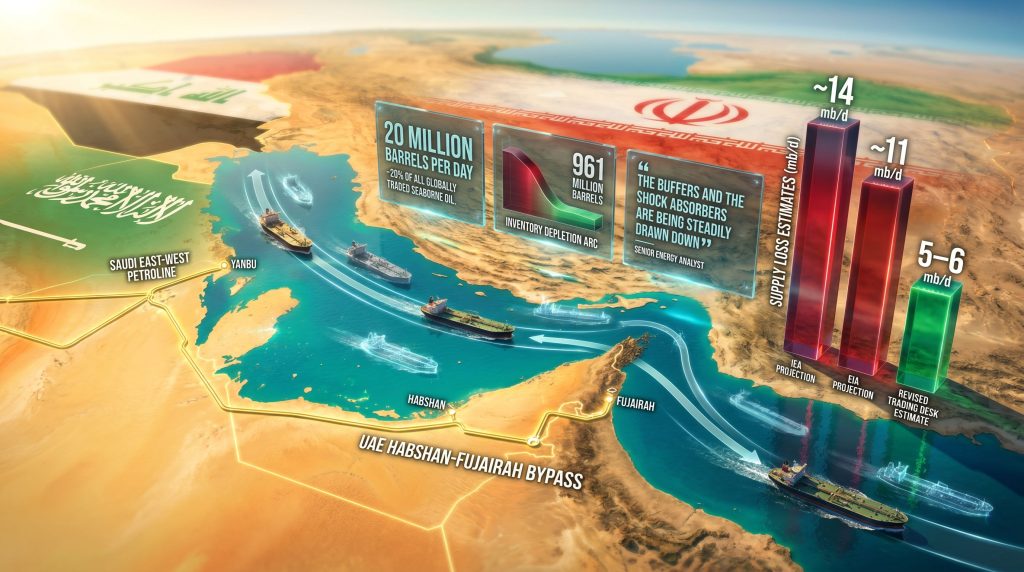
Under normal operating conditions, approximately 20 million barrels per day (mb/d) of crude oil and petroleum products transit the Strait of Hormuz, representing roughly 20% of all globally traded seaborne oil. No other maritime chokepoint on the planet handles a comparable share of global energy trade. Furthermore, according to Britannica, this volume has remained consistently critical to global supply for decades.
The waterway also carries approximately one-quarter of global LNG volumes, making it simultaneously the world's most critical oil corridor and its most consequential gas transit route. The strait connects the Persian Gulf to the Gulf of Oman and serves as the only maritime exit for oil exports from Saudi Arabia, Iraq, Kuwait, the UAE, Qatar, and Iran.
What makes the strait so strategically fragile is its geography. At its narrowest navigable point, the waterway measures just 21 nautical miles across, creating conditions where a relatively modest physical intervention can threaten flows that underpin the entire global energy system.
Why the Strait Cannot Be Easily Replaced
The persistent assumption that bypass pipelines can substitute for Hormuz throughput does not survive close scrutiny. The combined capacity of all available alternative routes falls well short of normal transit volumes:
| Alternative Route | Operator | Max Capacity (mb/d) | Key Limitation |
|---|---|---|---|
| Saudi East-West Pipeline (Petroline) | Saudi Aramco | ~5.0 | Terminates at Red Sea port of Yanbu |
| Iraq-Turkey Pipeline (ITP) | SOMO | ~1.6 | Conflict-prone northern corridor |
| UAE Habshan-Fujairah Pipeline | ADNOC | ~1.5 | Bypasses strait to Gulf of Oman only |
| Oman LNG overland routes | Various | Limited | Not configured for crude-scale volumes |
Combined bypass capacity sits at approximately 8.1 mb/d, covering less than 40% of normal Hormuz throughput even if all routes operate simultaneously at maximum utilisation. This infrastructure gap is a foundational constraint that no diplomatic agreement changes in the near term.
What Were the Initial Supply Loss Estimates?
A Wide Divergence in Institutional Projections
When the strait closed following military escalation, the early institutional response produced a cluster of estimates that all exceeded 10 mb/d in daily supply loss. These geopolitical oil price factors were immediately reflected in volatile market responses across all major benchmarks:
- The International Energy Agency placed daily losses at approximately 14 mb/d, warning of severe physical shortages emerging by July 2026 if normal traffic flows were not restored
- The U.S. Energy Information Administration projected losses exceeding 11 mb/d and estimated that global oil inventories would fall by an average of 6.3 mb/d in Q2 2026 and 7.6 mb/d in Q3 2026, per its May 2026 Short-Term Energy Outlook
- Commodity flow analytics estimated cumulative supply losses of approximately 961 million barrels between the disruption's start and late May 2026, with the total projected to breach 1 billion barrels as summer demand accelerated
- World Bank scenario modelling identified a global oil supply contraction of approximately 10.1 mb/d in March 2026 and projected a 3.7 mb/d market deficit in Q2 2026
Key takeaway for investors: The spread between 10.1 mb/d and 14 mb/d in institutional estimates reflects not just methodological differences, but fundamentally different assumptions about how quickly bypass routes and dark-mode shipping could scale. The answer to that question turned out to be: faster than anyone projected.
Why Are Revised Estimates Now Significantly Lower?
The Logistics Adaptation Effect
One of the most consequential and underappreciated dynamics of the post-disruption period was the speed at which Gulf producers restructured their export logistics. The market was not passive in the face of closure, and the practical creativity of export adaptation significantly compressed actual Strait of Hormuz oil supply losses relative to early projections.
Several mechanisms drove the downward revision in loss estimates:
- Saudi Arabia activated its East-West Pipeline at or near capacity, rerouting crude exports through the Red Sea port of Yanbu and bypassing the strait entirely
- Multiple Gulf producers reportedly shifted tanker traffic to so-called dark mode operations, disabling AIS transponders to move cargoes through the strait without detection by standard monitoring systems
- A claim from the U.S. government that American naval assets had facilitated the movement of 100 million barrels out of the Persian Gulf contributed to shifting market sentiment, though this figure was disputed and never independently verified
- Commodity flow analytics subsequently noted that after an initial oil price shock at conflict onset, observed export flows strengthened materially as alternative logistics pathways were scaled up
What makes dark-mode tanker operations particularly significant from an analytical standpoint is that they are structurally invisible to the satellite-based vessel tracking systems that most commodity flow analytics firms rely upon. This means that standard flow data systematically underestimates actual throughput during periods when producers have strong incentives to operate outside normal monitoring frameworks.
The 5-6 mb/d Revised Estimate
By June 2026, sources at major commodity trading firms were circulating revised supply loss estimates substantially below the institutional consensus. According to reporting by Reuters, trading desk sources indicated that actual daily supply losses as of June 2026 may have been closer to 5 to 6 mb/d, roughly half the IEA's initial estimate, as producing nations successfully activated bypass routes and dark-mode shipping.
Key factors driving the downward revision:
- Saudi Arabia's East-West Pipeline operating at or near capacity
- UAE's Habshan-Fujairah bypass pipeline redirecting Abu Dhabi crude to the Gulf of Oman
- Tanker traffic continuing through the strait under reduced AIS visibility conditions
- U.S. crude exports surging to partially offset lost Middle Eastern barrels in Asian markets
How Did Chinese Demand Destruction Change the Equation?
China's Import Collapse: An Unexpected Demand-Side Buffer
While supply-side adaptation was reshaping the loss narrative, a simultaneous demand-side contraction in China significantly reduced the overall market imbalance. Chinese crude oil imports fell sharply in May 2026, reaching their lowest level in eight years, according to reporting by OilPrice.com. This decline introduced a second force moderating the market imbalance, independent of whatever supply adaptation was occurring on the Gulf side.
When factoring in China's reduced consumption alongside the revised supply loss figures, one market analyst estimated the total global oil market imbalance could be as low as 2 mb/d, a fraction of the 10 to 14 mb/d deficit projected by institutions in the early weeks of the disruption. An analyst at SEB, as cited by Reuters, described the market as sufficiently supplied given the multiple ways the global system had adapted to the shock.
Demand Destruction vs. Temporary Slowdown: A Critical Distinction
The nature of China's demand decline matters enormously for forward price projections. If the import contraction reflects temporary logistics disruption and procurement caution, Chinese demand will snap back sharply once the strait reopens, potentially creating a sudden tightening. If, however, it reflects structural factors related to electric vehicle adoption, energy efficiency improvements, or industrial slowdown, the demand recovery will be gradual and the market imbalance will remain contained.
| Factor | Short-Term Market Impact | Long-Term Implication |
|---|---|---|
| Chinese import decline | Reduces immediate market deficit | May signal structural EV/efficiency transition |
| Asian fuel rationing programmes | Suppresses visible demand | Masks underlying consumption pressure |
| U.S. inventory drawdowns | Offsets supply gap in near term | Depletes strategic buffer capacity |
| Higher delivered cost of U.S. crude to Asia | Reduces purchasing appetite | Accelerates diversification away from spot markets |
The Risk Hiding Beneath the Revised Numbers
Global Inventory Depletion: The Structural Vulnerability That Persists
The most important analytical point in this entire episode is one that revised supply loss estimates do not resolve. Even if actual daily losses were 5 to 6 mb/d rather than 11 to 14 mb/d, the cumulative drawdown of global crude inventories during the disruption period has left the market with materially reduced capacity to absorb any future supply shock.
The EIA's own modelling projected inventory draws averaging 6.3 mb/d in Q2 2026 and 7.6 mb/d in Q3 2026. Cumulative depletions at that scale compress the market's buffer against future disruptions regardless of whether Hormuz traffic is restored. In addition, OPEC's market influence over production discipline means that inventory replenishment timelines remain highly uncertain.
Chevron's chief executive communicated this concern publicly earlier in June 2026, noting that the buffers and shock absorbers in the global oil system were being steadily drawn down, that the market's capacity to absorb the imbalance had been drastically diminished relative to where it started, and that upward price pressure was likely to intensify through June and into July. A senior Exxon executive separately warned that ongoing inventory depletion presents a material upside risk to physical oil prices, independent of whether Hormuz traffic is restored.
Critical insight for energy investors: Low inventory levels do not create price spikes immediately. Their function is more insidious. They eliminate the market's capacity to absorb the next supply disruption. When inventories fall below operational minimums, even a modest supply shortfall can produce disproportionate price responses. The risk is not linear.
The Inventory Depletion Risk Matrix
Several scenarios could transform depleted inventories from a background risk into a front-line market crisis:
- Hormuz deal collapses – renewed closure removes 5 to 14 mb/d depending on bypass utilisation at the time
- Seasonal demand surge – summer driving and cooling demand in Asia and the U.S. strains already-depleted stocks through Q3 2026
- OPEC production discipline – continued output restraint by Gulf producers limits the speed of inventory replenishment
- Strategic reserve depletion – repeated drawdowns from the U.S. Strategic Petroleum Reserve reduce emergency response capability for any subsequent crisis
The next major ASX story will hit our subscribers first
What Would a Full Closure Actually Cost the Global Economy?
Scenario Modelling: Price and Welfare Impacts Across Disruption Durations
Academic and institutional scenario modelling has produced a range of economic impact estimates depending on disruption severity and duration. Consequently, the oil market disruptions seen in 2026 have prompted a fundamental reassessment of how energy markets price geopolitical tail risk:
| Scenario | Daily Supply Loss | Estimated Price Impact | Primary Affected Regions |
|---|---|---|---|
| Partial disruption (bypass active) | 5-6 mb/d | +$20-$40/bbl premium | Asia-Pacific, Europe |
| Moderate disruption (limited bypass) | 10-11 mb/d | +$50-$80/bbl premium | Global |
| Full closure (no bypass) | ~20 mb/d | Potentially $150+/bbl | All net importers |
| Extended full closure (3+ months) | ~20 mb/d sustained | Recessionary shock | Global GDP contraction |
The Kiel Institute assessed that a full Hormuz shutdown would remove approximately one-fifth of global oil supply and one-quarter of global LNG simultaneously, producing severe welfare losses concentrated in energy-dependent Asian economies. Extreme scenario analysis has placed oil prices at $150 per barrel or above in the event of a complete ceasefire breakdown.
How Have Asian Economies Adapted?
The Asia-Pacific Response
Given that Asia-Pacific nations account for the overwhelming majority of Hormuz-transiting crude imports, the regional policy response has been the most consequential adaptation story of the entire disruption. The Asian LNG pressures emerging from the closure have, furthermore, accelerated a broader strategic rethink of energy supply diversification across the region:
Japan:
- Activated strategic petroleum reserves to buffer domestic supply
- Accelerated procurement from non-Gulf suppliers, including U.S. crude and West African grades
- Japanese shipping companies remained cautious about resuming normal Hormuz transit even after diplomatic progress was reported
India:
- Implemented fuel sales caps to prevent domestic shortages
- Secured forward crude supply through August 2026 via elevated UAE import volumes
- Flagged multiple tanker incidents off the Omani coast, indicating continued maritime risk
- Faced fiscal pressure with budget deficit projections revised upward due to the oil price shock
Malaysia:
- Undertook a comprehensive overhaul of its crude supply chain following the disruption
- Redirected procurement toward Atlantic Basin and Southeast Asian suppliers
Canada (Trans Mountain Pipeline):
- Hit full operational capacity as Asian buyers sought Pacific-facing North American crude to reduce Persian Gulf exposure
The U.S.-Iran Deal and What It Does and Does Not Resolve
Market Relief vs. Structural Fragility
The announcement of a U.S.-Iran agreement to reopen the Strait of Hormuz triggered an immediate and sharp market reaction across multiple benchmarks:
- WTI Crude fell approximately 4.87% on deal announcement
- Brent Crude declined approximately 4.24%
- Murban Crude (the UAE benchmark most sensitive to Hormuz flow changes) fell approximately 7.48%
- European natural gas prices dropped approximately 6% on the same news
- The first LNG tanker cleared the strait within hours of the deal announcement
The speed and scale of the price decline itself introduces a new risk. Markets that rapidly compress their geopolitical risk premium before physical inventory levels are restored may be underpricing the structural vulnerability that accumulated during the disruption period.
Key unresolved questions following the deal:
- Will Iranian compliance with reopening terms be verifiable and sustained over the medium term?
- How quickly can Gulf producer export volumes return to pre-disruption levels?
- Can global inventories be meaningfully replenished before the Q3 2026 seasonal demand peak arrives?
- Will dark-mode tanker operators normalise operations or continue outside standard monitoring frameworks, creating persistent data blind spots in commodity flow analytics?
Summary: What the Competing Estimates Actually Tell Us
The gap between institutional supply loss estimates and revised market estimates is not simply a measurement error. It reflects the speed and ingenuity of logistical adaptation under extreme commercial pressure, combined with a simultaneous demand-side contraction that nobody modelled in advance.
| Source | Estimated Daily Loss | Key Caveat |
|---|---|---|
| IEA | ~14 mb/d | Warned of July 2026 shortage risk |
| EIA (May 2026 STEO) | ~11 mb/d | Projected 7.6 mb/d Q3 inventory draw |
| Commodity flow analytics | ~11 mb/d | Approaching 1 billion barrel cumulative loss |
| World Bank scenario | ~10.1 mb/d (March) | Modelled scenario basis |
| Major trading company sources | 5-6 mb/d | Accounts for bypass and dark-mode flows |
| Net market imbalance (demand-adjusted) | ~2 mb/d | Incorporates China demand destruction |
The core analytical conclusion is this: the revised supply loss figures are genuinely good news, but they do not neutralise the structural inventory depletion risk that accumulated during the disruption. The market's capacity to absorb the next shock has been materially diminished, and the speed with which prices fell following the diplomatic announcement may itself represent a form of false comfort.
For energy markets, the Strait of Hormuz oil supply losses episode of 2026 will serve as a defining case study in the difference between headline disruption figures and the more complex reality of how global supply chains adapt, how demand responds, and why the risks that linger after a crisis resolves can be more dangerous than the crisis itself.
This article is for informational purposes only and does not constitute financial or investment advice. Forecasts, scenario projections, and price estimates referenced herein are based on institutional modelling and market analyst commentary as of June 2026 and are subject to material uncertainty. Readers should conduct their own due diligence before making any investment decisions related to energy markets or commodity prices.
Want to Stay Ahead of the Next Major Resource Discovery Before the Market Reacts?
The energy disruptions reshaping global commodity flows create ripple effects across the entire resources sector — and Discovery Alert's proprietary Discovery IQ model scans ASX announcements in real time, delivering instant alerts on significant mineral discoveries so subscribers can identify actionable opportunities before the broader market catches on. Explore historic examples of exceptional discovery returns or begin your 14-day free trial at Discovery Alert to position yourself ahead of the next major market-moving find.