June 16, 2026
The Hidden Mechanics of Heavy Crude Markets and Why Venezuela's Return Changes Everything
For most of the past decade, global crude oil markets operated under an assumption that had quietly become structural: Venezuelan heavy crude was effectively off the table. Sanctions, institutional collapse, and infrastructure decay had reduced a country sitting atop the world's largest proven oil reserves to a marginal supplier. The market adapted, refiners reconfigured their procurement strategies, and Venezuela faded from the conversation. That assumption is now being dismantled at speed.
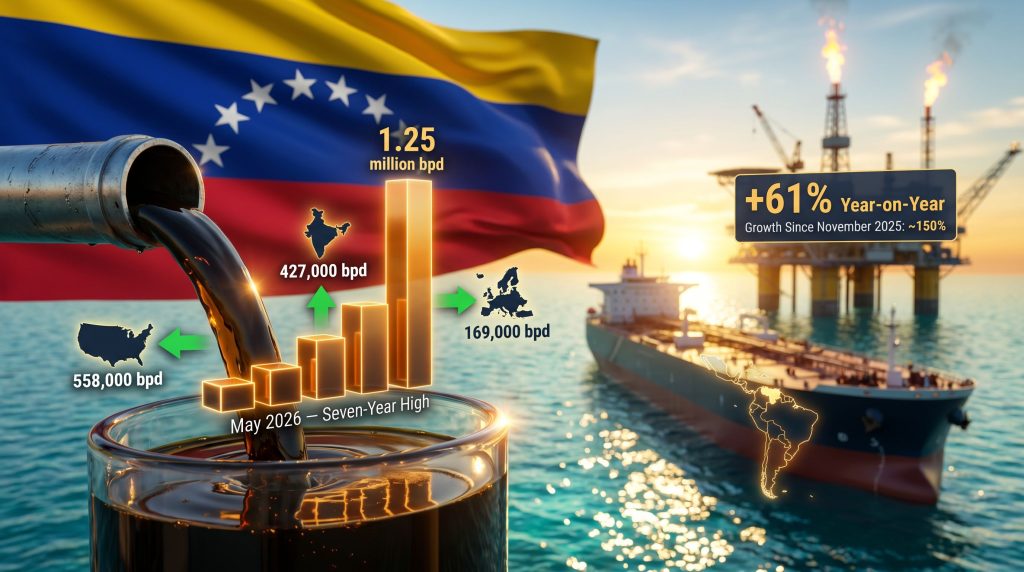
The data emerging from tanker tracking and commodity flow analysis tells a story that goes well beyond a temporary supply spike. Venezuela oil exports hit seven-year high volumes in May 2026, reaching an estimated 1.25 million barrels per day (bpd) — a figure that would have seemed implausible as recently as late 2024. More significantly, the trajectory driving that number reflects multiple reinforcing factors converging simultaneously, which is precisely the combination that tends to produce lasting structural shifts rather than short-lived recoveries.
When big ASX news breaks, our subscribers know first
Understanding Venezuela's Crude: The Heavy Oil Fundamentals That Drive Buyer Behaviour
Before examining the export surge in isolation, it is worth understanding what makes Venezuelan crude distinctive from a refinery economics standpoint. Venezuela's primary production comes from the Orinoco Heavy Oil Belt, one of the largest hydrocarbon accumulations on Earth. The crude produced there is predominantly extra-heavy, with API gravity readings typically ranging between 8 and 16 degrees — considerably denser and more viscous than the light sweet grades that dominate benchmark pricing conversations.
This quality characteristic has profound implications for which refineries can actually process Venezuelan barrels efficiently:
- Extra-heavy crude requires specialised downstream configurations, specifically coking units (which thermally crack heavy residues) and hydrocracking capacity (which uses hydrogen under pressure to upgrade heavy molecules into lighter, more valuable products)
- Refineries without these units cannot process Venezuelan grades at competitive yields, effectively excluding a large portion of global refining capacity from the buyer pool
- U.S. Gulf Coast refineries were deliberately configured in previous decades to handle heavy sour crude from Venezuela and Mexico, giving them a structural advantage when these grades become available at a discount to light sweet benchmarks
- The heavy-light crude differential — the price spread between Brent or WTI and heavy grades like Venezuelan Merey — is a critical variable; when this spread widens, coker-equipped refineries generate significantly superior margins
This refinery configuration dynamic explains why the United States, despite the political complexity surrounding Venezuela, absorbed approximately 558,000 bpd in May 2026 — the largest single-country share of Venezuelan exports. The economics are simply compelling for Gulf Coast facilities built around heavy crude processing.
The Export Recovery in Numbers: Three Months That Signal a Structural Shift
The scale and consistency of Venezuela's export recovery over the first half of 2026 distinguishes it from previous false starts. The country has experienced several premature announcements of production recovery over the past decade, each of which ultimately failed to materialise into sustained output growth. Furthermore, understanding the broader crude oil market dynamics helps contextualise just how significant this reversal truly is.
| Metric | Figure |
|---|---|
| May 2026 Estimated Exports | ~1.25 million bpd |
| April 2026 Exports | ~1.23 million bpd |
| Year-on-Year Export Growth (May vs May 2025) | ~61% |
| Incremental Growth Since November 2025 | |
| Historical Peak Production | ~3 million bpd |
| Current Output as % of Historical Peak | ~42% |
| 2026 Production Target | ~1.3 million bpd |
| 2027 Output Projection | ~1.5 million bpd |
Three consecutive months of export growth, combined with a 61% year-on-year increase and approximately 750,000 bpd of incremental supply added since November 2025, represent a momentum profile that commodity analysts tracking Venezuelan flows are characterising as an aggressive and credible ramp-up rather than a statistical aberration.
Kpler's analysis of Venezuelan crude output, published in May 2026, concluded that the country's production recovery has moved beyond the speculative phase, with output targeting close to 600,000 bpd of year-on-year growth through 2026. That is a meaningful volume shift in a global market where marginal barrels consistently influence price direction.
Who Is Buying Venezuelan Crude — and the Strategic Logic Behind Each Destination
The buyer breakdown for May 2026 exports reflects deliberate procurement strategies across three distinct market regions, each driven by different underlying economics.
United States: Refinery Configuration as Competitive Advantage
At 558,000 bpd, the U.S. accounted for roughly 45% of Venezuela's total May exports. This concentration reflects the structural alignment between Venezuelan crude quality and Gulf Coast refinery infrastructure. The recent Venezuela policy shift has been central to enabling this re-engagement at scale. U.S. Energy Secretary Chris Wright confirmed in mid-June 2026 that American refineries retain meaningful capacity to absorb additional Venezuelan volumes, noting that demand from U.S. refiners is expected to continue growing incrementally as the supply relationship matures.
The progression will not happen instantaneously. Refinery procurement contracts, blending configurations, and logistics arrangements require time to optimise. However, the directional trend toward higher U.S. absorption of Venezuelan heavy crude is well-supported by the underlying economics.
India: Discounted Heavy Crude as a Refining Margin Strategy
India's intake of approximately 427,000 bpd reflects a procurement philosophy that Indian state refiners have applied consistently across various sanctioned or discounted crude sources. Indian refineries, particularly those operated by Indian Oil Corporation, Bharat Petroleum, and Hindustan Petroleum, have invested heavily in hydrocracking and desulphurisation capacity over the past two decades precisely to capitalise on discounted heavy and sour crude grades.
Venezuelan barrels marketed through Vitol and Trafigura at competitive price points align directly with this strategy, providing Indian refiners with the margin advantage they need to manage input costs against domestic fuel pricing constraints. According to Bloomberg's reporting, Venezuela oil exports hit seven-year high volumes in large part due to this surge in Indian demand.
Europe: Supply Route Diversification in a Post-Hormuz Risk World
Europe's absorption of approximately 169,000 bpd is smaller in volume but significant in strategic context. European buyers have been accelerating diversification away from supply chains routed through the Strait of Hormuz, particularly given the geopolitical trade tensions escalating across the region. Venezuelan crude, while requiring longer Atlantic shipping routes, offers a geopolitical risk profile that is structurally different from Middle Eastern supply — a characteristic that is increasingly valued by European energy security planners.
The Policy and Commercial Architecture Behind the Recovery
Venezuela's export surge did not emerge spontaneously. It is the product of several overlapping developments that collectively created the conditions for international re-engagement.
Regulatory developments include the U.S. Treasury's Office of Foreign Assets Control issuing updated general licence guidance in June 2026, materially lowering compliance barriers for operators across Venezuela's oil, gas, and minerals sectors. Critically, this does not represent a full removal of sanctions. The framework operates through expanded general licence categories that permit more commercial activity while retaining selective oversight mechanisms — a distinction with important implications for international operators still managing residual compliance risk.
SLB's framework agreement with PDVSA, signed in June 2026, covers a broad operational mandate:
- Exploration and field development support
- Production optimisation across existing assets
- Digital enablement and technology integration
- Workforce training and capability development
The significance of SLB's re-engagement extends beyond its operational scope. When the world's largest oilfield services provider commits long-term technical and capital resources to a jurisdiction, it sends a signal to the broader international investment community that the operating environment has reached a threshold of stability. This kind of institutional endorsement has historically preceded broader waves of international operator re-entry into post-sanctions environments.
Vitol and Trafigura's involvement as marketing agents for Venezuelan crude provides a commercial layer that PDVSA cannot independently replicate. These trading houses bring established buyer networks, shipping logistics, trade finance infrastructure, and crucially, the commercial credibility that allows risk-averse buyers in regulated markets to transact with confidence. Their participation effectively bridges the institutional gap between PDVSA's current operational capacity and the requirements of international crude markets.
Venezuela in the Context of South America's Broader Supply Expansion
Venezuela's recovery is not occurring in isolation. It is part of a broader structural shift in South American crude supply that is reshaping global trade flows. In addition, the trade war impact on oil has accelerated many buyers' interest in diversifying away from politically volatile supply chains.
| Supply Source | Recent Trend | Key Buyer Regions |
|---|---|---|
| Venezuela | +61% YoY exports; 7-year high | U.S., India, Europe |
| Brazil | Continued deepwater production growth | Asia, Europe |
| Guyana | Rapid offshore capacity expansion | Global |
| Nigeria | 15-month production high | Europe, Asia |
For Asian and European buyers who have spent years managing concentrated exposure to Middle Eastern supply routes, the simultaneous expansion of Venezuelan, Brazilian, and Guyanese output represents a genuine diversification opportunity. South American crude involves longer shipping distances and higher freight costs, but the geopolitical risk premium attached to Atlantic Basin supply is fundamentally lower than for Persian Gulf barrels in the current environment.
The next major ASX story will hit our subscribers first
The Structural Barriers That Will Determine the Recovery's Ceiling
Despite the momentum, several constraints could limit how far and how fast Venezuela's production recovery can progress:
- Infrastructure degradation: Decades of underinvestment and sanctions have left upstream and midstream assets in deteriorating condition. Field injection systems, pipeline networks, and terminal infrastructure require substantial capital expenditure before production can scale meaningfully beyond current levels
- Workforce capability deficits: The sanctions era triggered a significant exodus of skilled petroleum engineers and technical professionals. SLB's training mandate is partly designed to address this human capital gap, but rebuilding institutional knowledge takes years rather than months
- Residual compliance risk: The absence of full sanctions removal means international operators must continue managing complex compliance obligations, which introduces friction into investment decision-making and limits the universe of potential entrants
- PDVSA's institutional capacity: The state oil company's ability to coordinate a multi-partner production ramp-up across a deteriorated asset base remains a key variable that cannot be resolved through commercial agreements alone
Three Scenarios for Venezuela's Production Trajectory Through 2027
Investors and market participants should treat all production projections as scenario-based estimates rather than guaranteed outcomes. Venezuela's recovery path involves material political, regulatory, and operational uncertainties.
Scenario 1: Accelerated Recovery (Bull Case)
Full or near-full sanctions removal occurs by late 2026, triggering accelerated international investment and driving output toward 1.8 to 2.0 million bpd by end of 2027. This scenario would exert meaningful downward pressure on global heavy crude prices and compress the heavy-light differential that currently benefits coker-equipped refiners.
Scenario 2: Steady-State Recovery (Base Case)
The licensing framework continues to expand incrementally without full sanctions removal, with SLB and trading firm engagement driving gradual improvement. Output reaches 1.3 to 1.5 million bpd by end of 2027, broadly consistent with current projections. This scenario represents a moderate supply addition that partially offsets Middle Eastern disruption risk without dramatically repricing crude markets.
Scenario 3: Stalled Recovery (Bear Case)
Political or regulatory setbacks interrupt the licensing expansion process, or infrastructure constraints prove more severe than anticipated. Production plateaus below 1.2 million bpd through 2027, limiting Venezuela to a secondary rather than primary role in global supply dynamics. Consequently, oil price movements in this scenario would be considerably less volatile than many analysts currently anticipate.
Frequently Asked Questions About Venezuela's Oil Export Recovery
Why does Venezuelan crude require specialised refinery configurations?
Venezuelan crude is predominantly extra-heavy and high in sulphur content. Processing it efficiently requires coking units to thermally crack heavy residues and hydrocracking capacity to upgrade those residues into lighter, more valuable products. Standard distillation refineries lack this capability and cannot economically process Venezuelan grades at competitive yields.
Are U.S. sanctions on Venezuela fully removed?
As of mid-2026, sanctions have not been fully removed. The U.S. Treasury expanded the scope of general licences, lowering compliance barriers for commercial activity in Venezuela's energy sector, but selective sanctions mechanisms remain active. The current framework permits significantly more operational flexibility than existed previously without constituting a complete sanctions removal.
What role do Vitol and Trafigura play?
Both trading houses have been engaged to market Venezuelan crude to international buyers. This arrangement provides Venezuela with immediate access to established global buyer networks, shipping infrastructure, and trade finance capabilities that PDVSA currently cannot manage independently at scale. Their participation also provides commercial credibility that facilitates transactions with risk-averse buyers in regulated markets.
How does Venezuela's recovery affect global crude price dynamics?
The addition of approximately 750,000 bpd to global supply since November 2025 represents a meaningful volume increment in a market where marginal barrels influence pricing. Venezuelan heavy crude partially substitutes for sanctioned Iranian heavy grades previously absorbed by Chinese and Indian refiners. As Venezuelan barrels re-enter through legitimate channels, some displacement of sanctioned crude flows is likely, with complex secondary effects on pricing across different crude grade differentials.
For ongoing coverage of Venezuelan production trends, PDVSA developments, and broader crude market dynamics, OilPrice.com provides detailed reporting and analysis on emerging supply shifts across the global energy market. Venezuela oil exports hit seven-year high levels at a moment when global supply diversification has never been more strategically important, and the structural forces underpinning this recovery suggest its significance will only grow in the months ahead.
Want to Stay Ahead of the Next Major Commodity Shift?
Discovery Alert's proprietary Discovery IQ model scans ASX announcements in real time, instantly identifying significant mineral discoveries across 30-plus commodities — including those driven by the same global energy and resource trends reshaping markets today. Explore historic discovery returns on Discovery Alert's dedicated discoveries page and begin your 14-day free trial to position yourself ahead of the broader market.