June 15, 2026
Why the US-Iran Accord Alone Cannot Untangle a Decade of Sanctions Architecture
The architecture of modern energy sanctions was never designed to be dismantled overnight. Built through decades of legislative layering, executive orders, and bilateral enforcement agreements, the US sanctions regime against Iran represents one of the most technically complex regulatory structures in international economic history. Understanding why the recent preliminary US-Iran accord and Chinese firms sanctioned for Iranian oil have simultaneously triggered a sharp oil price selloff and left Chinese energy firms in a deeply uncertain legal position requires stepping back from the headlines and examining the structural mechanics that govern how sanctions regimes operate.
The current situation sits at the intersection of three powerful forces: a fragile diplomatic breakthrough between Washington and Tehran, an accelerating US enforcement campaign targeting Chinese entities facilitating Iranian oil trade, and a Chinese regulatory response designed to insulate domestic firms from foreign sanctions pressure. Each of these forces operates according to its own logic, timeline, and institutional framework, creating a layered complexity that markets and analysts are only beginning to process.
When big ASX news breaks, our subscribers know first
The Sino-Iranian Oil Trade: Scale, Structure, and Strategic Dependency
How China Became the Sole Viable Market for Iranian Crude
Before the reimposition of US sanctions following Washington's 2018 withdrawal from the Joint Comprehensive Plan of Action (JCPOA), Iran sold crude oil to a diverse range of buyers including South Korea, Japan, India, and several European nations. That diversification collapsed systematically under the "maximum pressure" campaign, as sanctions and oil trading threats forced non-Chinese buyers to exit the market to protect their access to the US financial system.
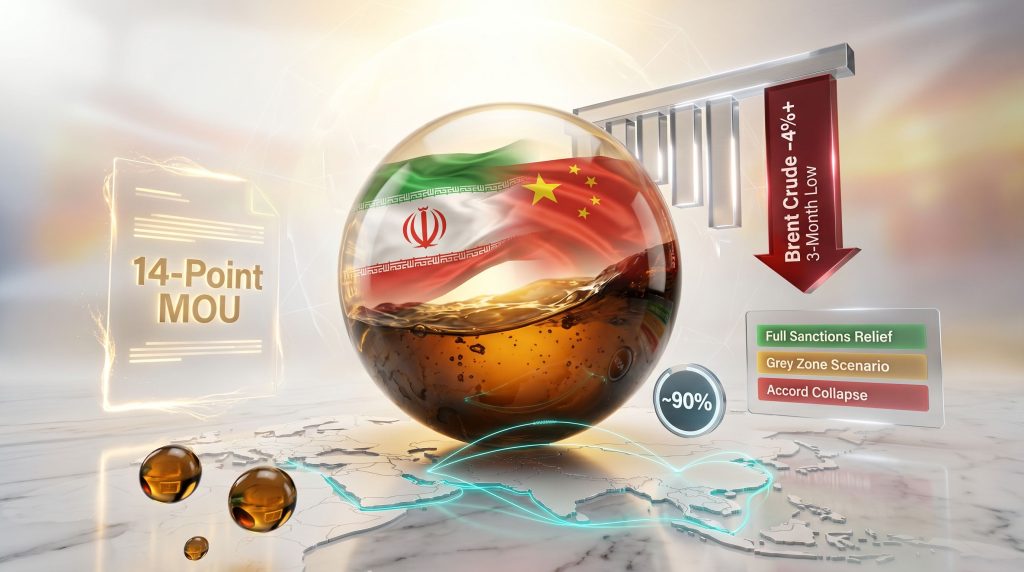
The result is a level of trade concentration that is almost without parallel in global commodity markets. China now absorbs an estimated 90% of Iran's exported crude oil, according to reporting by the South China Morning Post, creating a bilateral dependency that carries profound strategic implications for both nations.
The concentration of Iranian export flows through a single buyer nation is not merely a trade statistic. It fundamentally reshapes the geopolitical leverage dynamic between Tehran and Beijing, giving Chinese importers structural pricing power that has allowed them to secure Iranian crude at substantial discounts to global benchmark prices.
The buyers at the centre of this trade are primarily Chinese independent refiners, commonly referred to in the industry as "teapot" refineries. These smaller, privately operated facilities, concentrated heavily in Shandong province, have developed estimated aggregate processing capacity of approximately four million barrels per day. Their operational flexibility and limited exposure to US-regulated financial systems have made them the structural backbone of Iran's sanctions-era export infrastructure.
Key Data Snapshot: The Sino-Iranian Oil Trade
| Metric | Estimated Figure |
|---|---|
| China's share of Iranian oil exports | ~90% |
| Brent crude price reaction post-accord | -4%+ (three-month low) |
| Duration of US-Iran conflict preceding accord | ~4 months |
| Deal structure | 14-point Persian-language MOU (preliminary) |
| Iranian export volumes pre-2018 sanctions (peak) | ~2.8 million barrels per day |
| Iranian export volumes post-maximum pressure (trough) | ~300,000 barrels per day |
Disclaimer: Volume estimates are drawn from publicly available trade data and media reporting. Actual figures may differ due to the opacity of sanctioned oil trade flows.
Why Teapot Refiners Built Structural Reliance on Discounted Iranian Crude
The economics of Iranian crude for Chinese independent refiners extend well beyond simple cost advantages. Furthermore, several structural factors have reinforced this dependency over time:
- Discount depth: Iranian crude has traded at discounts of $10 per barrel or more to comparable grades, providing teapot refiners with margin advantages unavailable through conventional supply channels.
- Payment flexibility: Arrangements have reportedly included barter components, delayed payment structures, and yuan-denominated settlement mechanisms, reducing reliance on the US dollar-based financial system.
- Infrastructure lock-in: Dedicated storage, blending facilities, and logistics networks have been developed specifically around Iranian crude grades, creating switching costs that make rapid diversification operationally complex.
- Opacity infrastructure: Shipping intelligence services and satellite monitoring have documented extensive use of ship-to-ship transfers, vessel identity obfuscation, and extended periods of "dark fleet" operations where vessels disable their Automatic Identification Systems (AIS) during transit.
This operational ecosystem represents years of accumulated technical and logistical investment, which is why market analysts caution that even a comprehensive sanctions relief agreement would take considerable time to normalise Iranian oil flows through transparent market channels.
What the Preliminary US-Iran Accord Actually Commits To
Unpacking the 14-Point Memorandum of Understanding
The document at the centre of global market attention is a 14-point Persian-language draft memorandum of understanding, described in reporting by the South China Morning Post as a preliminary framework rather than a binding final agreement. This distinction is critical for investors and energy market participants attempting to assess the practical implications of the announcement.
The accord, as publicly reported, contains three core US commitments:
- Maritime blockade removal: Washington agreed to lift restrictions on Iranian maritime activity that had constrained the movement of Iranian crude tankers.
- Export waivers: The US committed to issuing waivers for Iranian oil exports, creating a mechanism for legal crude purchases without triggering fresh sanctions exposure for buyers.
- Sanctions relief pathway: The agreement outlines a roadmap toward broader relief from both primary and secondary sanctions, contingent on a future binding final agreement being reached.
The preliminary US-Iran accord is a draft memorandum of understanding, not a binding treaty. It outlines US commitments to lift its maritime blockade, issue waivers for Iranian oil exports, and establish a roadmap toward broader primary and secondary sanctions relief, all contingent on a future final agreement being reached.
The conditional nature of the third commitment is particularly significant. The phrase "under a future final agreement" means that comprehensive sanctions relief, including relief from secondary sanctions targeting third-party entities, remains aspirational rather than operational. This framing preserves US leverage while providing Iran with enough diplomatic momentum to justify continued engagement, but it offers Chinese firms navigating current sanctions exposure very limited immediate protection.
The Critical Distinction: Preliminary Accord vs. Binding Treaty
A memorandum of understanding in diplomatic practice carries no binding legal force equivalent to a ratified treaty. In the US context, agreements of this nature that involve sanctions relief typically require at minimum:
- Presidential certification to Congress under applicable legislation
- Compliance review periods specified in existing statutory frameworks
- Coordination with OFAC regarding specific licence issuance
- In many cases, explicit congressional notification or potential legislative action
Historical precedent reinforces this complexity. The 2015 JCPOA, despite being far more developed than the current preliminary accord, required months of technical implementation guidance from OFAC before practical sanctions relief could be accessed by foreign entities. The current framework offers considerably less specificity, suggesting an even longer pathway to operational implementation.
Chinese Firms and the Legal Grey Zone: Why Relief Is Not Imminent
New Purchases vs. Existing Sanctions: A Critical Legal Distinction
The most practically significant analytical insight from the accord's announcement concerns the asymmetry between treatment of new purchases and existing sanctions exposure. Lynn Song, chief economist for Greater China at ING, noted that new purchases of Iranian oil would ostensibly not be subject to fresh sanctions, but that a rapid lifting of existing sanctions on Chinese importers of Iranian oil is unlikely to follow. This distinction creates a two-tier legal environment that market participants are actively working to decode.
For Chinese firms already designated under US sanctions for Iranian oil-related activities, the preliminary accord provides no immediate relief pathway. The accord's export waivers, if and when operationalised, would govern the status of future purchases rather than retroactively clearing entities already subject to Treasury Department designations. Consequently, firms currently carrying sanctions designations face continued legal exposure, banking restrictions, and potential secondary effects on their ability to engage with entities maintaining compliance obligations to US regulators.
Why Traders Are Adopting a Wait-and-See Posture
The market response to this uncertainty is visible in trader behaviour. However, despite the dramatic initial oil price reaction, energy market participants have largely adopted cautious positioning, awaiting:
- Formal OFAC guidance on the scope and conditions of any export waivers
- Clarity on which designated Chinese entities, if any, will receive licence relief
- Assessment of whether the accord's provisions are compatible with existing statutory sanctions requirements
- Monitoring of congressional reaction, which could complicate or constrain executive implementation
ING's Lynn Song specifically flagged uncertainty regarding deal longevity as a central concern, noting that this uncertainty remains a critical variable even as market optimism registers concretely in commodity prices and financial markets.
The Escalating Sanctions Standoff: US Enforcement vs. China's Blocking Statute
How Beijing Has Deployed Its Blocking Statute
China's regulatory response to US secondary sanctions targeting Chinese entities has centred on a legal instrument that remains poorly understood outside specialist circles: the blocking statute. Understanding this mechanism is essential to evaluating the practical effectiveness of continued US enforcement against Chinese firms.
What Is a Blocking Statute? A blocking statute is a domestic legal instrument that prohibits entities within a jurisdiction from complying with foreign sanctions laws deemed illegitimate by the home government. China has invoked this mechanism to direct domestic firms to disregard US secondary sanctions measures targeting their engagement in Iranian oil trade.
China's Commerce Ministry has issued directives to domestic firms instructing them to ignore US secondary sanctions measures, relying on the blocking statute framework as legal cover. This creates a direct jurisdictional conflict where Chinese firms face competing legal obligations: compliance with US secondary sanctions requirements to maintain access to dollar-based financial systems, versus compliance with Chinese regulatory directives to continue operating without reference to foreign sanctions frameworks. Indeed, US-China trade tensions have significantly amplified this jurisdictional standoff in recent months.
The Secondary Sanctions Mechanism and Its Real-World Consequences
Secondary sanctions, as deployed by the United States against Iranian oil buyers, operate by threatening to restrict designated foreign entities from accessing the US financial system, US-regulated counterparties, and US-origin goods and technology. For large Chinese state-owned enterprises with substantial international operations, this threat carries significant weight. For smaller teapot refineries with limited US-facing business, however, the practical deterrent effect is considerably weaker, which helps explain why independent refiners have absorbed the bulk of Iranian crude trade.
The consequences for sanctioned Chinese firms can include:
- Designation on OFAC's Specially Designated Nationals (SDN) list
- Blocking of any US-jurisdiction assets
- Prohibition on transactions with US persons
- Reputational and compliance cascades affecting relationships with non-US counterparties maintaining their own OFAC compliance programmes
Which Chinese Entities Have Been Targeted
US enforcement actions have progressively expanded their scope across the Iranian oil supply chain, targeting not only the end-buyer refiners but also:
- Shipping operators and vessel owners involved in transporting Iranian crude
- Terminal operators providing offloading and storage services
- Financial intermediaries facilitating payment flows connected to Iranian oil sales
- Front companies used to obscure the ultimate ownership and origin of Iranian crude cargoes
This systemic approach reflects the US Treasury and State Department's strategy of targeting the entire evasion infrastructure rather than individual transactions, consistent with their publicly stated objective of making the sanctions-evasion ecosystem commercially unviable.
Global Commodity Market Reaction: What the Oil Price Signal Actually Tells Us
Interpreting the 4%+ Brent Crude Drop
Brent crude's decline of more than 4% to a three-month low following the accord announcement represents a concrete market signal, but interpreting what this signal means requires distinguishing between two separate phenomena: the removal of geopolitical risk premium and the pricing-in of actual supply increases. The broader oil price impact of evolving US foreign policy has been a defining theme across energy markets throughout 2025 and into 2026.
Nick Marro, principal economist for Asia and global trade lead at the Economist Intelligence Unit, observed that the market optimism associated with the accord is generating concrete effects in commodity flows and financial markets, while simultaneously cautioning that the current stage of diplomacy still warrants careful scrutiny rather than unbridled confidence.
The geopolitical risk premium that had been embedded in crude prices during the four-month US-Iran conflict period was likely the primary driver of the initial selloff, as markets repriced the probability of supply disruption and regional escalation. The secondary question — whether markets are also pricing in meaningful new Iranian supply entering global markets in the near term — is considerably more speculative given the preliminary status of the agreement.
Comparing Oil Price Responses to Iran-Related Diplomatic Events
| Event | Approximate Brent Crude Response |
|---|---|
| 2015 JCPOA announcement | Significant multi-session decline as Iranian supply reintegration was anticipated |
| 2018 US JCPOA withdrawal | Sharp multi-week rally as maximum pressure campaign signalled supply restriction |
| 2026 preliminary US-Iran accord | -4%+ single session, reflecting risk premium removal and supply optimism |
Disclaimer: Historical price responses are approximate and reflect publicly available market data. Past price movements should not be used as predictive indicators for future outcomes.
The next major ASX story will hit our subscribers first
The Risks That Could Unravel the Accord
Deal Longevity as the Central Variable
Energy markets are pricing in outcomes that remain contingent on a series of conditions that have historically proven difficult to sustain in US-Iran diplomacy. The defining question overhanging the entire framework is not whether the preliminary accord was signed, but whether it will survive the transition from memorandum to binding agreement. Several risk vectors warrant close monitoring:
Congressional opposition: The US Congress has historically exercised significant oversight over Iran sanctions policy. Legislation requiring presidential certification, reporting requirements, and potential new statutory measures could complicate or constrain executive flexibility in implementing sanctions relief.
Israeli interference: Regional actors with strong incentives to prevent Iranian economic normalisation retain the capacity to create disruptions that could derail the diplomatic process. Analysts covering the Middle East have consistently identified this as a material risk variable in any Iran-related diplomatic framework.
Verification disputes: Technical disagreements over compliance monitoring and verification procedures have historically been among the most difficult obstacles to resolve in US-Iran negotiations, as demonstrated by the complex verification architecture required under the 2015 JCPOA.
OFAC's institutional independence: The Office of Foreign Assets Control administers Iran sanctions through a regulatory framework that operates with significant institutional continuity across administrations. Executive diplomatic commitments do not automatically translate into changed OFAC enforcement postures, as the agency's statutory mandates require formal regulatory processes for implementation.
Three Operational Scenarios for Chinese Energy Firms
Chinese refiners and energy firms are likely modelling their operational responses around at least three distinct scenario frameworks:
-
Full Sanctions Relief Scenario: The MOU progresses to a binding final agreement, OFAC issues broad waivers, and Chinese importers can resume open-market Iranian crude purchases without meaningful legal exposure. Existing designations on Chinese firms are reviewed and potentially lifted. This scenario would normalise Iranian crude flows and likely result in further price pressure on global oil benchmarks.
-
Partial Relief / Grey Zone Scenario: Existing sanctions remain in place while new purchases proceed under an ambiguous enforcement posture. Chinese firms operate under elevated but tolerated legal risk, continuing to import Iranian crude through established evasion channels while the diplomatic process advances slowly. This is arguably the most likely near-term scenario given the preliminary status of the accord.
-
Accord Collapse Scenario: The diplomatic process breaks down due to congressional opposition, Israeli interference, or Iranian non-compliance with interim conditions. The US re-escalates enforcement, secondary sanctions tighten, and the Chinese refining sector faces potential supply disruption and margin compression as Iranian crude flows become more difficult to sustain.
Iranian Crude Re-Entry and Global Supply Dynamics in the Second Half of 2026
Volume Estimates and OPEC+ Interaction
Any meaningful increase in Iranian crude exports under sanctions relief would represent a significant addition to global supply, with implications that extend well beyond bilateral US-Iran relations. At peak production before sanctions, Iran was exporting approximately 2.8 million barrels per day. Even a partial restoration to pre-sanctions export volumes would represent a substantial market event, particularly given the OPEC market influence already shaping existing production management efforts to maintain price stability.
The interaction between Iranian re-entry and OPEC+ strategy presents one of the most complex analytical questions in current energy markets. As a member of OPEC, Iran would presumably seek to reintegrate into the production management framework, but the terms under which it might accept output quotas after years of sanctions-constrained production remain unclear. Saudi Arabia and other Gulf producers, already navigating the challenge of managing compliance among existing members, would face additional complication from an Iran seeking to maximise its post-sanctions production recovery.
Downstream Effects on Asian Refining Margins
The downstream implications of Iranian crude re-entry for Asian refining margins are particularly relevant for investors tracking the region's energy sector. Iranian crude grades, particularly Iranian Heavy and Iranian Light, compete directly with other Middle Eastern sour crudes in the Asian market. Increased Iranian availability at competitive prices would exert downward pressure on regional crude differentials, benefiting complex refiners capable of processing sour crude but potentially compressing margins for simpler refining configurations.
The long-term structural question of whether Iranian oil can be fully reintegrated into transparent, openly traded commodity markets remains deeply uncertain. The sophisticated evasion infrastructure that has developed over years of sanctions pressure, including the dark fleet, alternative payment systems, and front company networks, cannot be dismantled rapidly even if political will exists on all sides. Furthermore, the broader geopolitical risk landscape affecting commodities more widely suggests that market transparency in Iranian crude flows would require sustained regulatory reform and international verification mechanisms extending well beyond the scope of the current preliminary memorandum.
Frequently Asked Questions: US-Iran Accord and Chinese Sanctions Exposure
What did the US and Iran agree to in the 2026 preliminary accord?
The US and Iran agreed to a 14-point Persian-language draft memorandum of understanding committing the United States to lift its maritime blockade, issue waivers for Iranian oil exports, and outline a pathway toward broader primary and secondary sanctions relief. The agreement is preliminary and not legally binding, with full implementation contingent on a future final agreement.
Are Chinese companies currently under US sanctions for buying Iranian oil?
Yes. Reuters has reported that US enforcement actions have resulted in multiple Chinese entities, including refiners, shipping operators, terminal operators, and financial intermediaries, being designated under OFAC sanctions programmes for their roles in facilitating Iranian oil trade.
Will existing sanctions on Chinese oil importers be lifted immediately?
Analysts, including ING's chief economist for Greater China, assess that a rapid lifting of existing sanctions on Chinese importers is unlikely, even as the preliminary accord creates a framework for future relief. Existing designations would require formal regulatory processes to modify or remove.
Why does China buy so much Iranian crude oil?
China's dominant position in the Iranian crude market reflects the systematic exit of other major buyers following US secondary sanctions pressure after 2018, combined with the economic advantages of discounted pricing, flexible payment terms, and the established operational infrastructure developed by Chinese independent refiners to process Iranian crude grades.
What is a secondary sanction and how does it affect non-US companies?
A secondary sanction targets foreign entities that engage in specified activities with a sanctioned country or party, threatening to restrict their access to the US financial system, US counterparties, and US-origin goods. Secondary sanctions allow the United States to extend the reach of its foreign policy restrictions to non-US entities that have no direct connection to the US.
What role does OFAC play in enforcing Iran oil sanctions?
OFAC, the Office of Foreign Assets Control within the US Treasury Department, administers Iran sanctions through regulatory frameworks requiring specific licences for virtually all Iran-related transactions. OFAC maintains the Specially Designated Nationals list on which sanctioned entities are designated, and issues enforcement actions, penalties, and licences relevant to sanctions compliance.
Could Israel disrupt the US-Iran diplomatic process?
Analysts identify Israel as a regional actor with strong incentives to prevent Iranian economic normalisation, given Israel's longstanding security concerns regarding Iranian regional influence and nuclear programme development. Fox News has noted that Israeli actions, whether diplomatic, economic, or otherwise, represent a material risk variable for the accord's durability, particularly given China's defiant posture on sanctions compliance.
What happens to oil prices if the accord collapses?
An accord collapse would likely reverse the geopolitical risk premium reduction that drove the initial selloff, potentially driving Brent crude significantly higher. The magnitude of any recovery would depend on the severity of the breakdown and whether the US re-escalates enforcement measures targeting Iranian oil infrastructure and Chinese importers.
Five Structural Realities Defining the Path Forward
As markets absorb the implications of the US-Iran accord and Chinese firms sanctioned for Iranian oil, five structural realities should anchor any serious analytical framework:
- The accord is preliminary, not binding: Implementation risk is high, and the pathway from memorandum to operational sanctions relief involves institutional processes that cannot be accelerated by diplomatic announcements alone.
- Existing designations will not dissolve rapidly: Chinese firms currently on OFAC sanctions lists face a different legal reality than firms considering new Iranian oil purchases, and the accord does not create an automatic mechanism for relief from existing designations.
- China's blocking statute creates a direct legal conflict: Beijing's regulatory directive to domestic firms to disregard US secondary sanctions places Chinese energy companies in a genuine dual-obligation environment that cannot be resolved by either government acting unilaterally.
- The 90% concentration figure represents systemic risk: Iran's extraordinary dependence on a single export market, combined with China's structural reliance on discounted Iranian crude, means that disruptions to either side of this relationship carry consequences that extend well beyond the bilateral energy trade.
- Deal longevity is the defining analytical variable: Market optimism is real and reflected in commodity prices, but the history of US-Iran diplomacy suggests that the distance between preliminary agreement and durable implementation is measured in years, not months.
This article contains analysis of preliminary diplomatic agreements and forward-looking assessments regarding sanctions relief, energy market dynamics, and geopolitical scenarios. These assessments involve material uncertainty and should not be construed as financial or legal advice. Readers should consult qualified professionals before making investment or compliance decisions based on information contained herein.
Want to Stay Ahead of Major Commodity Discoveries While Geopolitical Shifts Reshape Energy Markets?
As sanctions architecture, oil supply dynamics, and commodity markets continue to evolve at pace, Discovery Alert's proprietary Discovery IQ model delivers real-time ASX mineral discovery alerts — instantly transforming complex market data into actionable investment insights for both short-term traders and long-term investors. Explore how historic mineral discoveries have generated substantial returns on Discovery Alert's dedicated discoveries page, and begin your 14-day free trial today to position yourself ahead of the next major market opportunity.