
June 15, 2026
The Structural Reality Behind Global Coal's Stubborn Dominance
Every major energy transition in history has followed a pattern of addition rather than substitution. Wood was not abandoned when coal arrived. Coal was not eliminated when oil emerged. The global energy system expanded its portfolio while maintaining what already worked. Understanding this pattern is the most useful lens through which to examine India energy transition and coal production, because the country is not defying the logic of energy transition. It is following the same structural logic that every industrialising economy before it has followed, under far more demanding conditions.
The central challenge facing India is not a lack of climate ambition. It is a collision between the pace of development required to lift hundreds of millions of people out of energy poverty and the pace of clean technology deployment that the world's current storage and grid infrastructure can actually support. That collision is the defining energy story of the 2020s.
When big ASX news breaks, our subscribers know first
How India's Coal Production Fits Into the Global Energy Hierarchy
Global coal output in 2024 was extraordinarily concentrated. A small group of economies produced the overwhelming majority of the world's coal, with Asia at the centre of that concentration.
| Country | Production (Million Tonnes, 2024) | Share of Global Output (%) |
|---|---|---|
| China | 4,780 | 51.7 |
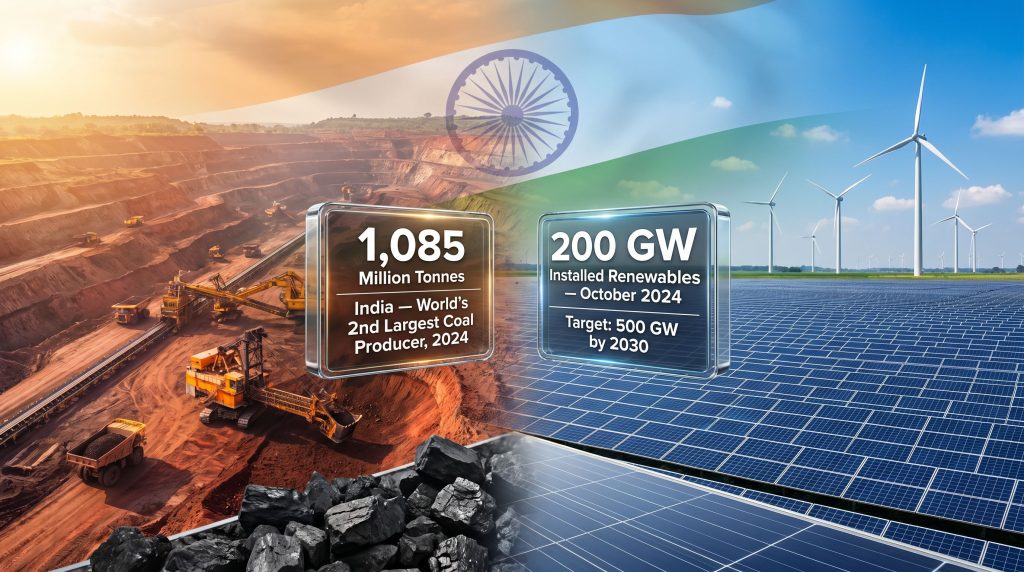
| India | 1,085 | 11.7 |
| Indonesia | 836 | 9.0 |
| United States | 465 | 5.0 |
| Australia | 463 | 5.0 |
| Russia | 427 | 4.6 |
| South Africa | 235 | 2.5 |
| Germany | 92 | 1.0 |
| Türkiye | 87 | 0.9 |
| Poland | 85 | 0.9 |
Source: Statistical Review of World Energy 2025
What this table reveals is not simply an energy story. It is a development story. The three largest coal producers — China, India, and Indonesia — are simultaneously among the largest investors in renewable energy infrastructure. These are not economies choosing coal over clean power. They are economies deploying both, because the scale of their energy demand growth makes a sequential approach structurally impossible.
Among the top coal-producing countries, China, India, and Indonesia together accounted for nearly three-quarters of global coal output in 2024. Asia's dominance of global production reflects its position as the centre of global urbanisation, manufacturing expansion, and infrastructure investment. The continent's coal dependency is not a political choice made in isolation. It is the arithmetic consequence of building the energy infrastructure that hundreds of millions of people require.
Why India Cannot Simply Choose Renewables Over Coal
The Demand Arithmetic That Shapes India's Energy Policy
India's electricity demand is growing from an unusually low base. Per-capita electricity consumption in India remains well below the global average, which means the country's primary energy challenge is not managing consumption. It is dramatically expanding it. The following comparison illustrates just how significant that gap is.
| Region | Relative Consumption Position |
|---|---|
| North America | Very High |
| Europe | High |
| China | Moderate to High |
| World Average | Moderate |
| India | Low |
| Sub-Saharan Africa | Very Low |
Source: IEA and World Bank electricity consumption datasets
This starting point fundamentally reshapes the policy calculus. Every percentage point of grid capacity that is retired before an equivalent clean replacement is operational represents real economic harm to real people. Hospitals lose reliable power. Factories cannot run continuous production shifts. Data centres cannot guarantee uptime. Manufacturing competitiveness erodes.
Critical Insight: India's low per-capita electricity consumption is not a sign of efficiency. It is a measure of unmet demand. The country needs to dramatically expand its total electricity generation before it can meaningfully reduce any particular source within that mix.
The Drivers Pushing Electricity Demand Higher
Multiple structural forces are simultaneously adding pressure to India's grid, making coal's role as a dispatchable baseload source more critical in the near term, not less:
- Rapid urbanisation is intensifying cooling demand, particularly in second-tier cities where air conditioning penetration is rising sharply
- Electronics and chemicals manufacturing expansion requires consistent, reliable industrial power that weather-dependent generation cannot guarantee without substantial storage backup
- Data centre proliferation, driven by India's expanding digital economy, creates 24-hour baseload demand profiles that intermittent renewables struggle to serve independently
- Rising middle-class appliance penetration across residential sectors is compressing seasonal demand variation and extending peak demand hours
The Dispatchability Gap Solar and Wind Cannot Yet Close
India reached a milestone of 200 gigawatts of installed renewable energy capacity by October 2024, according to Ember data. That figure represents genuine progress and reflects sustained policy commitment. However, installed capacity and actual electricity generation are fundamentally different metrics, and conflating the two overstates clean energy's current role in India's power system.
Solar panels generate electricity only during daylight hours. Wind turbines produce power only when wind conditions are adequate. Coal-fired generation operates on demand, regardless of weather or time of day. Until grid-scale battery storage is available at a scale sufficient to compensate for these intermittency gaps across a national grid serving 1.4 billion people, coal retains a functional role that no amount of additional renewable capacity can yet fully replace.
Featured Snippet Opportunity: India's renewable energy capacity has crossed 200 GW, but coal still supplies the majority of actual electricity generated. This gap between installed capacity and real-world generation reflects the intermittency of solar and wind, which produce power only when weather conditions allow, unlike coal, which operates on demand.
India's Coal Expansion Strategy and the Energy Security Logic Behind It
Recent Policy Signals From India's Ministry of Coal
Rather than constraining domestic coal output in response to international climate pressure, India has moved to accelerate it. Recent policy actions have included relaxation of certain environmental clearance and community consultation requirements for coal mine expansions, alongside Ministry of Coal plans targeting further growth in domestic mining volumes.
The strategic rationale is not indifference to climate outcomes. It is a deliberate prioritisation of energy security in the transition over import dependency. India's policymakers have drawn a sharp distinction between the risks of domestic coal dependency and the risks of dependence on internationally traded energy commodities.
The energy security calculus driving India's coal expansion:
- Domestic coal production is insulated from the international supply disruptions that have repeatedly destabilised import-dependent energy systems
- Imported liquefied natural gas carries exposure to global price spikes and shipping route vulnerability, as demonstrated by the Russia-Ukraine conflict and Red Sea shipping disruptions
- Solar and wind generation, while domestically produced, remains weather-dependent and cannot yet be fully backed by storage at national scale
This logic reflects a broader reassessment occurring across the Global South. Furthermore, energy security has returned to the centre of policy priority following a series of geopolitical shocks that exposed the vulnerability of globally integrated energy supply chains. For economies like India, domestically produced coal carries a strategic premium that imported energy alternatives simply cannot match in the current geopolitical environment.
When Could India's Coal Demand Peak?
Multiple analytical frameworks project India's coal demand peaking somewhere in the 2030 to 2035 window, after which a plateau or gradual managed decline may emerge. The sequence of preconditions required for that peak to arrive and be sustained is specific:
- Grid-scale battery storage must become cost-competitive at the national scale India requires
- Renewable capacity additions must consistently outpace demand growth rather than merely keeping pace with it
- Industrial electrification must reduce process heat requirements that currently depend on thermal energy
- Either domestic carbon pricing mechanisms or credible international climate finance must create structural economic incentives for accelerated coal displacement
Important Caveat: These projections carry significant uncertainty. GDP growth rates above trend, weaker-than-expected monsoon seasons affecting hydropower output, and slower-than-projected battery cost reduction curves could all push coal's demand peak considerably further into the future. These are scenarios, not forecasts.
What China's Dual-Track Energy Strategy Teaches India
The Most Instructive Precedent in Energy Policy
China's experience over the past two decades offers the most directly applicable template for India's current strategic dilemma. Rather than sequencing a coal exit before renewable scale-up, China pursued simultaneous expansion across both conventional and clean energy domains. The outcomes of that dual-track approach are now well documented.
China's dual-track energy outcomes:
- China became the world's largest investor in renewable energy infrastructure
- It established global dominance in solar panel manufacturing, battery production, and electric vehicle supply chains
- It maintained substantial coal-fired generation capacity to support grid reliability through the transition period
- Domestic coal production reached approximately 4.78 billion tonnes in 2024, exceeding the combined output of every other nation on earth
The key analytical insight from China's approach is not that coal is a desirable long-term outcome. It is that transitions are structurally safer when pursued from a position of energy abundance rather than energy scarcity. Prematurely dismantling conventional generation capacity before clean alternatives can fully compensate creates reliability risks that undermine industrial competitiveness and erode public confidence in the transition itself.
India can adapt this framework to its own development context, using domestic coal to anchor grid reliability while rapidly scaling renewable capacity, storage infrastructure, and grid modernisation. Furthermore, the objective is not to lock in coal dependence permanently. It is to prevent a reliability gap from opening during the transition period, a concern that sits at the heart of ongoing coal supply challenges facing the region.
How Different Regions Define Their Energy Priorities
One of the most consequential analytical errors in global energy discourse is treating the energy transition as a single unified challenge with a single optimal solution. The reality is that different regions begin from fundamentally different starting points and face fundamentally different constraints.
| Region | Primary Strategic Priority |
|---|---|
| Europe | Decarbonisation of mature economies |
| United States | Energy competitiveness and supply security |
| China | Industrial growth and energy security |
| India | Development, affordability, and reliability |
| Africa | Energy access and poverty reduction |
| Southeast Asia | Economic growth and grid reliability |
Source: Synthesis of prevailing national and regional energy policy frameworks
Europe's challenge is decarbonising a mature economy with high per-capita consumption and established grid infrastructure. Africa's challenge is achieving first-generation energy access for populations still living without reliable electricity. India must navigate all of these challenges simultaneously — expanding access, maintaining affordability, ensuring reliability, and reducing emissions intensity — within a single policy framework and on a compressed timeline.
No developed economy has ever attempted this particular combination at this scale. Consequently, the absence of a historical precedent is itself a critical fact that global climate negotiations too rarely acknowledge. This complexity also shapes how analysts evaluate the broader clean energy transition across emerging markets.
The next major ASX story will hit our subscribers first
The Fiscal Risks Concentrated in India's Coal-Dependent States
Geographic Concentration and Revenue Vulnerability
India's coal economy is not evenly distributed. States including Odisha, Jharkhand, and Chhattisgarh carry disproportionately high structural dependency on coal royalties and related employment. Analysis from the Institute for Energy Economics and Financial Analysis highlights that these states face compounding fiscal and social risks if coal revenues contract before alternative economic structures are in place to absorb the transition.
Key vulnerability dimensions for coal-dependent states:
- State government revenue streams are significantly exposed to coal royalty income, creating fiscal cliff risks if demand declines faster than anticipated
- Employment concentration in mining and ancillary industries leaves limited labour market alternatives for workers in a transition scenario
- Industrial diversification in coal-belt regions remains limited, reducing the economic resilience buffer available during structural adjustment
- Social protection infrastructure in these regions has not been designed for the scale of adjustment a rapid transition would require
A managed coal transition at the national level requires a parallel economic development strategy at the state level. Without it, the social costs of transition fall disproportionately on the communities least able to absorb them, creating political resistance that can delay the transition itself.
Three Scenarios for India's Energy Mix Through 2035
The range of plausible outcomes for India's energy trajectory over the next decade is genuinely wide. The following scenarios reflect different combinations of technology cost trajectories, infrastructure investment rates, and international climate finance delivery.
Scenario 1: Accelerated Transition
Rapid battery storage cost reductions, strong international climate finance flows, and accelerated grid modernisation enable coal demand to peak before 2030 and decline meaningfully by 2035. This scenario requires technology and financing outcomes at the optimistic end of current projections.
Scenario 2: Managed Parallel Expansion (Base Case)
India continues expanding both renewable capacity and domestic coal output through the late 2020s. Coal demand plateaus around 2030 to 2032 before a gradual managed decline begins as storage and grid infrastructure matures. This scenario reflects the most probable trajectory given current policy settings and technology cost curves.
Scenario 3: Delayed Transition
Slower-than-expected storage technology cost reduction, weaker climate finance delivery, and stronger-than-projected electricity demand growth extend coal's dominance well into the 2030s. This scenario is not the most likely outcome but represents a credible risk under adverse conditions.
India's 2030 target of 500 GW of non-fossil fuel power capacity — up from approximately 200 GW of installed renewables reached in late 2024 — sets an ambitious framework. However, whether that target translates into coal displacement or simply adds to an expanding total energy system will depend on demand growth rates, storage deployment timelines, and the pace of industrial electrification. In addition, the scale of critical minerals demand required to build out that capacity adds another layer of complexity to the overall transition picture.
Frequently Asked Questions: India Energy Transition and Coal Production
Will India Phase Out Coal by 2030?
No credible official government commitment or independent analytical framework supports a 2030 coal phase-out for India. India's stated position in international climate negotiations has consistently been that coal will remain central to its power system through at least 2030, with demand potentially peaking in the 2030 to 2035 period under optimistic scenarios.
How Much Coal Does India Produce Each Year?
India produced over 1.085 billion tonnes of coal in 2024, making it the world's second-largest coal producer. China, the largest producer, generated approximately 4.78 billion tonnes in the same year, a volume greater than all other nations combined.
Is India Investing in Renewable Energy While Expanding Coal?
Yes. India's current energy strategy involves simultaneous expansion of renewable capacity and domestic coal production. By October 2024, India had reached 200 GW of installed renewable energy capacity while continuing to pursue coal mine expansions and relaxing some environmental clearance requirements for new mining activity.
Why Is Coal Still Dominant in India's Power Mix Despite Renewable Growth?
Coal provides dispatchable baseload power — electricity generated on demand regardless of weather conditions. Solar and wind generation is intermittent by nature, and India's grid-scale storage infrastructure is not yet sufficient to compensate for that intermittency at the scale a national grid serving 1.4 billion people requires. This dynamic is central to understanding India energy transition and coal production as it currently stands.
Which Indian States Are Most Dependent on Coal?
Odisha, Jharkhand, and Chhattisgarh carry the highest structural dependency on coal production among Indian states, both for government revenues and direct employment. These states face the greatest fiscal and social exposure if coal demand declines before alternative industrial sectors are sufficiently developed to absorb the adjustment.
This article contains forward-looking scenarios and analytical projections regarding energy demand, technology cost trajectories, and policy outcomes. These projections involve significant uncertainty and should not be interpreted as investment advice or predictions of future market conditions. Readers are encouraged to consult multiple independent sources when forming views on energy sector developments.
For ongoing coverage of India's coal sector, renewable energy policy, and energy security landscape, visit ETEnergyWorld.
Want To Stay Ahead Of The Next Major Resource Discovery Shaping The Energy Transition?
As India's dual-track energy strategy drives sustained demand for both coal and the critical minerals underpinning renewable infrastructure, the ASX exploration sector is generating significant opportunities for informed investors. Discovery Alert's proprietary Discovery IQ model delivers real-time alerts on significant ASX mineral discoveries the moment they are announced, transforming complex geological data into actionable insights — start your 14-day free trial today and explore how historic discoveries have generated substantial returns for those positioned early.