June 15, 2026
When Geography Becomes Destiny: Africa's Mineral Economies and the Gulf Crisis
The relationship between military conflict and commodity markets is rarely linear. Geopolitical shocks do not respect borders, and landlocked nations with no proximity to active conflict zones can find themselves absorbing economic consequences as severe as frontline states. The US-Iran war and its disruption of Strait of Hormuz shipping lanes represents precisely this kind of asymmetric exposure, and Zimbabwe mineral exports and US-Iran war dynamics have become increasingly intertwined in ways that most mainstream economic commentary has yet to fully interrogate.
Understanding why requires moving beyond headlines and into the structural architecture of how Zimbabwe actually moves its mineral wealth to global buyers, and who sits in the middle of that transaction.
When big ASX news breaks, our subscribers know first
Zimbabwe's Export Architecture: A Single Point of Failure
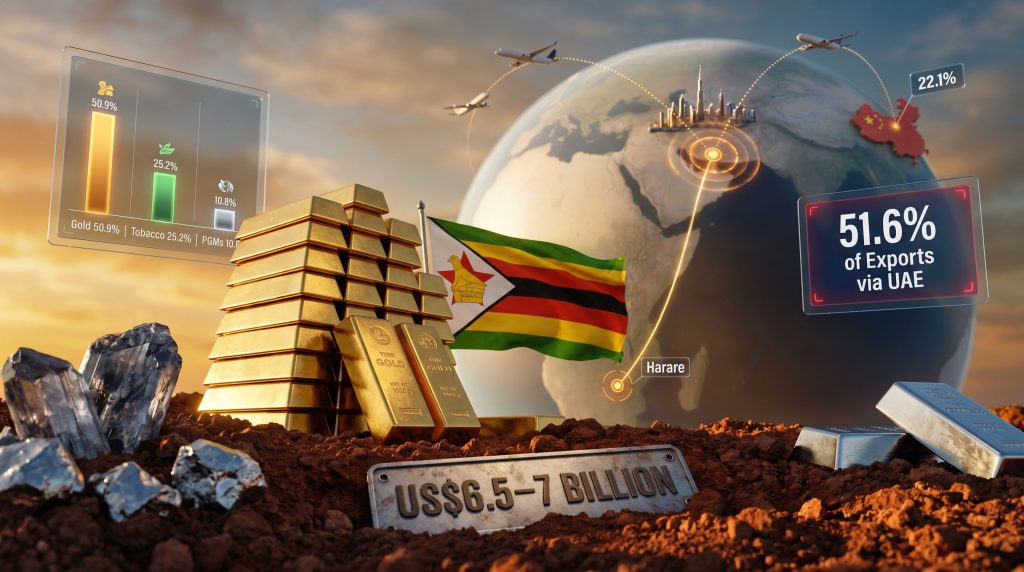
Zimbabwe's total merchandise exports currently sit at approximately US$969.4 million per reviewed period, a figure that obscures a deeper vulnerability in how those exports are routed. A striking 51.6% of all Zimbabwean exports flow through the UAE, with Dubai functioning as the dominant commercial transshipment gateway for the country's mineral trade.
This concentration is not a coincidence of geography. Dubai has, over decades, built the world's most sophisticated precious metals logistics infrastructure. The Dubai Multi Commodities Centre (DMCC) is the planet's largest free-trade zone for commodities, and it handles an enormous volume of African gold, which is refined, reweighted, and redistributed onward to buyers in Europe, Asia, and beyond. For Zimbabwe's Fidelity Gold Refinery, which channels most of the country's formal gold output, Dubai is the path of least resistance to international buyers.
The commodity breakdown reinforces just how much rides on this single corridor:
| Mineral Category | Share of Total Exports | Primary End Markets |
|---|---|---|
| Gold | ~50.9% | UAE (transshipment), then global bullion markets |
| Tobacco | ~25.2% | China, regional buyers |
| Platinum Group Metals (PGMs) | ~10.8% | Industrial buyers; recovering prices |
| Lithium (emerging) | Growing contributor | China-oriented battery supply chains |
China receives approximately 22.1% of Zimbabwe's exports, with South Africa accounting for 13.4%. Yet even China-bound mineral shipments frequently transit Gulf logistics infrastructure, meaning the UAE's share of route dependency is likely understated in headline export destination figures.
When more than half of a country's export revenues depend on a single regional hub located adjacent to an active conflict zone, the economic exposure stops being incidental. It becomes systemic.
How Gulf Disruptions Translate Into Direct Cost Pressure
The Freight and Insurance Transmission Mechanism
The Strait of Hormuz is the world's most strategically sensitive maritime chokepoint, with roughly 20% of global oil trade passing through its narrow passage daily, according to the US Energy Information Administration. Military conflict involving Iran fundamentally alters the risk calculus for every commercial operator using Gulf airspace and sea lanes. Furthermore, the economic impact of the conflict extends well beyond the immediate region, touching supply chains across multiple continents.
For Zimbabwe, the consequences are transmitted through several distinct channels:
- War-risk insurance surcharges applied to cargo transiting Gulf airspace or sea lanes, directly raising the cost of moving gold and mineral products through Dubai
- Aviation fuel cost escalation driven by oil price spikes, which compress the margins of air freight operators and push those costs onto shippers
- Route suspensions and rerouting by carriers unwilling to absorb conflict-zone liability, extending transit times and disrupting the timing of foreign currency inflows
- Sulfuric acid and diesel price inflation, both critical inputs to mining operations, as Gulf shipping disruptions tighten global supply of sulfur-derived industrial chemicals
The airfreight cost data from Zimbabwe's agricultural export sector provides a measurable proxy for mineral logistics cost inflation. Airfreight costs for Zimbabwean perishable exports have climbed to approximately US$3.80 per kilogram, compared with US$2.00 to US$2.20 per kilogram in the prior year. Zimbabwe supplies roughly 60% of the United Kingdom's sugar snap pea imports, and that cost competitiveness is now being eroded by Egyptian, Kenyan, and South American competitors who operate along unaffected routes.
The same air corridors, the same Dubai-based cargo handlers, and the same UAE-licensed freight forwarders that move perishables also handle refined gold bars and high-value mineral concentrates. The cost and risk dynamics are structurally identical, even if mineral-specific freight data is less frequently published in accessible form.
Upstream Input Costs: The Hidden Margin Squeeze
The conflict's impact on mining operations extends beyond logistics. Global prices for sulfur and diesel have risen sharply, and this matters considerably for Zimbabwe's active mining operations:
- Sulfuric acid, derived from sulfur, is essential to hydrometallurgical processing of copper, nickel, zinc, uranium, and certain rare earth elements
- Diesel cost inflation raises the operating cost baseline for open-pit and underground mining operations across all mineral categories
- Higher break-even costs can delay the economic viability of marginal deposits and compress project economics for newer operations still ramping toward full production
For Zimbabwe's PGM and base mineral sectors, which are already recovering from a period of depressed global prices, this input cost inflation arrives at a particularly inopportune moment. In addition, the supply chain risks for the mining industry more broadly suggest these pressures could persist well beyond an immediate ceasefire scenario.
The $6.5 to $7 Billion Revenue Target: What It Actually Requires
Zimbabwe's Ministry of Mines and Mining Development has outlined a projection of US$6.5 billion to US$7 billion in total mineral export receipts for the full fiscal year, up from approximately US$2 billion recorded in the first half alone. The Ministry of Mines, led by Dr. Polite Kambamura, has indicated that the sector is expected to experience accelerated growth in the second half of the year, as reported by Business Times Zimbabwe.
This projection rests on three intersecting pillars:
- Sustained gold price appreciation in global markets, driven by safe-haven gold demand during geopolitical uncertainty
- Recovery in PGM prices, particularly through the platinum and palladium markets, which serve critical industrial functions in automotive catalysts and hydrogen fuel cell technologies
- Commercialisation of lithium sulphate and lithium carbonate products from newly operational or near-operational processing facilities
The Arcadia Lithium Mine in Goromonzi is a focal point of the third pillar. The facility is advancing toward production of lithium carbonate, a significantly higher-value product than raw spodumene concentrate. The lithium carbonate market commands premium pricing in global battery supply chains and substantially better per-tonne economics than unprocessed ore.
Disclaimer: Revenue projections of this scale involve significant assumptions about commodity price trajectories, production ramp-up timelines, and logistics conditions. Investors and analysts should treat these figures as targets, not guarantees, and assess them against the structural risks outlined in this article.
The Raw Mineral Export Ban: Governance, Strategy, and Unintended Consequences
What the Ban Actually Covers and Why It Was Accelerated
In February of the current year, Zimbabwe imposed a ban on all raw mineral and lithium concentrate exports — a decision striking both for its scope and its timing. The Ministry cited two overlapping rationales:
- Systemic under-declaration of mineral volumes by licensed exporters, representing a form of revenue fraud that suppresses official export figures and government royalty receipts
- Excess export permit issuance and broader malpractice within export licensing systems, which had allowed volumes far exceeding declared quantities to leave the country unaccounted
The ban on lithium concentrate exports had originally been scheduled for 2027 under Zimbabwe's Base Minerals Export Control Order framework of 2023, which restricts the export of unprocessed lithium ore, nickel, and manganese. The timeline was accelerated because production volumes exceeded expectations and the existing permit system had been comprehensively gamed.
This is an underappreciated dimension of the story. The scale of under-declaration reportedly reached a level where the government felt that its entire royalty and tax collection architecture for lithium was being systematically undermined. Accelerating the ban was, in part, an acknowledgment that regulatory compliance mechanisms had failed.
The Value Addition Logic: Why Processing Before Export Changes the Economics
The strategic rationale for the ban extends beyond immediate governance concerns. There is a compelling value-chain argument for requiring in-country processing before export:
- Lithium carbonate trades at a substantial premium to raw spodumene concentrate on a per-tonne basis, with the value differential depending on market conditions but consistently significant
- Refined gold sold directly into accredited international bullion markets eliminates intermediary margins and reduces exposure to Gulf routing dependency
- Processed PGM products capture more of the value chain domestically rather than exporting it to foreign smelters and refiners
The strategic logic is straightforward: the higher the value-added content of Zimbabwe's exports, the less sensitive total revenue becomes to per-unit freight cost fluctuations. A tonne of lithium carbonate is worth multiples of a tonne of spodumene concentrate, so transport cost inflation represents a smaller proportion of realised revenue.
Zimbabwe's Competitive Position in the Global Critical Minerals Race
Why the "War Minerals" Dynamic Elevates Zimbabwe's Strategic Value
The US-Iran conflict, combined with sustained geopolitical tension across multiple theatres, is accelerating the depletion of Western military stockpiles of critical minerals. The antimony shortage risks are particularly acute, given that antimony is essential to armour-piercing ammunition, flame retardants, and semiconductor applications. US Department of Defense antimony inventories have been reported at historically low levels.
Simultaneously, China has shifted from dominant global antimony exporter to net importer, following the exhaustion of major domestic deposits, and has imposed export restrictions while sourcing aggressively from Bolivia, Chad, Australia, and Peru. This structural shift illustrates a broader dynamic: geopolitical conflict is reclassifying previously industrial minerals as strategic assets, which elevates both their market value and their political significance in bilateral trade negotiations.
Zimbabwe's endowment of PGMs, lithium, nickel, and other critical minerals demand positions the country as a potentially significant supplier to both Western and Asian industrial supply chains. Chinese investment in Zimbabwe's lithium sector alone has exceeded US$1 billion, reflecting the country's already-established position in global battery material supply chains.
The Competing Pressures: China's Position vs. Western Supply Chain Interests
Zimbabwe faces a genuinely complex geopolitical balancing act. Western nations, particularly the United States and European Union members, are actively seeking to reduce their dependency on Chinese-controlled critical mineral supply chains. Zimbabwe's lithium, PGMs, and nickel are precisely the resources those diversification strategies require.
However, China holds dominant investment positions in Zimbabwe's lithium sector through entities like Zhejiang Huayou Cobalt and others. Any pivot toward Western supply chain integration would need to navigate existing contractual and investment relationships that are deeply embedded in the country's mineral development landscape.
The next major ASX story will hit our subscribers first
Structural Reform Priorities for Resilient Export Growth
Three concrete structural priorities emerge from this analysis that go beyond revenue targets and touch the underlying architecture of Zimbabwe's mineral economy:
-
Route and market diversification: Reducing the UAE's share of export flows below 30% within a defined policy timeframe by expanding direct trade accreditation for Fidelity Gold Refinery in non-Gulf bullion markets and strengthening East African port corridor logistics through Beira, Dar es Salaam, and Durban
-
Value-addition acceleration: Fast-tracking lithium carbonate, refined gold, and PGM processing capacity to shift Zimbabwe's export profile toward higher-margin products that are less sensitive to per-unit freight cost inflation
-
Institutional integrity: Enforcing transparent and consistent regulatory standards across all mining operations, from artisanal small-scale miners to large foreign-owned enterprises, to eliminate the revenue leakage that has historically suppressed fiscal returns
The Ministry of Mines has publicly acknowledged that corruption within the ministry itself represents a structural impediment to sector performance, with calls for uniform treatment of all mining licence applicants regardless of political or financial influence, as reported by Business Times Zimbabwe. This acknowledgment is significant because institutional credibility is a prerequisite for the kind of foreign investment that value-addition capacity requires.
Frequently Asked Questions
How does the US-Iran war affect Zimbabwe's gold exports?
The conflict disrupts Gulf logistics infrastructure, particularly around the UAE, which handles over 51% of Zimbabwe's total exports. Higher freight costs, war-risk insurance premiums, and potential rerouting of cargo operations increase the cost and complexity of moving gold from Zimbabwe to international buyers. The Zimbabwe mineral exports and US-Iran war relationship is consequently more direct than many observers initially assumed.
What is Zimbabwe's mineral export revenue target for the current fiscal year?
The Ministry of Mines has projected total mineral export receipts of between US$6.5 billion and US$7 billion, anchored by gold price appreciation, recovering PGM prices, and new lithium carbonate production from facilities including the Arcadia Lithium Mine.
Why did Zimbabwe ban raw mineral and lithium concentrate exports?
The ban was introduced in response to documented under-declaration of mineral volumes, excess export permit issuance, and systemic revenue leakage. It also reflects a strategic commitment to capturing more value domestically through processing before export.
How significant is mining to Zimbabwe's economy?
Mining contributes between 13% and 15% of GDP and represents the largest share of Zimbabwe's export revenue. Gold alone accounts for approximately 50.9% of all merchandise exports, making it the country's single most important foreign currency earner.
Could the US-Iran conflict indirectly benefit Zimbabwe's mineral sector?
Potentially. Conflict-driven demand for critical minerals, rising gold prices as investors seek safe-haven assets, and tightening global supply chains for war-relevant minerals can all elevate the market value of Zimbabwe's mineral endowment. However, whether those revenue gains outweigh the logistics cost inflation and input cost pressures introduced by the same conflict remains the central uncertainty facing Zimbabwe mineral exports and US-Iran war conditions through 2026.
Want to Stay Ahead of the Next Major Mineral Discovery?
Discovery Alert's proprietary Discovery IQ model scans ASX announcements in real time, instantly identifying significant mineral discoveries across gold, lithium, PGMs, and more than 30 other commodities — turning complex data into clear, actionable investment insights. Explore historic discoveries and their market returns, then begin your 14-day free trial to position yourself ahead of the broader market.