June 15, 2026
The Quiet Revolution Reshaping How the World's Largest Energy Market Stores Power
Across the global energy storage industry, a familiar pattern has played out for years: batteries get deployed primarily as an afterthought, bolted onto renewable projects to satisfy grid connection requirements or regulatory mandates. Storage was treated as a compliance cost, not a commercial asset. That paradigm is now breaking down in China, and the Q1 2026 data from the CNESA DataLink Global Energy Storage Database offers the clearest evidence yet of what a post-compliance storage market actually looks like at scale.
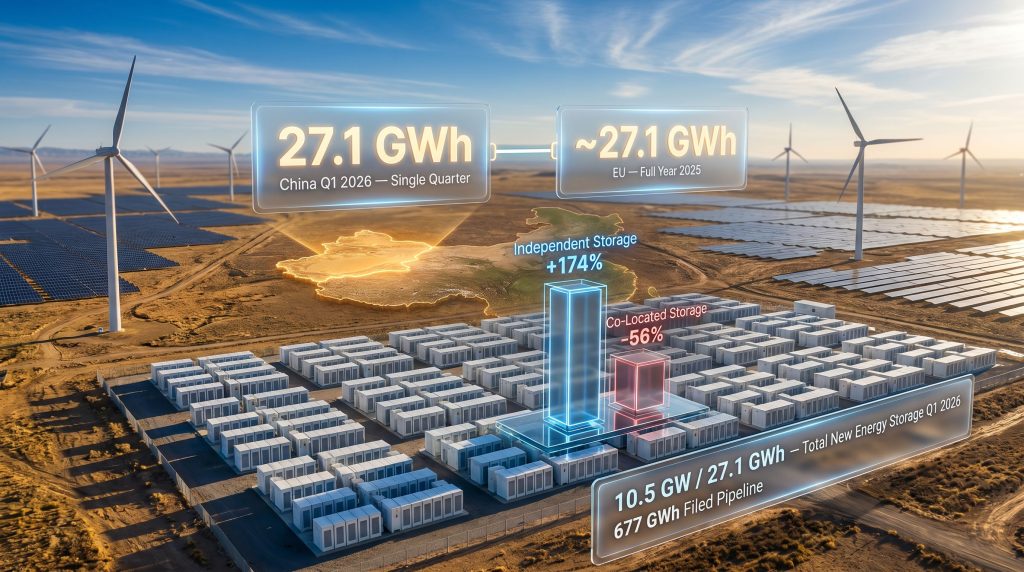
When China adds 27.1 GWh of new energy storage in Q1 2026 alone, the headline number deserves unpacking. This is not simply a record quarter. It represents a structural reorganisation of who builds storage, why they build it, and how it earns revenue once commissioned.
When big ASX news breaks, our subscribers know first
Segment Performance: A Market Splitting in Two Directions
The Q1 2026 data reveals two sharply diverging trajectories running simultaneously within China's storage market. Understanding both is essential for anyone seeking to interpret the headline totals accurately. Furthermore, the role of critical minerals in energy transition strategies adds another layer of complexity to how these figures should be interpreted globally.
On one side, independent grid-side storage is expanding at a pace that few markets globally have ever sustained. On the other, the segments that once defined China's storage build-out — renewable co-located storage and user-side installations — are contracting materially. These are not temporary fluctuations. They reflect fundamentally different responses to an evolving policy and revenue environment.
The Independent Storage Surge: Numbers Behind the Transformation
The dominant story of Q1 2026 is the extraordinary performance of independently operating battery energy storage systems. The data from CNESA shows 8.7 GW / 23.0 GWh of newly commissioned independent storage, representing year-on-year growth of 174% in power capacity and 205% in energy capacity.
That energy capacity growth rate outpacing power capacity growth is not an accident. It is a deliberate engineering and commercial decision. When independent storage projects are designed with longer discharge durations, they can stack revenue across multiple market mechanisms simultaneously, including frequency regulation, peak shaving, capacity payments, and energy arbitrage. A system with a longer duration window has more flexibility to respond to price signals across a broader daily cycle.
| Segment | Q1 2026 Power Capacity | Q1 2026 Energy Capacity | YoY Power Change | YoY Energy Change | Share of New Power Additions |
|---|---|---|---|---|---|
| Independent Storage | 8.7 GW | 23.0 GWh | +174% | +205% | 83% |
| Renewable Co-Located | 1.0 GW | 2.5 GWh | -56% | -54% | ~10% |
| User-Side Storage | 545 MW | 1,252 MWh | -50% | -49% | ~5% |
| Grid/Generation-Side Total | 9.9 GW | 25.8 GWh | +82% | +100% | 95% |
| Total New Energy Storage | 10.5 GW | 27.1 GWh | +60% | +76% | — |
Independent storage now accounts for 83% of all new power capacity additions, up 34 percentage points compared to Q1 2025. This is no longer a niche segment competing for market share. It is the market.
The ratio of energy capacity growth at +205% significantly outpacing power capacity growth at +174% for independent storage indicates that developers are deliberately engineering longer discharge durations into new projects, a design choice optimised for stacking multiple revenue streams rather than serving a single grid function.
Why Renewable Co-Located Storage Is Losing Ground
The reversal in co-located storage fortunes is one of the more counterintuitive findings in the Q1 2026 data. New renewable-paired storage fell to just 1.0 GW / 2.5 GWh, down 56% in power terms and 54% in energy terms year-on-year. Its share of new power additions dropped by 23 percentage points from the same period in 2025.
The core issue is structural rather than cyclical. When storage is physically and contractually tied to a single renewable generator, its ability to optimise dispatch is severely constrained. It can only charge when its paired wind or solar asset is generating, and it can only discharge according to the operating profile of that generator.
This limitation means co-located storage cannot respond freely to price signals across the broader grid, reducing its revenue ceiling. As independent storage operators demonstrate that grid-side assets can generate superior returns through multi-revenue-stream dispatch, the economic case for mandatory co-location weakens considerably. Developers and investors are recalibrating accordingly.
The User-Side Correction: Four Forces Reshaping C&I Storage Economics
User-side storage, which is dominated by commercial and industrial applications, fell to 545 MW / 1,252 MWh in Q1 2026, down 50% in power terms and 49% in energy terms year-on-year. CNESA's analysis points to four interconnected headwinds driving this deterioration:
- Peak-valley tariff compression — Narrowing spreads between peak and off-peak electricity prices directly erode the arbitrage margins that make C&I storage economically viable. When the price differential shrinks, the revenue case weakens proportionally.
- Fixed time-of-use tariff cancellations — Several provinces have withdrawn predictable tariff structures that previously gave project developers the revenue certainty needed to secure financing. Without reliable price signals, lenders and investors become reluctant to commit capital.
- Subsidy rollbacks — Local government incentive programmes that once shortened payback periods have been progressively reduced, increasing the effective cost burden on project developers.
- Declining internal rates of return — The combination of the above factors has compressed project-level returns below the investment thresholds that institutional capital requires, stalling new C&I storage deployment across multiple provinces.
Commercial and industrial storage still accounts for 96% of user-side power additions, but the geographic concentration of that activity reveals how narrowly the remaining viable opportunity is distributed. The top five provinces — Jiangsu, Sichuan, Guangdong, Anhui, and Shandong — collectively represented 93% of national user-side additions. Jiangsu alone accounted for more than half of all national user-side power capacity additions, underlining just how dependent the segment has become on a single province's tariff and industrial demand conditions.
Regional Anatomy: Where China's Storage Infrastructure Is Being Built
The geographic distribution of Q1 2026 commissioning activity reveals a market shaped by resource geography as much as policy design. Storage is being built where renewable energy is abundant, curtailment pressures are acute, and grid infrastructure requires the most support.
Northwest China: The Emerging Storage Infrastructure Corridor
Northwest China accounted for 55% of total newly installed energy capacity in Q1 2026. This concentration reflects the region's dual role as both China's primary renewable energy production zone and its most grid-constrained transmission corridor. Provinces such as Xinjiang and Ningxia host enormous wind and solar resources but face chronic challenges in delivering that power to eastern demand centres.
Storage deployed in these regions serves a different primary function than storage installed in industrial coastal provinces. Rather than arbitraging retail electricity tariffs, northwest storage assets are designed to absorb renewable generation that would otherwise be curtailed, hold it, and release it during periods when transmission capacity allows delivery to load centres. This curtailment mitigation function creates a distinct and relatively stable revenue rationale independent of spot market volatility.
Xinjiang led all provinces with more than 5 GWh of new additions in a single quarter — a figure that would represent a significant annual achievement in most other national markets. Seven provincial-level regions in total each surpassed 1 GWh of new additions, including Xinjiang, Ningxia, Jiangsu, Shandong, and Inner Mongolia.
| Regional Tier | Key Provinces | Estimated Share of Q1 2026 Energy Additions | Primary Driver |
|---|---|---|---|
| Tier 1 (>5 GWh) | Xinjiang | ~18%+ | Wind/solar curtailment mitigation |
| Tier 2 (1-5 GWh) | Ningxia, Jiangsu, Shandong, Inner Mongolia + 2 others | ~37% combined | Grid balancing, industrial demand |
| Tier 3 (<1 GWh) | Remaining 23 regions | ~45% | Distributed policy rollout |
Despite the clear concentration in northwestern provinces and a handful of industrial coastal markets, CNESA data confirmed that new energy storage projects were commissioned across all 30 provinces, municipalities, and autonomous regions tracked by the database. This breadth indicates that policy frameworks have reached national scale, even as economic deployment remains regionally concentrated.
The Pipeline Signal: Scale Concentration Is Accelerating
If the commissioned capacity data tells one story, the project filing data tells an even more consequential one about where China's storage market is heading.
CNESA recorded 2,919 newly filed new energy storage projects in Q1 2026, totalling approximately 677 GWh in planned energy capacity. The number of filings actually declined 9% year-on-year. Yet the aggregate planned energy capacity surged 199% over the same period. The arithmetic is striking: fewer projects, dramatically more capacity per project.
This inverse relationship implies that the average project size has grown approximately 2.3 times larger year-on-year. China's storage development model is consolidating around large, centralised utility-scale installations rather than the more distributed project mix that characterised earlier phases of market development. The battery storage-driven lithium boom is, consequently, being reshaped by this shift toward fewer but larger projects.
From Filing to Commissioning: How a Project Becomes Grid Infrastructure
Understanding the pipeline-to-commissioning conversion process is important context for interpreting the 677 GWh filing figure relative to the 27.1 GWh commissioned in the same quarter.
- Project Registration — Developer files with provincial energy authority, triggering inclusion in CNESA DataLink records
- Grid Connection Agreement — Negotiation with provincial grid operator for interconnection capacity and dispatch classification
- Environmental and Land Approvals — Site permitting, particularly significant for large northwestern deployments on sensitive terrain
- EPC Contracting — Engineering, procurement, and construction tendering, a process increasingly dominated by vertically integrated battery manufacturers
- Grid Commissioning — Final testing and grid synchronisation, the threshold for inclusion in commissioned capacity statistics
- Revenue Activation — Entry into capacity payment, ancillary services, or arbitrage markets depending on project classification and provincial tariff structures
With 677 GWh filed against 27.1 GWh commissioned in a single quarter, the pipeline-to-commissioning ratio signals significant future capacity overhang. Whether that pipeline converts efficiently will depend on grid connection queue management, financing market conditions, and the durability of provincial procurement frameworks that have been driving independent storage demand.
China vs. the World: A Scale Comparison That Changes the Frame
Perhaps no comparison better illustrates the structural asymmetry of global energy storage markets than this: the EU's battery storage additions reached approximately 27.1 GWh across the entire calendar year 2025. China adds 27.1 GWh of new energy storage in a single quarter of 2026, matching that figure in just three months.
| Geography | Storage Addition Period | Energy Capacity Added | Notes |
|---|---|---|---|
| China | Q1 2026 (single quarter) | 27.1 GWh | New-type storage only, excludes pumped hydro |
| European Union | Full Year 2025 | ~27.1 GWh | Annual battery storage additions |
| China | Cumulative to end-2025 | ~136,000 MW installed | New-type energy storage only |
China's battery export volumes add another dimension to this picture. Total battery exports reached 84.1 GWh in Q1 2026, including 27.3 GWh of cumulative ESS battery exports designated for stationary storage applications. The domestic commissioning and export markets are therefore running in parallel at comparable scales, illustrating the industrial depth that underpins China's storage numbers.
It is worth noting the definitional precision required when comparing these figures. China's new-type energy storage specifically excludes conventional pumped hydro, which is tracked separately. When total commissioned power storage including pumped hydro is counted, the Q1 2026 figure reaches 10.9 GW, up 41% year-on-year. Readers comparing Chinese statistics to those of other markets should confirm which storage technologies each figure includes before drawing direct comparisons.
Furthermore, developments such as the Chinese battery recycling breakthrough and shifts in the broader battery raw materials market are likely to influence the long-term economics of this rapidly expanding sector. In addition, South Korea battery expansion alliances signal that China's competitors are also recalibrating their strategies in response to this new scale reality.
The next major ASX story will hit our subscribers first
Five Strategic Conclusions for Market Observers
The Q1 2026 data, read as a structural market intelligence signal rather than simply a quarterly performance report, points toward five conclusions with durable implications:
- Independent storage is now China's primary deployment vehicle, with 83% market share and 174% year-on-year power capacity growth confirming a structural rather than cyclical shift in developer preferences and revenue economics
- The user-side segment faces a fundamental reset, as the policy and tariff conditions that initially made C&I storage viable are being normalised or withdrawn across multiple provinces
- Northwest China is emerging as a storage infrastructure corridor, with deployment patterns mirroring the region's renewable energy resource geography and grid constraint profile
- Project scale inflation is accelerating, with the 199% pipeline capacity surge against a 9% filing count reduction pointing toward utility-scale storage parks becoming the default project format rather than the exception
- China's quarterly commissioning volumes now rival the EU's annual totals, a scale asymmetry with direct consequences for global battery supply chain dynamics, technology pricing trajectories, and the competitive landscape for storage hardware and software suppliers worldwide
Disclaimer: This article contains forward-looking analysis, market projections, and structural interpretations based on data published by CNESA and publicly available industry sources. The pipeline conversion estimates, average project size calculations, and regional share figures presented here involve analytical assumptions and should not be treated as verified forecasts. Readers should conduct independent due diligence before making investment or commercial decisions based on this content.
Want To Stay Ahead of the Next Major Mineral Discovery Driving the Energy Transition?
As critical minerals underpin the global battery storage revolution, Discovery Alert's proprietary Discovery IQ model delivers real-time notifications on significant ASX mineral discoveries — instantly translating complex data into actionable opportunities for investors at every level. Explore historic discoveries and their extraordinary returns, then begin your 14-day free trial at Discovery Alert to position yourself ahead of the market.