June 15, 2026
The Chokepoint That Holds the World to Ransom
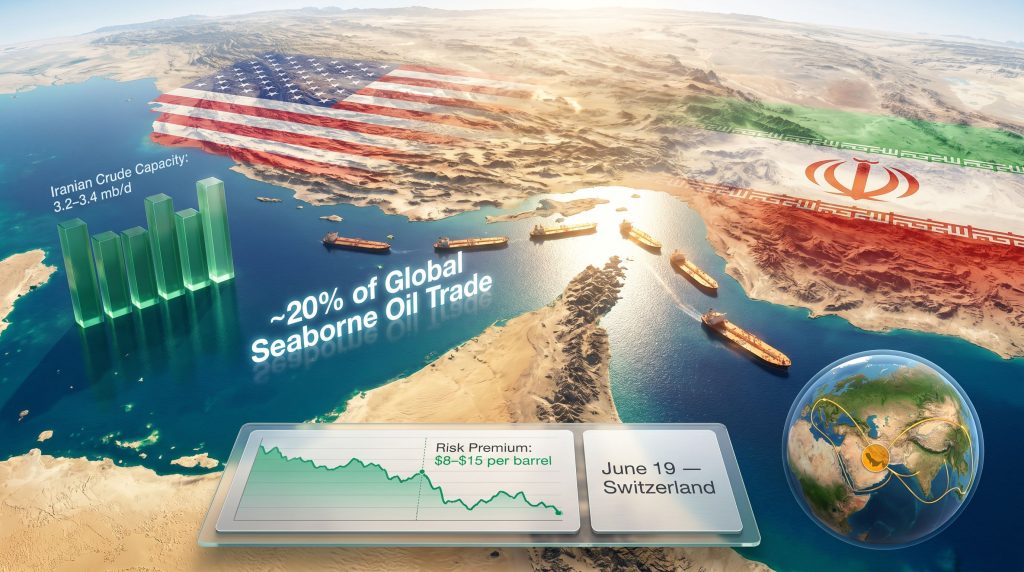
Every barrel of crude oil has a story, and for roughly one in five barrels traded globally, that story passes through a narrow band of water no wider than a modest river crossing at its most navigable point. The Strait of Hormuz, squeezed between the Iranian coastline and the Omani peninsula, has long functioned as the central nervous system of global energy trade. When it operates freely, its role goes largely unnoticed. When it does not, the consequences radiate across every economy on earth within weeks.
The 100-day conflict that erupted between the United States and Iran beginning February 28, 2026, turned that theoretical vulnerability into a lived economic reality for billions of people. What began as a coordinated military operation targeting Iranian strategic infrastructure rapidly escalated into a regional confrontation with direct consequences for maritime security, tanker routing, insurance markets, and crude oil price trends worldwide.
The reported emergence of a de-escalation framework ahead of a scheduled formal signing on June 19, 2026, in Switzerland has shifted market attention from crisis management to recovery modelling. However, the distinction between a durable resolution and a temporary pause remains critically important.
This article contains forward-looking analysis and scenario projections. Energy market forecasts involve significant uncertainty, and readers should not treat any projected price or timeline figures as investment advice.
When big ASX news breaks, our subscribers know first
Understanding What Has Actually Been Agreed
The language surrounding the US-Iran peace agreement and Strait of Hormuz reopening has been characterised by a notable lack of precision across reporting channels. The distinction between a finalised binding treaty and a Memorandum of Understanding carries enormous practical weight for traders, policymakers, and energy planners.
Based on available reporting as of mid-June 2026, the framework rests on four broad pillars:
- Maritime security restoration – including unimpeded passage through the Strait of Hormuz, removal of Iranian naval mines, and cessation of commercial shipping harassment
- Nuclear programme negotiations – the agreement reportedly establishes a pathway for continued talks rather than resolving enrichment, verification, or IAEA access questions outright
- Sanctions relief architecture – reported inclusion of mechanisms for phased sanctions relief, though the sequencing of compliance versus relief remains contested
- Humanitarian and asset provisions – reported elements covering civilian economic relief and possible unfreezing of previously restricted assets
US President Donald Trump announced via Truth Social that the deal with Iran was complete, stating that the Strait of Hormuz would reopen on the day of the formal signing. The announcement carried the tone of a concluded agreement, yet multiple reporting streams characterised the document as a preliminary framework still requiring final US ratification.
Analyst Caution: Until formal signing is confirmed and ratification processes are completed by both parties, the current framework should be treated as a de-escalation structure rather than a binding resolution. Markets that fully price out the geopolitical risk premium ahead of confirmed implementation carry meaningful reversal risk.
The Strait of Hormuz: Why This Chokepoint Is Irreplaceable
Key Metrics of Global Energy Dependency
| Metric | Estimated Figure |
|---|---|
| Share of global seaborne oil trade transiting the strait | ~20-21% |
| Daily crude oil volume at peak pre-conflict flow | ~17-18 million barrels per day |
| Narrowest navigable width of the strait | ~33 kilometres |
| Tankers transiting per day (pre-conflict) | ~20+ laden vessels |
| Additional transit time via Cape of Good Hope rerouting | 10-15 additional days |
| Analyst estimate of conflict-era geopolitical risk premium | $8-$15 per barrel |
The figures above do not fully capture the secondary market effects. War-risk insurance premiums on vessels entering the Persian Gulf during peak conflict intensity escalated sharply, adding a structural cost layer to every cargo regardless of origin. Freight rates for Very Large Crude Carriers (VLCCs) rerouted around southern Africa incorporated both the additional fuel burn and the extended vessel deployment time, compressing refinery margins at destination ports.
Why Pipeline Bypasses Cannot Fill the Gap
A frequently misunderstood aspect of Hormuz dependency is the assumption that existing pipeline infrastructure could absorb a prolonged closure. The reality is more constrained:
- The Iraq-Turkey pipeline (Kirkuk-Ceyhan) has operated well below its design capacity for years due to political and technical disruptions
- Saudi Arabia's East-West Pipeline (Petroline) has a theoretical capacity of approximately 5 million barrels per day but has not been operationally tested at full throughput in recent years
- The UAE's Abu Dhabi Crude Oil Pipeline has an export capacity of roughly 1.5 million barrels per day to the port of Fujairah, bypassing Hormuz entirely
- Combined bypass capacity across all available infrastructure falls significantly short of the 17-18 million barrels per day that transited Hormuz at pre-conflict levels
This structural gap explains why even a partial or intermittent closure generates disproportionate price impacts. The market cannot efficiently reroute; it can only absorb the shortage or draw down reserves.
How Oil Markets Will Respond to Reopening
The Unwinding of the Risk Premium
Analyst estimates have placed the geopolitical risk premium embedded in Brent crude and WTI benchmarks during peak conflict intensity at between $8 and $15 per barrel above pre-conflict baseline pricing. The reopening of the strait, if formally confirmed, would be expected to initiate a rapid unwinding of this premium. Furthermore, the speed and completeness of that adjustment depends on several factors:
- Confirmation of formal signing on June 19 versus a further delay
- Evidence of Iranian compliance with mine clearance and cessation of shipping interference
- OPEC+ production response – member states will need to decide whether to maintain existing output discipline or adjust quotas to reflect the changed supply environment, a decision closely tied to OPEC's market influence over global benchmarks
- Speed of Iranian export normalisation, which is constrained by infrastructure assessment requirements, tanker fleet repositioning, and buyer re-engagement timelines
Iranian Crude Re-entering the Market
Iran's pre-conflict production capacity sat at approximately 3.2 to 3.4 million barrels per day. During the conflict and blockade period, a substantial portion of this capacity was either shut in or unable to reach export markets. The pathway back to full production involves more complexity than simply reopening a valve:
- Subsurface reservoir management during shut-in periods can create well integrity challenges requiring careful restart procedures
- Storage infrastructure that accumulated crude during the export embargo will need to be systematically cleared
- Tanker fleet operators, many of whom rerouted vessels to avoid war-risk exposure, will need to reposition assets
- Key demand centres including Chinese and Indian refiners will need to re-engage procurement channels that were disrupted during the conflict
A realistic timeline for Iranian crude exports to return toward pre-conflict volumes is estimated at 6 to 12 months post-agreement, with the first meaningful volume increases potentially visible within 60 to 90 days of a confirmed Hormuz reopening.
India's Particular Vulnerability and What Relief Looks Like
The Scale of India's Gulf Dependency
No major importing economy sits more directly in the blast radius of Hormuz disruption than India. Approximately 60 to 65 percent of India's crude oil imports originate from Gulf region suppliers, making the Persian Gulf not merely a preferred sourcing region but a structural necessity for Indian refinery operations.
The economic transmission mechanism from Hormuz closure to Indian household budgets operated with brutal efficiency during the conflict period:
- LPG, petrol, and diesel prices recorded significant increases as global crude benchmarks rose
- Transportation costs escalated, pushing up freight charges across the logistics sector
- Food service and hospitality businesses faced compounding cost pressures from both fuel and supply chain disruptions
- Manufacturing input costs rose as energy and freight components of production expanded
India's Diplomatic Response
Prime Minister Narendra Modi formally welcomed the US-Iran understanding during a diplomatic visit to Bratislava, Slovakia, emphasising India's interest in the restoration of regional stability, freedom of navigation, and unimpeded commercial shipping. India's welcome of the framework reflects not just immediate economic self-interest but a broader strategic concern about the reliability of Persian Gulf supply lanes that underpin the country's industrial economy.
India occupies a distinctive position in this geopolitical moment. It maintains significant commercial and diaspora ties across the Gulf region while simultaneously being one of the world's fastest-growing crude import markets. Consequently, the reopening of Hormuz shipping lanes represents immediate relief on multiple economic vectors simultaneously.
Scenario Modelling: Three Possible Trajectories
How Each Path Plays Out for Energy Markets
| Scenario | Key Conditions | Oil Price Trajectory | Shipping Impact |
|---|---|---|---|
| A: Full Implementation | Formal signing June 19; Iranian compliance confirmed | Significant risk premium unwind; prices retrace $8-$15/bbl | Insurance normalises; VLCC routing reverts |
| B: Partial Implementation | Signing proceeds; compliance disputes emerge | Partial price recovery; residual uncertainty discount | Elevated war-risk premiums persist |
| C: Deal Collapse | Ratification fails or triggering incident occurs | Prices spike to new cycle highs | SPR drawdowns; OPEC+ pressure mounts |
Scenario B deserves particular attention from analysts because it represents the most historically probable outcome from US-Iran diplomatic cycles. The oil price volatility generated by such cycles has historically demonstrated that even formally ratified, multilaterally endorsed agreements can unravel under domestic political pressure. The current framework, reportedly structured as a 60-day MOU rather than an immediately binding treaty, carries an elevated risk of a frozen conflict dynamic where formal hostilities cease but strategic uncertainty continues to suppress normal trade and investment flows.
The next major ASX story will hit our subscribers first
The Historical Weight of US-Iran Diplomacy
Why Previous De-escalation Cycles Matter
The 2015 JCPOA stands as the most instructive precedent. That agreement successfully capped Iranian uranium enrichment, provided for enhanced IAEA inspection access, and unlocked a phased sanctions relief programme. Iranian crude exports subsequently increased meaningfully as buyers who had reduced purchases during the sanctions period re-engaged. The 2018 US withdrawal demonstrated, however, that the durability of such frameworks is hostage to domestic political continuity in ways that purely bilateral military agreements are not.
The 2019 Gulf of Oman tanker incidents provided a more granular lesson in escalation-de-escalation dynamics. Attacks on commercial shipping near Hormuz in that period generated sharp short-term oil price spikes that partially retraced as diplomatic channels remained open. The current conflict is substantively more severe in both military scope and economic impact, suggesting that the recovery trajectory will be correspondingly more extended.
Long-Term Structural Implications for Energy Security
The conflict has accelerated a pre-existing conversation about single-chokepoint dependency in global oil architecture. In addition, several structural shifts are likely to gain momentum regardless of how the current framework resolves:
- Strategic Petroleum Reserve adequacy is under review across major importing nations, with the conflict period exposing gaps between theoretical reserve levels and practical drawdown capacity
- Pipeline bypass investment is likely to attract renewed interest, though the capital requirements and political complexity of new infrastructure mean meaningful additional capacity is years away
- Alternative supplier diversification among major importers, including India, may accelerate as procurement teams reassess concentration risk in Gulf sourcing
- Energy transition timelines could be influenced in both directions — higher sustained energy costs may accelerate the investment case for domestic renewables, and energy transition pressures may simultaneously create fiscal constraints that slow capital deployment
Furthermore, OPEC demand forecasts will likely require significant revision as Iranian supply normalisation intersects with shifting global consumption patterns in the post-conflict period.
Key Structural Insight: The conflict has effectively served as a stress test of the global energy system's chokepoint vulnerability. Even if the US-Iran peace agreement and Strait of Hormuz reopening proceed as scheduled, the memory of a 100-day supply disruption will reshape procurement strategy, reserve policy, and infrastructure investment planning for a decade or more.
Frequently Asked Questions
What is the current status of the US-Iran peace agreement?
As of mid-June 2026, a de-escalation framework has been acknowledged by both parties, with formal signing reported as scheduled for June 19 in Switzerland. However, some reporting characterises the document as a Memorandum of Understanding pending final US ratification rather than an immediately binding treaty. The distinction matters significantly for how markets should price residual geopolitical risk.
When Will the Strait of Hormuz Reopen?
US President Trump stated that the strait would reopen on the day of formal agreement signing. Reported preconditions include Iranian removal of naval mines and verifiable cessation of interference with commercial shipping. Whether these preconditions can be confirmed in the timeframe claimed remains to be verified.
How Large Is the Conflict-Era Oil Price Risk Premium?
Analysts have estimated the geopolitical risk premium embedded in global crude benchmarks during peak conflict intensity at approximately $8 to $15 per barrel above pre-conflict baseline levels. A confirmed reopening would be expected to progressively unwind this premium, though the speed of adjustment depends on compliance verification and Iranian export normalisation timelines.
What Remains Unresolved in the Nuclear Dimension?
The agreement reportedly establishes a framework for continued talks on Iran's nuclear enrichment programme rather than resolving the issue definitively. Verification mechanisms, specific enrichment caps, and International Atomic Energy Agency access protocols are understood to remain subjects for subsequent negotiation rounds, representing the most structurally contested element of any durable US-Iran normalisation.
Readers seeking ongoing coverage of West Asian energy geopolitics and downstream price developments can follow reporting at ET EnergyWorld via energy.economictimes.indiatimes.com.
Want to Stay Ahead of the Next Major Market-Moving Discovery?
When geopolitical shocks ripple through energy and commodity markets, the investors best positioned are those already holding stakes in significant resource discoveries — Discovery Alert's proprietary Discovery IQ model delivers real-time ASX mineral discovery alerts, turning complex geological data into actionable insights for both short-term traders and long-term investors. Explore historic discoveries and their exceptional market returns to understand the opportunity, then begin your 14-day free trial to ensure you're positioned ahead of the market when the next major discovery is announced.