June 14, 2026
The Processing Bottleneck That Determines Who Wins the Clean Energy Race
The global transition to clean energy, electric vehicles, and advanced digital infrastructure has exposed a structural vulnerability that financial markets and policymakers are only beginning to price in properly. It is not a shortage of raw materials in the ground. It is a shortage of the industrial capacity to transform those materials into usable inputs. The ADB critical minerals financing facility has emerged as a direct response to this gap, targeting the stage of the value chain where the greatest economic and geopolitical leverage is concentrated. The nation that refines, processes, and manufactures holds the leverage. The nation that merely digs holds the risk.
This distinction sits at the heart of why the Asian Development Bank's Critical Minerals-to-Manufacturing Financing Partnership Facility (CMM FPF) represents one of the more strategically significant multilateral financing instruments launched in recent years. Announced on May 3, 2026, in Samarkand, Uzbekistan, the facility targets the exact stage of the value chain where leverage is concentrated: the transformation of raw mineral wealth into refined, processed, and manufactured outputs.
When big ASX news breaks, our subscribers know first
Why Processing Power Outranks Reserve Ownership
Conventional analysis of critical minerals tends to focus on who holds the largest deposits. This framing misses the more consequential variable. According to reporting from the South China Morning Post, China holds the world's largest reserves of more than a dozen strategically essential minerals, including rare earth supply chains that are indispensable for advanced weapons systems, wind turbines, EV motors, and high-technology manufacturing. Yet it is China's near-total control over the processing of these materials globally that represents its deeper and more durable strategic advantage.
Processing is the chokepoint. Every tonne of ore extracted anywhere in the world must pass through a refining and transformation stage before it can enter a battery cell, a permanent magnet, or a semiconductor package. When a single nation controls that transformation stage at scale, upstream resource diversity becomes strategically hollow. Multiple mining jurisdictions feeding into a single processing monopoly do not constitute a diversified supply chain. They constitute a funnel.
A raw materials exporter captures the smallest share of the value its resources ultimately generate. A processing and manufacturing hub captures the multiplier. This is the economic logic that the CMM FPF is designed to operationalise across Asia-Pacific.
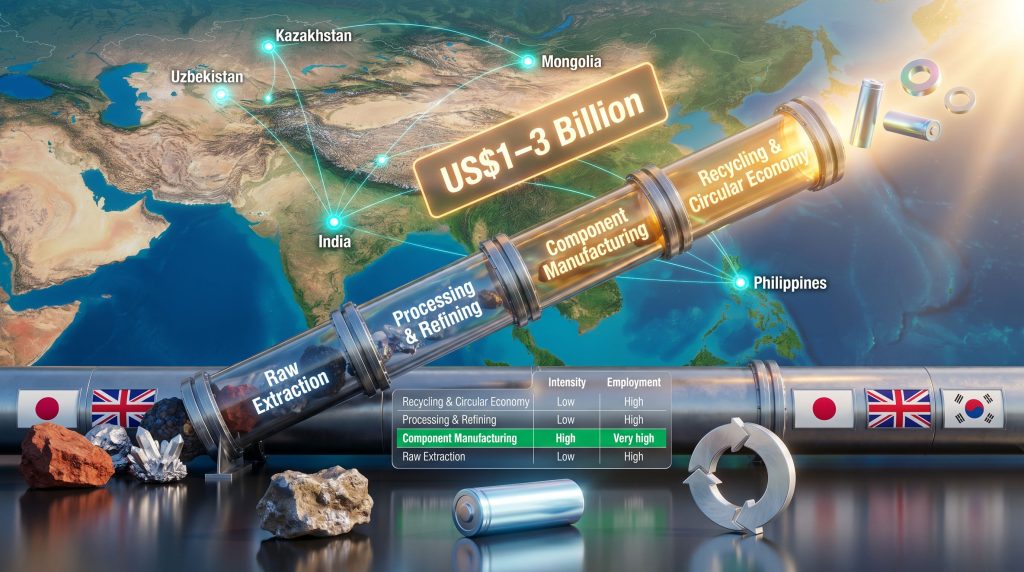
The value-chain arithmetic is stark. Consider the differential between what a nation earns per tonne of unprocessed ore versus the same material after refining, component fabrication, and integration into an advanced product. Furthermore, the further up the chain, the greater the margin, the higher the employment intensity, and the stronger the industrial capability base that accumulates over time.
| Value Chain Stage | Relative Economic Value | Employment Intensity | Current Asia-Pacific Participation |
|---|---|---|---|
| Raw Extraction | Low | Moderate | High |
| Processing and Refining | Medium to High | High | Low |
| Component Manufacturing | High | Very High | Very Low |
| Recycling and Circular Economy | High and Growing | High | Nascent |
Structural Architecture of the CMM FPF
The facility operates through two distinct financing windows, each targeting a different phase of the investment risk curve. Understanding this dual-window structure is essential to appreciating how the ADB critical minerals financing facility aims to unlock private capital at scale.
Window 1: The Grant Mechanism
Early-stage project development is where private capital is most reluctant to commit. Feasibility uncertainty, regulatory complexity, environmental assessment requirements, and the absence of bankable project documentation create a barrier that conventional commercial finance will not cross without risk mitigation. The grant window addresses this directly by funding:
- Feasibility studies and pre-investment technical analysis
- Environmental and social impact assessments
- Technical assistance programmes for government agencies and project developers
- Regional knowledge-sharing platforms and capacity-building initiatives
- Geological data programmes that establish the foundational resource intelligence required to attract downstream investment
Japan has committed US$20 million to the grant window, while the United Kingdom has pledged US$1.6 million. These are not large sums in absolute terms. Their strategic function, however, is disproportionate to their size: grant capital de-risks the earliest and most uncertain project phase, creating a pipeline of documented, assessed, and technically validated projects that subsequent capital can scale.
Window 2: The Catalytic Finance Mechanism
Once projects have cleared the feasibility and assessment threshold, the catalytic window provides large-scale cofinancing and risk-sharing instruments designed to attract private sector capital. Korea Eximbank and Korea Trade Insurance Corporation (K-SURE) have each signed memoranda of understanding representing US$500 million in catalytic financing capacity. Combined with the grant window commitments, the total coordinated investment potential of the facility reaches an estimated US$1 to US$3 billion.
| Partner | Commitment Type | Amount |
|---|---|---|
| Japan | Grant Window | US$20 million |
| United Kingdom | Grant Window | US$1.6 million |
| Korea Eximbank | Catalytic Finance MOU | US$500 million |
| Korea Trade Insurance Corp (K-SURE) | Catalytic Finance MOU | US$500 million |
| Total Coordinated Potential | Blended | US$1 to US$3 billion |
The asymmetry embedded in this model is its most important feature. Small concessional grants create large bankable pipelines. Bankable pipelines attract commercial and quasi-commercial capital at multiples of the original grant. This is the fundamental logic of blended finance, and it addresses the persistent "valley of death" problem in development finance: the gap between a compelling project concept and an investable asset that commercial capital will actually fund.
The dual-window structure does not simply provide capital. It manufactures the conditions under which private capital becomes willing to deploy.
The ADB's 2025 Critical Minerals Strategic Framework
The CMM FPF was not designed in isolation. It operates within the ADB's broader 2025 Sustainable Critical Minerals Strategy, which established the institutional framework for the bank's engagement across the full value chain. That strategy introduced an accompanying Critical Minerals Database, a transparency and due diligence tool designed to improve data availability, reduce information asymmetries, and improve investment decision-making across the region.
Environmental, social, and governance safeguards are embedded requirements across all projects supported by the facility, not optional overlays. This matters for investor confidence and for the long-term social licence that processing and manufacturing investments require in host communities. In addition, the critical raw materials transition agenda has intensified the urgency of establishing robust governance frameworks across the region.
Active Pipeline: Where the Facility Is Already Deploying
The strategic intent of the CMM FPF is already translating into specific country-level initiatives. The geographic diversity of the pipeline reflects the breadth of Asia-Pacific's mineral endowments and the range of value-chain stages where intervention is needed.
| Country | Project Focus | Strategic Significance |
|---|---|---|
| India | Battery production and recycling | EV supply chain integration |
| Mongolia | Geological data mapping | Resource bankability and discovery |
| Uzbekistan | AI-enabled mineral production and circular economy | Technology-led value-chain ascent |
| Kazakhstan | Policy reform and minerals strategy | Regulatory enabling environment |
| Philippines | Critical minerals strategy development | Archipelagic resource mobilisation |
Why Geological Data Is Investment Infrastructure
Mongolia's geological mapping initiative deserves particular analytical attention because it illustrates a principle that is often overlooked in discussions of critical minerals investment. Before processing facilities can be financed, before manufacturing hubs can be planned, the resource base must be credibly mapped, characterised, and documented to a standard that international investors can rely on.
Geological data is not merely scientific information. It is the foundational layer of investment bankability. Without high-quality, independently verifiable geological surveys, resource estimates carry exploration-stage uncertainty that institutional investors cannot price with confidence. Mongolia's initiative, funded through the grant window, creates the data infrastructure that makes all subsequent investment stages viable.
This sequencing insight has broader applicability across developing Asia-Pacific. Many resource-rich nations have abundant mineral endowments that remain functionally invisible to international capital markets because the underlying geological documentation does not meet the standards required for bankable project development. Consequently, grant-funded geological programmes are not merely scientific expenditures. They are investment catalysts.
Uzbekistan's Technology Leapfrogging Model
The use of AI-enabled production systems in Uzbekistan's critical minerals initiatives represents a qualitatively different approach to value-chain ascent. Rather than replicating the industrial development pathways of mature mining economies, Uzbekistan's model deploys contemporary technology to compress the development timeline and build processing capability with lower capital intensity than conventional approaches would require.
This technology leapfrogging dynamic has historical precedent in telecommunications, where developing nations bypassed fixed-line infrastructure entirely to adopt mobile and digital systems. The same logic may apply to critical minerals processing: nations without legacy infrastructure may be better positioned than incumbents to adopt the most efficient contemporary processing technologies.
The Geopolitical Demand Signal Behind the Facility
The CMM FPF did not emerge from abstract development finance theory. It emerged from a specific and accelerating geopolitical reality: the recognition across multiple major economies that concentration of critical processing capacity in a single jurisdiction represents a structural supply chain vulnerability. This recognition has driven a marked critical minerals demand surge across the Asia-Pacific region and beyond.
As the South China Morning Post reported, global efforts to develop alternative sources of critical minerals have intensified as China has increasingly leveraged its sector dominance for strategic purposes. The facility should be understood within this context, not as a confrontational initiative, but as a structural diversification response to a supply chain architecture that major economies have assessed as fragile.
The ADB CMM FPF is not the only multilateral response to this challenge, though it is notable for its focus on Asia-Pacific processing and manufacturing capability specifically.
| Initiative | Lead Institution | Focus Area | Scale |
|---|---|---|---|
| ADB CMM FPF | Asian Development Bank | Asia-Pacific processing and manufacturing | US$1 to US$3 billion potential |
| Minerals Security Partnership | US-led multilateral | Global supply chain diversification | Multi-billion |
| Critical Raw Materials Act | European Union | European processing capacity | Regulatory and investment combined |
| Quad Critical Minerals Initiative | US, Australia, India, Japan | Indo-Pacific supply chain resilience | Strategic MOU level |
ADB President Masato Kanda articulated the facility's economic sovereignty rationale with precision: the Asia-Pacific region should not be confined to the role of raw materials exporter. The jobs, technology, and industrial value that flow from critical minerals and energy security processing and manufacturing should accrue to the economies where those minerals originate.
This is not a peripheral observation. It represents a fundamental reframing of the development finance mandate: from infrastructure provider to active architect of industrial capability.
The next major ASX story will hit our subscribers first
Long-Term Scenarios and Investment Implications
The CMM FPF's ultimate impact will depend on whether the catalytic finance window can crowd in private capital at scale. Three structural scenarios define the range of outcomes.
| Scenario | Conditions | Outcome for Asia-Pacific |
|---|---|---|
| Accelerated Ascent | CMM FPF fully subscribed; private capital mobilised at US$3 billion scale | Regional processing hubs emerge; substantial value-chain capture |
| Partial Progress | Grant window deployed; catalytic window underperforms targets | Incremental capability gains; extraction dependency persists |
| Status Quo Persistence | Geopolitical normalisation reduces urgency; funding stalls | Asia-Pacific remains raw materials exporter; value continues to be captured offshore |
The downstream demand environment provides a structural tailwind for the accelerated scenario. Battery supply chains for electric vehicles and grid-scale energy storage, rare earth permanent magnets for wind turbines and EV motors, and semiconductor-adjacent mineral applications for digital infrastructure collectively represent an expanding and durable demand base for exactly the processing and manufacturing capability the CMM FPF aims to build.
Recycling and circular economy integration adds a further dimension. As primary extraction faces increasing environmental scrutiny and resource depletion concerns over longer timeframes, secondary processing of end-of-life products becomes progressively more economically and strategically significant. Nations that build recycling capability now are positioning for the circular economy phase of the clean energy transition, not just the primary extraction and processing phase.
FAQ: ADB Critical Minerals Financing Facility
What is the ADB Critical Minerals-to-Manufacturing Financing Partnership Facility?
The CMM FPF is a dual-window financing mechanism launched by the Asian Development Bank on May 3, 2026, in Samarkand, Uzbekistan. It is designed to help Asia-Pacific nations advance from raw mineral extraction into processing, manufacturing, and recycling, capturing greater economic value from their mineral endowments.
How much funding has been committed to the ADB critical minerals financing facility?
Japan has committed US$20 million and the United Kingdom US$1.6 million to the grant window. Korea Eximbank and Korea Trade Insurance Corporation have each signed memoranda of understanding covering US$500 million in catalytic financing. Total coordinated investment potential is estimated at US$1 to US$3 billion.
Which countries are included in the facility's active pipeline?
Active and supported initiatives are underway across India, Mongolia, Uzbekistan, Kazakhstan, and the Philippines, with each project targeting a specific stage of the critical minerals value chain.
Why does China's processing dominance matter for Asia-Pacific strategy?
China holds the world's largest reserves of more than a dozen strategically essential minerals and maintains near-monopoly control over their global processing. Because processing is the stage at which raw materials become usable industrial inputs, control over this stage represents greater strategic leverage than reserve ownership alone. The critical raw materials facility model pursued by the European Union offers a parallel precedent, and the CMM FPF builds alternative processing capacity across Asia-Pacific to reduce structural dependency on any single nation's control over critical transformation stages.
What does the grant window fund?
The grant window funds feasibility studies, environmental and social impact assessments, technical assistance programmes, geological data mapping, policy reform support, and regional knowledge-sharing frameworks. These activities de-risk early-stage projects to create a pipeline of bankable assets for subsequent catalytic and private investment.
What is the ADB Critical Minerals Database?
The Critical Minerals Database is a transparency and due diligence tool developed as part of the ADB's 2025 sustainable critical minerals strategy. It is designed to improve data availability and investment decision quality across the Asia-Pacific region. According to reporting from Reuters, the database forms a central pillar of the bank's broader effort to standardise information flows and reduce barriers to investment across the region.
A New Model for Multilateral Industrial Strategy
The announcement in Samarkand carries symbolic weight that extends beyond the facility's financial architecture. Uzbekistan is a Central Asian crossroads nation, historically positioned at the intersection of major trade and resource corridors. Its selection as the launch venue signals that the geography of the global critical minerals competition is broader and more complex than conventional Western-centric framings suggest.
More substantively, the CMM FPF represents a structural innovation in development finance. By using concessional grant capital to manufacture bankable project pipelines, and catalytic instruments to attract commercial capital at multiples of the original grant, the facility addresses the most persistent failure point in the traditional development finance model: the inability to bridge the gap between project concept and investable asset.
The broader signal is that multilateral development banks are repositioning themselves. The ADB is not functioning here merely as a lender of record for physical infrastructure. It is functioning as an architect of industrial capability, using financial instruments to reshape the economic geography of an entire value chain.
For resource-rich developing economies across Asia-Pacific, the ADB critical minerals financing facility offers not just capital but the institutional scaffolding to transform natural endowments into durable industrial capability. The minerals are already in the ground. The question is who captures the value when they come out of it.
This article is intended for informational purposes only and does not constitute financial advice. References to investment potential figures, scenario projections, and strategic outcomes involve forward-looking assessments subject to significant uncertainty. Readers should conduct independent research before making any investment decisions.
Want to Know Which ASX Mineral Discoveries Could Benefit From the Clean Energy Supply Chain Race?
Discovery Alert's proprietary Discovery IQ model delivers real-time alerts the moment significant ASX mineral discoveries are announced, transforming complex geological data into clear, actionable investment insights across more than 30 commodities. Explore why early positioning in major discoveries has historically generated substantial returns by visiting Discovery Alert's dedicated discoveries page, and begin your 14-day free trial today to ensure you're never behind the market when the next significant find is announced.