June 14, 2026
The Quiet Power of Commodity-Linked Dividends: Why Mining Income Behaves Differently
Most passive income conversations on the ASX begin and end with the major banks. Commonwealth Bank, NAB, ANZ — these names dominate retirement portfolios precisely because their dividends feel predictable, almost clock-like in their reliability. However, there is a different kind of income stock hiding in plain sight on the Australian exchange, one that operates under an entirely different set of rules and rewards investors who understand those rules well.
Resource-sector dividends are not structured like bank dividends. They do not follow a progressive schedule tied to loan book growth or net interest margins. Instead, they breathe with commodity cycles — expanding when iron ore trades at elevation and contracting when steel demand softens. For investors who grasp this dynamic, BHP Group Ltd (ASX: BHP) offers something genuinely compelling: a grossed-up yield that, in the right conditions, competes seriously with the most popular income plays on the market.
Understanding BHP shares passive income in 2027 requires more than simply reading a dividend forecast. It requires understanding how the payout is constructed, what variables can shift it materially, and how the uniquely Australian mechanism of franking credits transforms the effective return for domestic shareholders.
When big ASX news breaks, our subscribers know first
How BHP's Dividend Architecture Actually Works
The Variable Payout Policy and Why Income Predictability Is Limited
Unlike many ASX dividend stalwarts that commit to progressive payout growth regardless of earnings conditions, BHP operates a variable dividend policy. This means the board sets each half-year payout based on underlying earnings and free cash flow generation at that point in time, rather than anchoring to a predetermined growth trajectory.
The practical consequence for income investors is meaningful: BHP's dividend per share can rise sharply in a strong commodity cycle and fall with equal speed when prices retreat. Over the past decade, BHP's annual dividend has ranged from very modest levels during periods of commodity weakness to extraordinarily generous payouts during supercycle conditions. Furthermore, commodity cycle dynamics mean that investors anchoring to a single year's payout as a permanent baseline are likely to be disappointed or pleasantly surprised — depending on which direction commodity markets move.
The USD Earnings, AUD Dividend Translation Problem
One of the most underappreciated variables in any BHP income calculation is currency translation. BHP reports its financial results and declares dividends in US dollars, reflecting the global nature of its commodity revenues. However, Australian shareholders receive their payments converted into Australian dollars.
This creates a hidden lever in the income equation. If the Australian dollar strengthens materially against the US dollar between dividend declaration and payment, the AUD-equivalent income shrinks — even if the underlying USD dividend is unchanged. Conversely, a weaker Australian dollar amplifies the AUD payout beyond what the USD figure alone would suggest.
"Many income calculators and broker forecasts present BHP's projected dividends in AUD without clearly flagging that exchange rate assumptions are embedded in that conversion. A 5% swing in the AUD/USD rate can shift the final income by a comparable margin, which is material when the income itself is part of a retirement budget."
BHP pays dividends on a semi-annual basis, with an interim dividend typically declared alongside the half-year results (usually around February) and a final dividend accompanying the full-year result (typically around August or September). Australian shareholders generally receive cash payments in the months following each declaration, meaning FY2027 income will arrive in two instalments across the calendar year.
What FY2027 Dividend Forecasts Currently Show
Analyst Projections: A Table of Key Estimates
Consensus forecasts for BHP's FY2027 dividend vary depending on the assumptions each analyst applies to iron ore pricing, copper volume growth, and the AUD/USD exchange rate. The table below captures the key projections available from publicly reported sources.
| Forecast Source | Est. FY27 Dividend Per Share (AUD) | Franking Status | Cash Yield (Approx.) | Grossed-Up Yield (Approx.) |
|---|---|---|---|---|
| CommSec Projection | A$2.113 | Fully Franked | ~3.5% | ~5.0% |
| Morgan Stanley Estimate | ~A$1.70 | Fully Franked | Varies with price | Varies with price |
| Broader Market Consensus | ~A$1.80 | Fully Franked | Varies with price | Varies with price |
The spread between the CommSec projection and the broader analyst consensus reflects genuine uncertainty about where commodity prices will sit across BHP's FY2027 reporting period. Iron ore price trends in particular remain subject to wide forecast dispersion, with outcomes heavily tied to Chinese steel production levels and infrastructure spending trajectories.
Investors should treat this range as a probability distribution rather than anchoring to any single figure. The CommSec figure of A$2.113 sits at the more optimistic end, while the Morgan Stanley estimate near A$1.70 implies a more conservative commodity price environment. Neither is definitively correct at this stage. For further context, BHP's FY2027 dividend forecast has been set at $1.80 per share by some market analysts, reflecting this mid-range estimate.
What the FY2026 Half-Year Result Revealed
The momentum heading into FY2027 forecasts was established during BHP's FY26 interim result, which delivered a net profit increase of approximately 28% to US$5.6 billion. On the back of this earnings uplift, BHP's interim dividend per share rose by approximately 46%, demonstrating just how directly earnings translate into payout capacity under the variable dividend policy.
Iron ore price recovery and improving copper contribution both supported this outcome. Whether this earnings trajectory sustains into FY2027 will depend on several factors examined in the risk section below. The key takeaway is that BHP's dividend capacity is highly geared to commodity prices — strong results can produce outsized payout growth, but the relationship works in reverse just as readily.
Passive Income Modelling: What $8,000 in BHP Shares Could Generate in 2027
Step-by-Step Calculation Using the CommSec Consensus Forecast
Methodology Disclaimer: The following calculations use publicly available forecast data and are illustrative only. Actual dividends will depend on BHP's FY2027 earnings outcomes, board decisions, and prevailing AUD/USD exchange rates at the time of payment. This content is general in nature and does not constitute financial advice.
Step 1: Determine Approximate Share Count
At an indicative BHP share price of approximately A$60.15, an investment of $8,000 would purchase approximately 133 BHP shares, with a small residual cash balance remaining.
Step 2: Apply the Forecast Dividend
Using the CommSec FY2027 projection of A$2.113 per share:
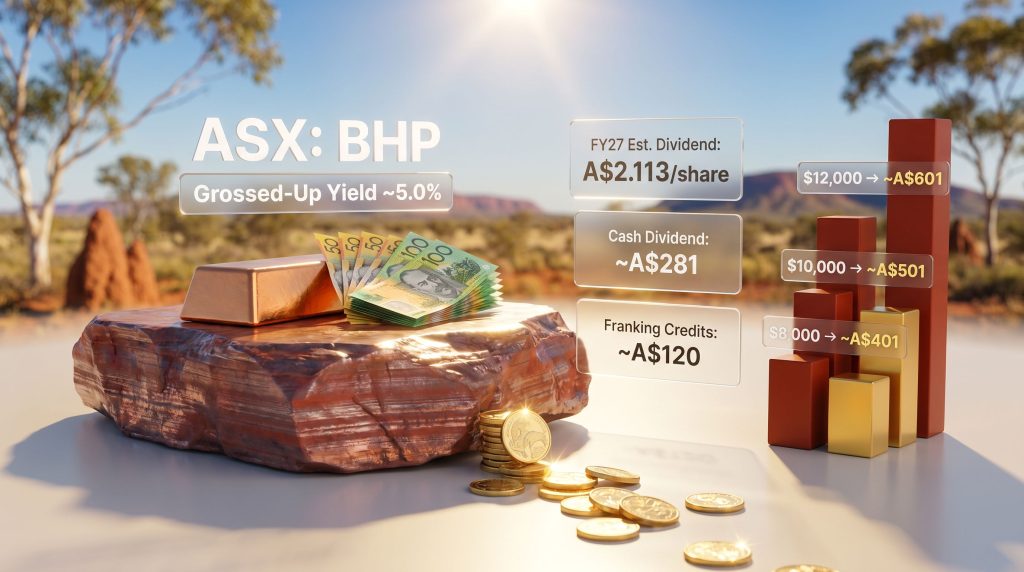
- 133 shares × A$2.113 = approximately A$281.03 in cash dividends
Step 3: Calculate Franking Credit Value
BHP's dividends are currently paid as fully franked, carrying a 30% corporate tax credit attached to each payment. For eligible Australian shareholders:
- Estimated franking credit value: approximately A$120.44
Step 4: Calculate Grossed-Up Total and Effective Yield
- Total grossed-up value: approximately A$401.47
- Cash dividend yield (excluding franking): approximately 3.5%
- Grossed-up effective yield (including franking): approximately 5.0%
Scaling the Income Across Different Portfolio Sizes
The table below scales the same methodology across a range of investment amounts, using the CommSec A$2.113 per share forecast and a 30% franking credit assumption.
| Investment Amount | Approx. Shares | Est. Cash Dividend (FY27) | Est. Franking Credits | Grossed-Up Total |
|---|---|---|---|---|
| $4,000 | ~66 | ~A$139.46 | ~A$59.77 | ~A$199.23 |
| $8,000 | ~133 | ~A$281.03 | ~A$120.44 | ~A$401.47 |
| $15,000 | ~249 | ~A$526.14 | ~A$225.49 | ~A$751.63 |
| $25,000 | ~415 | ~A$876.90 | ~A$375.81 | ~A$1,252.71 |
| $50,000 | ~831 | ~A$1,756.20 | ~A$752.66 | ~A$2,508.86 |
Important Caveat: These projections are sensitive to commodity price movements, currency shifts, and BHP's capital allocation decisions. Investors using lower analyst estimates (such as Morgan Stanley's ~A$1.70 figure) would see proportionally reduced income outcomes across all portfolio sizes.
Is BHP's Yield Competitive Within the ASX Income Universe?
Comparing BHP Against Sector Peers and Non-Mining Alternatives
| Company | ASX Code | Est. FY27 Yield (Ex-Franking) | Franking Status | Income Consistency |
|---|---|---|---|---|
| BHP Group | BHP | ~3.5% | Fully Franked | Moderate (commodity-linked) |
| Rio Tinto | RIO | Comparable range | Fully Franked | Moderate (commodity-linked) |
| Fortescue | FMG | Historically higher | Fully Franked | Higher earnings variability |
| Major ASX Banks | CBA/NAB/ANZ | Typically 3.5%–5.5% | Fully/Partially Franked | More consistent |
Fortescue has historically offered a higher headline dividend yield than BHP, but this comes with substantially greater earnings variability given its near-total exposure to iron ore pricing and its less diversified commodity mix. BHP's strategic pivot toward growing copper revenue provides a partial natural hedge — copper demand is structurally supported by electrification megatrends, while iron ore remains more cyclically exposed to Chinese construction activity.
When compared to the major ASX banks, BHP's grossed-up yield of approximately 5% sits within a competitive range, but the income profile is less predictable. Bank dividends tend to be stickier — boards are often reluctant to cut them even during earnings pressure — whereas BHP's variable policy means the board will cut before compromising the balance sheet. This distinction matters enormously for investors relying on consistent income streams.
The Franking Credit Advantage: A Uniquely Australian Consideration
Fully franked dividends carry a tax credit equal to the corporate tax already paid on the underlying earnings. For Australian tax residents, this credit can be applied to reduce personal income tax liabilities, or in certain circumstances, received as a cash refund.
The beneficiaries of this mechanism vary considerably by tax bracket:
- SMSF members in pension phase (0% tax rate): Receive the full franking credit as a refund, making the grossed-up yield the genuine all-in return
- Investors in the 15% tax bracket (accumulation phase super): Benefit materially from the 30% credit, which effectively subsidises their tax obligation
- Investors in higher marginal tax brackets (45%): The franking credit offsets tax owed but does not generate a refund, reducing but not eliminating its value
This layered tax dynamic means that the same BHP dividend has different effective values depending on who holds the shares and in what structure. For retirees drawing income through an SMSF pension account, the grossed-up yield is the real yield. For high-income earners holding BHP in a personal name, the after-tax yield calculation is more complex and should be modelled individually.
What Analysts Currently Think About BHP's Valuation
A Predominantly Neutral Broker Consensus
Across approximately 15 recent analyst ratings on BHP, the overwhelming majority sit at hold, with only a single buy rating recorded in the most recent round of assessments reviewed via CMC Invest data. The consensus price target derived from those ratings sits at approximately A$57.43, which at the time of writing implies some downside from current trading levels.
BHP's 52-week trading range has spanned from below A$36 to above A$64, highlighting the volatility inherent in commodity-exposed equities. The analyst community appears to be pricing in a period of consolidation rather than renewed upside momentum, at least over the near-term horizon.
What a Neutral Rating Means for Income-First Investors
The interpretation of a hold rating differs substantially between a growth-oriented investor and an income-focused one. For a growth investor, a neutral consensus with a price target below the current trading price is a clear signal to look elsewhere. For an income investor, however, the picture is more nuanced.
If capital appreciation expectations are muted, the dividend becomes the primary return driver. In this environment, a grossed-up yield of approximately 5% from a globally significant mining company represents a legitimate income position — particularly within a tax-advantaged superannuation structure where the franking refund mechanism amplifies the effective return.
"The distinction between evaluating BHP as a capital growth stock versus an income vehicle is not merely semantic. Investors who understand they are buying a dividend stream rather than a re-rating story will calibrate their expectations more accurately and be less likely to exit at precisely the wrong point in a commodity cycle."
The next major ASX story will hit our subscribers first
Key Risk Factors That Could Materially Alter the FY2027 Payout
Iron Ore: Still the Dominant Earnings Variable
Despite BHP's meaningful diversification into copper and potash, iron ore remains the company's single largest earnings contributor. Sustained iron ore prices below approximately US$90 per tonne would compress free cash flow meaningfully and place downward pressure on the dividend. The China steel demand outlook remains the primary variable to monitor, as the property sector has been a significant source of steel demand uncertainty in recent years.
A slower-than-expected recovery in Chinese construction activity, combined with rising domestic Chinese iron ore production, represents the clearest downside scenario for BHP's earnings base heading into FY2027.
Copper's Growing Contribution: A Double-Edged Dynamic
Copper market trends are increasingly material to BHP's earnings mix, and for good reason. Global electrification demands — from electric vehicles to power grid upgrades — create a structurally supportive demand backdrop that is largely independent of the Chinese construction cycle. This is a genuine diversification benefit.
However, copper also introduces its own set of risks:
- Supply disruptions at major South American operations (weather, labour action, or community opposition) can affect production volumes
- Copper pricing is itself subject to speculative positioning and sentiment shifts in futures markets
- BHP's capital expenditure commitments to expand copper capacity, including the Jansen potash project, compete with dividend capacity for available free cash flow
Currency Translation Risk Revisited
A scenario where the Australian dollar strengthens from current levels toward the US$0.70 range or above would reduce the AUD value of BHP's USD-denominated dividends even if the underlying payout in USD terms holds steady. This is not a hypothetical — the AUD/USD rate has oscillated significantly over BHP's recent history, and currency-driven dividend reductions have caught Australian investors off guard before.
Building a Smarter Passive Income Strategy Around BHP
Portfolio Construction: Why Concentration Risk Matters
Single-stock commodity exposure is not a passive income strategy on its own — it is a commodity price bet dressed in dividend clothing. The most effective approach to incorporating BHP shares passive income in 2027 involves treating it as one node within a diversified income portfolio rather than a standalone income solution.
A considered allocation framework might look as follows:
- Core income holdings (lower volatility): Major ASX bank shares, infrastructure trusts, or diversified income ETFs
- Satellite income holdings (higher yield potential, more variability): BHP, Rio Tinto, or other commodity-exposed dividend payers
- Tax-efficient wrappers: Holding fully franked dividend payers within superannuation structures to maximise the franking credit refund mechanism
Dividend Reinvestment vs. Cash Extraction: Two Valid Approaches
BHP offers a Dividend Reinvestment Plan (DRP), allowing shareholders to receive their dividends as additional shares rather than cash. For investors in the accumulation phase, this approach compounds their share count over time without requiring additional capital outlay or brokerage costs.
For investors in or near retirement who require cash income, the DRP is less relevant. In that context, the focus shifts to optimising the after-tax cash yield, which means understanding the franking credit refund mechanism within whichever structure holds the shares.
The long-run compounding effect of DRP participation is material. An investor who reinvested BHP dividends consistently through a full commodity cycle would hold a substantially larger share count at the cycle's peak than one who extracted cash throughout — consequently amplifying the income effect when conditions next favour elevated payouts. You can explore passive income projections for various investment amounts to better understand how different entry points affect long-term returns.
Frequently Asked Questions: BHP Shares and Passive Income in 2027
How much passive income does $8,000 in BHP shares generate in 2027?
Based on the CommSec consensus forecast of approximately A$2.113 per share in annual dividends for FY2027, an $8,000 investment purchasing approximately 133 shares is projected to generate roughly A$281 in cash dividends and approximately A$120 in franking credit value, for a grossed-up total of around A$401. These are projections subject to commodity price and currency risk.
Are BHP dividends fully franked in 2027?
BHP's dividends have historically been paid as fully franked, meaning they carry a 30% corporate tax credit. Eligible Australian shareholders can apply this credit against their tax liability or, in certain circumstances such as pension-phase SMSF accounts, receive it as a cash refund.
When are BHP's FY2027 dividends expected to be paid?
BHP typically distributes dividends twice yearly. The interim dividend is usually paid around March or April following the half-year result announcement, while the final dividend follows the full-year result, generally arriving with shareholders in September or October.
Does BHP's dividend change from year to year?
Yes, and sometimes significantly. BHP's variable dividend policy means each payout is directly linked to earnings performance, which is heavily influenced by prevailing commodity prices. The approximately 46% uplift in the FY26 interim dividend illustrates how responsive the payout can be in either direction.
How do franking credits affect the real value of BHP dividends?
Franking credits increase the effective pre-tax income value of each dividend. For investors in a 0% tax environment (such as an SMSF drawing a pension), the entire franking credit is refunded, making the grossed-up yield of approximately 5% the true effective return rather than the headline cash yield of approximately 3.5%.
Is BHP a good passive income stock for 2027?
BHP offers a competitive grossed-up yield that compares favourably with many ASX income alternatives, particularly within superannuation structures. However, income is not guaranteed and is directly tied to commodity market conditions. Investors seeking highly predictable income may wish to balance BHP exposure with lower-volatility dividend sources.
Calibrating Realistic Expectations for BHP Passive Income in 2027
Summarising the Income Opportunity
The FY2027 passive income picture for BHP shares passive income in 2027 is genuinely compelling in the right context, but demands careful calibration. The key data points worth retaining are:
- CommSec projects FY2027 dividends at approximately A$2.113 per share, representing the more optimistic end of the consensus range
- Alternative analyst estimates from Morgan Stanley and broader market consensus sit closer to the A$1.70 to A$1.80 range per share
- An $8,000 investment is projected to yield approximately A$281 in cash dividends and A$120 in franking credit value under the CommSec scenario
- The grossed-up effective yield of approximately 5% positions BHP competitively within the ASX income landscape, particularly for superannuation investors
The Broader Investment Context
Analyst sentiment is predominantly neutral on BHP's near-term capital appreciation potential, with a consensus price target of approximately A$57.43 suggesting limited upside from current trading levels. For investors entering BHP primarily for income rather than capital growth, this neutral consensus does not automatically disqualify the position. In addition, the dividend becomes the primary return driver in a price-stable environment.
What separates a well-informed BHP income investor from a passive one is the recognition that this yield is conditional. It is conditional on iron ore prices staying above critical thresholds, on copper production meeting volume targets, on the Australian dollar not appreciating aggressively, and on BHP's board prioritising dividend payments over capital expenditure or balance sheet rebuilding.
"BHP's passive income credentials are genuine but not unconditional. Investors who model a range of dividend scenarios across different commodity price assumptions, rather than anchoring to a single consensus figure, will be far better positioned to manage income expectations through what remains an inherently cyclical asset class."
This article is general in nature and does not constitute financial advice. Readers should consider their personal financial circumstances and consult a qualified financial adviser before making investment decisions. Dividend forecasts referenced are sourced from publicly available analyst projections and are subject to change.
Want to Spot the Next Major ASX Mineral Discovery Before the Broader Market Does?
While BHP offers commodity-linked income through its dividend cycle, the most significant wealth-creation moments in the resources sector often come from early-stage mineral discoveries — and Discovery Alert's proprietary Discovery IQ model delivers real-time alerts the moment significant ASX discoveries are announced, turning complex geological data into actionable investment insights. Explore Discovery Alert's dedicated discoveries page to see the historic returns major mineral discoveries have generated, and begin your 14-day free trial to position yourself ahead of the market.