
June 13, 2026
Africa's Mineral Wealth and the Shift Away From Aid-Dependent Budgeting
Across sub-Saharan Africa, a quiet but consequential transformation is underway. Governments that once structured their national budgets around foreign aid disbursements and concessional lending are increasingly turning to their own resource endowments as fiscal anchors. This shift is not uniform, nor is it without risk, but it represents one of the more meaningful structural changes in African public finance over the past decade. Burundi, long considered one of the continent's most aid-dependent economies, is now offering an instructive case study in how mineral revenue can begin to reshape the architecture of a national budget.
The question worth examining is not simply whether Burundi government spending helped by mining is a positive headline. The more important issue is whether this represents a durable structural shift or a commodity-cycle windfall that could reverse just as quickly as it arrived.
When big ASX news breaks, our subscribers know first
Breaking Down Burundi's 2026–27 National Budget
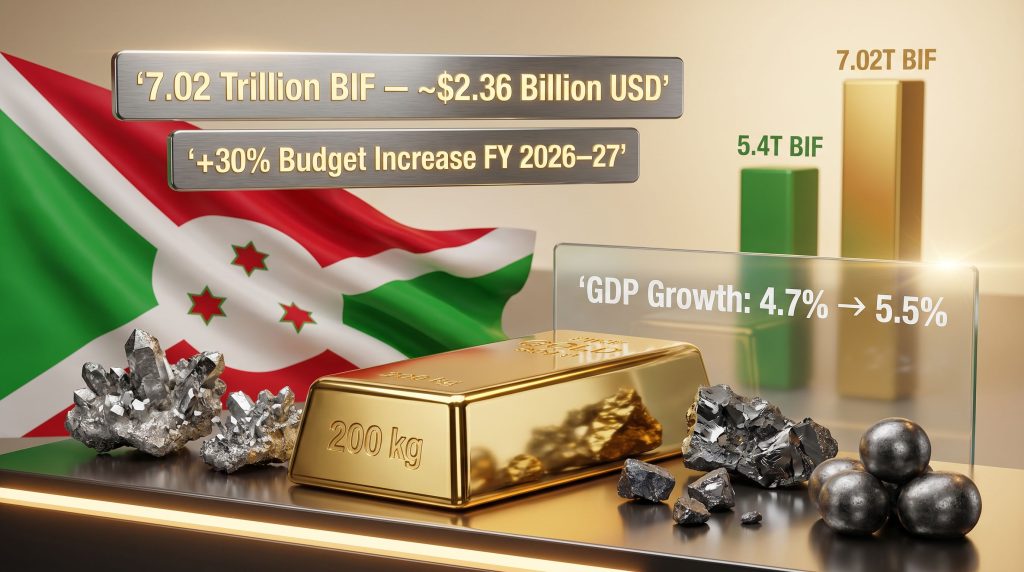
Burundi's parliament approved a national budget of 7.02 trillion Burundi francs, equivalent to approximately $2.36 billion USD at an exchange rate of 1 USD to 2,969 BIF, for the fiscal year commencing July 2026. The scale of the increase is striking for an economy of Burundi's size: the approved figure represents a 30% expansion over the prior year's allocation of 5.4 trillion francs.
What makes this budget cycle particularly notable is the dynamic between the executive and legislature. Finance Minister Alain Ndikumana initially proposed a spending envelope of 6.7 trillion BIF, already a substantial increase over the prior year. Parliament, however, voted to push that figure even higher, ultimately settling on the 7.02 trillion figure in an early morning vote. According to CNBC Africa, the upward revision by parliament signals not just fiscal ambition but a degree of legislative confidence in the revenue projections underpinning the budget.
| Budget Metric | FY 2025–26 | FY 2026–27 | Change |
|---|---|---|---|
| Total Budget (BIF Trillions) | 5.4T | 7.02T | +30% |
| Total Budget (USD Approx.) | ~$1.82B | ~$2.36B | +30% |
| GDP Growth Forecast | 4.7% | 5.5% | +0.8 ppts |
| Exchange Rate (USD:BIF) | N/A | 1 : 2,969 | N/A |
Economic growth is projected to reach 5.5% in the coming fiscal year, accelerating from 4.7% in the current period. The dual drivers cited in the Finance Minister's budget speech are the intensification of irrigated agricultural production and a gradual scaling of mineral extraction across multiple commodity categories.
What Role Is Mining Playing in Burundi's Revenue Growth?
For most of Burundi's recent economic history, the mining sector occupied a peripheral position in public finance discussions. The country's fiscal story was dominated by coffee and tea exports, humanitarian assistance flows, and multilateral lending. That context makes the current moment more significant: mineral exports are now being cited explicitly as a contributor to budget expansion, reflecting improvements in both export volumes and the government's ability to capture revenue from those exports.
Burundi's mineral export portfolio centres on four key commodities:
- Gold — the highest-value export and most liquid commodity in the portfolio
- Tin — a globally traded industrial metal with steady electronics and soldering demand
- Tantalum — a critical mineral used extensively in capacitors for consumer electronics and defence systems
- Tungsten — a dense, high-melting-point metal with growing applications in industrial tooling, defence, and electronics
Late 2025 export data offers a concrete illustration of this momentum. Furthermore, the critical minerals demand for these specific commodities continues to grow globally, underpinning the revenue potential of Burundi's export portfolio.
| Mineral Category | Volume (Late 2025) | Estimated Export Value |
|---|---|---|
| Gold | Over 200 kg | More than $27 million |
| Other Minerals (combined) | Over 950 tonnes | More than $7 million |
| Total Mineral Export Revenue | Combined | ~$34+ million |
While these figures may appear modest by global standards, they are material within the context of Burundi's overall export base. More importantly, they represent formalised, trackable revenue that can be channelled into treasury accounts rather than leaking through informal trade networks.
Why Tantalum and Tungsten Carry Strategic Weight Beyond Their Export Value
The presence of tantalum and tungsten in Burundi's mineral mix deserves more analytical attention than their current export volumes might suggest. Both metals appear on critical mineral lists maintained by major economies including the United States, the European Union, and Japan. Tungsten's strategic importance is growing considerably, alongside tantalum, which is sourced predominantly from Central and East Africa, with the Democratic Republic of Congo and Rwanda historically accounting for the largest share of global supply.
Burundi's tantalum deposits are geologically connected to the same mineralised belts that extend through Rwanda and eastern DRC, a region often referred to in the industry as the 3T corridor (tin, tantalum, tungsten). The mineralisation in this belt is associated with Precambrian pegmatite intrusions, a geological setting that tends to produce tantalum-bearing coltan with variable but often commercially viable grades. The fact that Burundi sits within this belt, yet has remained largely underdeveloped compared to its neighbours, points to a potential supply gap that future exploration could begin to address.
One lesser-known dynamic in the Great Lakes mineral trade is the degree to which Burundian minerals have historically entered regional supply chains without being correctly attributed to their country of origin. Improved traceability frameworks, including chain-of-custody certification systems, are gradually closing this gap, which has the dual effect of boosting Burundi's official export statistics and reducing the revenue leakage that has long undermined fiscal capture.
How Does Burundi's Mining Revenue Compare to Regional Peers?
Placing Burundi's fiscal evolution in regional context requires acknowledging the significant structural differences between neighbouring mining economies.
| Country | Key Minerals | Mining Share of Government Revenue (Approx.) |
|---|---|---|
| Burundi | Gold, Tin, Tantalum, Tungsten | Low but rising |
| Tanzania | Gold, Diamonds, Tanzanite | ~10–15% |
| Rwanda | Tin, Tantalum, Tungsten | ~5–8% |
| DRC | Cobalt, Copper, Coltan | ~20–30% |
Rwanda offers the most instructive benchmark for Burundi. The two countries share a geological endowment, a similar colonial administrative history, and overlapping mineral export profiles. Rwanda has invested substantially in the institutional architecture needed to convert mineral exports into reliable government revenue, including formalised artisanal mining cooperatives, mineral trading centres with documented chain of custody, and active participation in the Extractive Industries Transparency Initiative (EITI). Burundi's revenue capture from the same mineral categories has lagged, but the current budget cycle suggests that gap is beginning to narrow.
The DRC comparison, while instructive on scale, also carries a cautionary dimension. Despite the vast natural resources in the DRC, the country has struggled to translate raw mineral wealth into stable fiscal capacity, largely due to governance failures, infrastructure deficits, and entrenched informal trade networks. Burundi faces versions of all three challenges in miniature, making Rwanda's trajectory the more realistic aspirational model.
The Dual Engine Growth Model: Agriculture and Minerals
A critical feature of Burundi's growth narrative that distinguishes it from pure resource-economy models is the co-equal emphasis placed on agricultural intensification. The Finance Minister's budget speech specifically cited irrigated agricultural production alongside mineral output as twin drivers of the projected GDP acceleration to 5.5%.
This dual-engine approach has genuine structural logic. Agriculture accounts for the majority of Burundi's employment and represents the dominant livelihood base for its rural population. Expanding irrigated cultivation reduces the country's vulnerability to rainfall variability, which has historically been a source of economic volatility.
When agricultural productivity grows in parallel with mineral exports, the resulting GDP expansion is more broadly distributed and less susceptible to the concentrated shocks that typically affect single-commodity resource economies. That said, the two sectors are not entirely independent. Mining operations require energy, water, and transport infrastructure, while agricultural expansion competes for the same rural labour pools.
Burundi's Energy Policy Shift: EV Tax Exemptions and Fuel Vulnerability
One of the more unexpected elements of the 2026–27 budget is the decision to eliminate import duties on electric and hybrid vehicles. The Finance Minister linked this move directly to fuel supply disruptions exacerbated by the conflict involving Iran, which has contributed to tightened global petroleum markets and elevated fuel costs in import-dependent economies like Burundi.
This is a pragmatic response to an acute logistical vulnerability rather than a climate-policy statement. Burundi has no domestic petroleum production and depends entirely on imported fuel transported overland through East African supply corridors. Disruptions to those corridors translate directly into fuel scarcity, elevated transport costs, and knock-on inflation across the economy.
The EV tax exemption is also relevant to the mining sector in a less obvious way. Mining operations are among the largest consumers of diesel fuel in any developing economy. Any structural shift toward electrified transport and equipment reduces the sector's exposure to imported fuel price volatility, consequently improving operating economics for both formal and artisanal mining activities over the medium term.
The next major ASX story will hit our subscribers first
Governance Reforms Enabling Greater Revenue Capture
The conversion of mineral exports into budget revenue does not happen automatically. It requires functioning royalty collection systems, enforceable licensing regimes, and mineral traceability frameworks capable of distinguishing legitimate production from smuggled output. Burundi has historically struggled with all three.
Key reform areas that are beginning to show results include:
- Strengthening royalty and tax collection across both formal and artisanal mining operations
- Deploying chain-of-custody certification for gold and 3T mineral exports to reduce revenue leakage
- Progressing toward alignment with EITI reporting standards, which improve transparency and investor confidence simultaneously
- Formalising artisanal mining cooperatives to bring a larger share of small-scale production into the regulated fiscal framework
The formalisation of artisanal and small-scale mining (ASM) is arguably the most impactful near-term lever available to Burundi's government. ASM operations account for a disproportionately large share of actual mineral output in the Great Lakes region, yet they contribute a fraction of what their production volumes would theoretically generate in government royalties. Closing this gap is both a governance challenge and a revenue opportunity.
Smuggling remains a persistent structural problem. The Great Lakes region's porous borders and well-established informal trade networks mean that minerals produced in Burundi can enter international supply chains attributed to neighbouring countries, depriving Burundi's treasury of royalties and export duties. Regional coordination frameworks, including shared mineral traceability standards, represent the most credible long-term solution to this leakage problem.
Risk Assessment: Five Structural Vulnerabilities in Burundi's Mining-Backed Fiscal Model
A 30% budget expansion built partly on mineral revenue requires sober risk assessment. The following structural vulnerabilities warrant close monitoring:
- Commodity price volatility — Gold and tin prices can swing dramatically within a single fiscal year. A significant gold price correction would directly reduce export revenue and compress the fiscal headroom underpinning the expanded budget.
- Limited mineral diversification — While the four-mineral portfolio provides some buffer, it remains narrow. The absence of copper, cobalt, or lithium production limits Burundi's participation in the most rapidly growing segments of global mineral demand.
- Infrastructure constraints — Inadequate road networks, limited processing capacity, and unreliable power supply continue to cap export volume growth and increase per-unit production costs.
- Governance and transparency gaps — Incomplete formalisation of artisanal operations means that a large share of actual mineral production continues to flow outside the fiscal framework.
- Geopolitical exposure — Regional instability in the Great Lakes area, including ongoing conflict dynamics in eastern DRC, creates persistent risks to export corridor reliability and investor confidence.
Scenario Analysis: Gold Price Sensitivity
Given gold's dominance in Burundi's mineral export revenue, the budget's vulnerability to gold price movements deserves specific quantification. Furthermore, critical metals for defence such as tantalum and tungsten carry their own price dynamics that could influence overall revenue outcomes.
| Scenario | Gold Price Impact | Estimated Revenue Effect | Budget Risk Level |
|---|---|---|---|
| Base Case | Stable prices | Revenue on track | Low |
| Moderate Correction (-10%) | Reduced export receipts | ~$2.7M revenue shortfall | Moderate |
| Significant Correction (-20%) | Sharp export value decline | ~$5.4M+ revenue shortfall | High |
Disclaimer: These scenario estimates are derived from late 2025 export data and should be treated as indicative rather than precise forecasts. Actual revenue outcomes will depend on production volumes, exchange rates, and global price movements that cannot be predicted with certainty.
What the Budget Signals for Foreign Mining Investment in Burundi
For foreign mining investors and junior explorers, the budget expansion carries a signal that transcends its headline figures. A government that expands its national budget on the basis of mineral revenue, rather than aid disbursements, is demonstrating that it views the mining sector as a reliable fiscal pillar. According to the World Bank's research on Burundi's mineral sector, this posture typically precedes increased regulatory attention to the sector, which can cut both ways: better investor protections and clearer licensing frameworks on one hand, and higher royalty expectations and more complex compliance requirements on the other.
Factors that could attract junior mining explorers to Burundi include:
- Geological prospectivity across the 3T corridor and gold-bearing greenstone belts
- Relatively low exploration density compared to the DRC and Tanzania, suggesting potential for new discoveries
- A government that is increasingly motivated to grow formal mineral production to sustain fiscal expansion
- Proximity to established regional mineral trading infrastructure in Rwanda and Tanzania
Barriers that continue to limit large-scale foreign direct investment include political risk perceptions, infrastructure deficits, limited domestic processing capacity, and a regulatory environment that is still maturing relative to more established African mining jurisdictions.
Frequently Asked Questions: Burundi Government Spending and Mining Revenue
What is Burundi's total government budget for 2026–27?
Parliament approved a budget of 7.02 trillion Burundi francs, equivalent to approximately $2.36 billion USD, for the fiscal year beginning July 2026.
By how much is Burundi increasing government spending?
The approved budget represents a 30% increase over the prior year's allocation of 5.4 trillion Burundi francs.
What minerals is Burundi exporting to generate additional revenue?
Burundi's primary mineral exports include gold, tin, tantalum, and tungsten, a portfolio aligned with global demand for both industrial and critical minerals.
How much gold did Burundi export in late 2025?
Available data indicates that Burundi exported over 200 kg of gold in late 2025, generating more than $27 million in export revenue.
Is mining a major part of Burundi's economy?
Mining has historically been a modest contributor to Burundi's public finances, but recent export growth and improved revenue collection are elevating the sector's fiscal significance meaningfully.
What is Burundi's projected GDP growth rate for the coming fiscal year?
Economic growth is forecast to reach 5.5%, up from 4.7% in the current fiscal year, with Burundi government spending helped by mining identified as one of the key structural drivers behind this acceleration.
Key Takeaways
- Burundi's parliament approved a 30% budget increase for FY 2026–27, reaching 7.02 trillion BIF (~$2.36B USD)
- Mining revenue from gold, tin, tantalum, and tungsten is a named contributor to this fiscal expansion
- Late 2025 export data shows over 200 kg of gold generating more than $27 million, alongside 950+ tonnes of other minerals worth over $7 million
- GDP growth is projected to accelerate to 5.5%, supported by both agricultural intensification and rising mineral output
- Governance reforms including improved royalty collection and traceability frameworks are enabling greater conversion of mineral exports into public revenue
- Structural risks including commodity price volatility, infrastructure gaps, and regional instability remain important constraints on sustained mining-led fiscal growth
- The geological overlap with Rwanda's established 3T mineral corridor positions Burundi as an under-explored jurisdiction with meaningful medium-term upside for both production and revenue capture
This article contains forward-looking statements and scenario projections based on available data as of mid-2026. Readers should not treat fiscal forecasts, revenue estimates, or investment observations as financial advice. Commodity markets are subject to significant volatility and actual outcomes may differ materially from projections presented here.
Want to Track the Next Major Mineral Discovery Before the Market Does?
Discovery Alert's proprietary Discovery IQ model delivers real-time alerts on significant ASX mineral discoveries — turning complex data across 30+ commodities into actionable insights for both short-term traders and long-term investors. Explore Discovery Alert's dedicated discoveries page to understand how historic mineral discoveries have generated extraordinary returns, and begin your 14-day free trial today to position yourself ahead of the broader market.