June 13, 2026
Why Commodity Volatility and Debt Cycles Are Reshaping the Case for Precious Metals
Across centuries of monetary history, few forces have proven more disruptive to investor wealth than the collision of rising prices and falling economic output. This is not a theoretical construct. It has played out repeatedly across sovereign debt cycles, commodity shocks, and currency debasement episodes. What makes the current macroeconomic environment particularly unusual is that inflation and deflation are not operating as opposing forces waiting their turn. Instead, they appear to be functioning simultaneously across different parts of the economy, creating a regime that conventional portfolio theory was never designed to navigate.
Understanding how gold and silver in stagflation and deflation behave at a structural level is no longer an abstract academic exercise. For investors assessing capital preservation in an environment of extreme uncertainty, it has become a foundational question.
When big ASX news breaks, our subscribers know first
The Debt Saturation Mechanism: How Leverage Turns Rate Rises Into Asset Deflation
Interest Rates as an Asset Price Compressor
The relationship between interest rates and asset valuations is widely discussed but rarely examined with sufficient precision. At its core, the mechanism is straightforward: when assets are purchased primarily with borrowed money, the maximum price a buyer can pay is constrained by how much they can borrow. As borrowing costs rise, that ceiling drops, and asset prices follow.
A concrete illustration clarifies this dynamic. When residential mortgage rates sit near 3.5%, a household with a given income might qualify for a $1,000,000 loan. When rates climb to 6.5% to 7%, that same household may only qualify for $500,000 to $600,000. The property has not changed. The supply has not changed. However, the pool of effective buyers has been cut roughly in half, purely through the cost of credit. This compression of purchasing power is one of the most direct transmission channels from monetary tightening to asset price deflation.
The same mechanism operates at the corporate level. Businesses that could roll over debt effortlessly in a low-rate environment find that refinancing at higher rates is either prohibitively expensive or structurally impossible. When companies cannot refinance, they are often forced into asset liquidation. Forced selling accelerates deflationary pressure, which feeds into further credit deterioration.
When Deflation and Inflation Coexist
What makes this cycle particularly destructive is that it does not unfold in isolation. While asset prices deflate under the weight of higher borrowing costs, the prices of everyday necessities continue rising. Energy, food, and essential services are not subject to the same credit-availability dynamics as financial assets or real estate. Commodity supply disruptions, geopolitical instability, and currency debasement push living costs higher at the same time that asset markets contract.
This is the defining characteristic of stagflation: rising costs of living occurring simultaneously with falling real wealth. Purchasing power erodes from both directions. Financial assets decline in value while the cost of maintaining a household increases. It is, as one analyst framing describes it, a double-edged sword that cuts simultaneously. For a deeper examination of how these forces interact, gold and bonds dynamics provide a useful complementary lens.
What Is Stagflation and Why Does It Present a Unique Investment Challenge?
Defining the Regime
Stagflation is a macroeconomic condition characterised by persistently high inflation, stagnant or contracting economic growth, and elevated unemployment. It renders conventional monetary policy largely ineffective because the tools used to fight inflation (higher interest rates, reduced money supply) tend to deepen the economic contraction, while the tools used to stimulate growth tend to accelerate inflation.
This distinguishes stagflation from a standard inflationary cycle, where rising prices are typically accompanied by economic expansion and earnings growth. In a conventional inflationary environment, equity markets can absorb price increases because corporate revenues are growing. In stagflation, however, revenue growth stalls or reverses while input costs remain elevated, creating simultaneous margin compression and valuation contraction.
The Compounding Burden of Sovereign Debt Service
One of the most structurally significant but underappreciated dimensions of the current macroeconomic environment is the transformation in sovereign debt servicing costs. For approximately 25 to 30 years prior to 2022, declining interest rates allowed governments to accumulate debt without experiencing a proportional rise in annual interest payments.
| Time Period | Annual US Debt Service Cost | Context |
|---|---|---|
| Approximately 1995 to 2022 | $350B to $500B per year | Supported by a 40-year declining rate cycle from 1982 to 2022 |
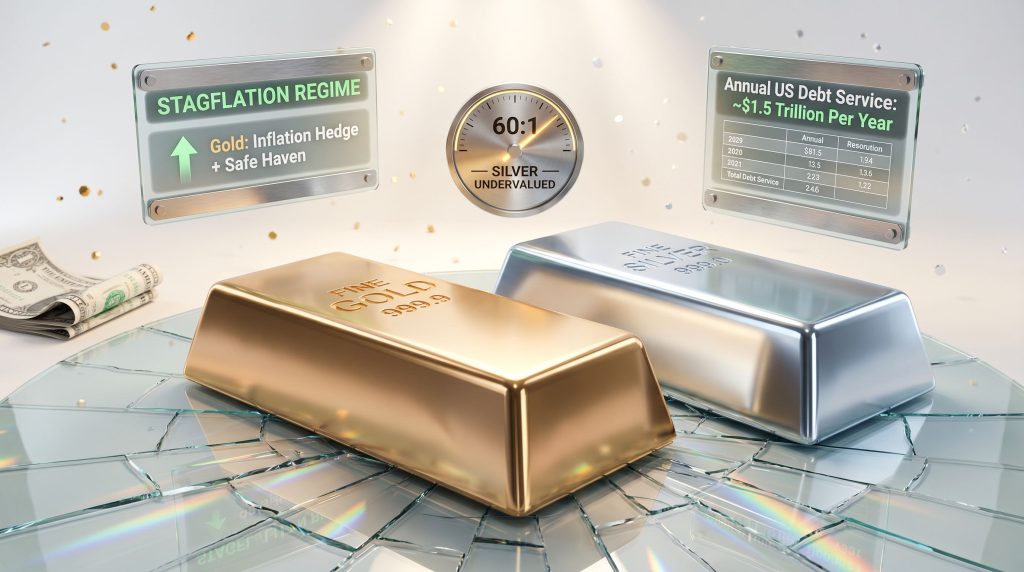
| Current trajectory | Approximately $1.5 trillion per year | Represents more than 25% of annual federal tax revenues |
The shift is not gradual. Debt service has moved from a manageable line item into a structural constraint on fiscal policy. When a sovereign government is directing more than a quarter of its tax revenue exclusively to interest payments before a single dollar reaches defence, healthcare, or infrastructure, the pressure to monetise that debt through currency creation becomes intense.
This is the dynamic Richard Russell's inflate or die framework describes. Governments carrying extreme debt burdens cannot permit deflation, because falling price levels increase the real value of outstanding obligations. The incentive structure pushes inexorably toward currency debasement, which provides short-term relief at the cost of longer-term purchasing power destruction for currency holders.
Supply Chain Disruption as a Stagflationary Amplifier
Commodity flow disruptions compound the problem by reducing economic output while simultaneously pushing input costs higher. Disruptions to energy, LNG, and fertiliser supply chains create cascading effects that take months to fully register in economic data. Agricultural output drops when fertiliser availability declines and drought conditions persist. Food prices rise while economic activity contracts.
This lag effect means markets frequently underestimate inflationary pressure until it becomes visible in hard data. By the time supply chain consequences appear in official inflation readings, the underlying structural damage to production capacity is already embedded. Furthermore, investing in gold and silver during inflation, stagflation and deflation reveals how these compounding forces have historically shaped precious metals demand across multiple economic cycles.
How Does Gold Perform in Stagflation and Deflation? Evidence and Structural Logic
Gold's Cross-Regime Performance Profile
Gold occupies a unique position among asset classes because its performance is not tethered to economic growth. Its weakest relative performance occurs during periods of genuine stability and expansion, when investors have access to yielding assets and opportunity cost weighs against holding a non-income-producing commodity. Outside of those periods, gold's structural characteristics as a monetary reserve asset and inflation hedge give it meaningful advantages. The gold safe haven role is particularly evident when conventional asset classes come under simultaneous pressure.
| Economic Environment | Gold Performance Profile | Primary Driver |
|---|---|---|
| Stagflation | Typically strong | Inflation hedge, safe haven demand, fiat devaluation |
| Deflation | Relatively resilient | Monetary reserve demand, crisis asset status |
| High growth and stability | Weakest relative performance | Opportunity cost of non-yielding asset rises |
| Hyperinflation | Strong in real terms | Direct inverse relationship to fiat currency value |
The 1930s Deflation Precedent
The 1930s provide the most direct historical case study for gold in a deflationary environment. Prior to 1933, the US gold price was fixed at $20.67 per ounce. Following the Banking Act of 1933 and subsequent executive action, the official price was revalued to $35.00 per ounce, representing a nominal increase of approximately 69%.
What made this period exceptional for gold producers was the coincidence of rising output prices with collapsing input costs. Labour, energy, and equipment costs all declined sharply during the Depression, while the price of the end product was mandated higher. The margin expansion experienced by gold mining companies during this period was exceptional precisely because deflation reduced their cost structure while their revenue base was protected and enhanced by government fiat.
Key Insight: In a deflationary environment, gold's fixed or government-revalued nominal price combined with falling production input costs creates a uniquely favourable operating environment for gold producers. This dynamic may partially replicate in modern deflationary scenarios where gold appreciation outpaces cost inflation in the mining sector.
The 1970s Stagflation Period: Separating Real from Nominal Rate Effects
A persistent misconception holds that rising interest rates are structurally negative for gold. The 1970s provide the definitive counterexample. Throughout the decade, nominal interest rates trended persistently higher, yet gold prices rose substantially. The explanation lies in understanding that gold's performance is driven by real interest rates (nominal rates minus prevailing inflation), not nominal rates in isolation.
When inflation rises faster than nominal interest rates, real rates remain negative or low. In that environment, the opportunity cost of holding gold falls, because the alternative of holding cash or bonds delivers a negative real return. The 1970s featured persistently negative real rates, which is why gold performed strongly despite surface-level rate increases.
This framework has direct relevance to the current environment. If inflation accelerates faster than central banks are willing or able to raise rates — a credible scenario given sovereign debt constraints — real rates could remain suppressed or turn negative, creating structural support for gold.
The Fiat Currency Debasement Relationship
Historical analysis of multiple fiat currency episodes reveals a consistent pattern: equity markets can deliver substantial nominal gains during periods of severe currency debasement, while real purchasing power simultaneously erodes. When a currency loses 60% to 70% of its value, a stock market that doubles in nominal terms still results in a net real loss for investors.
Gold's advantage in this scenario is structural. As a direct inverse to fiat currency value, physical gold captures the full benefit of currency debasement. Equity holders receive a partial and diluted offset, filtered through the multiple layers of corporate exposure to the depreciating currency. This distinction matters most in extreme debasement scenarios, where the gap between nominal and real returns widens dramatically.
Silver in Stagflation and Deflation: A More Complex and Volatile Proposition
The Dual Identity Problem
Silver's investment case is more nuanced than gold's because it simultaneously functions as a monetary metal and an industrial commodity. Approximately 50% of annual silver demand derives from industrial applications including electronics, photovoltaic solar panels, electric vehicle components, and medical devices. This dual identity creates asymmetric performance characteristics that depend heavily on which macroeconomic force is dominant.
Silver in Stagflation: Upside Potential With Embedded Risk
When inflation is the dominant force within a stagflationary regime, silver can outperform gold on a percentage basis. Its lower price base and higher speculative participation tend to amplify moves in both directions. However, the industrial demand component introduces a meaningful risk that gold does not carry: if stagflation deepens into recession, industrial offtake contracts, creating downward pressure that disproportionately affects silver relative to gold.
The gold-to-silver ratio analysis provides a useful valuation framework for assessing relative positioning:
Analytical Framework: A gold-to-silver ratio above 60 historically indicates that silver is undervalued relative to gold on a monetary basis. At ratios above this threshold, silver tends to offer greater percentage upside when precious metals enter a sustained bull phase. However, the same elevated ratio signals greater downside exposure in risk-off environments where industrial demand contracts rapidly.
Silver in Deflation: The Supply Deficit as a Counterbalancing Force
Silver faces a compounded challenge in deflationary environments. Falling industrial activity reduces manufacturing demand, while the liquidity-seeking behaviour that characterises acute financial crises can trigger forced selling by investors needing to raise cash. Both forces weigh on price simultaneously.
However, the structural silver supply deficits provide a longer-term counterbalancing dynamic:
| Silver Market Metric | Estimated Figure |
|---|---|
| Current annual global mine production | Approximately 850 million ounces |
| Projected annual demand by 2030 | Approximately 1.5 billion ounces |
| Consecutive years of structural deficit | Six years as of current analysis |
This projected supply shortfall of roughly 650 million ounces annually by 2030 suggests that while silver may face near-term deflationary pressure, the underlying supply-demand imbalance creates conditions for a significant repricing event. The mechanism most likely to trigger that repricing is a failure to deliver on paper contracts.
The Failure-to-Deliver Scenario: Silver as a Systemic Pressure Point
Paper commodity markets allow trading volumes that far exceed available physical supply, with naked short positions in futures markets capable of suppressing prices beyond what physical fundamentals would support. This suppression can persist indefinitely until the system encounters a delivery failure.
The critical insight here is the contagion pathway. A failure to deliver in silver futures would not remain contained. It would immediately undermine confidence in gold futures contracts, as holders of paper gold positions would be incentivised to demand physical delivery rather than cash settlement. The resulting rush to convert paper claims into physical metal could overwhelm the derivatives complex that underpins commodity price discovery across multiple markets.
This risk is amplified by gold's designation as a Tier 1 bank asset, meaning banks are permitted to hold gold on their balance sheets with no haircut. The integrity of gold price discovery is consequently embedded in the solvency structure of the global banking system in a way that no other commodity is.
Gold vs. Silver: Comparative Framework for Stagflationary and Deflationary Portfolios
Side-by-Side Comparison Across Key Dimensions
| Factor | Gold | Silver |
|---|---|---|
| Stagflation performance | Typically strong; primary monetary inflation hedge | Can outperform in percentage terms but carries higher volatility |
| Deflation performance | Relatively resilient; monetary reserve and crisis demand | More vulnerable; industrial demand contracts in downturns |
| Counterparty risk (physical) | None | None |
| Industrial demand exposure | Minimal | Significant (approximately 50% of total demand) |
| Liquidity | Highest among precious metals | High but below gold |
| Volatility | Lower | Higher |
| Current valuation signal | Near all-time highs in nominal terms | Elevated gold-to-silver ratio suggests relative undervaluation |
| Structural supply deficit | Moderate | Severe with projected widening to 2030 |
Portfolio Allocation Thinking in Conditions of Extreme Uncertainty
Conventional portfolio theory frames precious metals allocation as a percentage decision tied to risk tolerance. A more useful reframing for environments of extreme macroeconomic stress asks a different question: how much capital can you afford to lose entirely, and how much must be preserved regardless of what happens in broader financial markets?
Physical gold and silver are the only widely accessible asset classes with genuinely zero counterparty risk. Every other asset category — including bank deposits, brokerage accounts, insurance contracts, and real estate — carries some form of counterparty or regulatory exposure. Physical precious metals held in direct possession do not.
Analysts operating within the precious metals sector have suggested that meaningful physical exposure complemented by a 15% to 20% allocation to precious metals mining equities may offer a more resilient portfolio structure during periods of systemic financial stress than conventional equity-heavy positioning.
Why Platinum Group Metals Are a Different Proposition
Platinum, palladium, and rhodium are not globally recognised as monetary assets. Their demand profiles are predominantly industrial, with automotive catalytic converters representing a major consumption source. In a stagflationary or deflationary environment where manufacturing activity contracts and auto industry demand declines, platinum group metals face direct demand destruction that gold and silver, as monetary assets, do not.
The next major ASX story will hit our subscribers first
Precious Metals Mining Equities: The Operating Leverage Argument
How Miners Amplify Metal Price Gains
Mining equities offer a form of embedded financial leverage that physical metal does not. When the price of gold or silver rises faster than input costs, operating margins expand disproportionately. A 20% rise in the gold price against flat or declining energy and labour costs can translate into a 40% to 60% improvement in operating margins, which flows through to earnings and ultimately to equity valuations. In this context, gold price and mining equities demonstrate a particularly compelling relationship during sustained precious metals bull phases.
The 1930s again serve as a useful historical reference. Gold producers of that era experienced the simultaneous benefit of a mandated price increase and a general deflation in their cost structures. The net effect on margins was extraordinary. Today's environment, where gold prices are moving toward and beyond all-time highs while input cost inflation in some categories moderates, creates at least a partial parallel.
As a general market observation, mining equity prices tend to exhibit approximately three times the volatility of the underlying metal price. This amplification works in both directions. In sustained bull markets for precious metals, well-selected mining equities can substantially outperform the physical metal. In corrections, they can fall sharply.
The Certificate Risk: Why Brokerage Custody Matters
A practical but frequently overlooked consideration for mining equity investors relates to how shares are held. Shares held through a brokerage account in street name are technically recorded on the broker's balance sheet for the investor's benefit. In the event of broker insolvency, those assets may be treated as belonging to the estate, exposing investors to recovery risk.
Physical share certificates establish direct legal ownership independent of broker solvency. For investors with material positions in mining equities who are concerned about systemic financial stress, this distinction may have meaningful practical consequences.
Selection Criteria for Mining Equity Quality
When evaluating mining equity exposure in an uncertain macroeconomic environment, several criteria merit particular attention:
- Geographic diversification: Concentration in a single jurisdiction creates exposure to nationalisation, regulatory change, or political disruption. Spreading exposure across multiple geographies reduces this risk.
- Market capitalisation diversification: Majors, mid-tiers, juniors, and explorers each offer different risk-return profiles. Speculative upside increases as company size decreases, as does downside risk.
- All-in sustaining cost (AISC) discipline: Prioritising producers with low AISC relative to current spot prices ensures margin resilience even if metals prices experience periods of weakness.
- Metal preference alignment: Matching miner selection to personal conviction about gold versus silver relative performance allows portfolio construction to reflect macro views rather than work against them.
Are Equity Markets Systemically Mispricing Risk?
The Buffett Indicator and the Valuation Disconnect
The ratio of total stock market capitalisation to GDP — a measure associated with Warren Buffett's long-term valuation framework — has reached historically unprecedented levels in the US market. Buffett applied this same indicator as a cautionary signal prior to both the dot-com collapse and the 2008 financial crisis. His reported cash position of approximately $400 billion is widely interpreted by market observers as an expression of extreme caution about prevailing equity valuations.
The broader implication is significant. If the investor widely regarded as the most successful long-term equity allocator of the modern era is holding unprecedented levels of cash rather than deploying into equities, the signal about current market pricing deserves serious consideration. The madness of crowds dynamic, where momentum and narrative override fundamental valuation, has historically produced extended periods of apparent stability followed by rapid and severe corrections.
PE Multiple Compression and the Inflation Headwind
Historical analysis of equity market performance in sustained high-inflation environments reveals a consistent pattern: price-to-earnings multiples contract. The multiple investors are willing to pay for a dollar of earnings declines as inflation persists, and meaningful multiple expansion has historically only resumed after inflation is brought decisively under control.
This creates a structural headwind for equities during stagflation that operates even if nominal prices are partially supported by liquidity injections. Liquidity-driven price support delivers nominal gains while real purchasing power erodes. The practical result is that equity investors may feel wealthier in nominal terms while experiencing genuine wealth destruction in real terms. Furthermore, how gold performs with inflation, stagflation and recession illustrates this distinction across multiple historical cycles.
Frequently Asked Questions: Gold and Silver in Stagflation and Deflation
Does gold go up in stagflation?
Gold has historically performed well during stagflationary periods. The combination of high inflation, weak economic growth, and deteriorating confidence in fiat currencies tends to drive demand for gold as both an inflation hedge and a safe haven asset. The 1970s stagflation period is the most widely cited example, during which gold prices rose substantially even as nominal interest rates trended higher, because real interest rates (adjusted for inflation) remained negative or low throughout most of the decade.
Is silver a good hedge against stagflation?
Silver can benefit meaningfully from stagflation, particularly when the inflationary component is dominant. Its lower price base and higher speculative participation can enable it to outperform gold on a percentage basis during precious metals bull phases. However, the significant industrial demand component (approximately 50% of total consumption) makes silver more sensitive to economic slowdown than gold. If stagflation transitions into deeper recession, industrial demand contraction can weigh on silver prices in ways that do not affect gold equally.
What happens to gold in a deflationary environment?
Gold tends to be relatively resilient in deflation compared to most other asset classes. Its role as a monetary reserve asset supports demand even when general price levels are falling. The 1930s provide the most direct historical precedent, when gold's price was officially revalued upward and gold mining companies simultaneously benefited from falling production input costs. In acute liquidity crises, even gold can experience short-term selling pressure as investors raise cash, but this tends to be temporary relative to the broader deflationary cycle.
What happens to silver in deflation?
Silver typically underperforms gold in deflationary environments. Falling industrial activity reduces demand from manufacturing sectors, and the risk-off sentiment accompanying deflation tends to favour gold's purely monetary characteristics over silver's mixed monetary-industrial profile. Silver may also face greater selling pressure in liquidity crises due to its lower price point and higher speculative participation. However, the structural supply deficit projected to widen significantly through 2030 provides a longer-term counterbalancing force.
How much of a portfolio should be in gold and silver?
Allocation to precious metals is a personal decision dependent on individual circumstances. A useful reframing of this question shifts the emphasis from a percentage figure to a capital preservation question: how much of your wealth cannot afford to be lost or impaired in a systemic financial disruption? Physical gold and silver, held directly, carry no counterparty risk. Every other asset category carries some form of counterparty or regulatory exposure. The allocation question consequently becomes partly a function of how much counterparty-risk-free capital preservation matters in your specific situation.
What is the gold-to-silver ratio and why does it matter?
The gold-to-silver ratio measures how many ounces of silver are required to purchase one ounce of gold. Historically, the ratio has averaged between approximately 40:1 and 60:1. When the ratio rises significantly above this historical range, silver is considered monetarily undervalued relative to gold, suggesting greater percentage upside potential when precious metals markets strengthen. A ratio above 60 has historically been associated with silver offering better relative value on a forward-looking basis, though it also signals higher volatility risk in risk-off environments.
Key Takeaways: Positioning for the Macroeconomic Road Ahead
The macroeconomic environment facing investors over the coming years is unlikely to resolve neatly into a single regime of pure inflation or pure deflation. The more probable trajectory involves a simultaneous compression of asset values and elevation of living costs, a stagflationary dynamic amplified by historically unprecedented debt burdens and structural supply chain disruptions.
Within this context, gold and silver in stagflation and deflation offer distinct but complementary roles. Gold provides the more conservative, lower-volatility monetary anchor, with a track record of resilience across both inflationary and deflationary regimes. Silver offers higher potential upside with commensurately higher volatility, constrained by industrial demand exposure but supported by a structural supply deficit that projects to worsen materially through 2030.
Key principles worth retaining:
- Physical precious metals carry no counterparty risk, distinguishing them fundamentally from every other asset category.
- Gold's performance is driven by real interest rates, not nominal rates, which means rising rate environments do not automatically create headwinds if inflation rises faster.
- Silver's failure-to-deliver risk could represent the most consequential systemic event in commodity markets, with contagion potential extending directly into gold futures and the broader derivatives complex.
- Mining equities offer operating leverage that can amplify metal price gains, but require careful custody arrangements and geographic diversification to manage company-specific and jurisdictional risks.
- Equity market valuations by multiple historical measures sit at extremes that have historically preceded significant corrections, reinforcing the case for meaningful allocation to hard assets with genuine monetary properties.
This article is intended for general informational and educational purposes only. It does not constitute financial advice, investment advice, or a solicitation to buy or sell any asset. Past performance of any asset class is not indicative of future results. Readers should conduct their own research and consult a licensed financial adviser before making any investment decisions. Forecasts, projections, and historical comparisons referenced in this article involve inherent uncertainty and should not be relied upon as guarantees of future outcomes.
Want to Know When the Next Major ASX Mineral Discovery Hits the Market?
Discovery Alert's proprietary Discovery IQ model delivers real-time alerts on significant ASX mineral discoveries, instantly transforming complex geological data into actionable investment insights for both short-term traders and long-term investors — begin your 14-day free trial today and explore how historic discoveries have generated substantial returns for those who positioned early.