July 12, 2026
India's Aluminium Ambitions Are Being Forged in Odisha
Few industrial sectors reveal a country's development trajectory as clearly as aluminium. It is energy-intensive, capital-heavy, and strategically indispensable across everything from power transmission to electric vehicles. For India, which has long punched below its weight in domestic alumina refining despite sitting atop significant bauxite reserves, the next decade may look dramatically different from the last. At the centre of that transformation sits a single state, a single conglomerate, and a commitment measured in billions.
The Aditya Birla Group alumina refinery expansion in Odisha is not simply a capacity announcement. It represents a calculated industrial bet on the convergence of domestic resource availability, infrastructure scale, and long-cycle demand from India's energy transition. Furthermore, understanding the broader bauxite production trends shaping global supply chains helps contextualise why this investment carries strategic weight well beyond Odisha's borders.
When big ASX news breaks, our subscribers know first
Understanding the Kansariguda Investment at Full Scale
From Greenfield Start-Up to Industrial Anchor
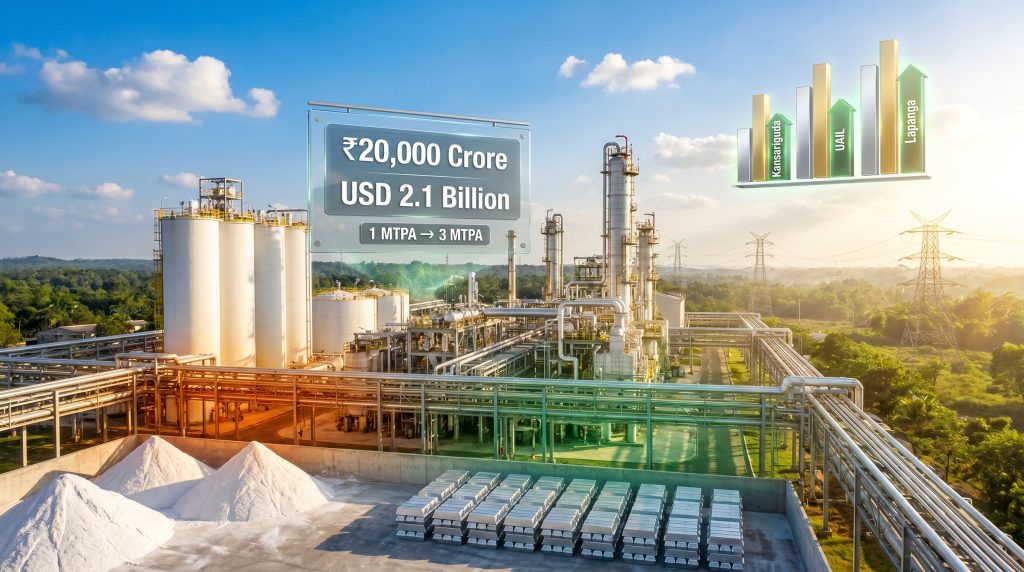
The Kansariguda alumina refinery in Odisha was conceived as a greenfield project with an initial production target of 1 million tonnes per annum (MTPA). Hindalco Industries, the aluminium and copper arm of the Aditya Birla Group, is now pursuing a tripling of that capacity to 3 MTPA through an additional outlay of approximately ₹12,000 crore (USD 1.26 billion).
When combined with the ₹8,000 crore already committed to the facility, the total project investment reaches roughly ₹20,000 crore, or approximately USD 2.1 billion. That figure places Kansariguda among the most significant single-site alumina capacity additions proposed in India in recent memory.
What the Capital Stack Actually Funds
At refinery scale, a ₹12,000 crore incremental investment covers far more than processing equipment. A facility handling 3 MTPA of alumina output requires:
- Dedicated digestion and calcination circuits capable of handling increased bauxite throughput
- Extensive caustic soda management and liquor recovery infrastructure
- High-volume materials handling systems for both input bauxite and output alumina
- Effluent and red mud disposal systems scaled to the expanded footprint
- Utility systems including steam generation, compressed air, and process water
- Logistics connectivity, including rail or road links to smelter offtake points
The capital intensity of alumina refining is structurally high because the Bayer Process, which underpins virtually all commercial alumina production globally, is both chemically complex and thermally demanding. Energy costs typically represent the largest single operating expense at a refinery of this scale, making the adjacent power infrastructure equally critical.
The Dual-Axis Expansion: Refinery and Smelter Together
Vertical Integration as a Margin Strategy
What distinguishes Hindalco's Odisha buildout from a straightforward capacity expansion is its simultaneous push across two distinct points in the aluminium value chain. Alongside the Kansariguda refinery increase, the company's subsidiary Aditya Aluminium is pursuing a brownfield expansion of its smelter at Lapanga, lifting aluminium production capacity from 6.8 lakh tonnes per annum to 9.0 lakh tonnes per annum, an addition of approximately 2.2 lakh tonnes.
This pairing is strategically coherent. Alumina is the direct feedstock for aluminium smelting, and its price can be volatile on international spot markets. By securing a captive, large-scale domestic refinery output and routing it to a co-located smelting operation, Hindalco insulates its integrated production margin from external alumina price fluctuations. The top aluminium companies globally have long recognised vertical integration as a defining competitive advantage.
Vertical integration in aluminium is not merely an efficiency play. It is a risk management structure, and at the scale Hindalco is pursuing in Odisha, it amounts to building a degree of feedstock sovereignty rarely achievable in the private sector.
Power Infrastructure: The Often-Overlooked Variable
Aluminium smelting is one of the most electricity-intensive industrial processes on Earth, consuming roughly 13 to 15 megawatt-hours per tonne of primary aluminium produced. Accordingly, Aditya Aluminium's captive power plant at Lapanga is being scaled from 1,230 MW to 1,530 MW, an addition of 300 MW of generation capacity.
This power expansion is not incidental. Without it, the smelter throughput increase would be constrained by grid dependency, exposing operations to tariff risk and supply reliability concerns. The captive model, while capital-intensive upfront, delivers a structural cost advantage over a multi-decade operational horizon. For instance, this mirrors the aluminium power strategy being pursued by major global producers seeking to decouple smelting economics from volatile grid electricity prices.
How Odisha Became India's Aluminium Industrial Corridor
Natural Resource Endowment Meets Industrial Infrastructure
Odisha's rise as India's primary aluminium manufacturing hub is not accidental. The state holds a disproportionately large share of India's economically viable bauxite deposits, the ore from which alumina is extracted. Bauxite quality matters considerably in refining economics. Higher-grade ores with elevated alumina content and lower silica and reactive silica fractions reduce caustic consumption in the Bayer Process, directly improving yield and lowering per-tonne production costs.
Odisha's bauxite deposits, particularly those in the Eastern Ghats belt, are generally considered to be of good quality for refinery purposes, which has historically attracted smelter and refinery investment to the state in preference to other bauxite-bearing states.
Comparing the Group's Odisha Footprint
Hindalco's expanded position in Odisha will span multiple facilities across the value chain:
| Facility | Type | Capacity (Post-Expansion) | Operator |
|---|---|---|---|
| Kansariguda Refinery | Greenfield alumina refinery | 3.0 MTPA alumina | Hindalco Industries |
| Utkal Alumina International (UAIL) | Existing alumina refinery | ~2.12 MTPA alumina | Hindalco Industries |
| Aditya Aluminium, Lapanga | Brownfield aluminium smelter | 9.0 lakh tonnes PA | Aditya Aluminium (Hindalco subsidiary) |
When both Kansariguda and UAIL are operational at target capacity, Hindalco's combined alumina refining output in Odisha alone would approach 5 MTPA, making it one of the largest single-state alumina production concentrations in Asia outside of China.
Regulatory Signals and Execution Risk
The EIA Hearing Outcome and What It Means
The Lapanga smelter expansion recently cleared a critical procedural milestone, receiving unanimous community support during the public hearing mandated under the Environmental Impact Assessment (EIA) Notification, 2006. In India's project approval landscape, this is a meaningfully positive outcome.
Public hearings for large industrial expansions in mineral-rich states can be contentious, particularly where land displacement or environmental concerns intersect with local livelihoods. Unanimous support at Lapanga reduces a frequently underappreciated source of execution risk for projects of this type.
A further structural advantage for the Lapanga expansion is that it will be executed within the existing plant boundary, requiring no additional land acquisition. Land access disputes have historically been among the most disruptive impediments to industrial project timelines in India, and their absence here materially simplifies the approvals pathway. According to reporting by The Hindu, the proposed ₹12,000 crore expansion reflects the group's confidence in the project's long-term viability.
State-Level Facilitation
Odisha's state administration has signalled its support for continued industrial investment in the minerals and metals sector, consistent with the state's broader objective of moving beyond raw ore export toward higher-value manufacturing. Facilitating large-scale aluminium infrastructure aligns with that economic development direction, and engagement at the Chief Minister level reflects the scale of the proposed commitment.
It should be noted that state-level facilitation of approvals and infrastructure coordination is distinct from direct financial support or formal project designation under national industrial policy frameworks. Investors should evaluate these as separate categories of project enablement.
India's Alumina Supply Deficit and the Strategic Case for Domestic Refining
The Gap Between Bauxite Wealth and Refining Capacity
India's aluminium sector carries a structural imbalance that has persisted for decades. The country possesses bauxite reserves estimated at over 3.4 billion tonnes, yet its domestic alumina refining capacity has historically lagged behind the refining output that those reserves could support. The result has been a partial dependence on alumina imports to feed smelting operations, a dynamic that exposes Indian producers to currency risk and global alumina price cycles.
Expanding domestic refining capacity at the scale Hindalco is targeting directly addresses this structural gap. In addition, broader alumina sector investment activity globally signals that the race to secure upstream aluminium supply chains is intensifying across multiple continents simultaneously.
Strategic Demand Drivers Across the Value Chain
The timing of the Aditya Birla Group alumina refinery expansion in Odisha aligns with several converging demand trajectories:
| Strategic Driver | Relevance to Domestic Alumina Expansion |
|---|---|
| Solar energy infrastructure | Aluminium frames and mounting structures are core components of utility-scale solar installations |
| Electric vehicle manufacturing | Aluminium's weight-to-strength ratio makes it central to EV body and battery enclosure design |
| Power transmission | High-voltage transmission lines and conductors rely heavily on aluminium for grid expansion |
| Import substitution | Domestic refinery scale-up reduces foreign exchange exposure from alumina procurement |
| Vertical integration economics | Integrated refinery-smelter model compresses margin volatility across price cycles |
India's announced renewable energy capacity targets, combined with domestic EV production ambitions, create a structural tailwind for primary aluminium demand. Consequently, India's energy transition strategy extends well beyond lithium, encompassing the full spectrum of materials required to build out a low-carbon industrial base. Furthermore, as reported by the Economic Times, the scale of Hindalco's commitment underscores how seriously Indian conglomerates are approaching the challenge of domestic supply chain sovereignty.
The next major ASX story will hit our subscribers first
Frequently Asked Questions: Hindalco's Kansariguda Expansion
What is the Kansariguda alumina refinery?
Kansariguda is a greenfield alumina refinery located in Odisha, India, being developed by Hindalco Industries under the Aditya Birla Group. It uses bauxite as a feedstock and produces alumina, the intermediate material processed in aluminium smelters.
What is the total investment committed to the facility?
The total proposed investment stands at approximately ₹20,000 crore (USD 2.1 billion), comprising an original ₹8,000 crore commitment and an additional ₹12,000 crore for the capacity expansion phase.
What will the refinery produce after expansion?
Post-expansion, the facility is targeted to produce 3 million tonnes per annum of alumina, triple its original design capacity of 1 MTPA.
Is Kansariguda the same as the Utkal Alumina refinery?
No. Utkal Alumina International (UAIL) is a separate, already-operational Hindalco refinery in Rayagada, Odisha, with a capacity of approximately 2.12 MTPA. Kansariguda is a distinct greenfield project at a separate location.
What other expansions is Hindalco pursuing in Odisha simultaneously?
Alongside Kansariguda, Hindalco's subsidiary Aditya Aluminium is expanding its Lapanga smelter from 6.8 to 9.0 lakh tonnes per annum of aluminium, and the associated captive power plant from 1,230 MW to 1,530 MW.
Has the Lapanga expansion received regulatory clearance?
The Lapanga smelter expansion received unanimous community support at its statutory EIA public hearing. Full regulatory approvals follow a multi-stage process in India, and investors should monitor formal clearance announcements through official channels.
Key Takeaways: The Industrial Logic Behind a USD 2.1 Billion Commitment
- Total investment of ₹20,000 crore (USD ~2.1 billion) makes Kansariguda one of India's largest single-site alumina refinery commitments
- Capacity tripling from 1 MTPA to 3 MTPA would position the facility as a major contributor to India's domestic alumina supply
- Simultaneous smelter expansion at Lapanga adds 2.2 lakh tonnes of downstream aluminium output, completing a vertically integrated production chain
- Captive power scaling from 1,230 MW to 1,530 MW is essential to the economics of expanded smelting operations
- No additional land acquisition required at Lapanga reduces regulatory execution risk materially
- Unanimous EIA public hearing support at Lapanga represents a favourable early regulatory signal
- Odisha's bauxite endowment underpins the location logic, with ore quality considerations directly influencing refinery yield economics
This article is intended for informational purposes only and does not constitute financial or investment advice. Statements regarding project timelines, capacity targets, and investment figures reflect publicly available information and proposed plans. Actual outcomes may differ from those described due to regulatory, operational, market, or other factors. Readers should conduct independent due diligence before making investment decisions.
Want to Track the Next Major ASX Mineral Discovery Before the Market Does?
Discovery Alert's proprietary Discovery IQ model delivers real-time alerts on significant ASX mineral discoveries — including bauxite, aluminium, and the full spectrum of commodities driving India's energy transition — instantly transforming complex geological data into actionable investment insights. Explore how historic discoveries have generated substantial returns on Discovery Alert's dedicated discoveries page, and begin your 14-day free trial today to position yourself ahead of the broader market.