July 12, 2026
The Logistics Infrastructure Powering the World's Largest Bauxite Exporter
West Africa's position at the centre of global bauxite supply is not simply a geological accident. It is the product of decades of capital investment, infrastructure development, and increasingly sophisticated operational frameworks that connect remote extraction sites to international shipping lanes. Within that ecosystem, the quality of logistics execution at the mine-to-port stage determines whether ore reaches alumina refineries on schedule or whether downstream production timelines absorb costly disruptions. In environments as demanding as Guinea's Boké region, vehicle reliability is not a procurement preference. It is a supply chain imperative.
Against that backdrop, the UMS and Renault Trucks Guinea bauxite partnership offers a compelling case study in how long-term industrial collaboration, structured around embedded operational support rather than transactional product supply, can deliver measurably superior outcomes across an entire commodity corridor.
When big ASX news breaks, our subscribers know first
Understanding the UMS–Renault Trucks Partnership Structure
More Than a Fleet Contract
When UMS United Mining Supply and Renault Trucks formalised their working relationship in 2016, the arrangement they established differed fundamentally from a standard commercial vehicle supply agreement. Rather than a procurement transaction followed by independent operation, the structure integrated Renault Trucks directly into UMS's ongoing maintenance, training, and performance optimisation cycles. Local distributor TGH Plus played a central role in establishing and sustaining this framework from the outset, providing the regional infrastructure through which technical support, parts supply, and specialist deployment could be coordinated at pace.
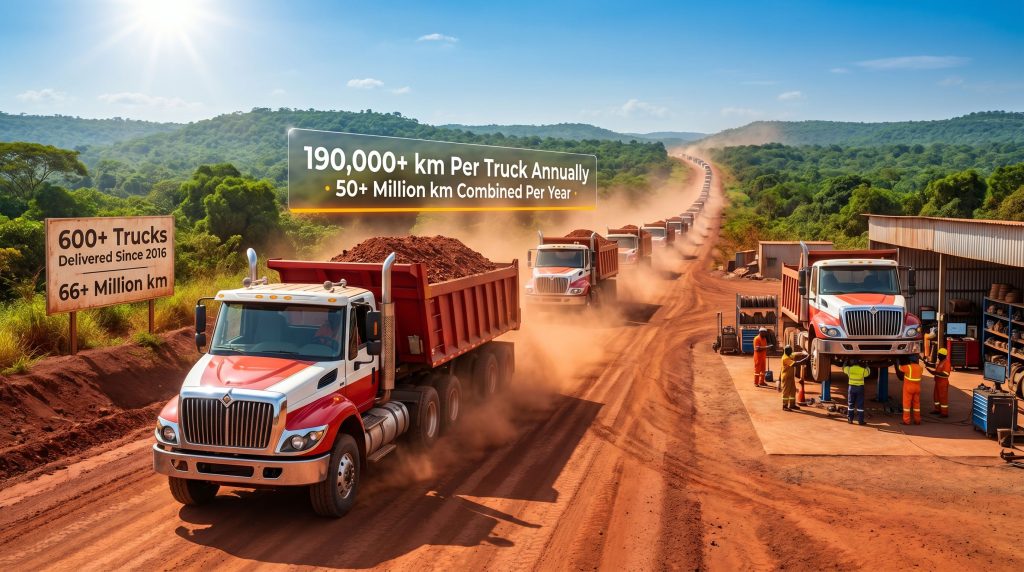
By 2026, the collaboration had reached its tenth anniversary, with more than 600 Renault Trucks delivered across the partnership's lifespan. Of those, 350 Renault K Trucks are actively deployed on bauxite haulage operations at any given time. This distinction matters: the cumulative delivery figure reflects the scale of the partnership's evolution over a decade, while the active deployment figure captures the current operational footprint. Furthermore, a detailed overview of this milestone is available through the ten-year anniversary coverage that charts the full trajectory of the collaboration.
Guinea's Boké Region: A Commodity Corridor Under Pressure
The Boké region sits at the heart of Guinea's bauxite belt, a geological formation that has positioned the country as the world's leading bauxite exporter by reserve volume. Guinea holds an estimated 7.4 billion tonnes of bauxite reserves, representing roughly one-quarter of total known global reserves, according to United States Geological Survey data. The country's export volumes have grown sharply over the past decade, driven primarily by Chinese alumina refinery demand, with Guinea now supplying a significant share of China's total bauxite import requirements. In addition, understanding global bauxite production leaders helps contextualise just how dominant Guinea's position has become.
The Boké-to-port corridor through which UMS operates connects inland extraction sites to coastal export terminals, forming one of the most logistically intensive heavy haulage routes in Sub-Saharan Africa. Conditions along this corridor include:
- High-abrasion lateritic road surfaces that accelerate tyre and drivetrain wear
- Persistent silica-rich dust that infiltrates filtration systems and accelerates engine component degradation
- Seasonal rainfall patterns that destabilise unpaved sections and reduce traction margins
- Round-the-clock operational demands with no tolerance for unplanned downtime
These conditions mean that standard road freight specifications are entirely inadequate. Heavy-duty mining configurations, purpose-adapted for continuous operation in tropical laterite environments, are a baseline requirement rather than an enhancement.
Fleet Composition and Operational Scale
The Numbers That Define a Decade of Haulage
The operational metrics underpinning the UMS and Renault Trucks Guinea bauxite partnership are striking in their scale. Each active truck covers more than 190,000 kilometres annually, a figure that dwarfs typical long-haul road freight benchmarks in developed markets, where annual distances of 120,000 to 150,000 kilometres are considered high-intensity. Across the full fleet of 350 trucks, the combined annual distance exceeds 50 million kilometres, and over the course of the partnership's operational history, cumulative fleet distance has surpassed 66 million kilometres.
| Operational Metric | Confirmed Figure |
|---|---|
| Active Renault K Trucks deployed | 350 units |
| Total trucks delivered since 2016 | 600+ units |
| Annual distance per truck | 190,000+ km |
| Combined annual fleet distance | 50+ million km |
| Cumulative fleet distance (decade) | 66+ million km |
| On-site mechanics employed | 150+ staff |
| Workforce localisation rate | ~98% Guinean employees |
To maintain continuous haulage across these distances, UMS operates integrated maintenance workshops staffed by more than 150 mechanics working across three shifts. This around-the-clock maintenance model ensures that vehicles cycling off haulage routes receive rapid turnaround servicing, minimising idle time and sustaining fleet availability at levels that extraction site throughput schedules demand.
Why the Renault K Platform Was Chosen
The Renault Trucks K series was selected for this application based on its technical suitability for heavy-payload, off-road mining cycles. The platform's chassis architecture, powertrain durability, and axle load ratings align with the demands of continuous ore transport over abrasive, unpaved surfaces. What is less commonly understood is the extent to which field-level operational feedback from UMS has subsequently shaped the vehicle's development trajectory.
Real-world data gathered from Guinea's mining environment, including wear patterns, failure modes, and performance under extreme dust loading, contributed to vehicle-level modifications that Renault Trucks later incorporated into its broader heavy-duty product range. This feedback loop is a genuinely significant dimension of the partnership: the mining operator effectively functions as an extended engineering test environment, generating applied performance intelligence that laboratory simulation cannot replicate.
This form of field-driven co-development represents a shift in how OEMs conceptualise their relationship with high-intensity operators. Rather than deploying a finished product, the manufacturer enters a continuous improvement cycle shaped by the most demanding real-world conditions on Earth.
The Integrated Support Model in Practice
Performance Optimisation Through Telematics
Renault Trucks conducts monthly reviews of telematics data drawn from the active fleet, analysing variables including fuel consumption rates, gear selection patterns, braking behaviour, and duty cycle intensity. The outputs of these reviews are fed back to UMS operational teams to drive adjustments in driving practice, load management, and route scheduling.
This approach to continuous performance monitoring reflects a broader shift in commercial vehicle partnerships from product-as-a-sale to product-as-a-service. In mining logistics, where fuel costs represent one of the largest variable operating expenses, even marginal efficiency gains compounded across a 350-truck fleet operating at 190,000 kilometres per unit annually translate into material cost reductions. Readers interested in how mine to port logistics strategies are structured across comparable West African operations will find further context in adjacent industry analysis.
Spare Parts Management and Uptime Assurance
Unplanned downtime in mining logistics carries disproportionate cost consequences. When a haul truck is offline, the ore it would have transported accumulates at the extraction face, creating potential bottlenecks that can propagate backwards through the mining operation and forwards into export scheduling. Renault Trucks supports UMS in managing on-site spare parts inventories in a coordinated manner designed to reduce the interval between fault identification and component replacement.
This inventory coordination model, which positions critical wearing parts within the operational perimeter rather than requiring procurement from distant distribution centres, is a structural advantage of embedded OEM partnerships over transactional fleet supply arrangements.
Workforce Development as Operational Infrastructure
The partnership's training architecture operates on two complementary cycles:
- Annual training programmes covering UMS mechanics, drivers, and on-site instructors, focused on vehicle systems, preventive maintenance procedures, and fault diagnosis
- Semi-annual specialist deployments in which Renault Trucks trainers visit operating sites to provide guidance on safe and fuel-efficient driving practices, with specific attention to conditions unique to the mining environment
With approximately 98% of UMS's workforce consisting of Guinean employees, these training programmes contribute directly to the development of in-country technical capability. In remote mining environments where third-party specialist support may require days to mobilise, the depth of locally embedded expertise is a critical operational resilience factor.
Why Mining Logistics Reliability Matters at a Global Scale
Guinea's Role in Aluminium's Raw Material Supply Chain
Bauxite is the singular raw material from which all aluminium is derived, processed first into alumina through the Bayer refining process and subsequently smelted into primary aluminium metal. Guinea's structural importance to this supply chain cannot be overstated: its reserve base, export growth trajectory, and proximity to Atlantic shipping routes position it as an indispensable node in global aluminium raw material flows. For context on bauxite's importance globally, the country's trajectory over the past decade stands as a defining feature of the aluminium supply chain.
Disruptions at the mine-to-port stage in Guinea have demonstrated the capacity to influence alumina spot prices in importing markets, particularly in China where refinery feedstock procurement is sensitive to West African supply continuity. Logistics reliability at the Boké corridor level is therefore not merely an operational concern for UMS and its mining clients. It has measurable downstream implications for aluminium production economics across multiple continents.
Embedded OEM Partnerships vs. Transactional Fleet Procurement
The structural distinction between these two models carries significant implications for total cost of ownership and operational performance in mining environments:
| Model Type | Key Characteristics | Typical Outcome |
|---|---|---|
| Transactional Fleet Supply | One-off vehicle purchase, third-party or self-managed servicing | Variable uptime, higher lifecycle maintenance cost |
| Embedded OEM Partnership | Integrated telematics, training programmes, coordinated parts management | Higher uptime, lower total cost of ownership |
The UMS framework exemplifies the embedded model at scale. By combining continuous data analysis, structured workforce development, and coordinated inventory management into a single operational relationship, the partnership creates uptime assurance mechanisms that a transactional procurement model structurally cannot replicate.
For mining operators in emerging markets where third-party service infrastructure is limited, the embedded OEM model effectively internalises capabilities that would otherwise require separate procurement from multiple specialist providers.
UMS as a West African Industrial Logistics Operator
Founded in 2001 by Fadi Wazni, UMS has grown into one of the most significant integrated logistics operators serving the West African mining sector. The company holds ISO 9001 certification, operates a total fleet exceeding 500 trucks across mining, industrial, and oil sector applications, and maintains its ~98% Guinean workforce as both an operational strength and a reflection of its long-term commitment to in-country capacity building.
This workforce localisation rate is not a marginal statistic. In the context of West African resource extraction, where the relationship between foreign-managed operations and host country communities has historically been a source of tension, a near-total local employment model represents a structural advantage in maintaining the social licence to operate, particularly across a decade of continuous expansion. The Renault Trucks official press release on this decade of collaboration provides further detail on how the partnership has been structured to support sustainable long-term operations.
Frequently Asked Questions
How long has the UMS–Renault Trucks partnership been operating in Guinea?
The partnership launched in 2016 with the involvement of local distributor TGH Plus, reaching its tenth anniversary in 2026. Over that period, more than 600 Renault Trucks have been delivered to support UMS operations across Guinea and West Africa.
What makes Guinea's bauxite logistics environment uniquely challenging?
The combination of continuous 24-hour operational demands, high-abrasion lateritic road surfaces, extreme airborne dust concentrations, and the need to sustain uninterrupted ore flow from extraction sites to export terminals creates one of the most mechanically intensive heavy haulage environments in the world. Each truck routinely covers more than 190,000 kilometres annually under these conditions.
How does telematics data improve fleet performance in this application?
Monthly telematics reviews analyse fuel consumption patterns, duty cycle intensity, and driving behaviour across the fleet. The findings are used to refine operating practices, adjust load scheduling, and identify vehicles requiring preventive maintenance before fault conditions develop into unplanned downtime events. Industry discussions at events such as the Fastmarkets bauxite conference have increasingly highlighted this kind of data-driven fleet management as a best practice across the sector.
Has operational feedback from Guinea influenced Renault Trucks' product development?
Confirmed. Performance data and modification requirements identified through UMS's Guinea operations have contributed to vehicle-level engineering changes subsequently incorporated into Renault Trucks' heavy-duty product range, demonstrating the compounding technical value of long-duration embedded partnerships. Projects such as the Niagara bauxite project elsewhere in the region illustrate how emerging operations may similarly benefit from adopting embedded logistics models from the outset.
The next major ASX story will hit our subscribers first
Key Takeaways
The UMS and Renault Trucks Guinea bauxite partnership illustrates several principles with broader relevance to mining logistics, OEM strategy, and West African resource development:
- Operational intensity at scale: 350 trucks covering 50+ million kilometres annually in among the most demanding haulage conditions on Earth demands an integrated support model that transactional procurement cannot provide
- Field-driven engineering value: A decade of real-world feedback from Guinea's laterite mining environment has produced vehicle modifications now embedded in Renault Trucks' heavy-duty product architecture
- Supply chain criticality: Guinea's position as the world's leading bauxite exporter means that logistics reliability at the Boké corridor level carries direct implications for global aluminium raw material supply continuity
- Localisation as resilience: A ~98% Guinean workforce is both an operational advantage in remote environments and a model for sustainable long-term resource sector engagement
- The embedded OEM model: The three-layer framework combining telematics analysis, coordinated parts management, and structured workforce training represents an increasingly influential template for mining fleet partnerships across Sub-Saharan Africa
Disclaimer: This article contains forward-looking observations and contextual analysis based on publicly available data. Figures relating to reserve estimates and market dynamics are drawn from third-party sources and should not be treated as investment advice. Readers should conduct independent research before making decisions based on industry data referenced herein.
Want to Know Which ASX Mineral Discoveries Could Define the Next Decade of Resources?
Discovery Alert's proprietary Discovery IQ model scans ASX announcements in real time, instantly identifying significant mineral discoveries — including those in the bauxite and alumina supply chain — and translating complex data into actionable investment insights, much like the historic returns documented on Discovery Alert's dedicated discoveries page. Start your 14-day free trial today and position yourself ahead of the broader market before the next major discovery is priced in.