July 11, 2026
The Technology Rewriting India's Coal Equation From the Ground Up
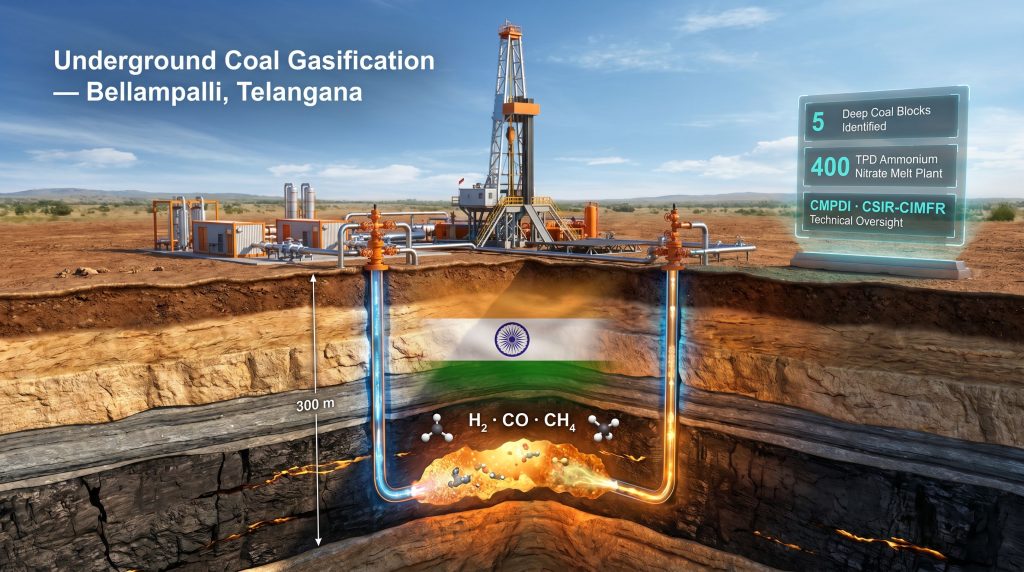
Most energy transitions begin at the surface. New turbines, new panels, new pipelines. But one of the most consequential shifts in India's energy landscape is happening hundreds of metres underground, where coal that can never be mined conventionally is being reimagined as a source of synthetic gas without a single tonne ever reaching the surface. This is the promise of underground coal gasification, and it sits at the heart of the SCCL coal gasification pilot project now advancing in the Godavari Valley Coalfields of Telangana.
Understanding why this technology matters requires stepping back from the corporate announcement and examining the deeper mechanics of what UCG does, why India's coal resource base makes it particularly relevant, and what operational realities will determine whether this pilot becomes a commercial template or a cautionary study.
When big ASX news breaks, our subscribers know first
Underground Coal Gasification: The Mechanism Beneath the Headlines
Underground Coal Gasification (UCG) converts coal into combustible syngas directly within the coal seam, eliminating the need for extraction entirely. The process relies on drilling injection wells and production wells into deep coal deposits, then introducing oxidants, typically air, oxygen, or steam, to initiate a controlled combustion reaction within the seam itself.
The resulting syngas is a mixture of:
- Hydrogen (H₂) – the highest-value component, useful for fuel cells and chemical feedstocks
- Carbon monoxide (CO) – a combustible component and chemical building block
- Methane (CH₄) – directly usable as a natural gas substitute
- Carbon dioxide (CO₂) – a process byproduct requiring management
The critical distinction between UCG and surface coal gasification is not just technical but economic. Surface gasification requires coal to be mined, transported, and fed into above-ground reactor systems, demanding substantial capital for both extraction infrastructure and processing plant construction. UCG, by contrast, treats the seam itself as the reactor. This makes it particularly well-suited to deep, structurally complex, or thin seams that conventional mining cannot economically access, echoing many of the underground mining challenges faced across the industry globally.
| Feature | Surface Coal Gasification | Underground Coal Gasification (UCG) |
|---|---|---|
| Coal extraction required | Yes | No |
| Suitable for deep seams | No | Yes |
| Infrastructure footprint | High | Lower |
| Syngas quality control | High | Variable |
| Environmental risk profile | Moderate | Requires careful site management |
| Commercial maturity | Established | Emerging/Pilot stage |
| Capital expenditure | High (surface plant) | Lower upfront, complex drilling |
| Timeline to production | 3-5 years | 5-10 years (pilot to commercial) |
Globally, UCG has been demonstrated across Australia, the United States, China, South Africa, and Uzbekistan. The Yerostigaz operation in Uzbekistan represents the world's longest-running commercial UCG facility, providing decades of operational continuity data that remains invaluable to programs at the pilot stage. China currently operates the largest active UCG research portfolio globally, with dozens of pilot sites providing a growing body of subsurface engineering knowledge.
What Does International UCG Experience Reveal?
Risk Insight: International UCG experience consistently identifies groundwater contamination and subsurface pressure management as the two most operationally critical risk factors. Australia's Linc Energy program was shut down by regulators after concerns over groundwater impacts, a lesson that shapes every credible UCG program's environmental management framework today.
Furthermore, in-situ extraction methods applied across various mineral sectors provide useful comparative frameworks for understanding how subsurface chemical processes can be managed responsibly at scale.
Why SCCL's Strategic Pivot Makes Sense Now
Singareni Collieries Company Limited operates across the Godavari Valley Coalfields in Telangana, one of India's most geologically significant coal-bearing formations. As Telangana's primary coal producer, SCCL's operational mandate has historically been defined by extraction volumes. The move into gasification represents a structural reimagining of that mandate.
India's coal dependency provides the macro context. Coal accounts for approximately 55-60% of India's electricity generation capacity, making it the dominant fuel in the country's power mix. Yet India has also committed to Nationally Determined Contribution targets under the Paris Agreement, creating genuine tension between near-term energy security requirements and longer-term decarbonisation obligations.
For state-owned coal enterprises, this tension is not abstract. It directly shapes how asset portfolios are valued, how future capital investment is justified, and how regulators and government stakeholders view the long-term role of coal companies. The energy transition demand for cleaner industrial processes only intensifies this pressure.
How Does Gasification Resolve the Coal Transition Dilemma?
The gasification pathway offers a compelling resolution to this tension. Rather than abandoning coal assets as stranded liabilities, gasification converts them into feedstocks for higher-value products including syngas for power generation, hydrogen for industrial use, and chemical precursors for fertilizer production. For SCCL specifically, five deep coal blocks in the Bellampalli and Ramagundam regions represent resources that are currently economically unmineable by conventional methods. UCG offers a mechanism to unlock that stranded value.
The involvement of the Directorate General of Hydrocarbons (DGH) under India's Ministry of Petroleum and Natural Gas reflects the inter-ministerial dimension of this transition. Coal gasification sits at the regulatory intersection of mining law and hydrocarbon law, and SCCL's engagement with DGH signals that the company is actively navigating that boundary rather than waiting for regulatory clarity to arrive on its own.
The Ammonium Nitrate Plant Assessment: Where the Numbers Stand
One of the more instructive elements of SCCL's gasification program is what the feasibility numbers revealed about the 400 tonnes per day Ammonium Nitrate Melt plant assessed by Engineers India Limited (EIL) for the Singareni Thermal Power Plant premises.
The EIL study concluded that current return-on-investment metrics do not meet acceptable thresholds. This is not unusual for first-generation gasification-linked chemical plants, where technology risk, scale limitations, and input cost uncertainties compress projected returns. What matters strategically is how SCCL is responding to that finding. Three distinct levers are being evaluated:
- Capacity scaling – moving beyond 400 TPD to improve unit economics through volume efficiency
- Viability Gap Funding (VGF) – accessing the central government's infrastructure subsidy mechanism designed for projects with long-term strategic value but insufficient near-term commercial returns
- Indigenous technology adoption – reducing capital expenditure and licensing costs by deploying domestically developed gasification technologies rather than imported systems
India's VGF scheme typically provides capital grants of up to 20-40% of project cost, structured to close the viability gap between what private economics justify and what national strategic interest requires. For gasification projects with multi-decade asset life but front-loaded capital intensity, VGF can be the difference between projects proceeding and projects remaining indefinitely at the feasibility study stage.
The economic breakeven for SCCL's gasification ambitions will ultimately depend on three converging variables: the achievable scale of operations, the regulatory cost structure for syngas production, and the market price realisation for downstream products including ammonium nitrate and potentially hydrogen.
Operational Design of the Bellampalli UCG Pilot
The Bellampalli dip-side block has been identified as the site for SCCL's first UCG pilot, and preparatory work is currently underway. The technical criteria that made Bellampalli the priority selection reflect the fundamental requirements for viable UCG operations:
- Coal seam depth exceeding 300 metres, sufficient to prevent surface subsidence and separate combustion zones from shallow groundwater systems
- Seam thickness and lateral continuity supporting sustained combustion pathways
- Hydrogeological isolation ensuring aquifer systems above the seam are not connected to the combustion zone
- Structural geology characteristics including manageable faulting and workable dip angles for well placement
Current preparatory activities encompass drilling operations planning covering well placement strategy for both injection and production wells, well completion design including casing specifications and ignition point engineering, and surface facility design for syngas capture, conditioning, and initial processing.
What Institutional Support Is Underpinning the Pilot?
Scientific and technical oversight is being provided by two institutions whose involvement is operationally significant. CMPDI (Central Mine Planning and Design Institute) brings deep expertise in Indian coalfield geology and mine planning, while CSIR-CIMFR (Central Institute of Mining and Fuel Research) is India's premier applied research institution for mining and fuel technology.
CSIR-CIMFR's specific role in the SCCL coal gasification pilot project is particularly important given international experience. The institute's involvement is specifically intended to address groundwater and subsurface pressure management within India's geological context rather than simply transplanting methodologies developed for Australian or Chinese coalfields.
Simultaneously, SCCL has established a dedicated UCG Project Group through its collaboration with CEPL, creating an organisational structure focused exclusively on gasification development within SCCL's existing coal lease areas. Parallel techno-economic feasibility studies are also underway for surface coal gasification at three additional locations: Bheemaram, Chennur South, and Naini.
Learning From Reference Projects: The Benchmarking Strategy
A team of SCCL officials is conducting technical study visits to three operational coal gasification installations, each offering distinct transferable insights:
| Reference Project | Partners Involved | Technology Type | Key Learning Objective |
|---|---|---|---|
| Talcher Fertilizer Plant | GAIL, CIL, RCF, FCIL | Surface coal gasification | Feedstock-to-fertilizer economics |
| MCL-BHEL Gasification Project | Mahanadi Coalfields + BHEL | Surface gasification | Indigenous technology integration |
| JSPL Gasification Facility | Jindal Steel and Power | Industrial syngas application | Private sector operational model |
The Talcher Fertilizer Plant is particularly instructive for SCCL's ammonium nitrate ambitions, as it represents one of the most advanced coal-to-fertilizer programs in India. The MCL-BHEL partnership demonstrates how indigenous technology can be integrated into a large-scale gasification program, directly relevant to SCCL's interest in reducing dependence on imported gasification systems. JSPL's facility, furthermore, provides a private sector reference point for industrial syngas economics.
The next major ASX story will hit our subscribers first
Environmental Trade-offs and the Transition Technology Question
Coal gasification occupies an ambiguous position in environmental discourse. Syngas combustion produces meaningfully lower particulate matter and sulfur dioxide emissions than direct coal combustion, addressing two of the most acute air quality impacts of coal-fired power generation in India. The process also creates structural compatibility with carbon capture and storage integration, though CCS at the scale required for commercial gasification operations remains expensive and technically demanding.
The net carbon accounting, however, remains challenging. UCG still produces CO₂ as a fundamental process output, and the full lifecycle emissions of gasification-to-power pathways remain higher than renewable alternatives. Consequently, effective mining waste management and emissions governance will be critical to maintaining regulatory and community confidence throughout the pilot phase.
India's government classifies coal gasification within its broader energy transition framework as a bridge technology: a mechanism for extracting economic value from existing coal assets while decarbonisation infrastructure is built out at scale. The green transition pressures facing state-owned enterprises make this classification both commercially useful and politically necessary.
India's stated target of gasifying 100 million tonnes of coal annually by 2030 provides the national policy backdrop for the SCCL coal gasification pilot project. Whether that target is achievable on that timeline is a subject of genuine industry debate, given the capital requirements, technology readiness levels, and regulatory complexity involved. What is clear is that state-owned coal enterprises are being positioned as active participants in that gasification build-out, with VGF mechanisms and institutional partnerships designed to accelerate the transition from feasibility study to operational pilot.
Key Takeaways: SCCL's Coal Gasification Program at a Glance
- Five deep coal blocks identified in Bellampalli and Ramagundam as UCG pilot candidates
- Bellampalli dip-side block selected as the first UCG pilot site, with drilling design and surface infrastructure planning actively underway
- 400 TPD Ammonium Nitrate Melt plant assessed by Engineers India Limited; currently below acceptable ROI thresholds without capacity enhancement or VGF support
- Three surface gasification areas at Bheemaram, Chennur South, and Naini under parallel techno-economic assessment
- CMPDI and CSIR-CIMFR providing scientific and technical oversight for the UCG pilot program
- DGH engagement reflecting inter-ministerial coordination between coal and petroleum regulatory frameworks
- Technical benchmarking visits planned to Talcher Fertilizer Plant, MCL-BHEL, and JSPL gasification facilities
Disclaimer: This article is intended for informational purposes only and does not constitute financial or investment advice. Forecasts, project timelines, and economic projections referenced herein are subject to change and involve inherent uncertainty. Readers should conduct independent research before making investment or operational decisions based on information contained in this article.
Want To Stay Ahead of Significant Mineral Discoveries on the ASX?
Discovery Alert's proprietary Discovery IQ model delivers real-time alerts the moment significant ASX mineral discoveries are announced, transforming complex geological data into clear, actionable investment insights for both short-term traders and long-term investors. Explore Discovery Alert's dedicated discoveries page to understand how historic mineral discoveries have generated substantial market returns, and begin your 14-day free trial today to position yourself ahead of the broader market.