
August 25, 2026
When the Safety Net Has Holes: Understanding the Worker Entitlement Crisis in Australian Industrial Insolvency
Every few years, a major industrial employer in Australia collapses under the weight of accumulated debt, leaving behind a workforce that discovers, often too late, that the legal framework designed to protect them has significant structural limitations. The Whyalla steelworks situation is not simply a story about one company's financial failure. It is a case study in how Australian insolvency law, worker protection legislation, and the political economy of industrial rescue operations interact in ways that consistently disadvantage employees over commercial creditors.
Understanding what is happening with GFG workers entitlements Whyalla requires stepping back from the immediate crisis and examining the legal architecture that determines who gets paid, how much, and when.
When big ASX news breaks, our subscribers know first
The Structural Disconnect Between Insolvency Law and Employee Protection
Australian corporate insolvency law operates on a creditor hierarchy that was designed primarily to manage commercial debt relationships. When a company enters administration or liquidation, the order in which creditors are paid is governed by the Corporations Act 2001, and while employees receive some priority protections, those protections are far from comprehensive.
Employees are classified as priority unsecured creditors for certain entitlement categories, including unpaid wages and annual leave. However, for other accrued entitlements, particularly long service leave in some circumstances and superannuation contributions, workers can find themselves competing with commercial creditors from a diminished asset pool. In practice, this distinction can mean the difference between recovering most of what is owed and recovering very little.
The Whyalla steelworks scenario illustrates this gap with particular clarity. With approximately $100 million in total worker entitlements at risk across the workforce, the sheer scale of potential losses makes this one of the most significant worker entitlement crises in recent Australian industrial history. Furthermore, commodity prices and mining performance have placed additional strain on industrial employers, making these collapses increasingly common.
"The fundamental problem is not that Australia lacks worker protection laws. The problem is that those laws were designed for a different era of corporate structure, one where employers were simpler entities with traceable assets rather than subsidiaries within opaque multinational conglomerates."
The Fair Entitlements Guarantee: What It Covers and What It Misses
The primary federal safety net for workers in this situation is the Fair Entitlements Guarantee (FEG), administered through the Department of Employment and Workplace Relations. The FEG was established to provide a last-resort payment system for eligible employees who lose their jobs due to employer insolvency. However, understanding its limitations is critical for any Whyalla worker assessing their recovery options.
What the FEG Covers
- Unpaid wages (capped at 13 weeks)
- Annual leave entitlements
- Payment in lieu of notice (capped at 5 weeks)
- Redundancy pay (capped at 4 weeks per year of service, up to a maximum of 16 weeks)
- Long service leave in some circumstances
What the FEG Does Not Cover
- Superannuation contributions owed by the employer
- Entitlements above the scheme's legislative caps
- Claims from workers employed through liquidated subsidiary companies where eligibility criteria are not met
- Bonuses, commissions, or non-standard contractual entitlements
The superannuation exclusion is particularly significant at Whyalla. For long-tenure workers who may have accumulated years of unpaid or underpaid super contributions, the FEG provides no recovery pathway. That responsibility falls to the Australian Taxation Office and individual superannuation funds, which can pursue unpaid contributions independently, though the process is slow and recovery is not guaranteed.
Breaking Down the $100 Million Shortfall: A Creditor Hierarchy Analysis
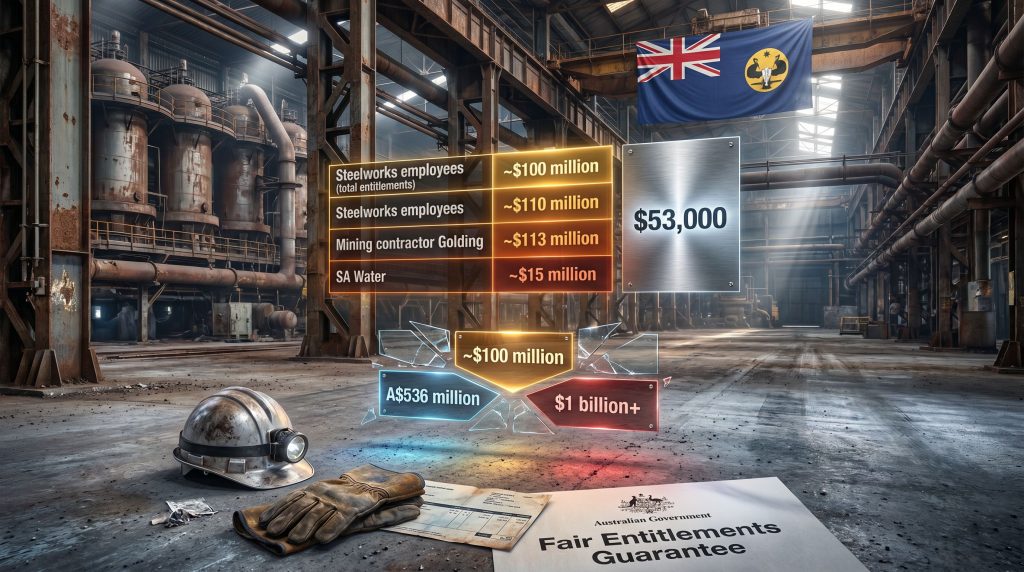
The financial complexity of the Whyalla administration becomes apparent when examining the full creditor landscape. The table below provides a structured overview of the estimated debt exposure and the priority status of each creditor category.
| Creditor Category | Estimated Amount Owed | Priority Status |
|---|---|---|
| Steelworks employees (total entitlements) | ~$100 million | Mixed (secured/unsecured by category) |
| GFG Alliance (largest creditor claim) | ~A$536 million | Contested |
| Mining contractor Golding | ~$113 million | Unsecured |
| SA Water | ~$15 million | Government creditor |
| Total estimated debt exposure | $1 billion+ | Multi-tiered |
One of the most unusual and troubling features of this administration is that GFG Alliance itself has lodged a creditor claim of approximately A$536 million against the estate. This creates a structural conflict of interest: the parent entity that was responsible for the steelworks' operations is simultaneously positioned as the largest creditor competing against workers and contractors for recovery from the same asset pool.
For workers, this dynamic is not merely an abstract legal concern. It directly affects the proportion of the asset pool available for employee entitlement recovery once secured creditors, administration costs, and priority claims are addressed. Indeed, the Glencore Mount Isa smelter bailout situation demonstrated similarly troubling patterns in how creditor hierarchies can marginalise workers.
What $53,000 in Lost Entitlements Means in Practice
Individual financial exposure varies significantly based on tenure and entitlement categories. A worker with 14 years of continuous service at the Whyalla facility faces a potential entitlement loss of approximately $53,000, a figure that encompasses unpaid wages, accrued leave balances, redundancy entitlements, and potentially years of superannuation shortfalls.
For workers in this position, the financial consequences compound in several ways:
- The immediate income loss affects mortgage repayments, household expenses, and short-term financial stability.
- Superannuation shortfalls reduce retirement savings at a point in the worker's career when compounding returns are most valuable.
- Long-service leave, often representing years of commitment to a single employer, may be partially or entirely unrecoverable.
- Workers have already waited more than 12 months without resolution, extending the period of financial and psychological uncertainty.
"Workers approaching the final decade of their careers are particularly exposed. A $53,000 entitlement loss is not easily absorbed, and the superannuation shortfall component, which is excluded from FEG coverage, can translate into a materially reduced retirement income for the remainder of their lives."
How Did the Administration Create Prolonged Uncertainty?
When the South Australian Parliament moved to place the steelworks into administration, the legislative action was framed primarily around preserving the industrial facility as a functioning asset. The trade-off involved in that approach, however, was that administration rather than immediate liquidation creates an extended period of uncertainty during which workers cannot finalise their entitlement claims.
Administration is designed to allow an insolvent company to continue operating while a restructuring or sale process is pursued. For creditors, including employees, this means waiting for asset realisation outcomes before recovery amounts can be determined. In complex administrations involving multiple related entities, that process can extend well beyond initial estimates.
The additional complexity introduced by GFG Alliance's corporate structure compounds this challenge. Multi-entity corporate groups create asset traceability problems that are difficult to resolve even with robust insolvency law. When subsidiary companies that were the direct employers of workers have been liquidated, as reported in the ABC's coverage of Whyalla's liquidated companies, the legal pathways for recovery become considerably more constrained.
Step-by-Step: What Affected Workers Should Do Now
Workers owed entitlements from the Whyalla steelworks administration should not wait for the process to conclude before taking action. Early registration and claim lodgement protect creditor positions and access to available schemes.
-
Register with the Administrator — File a formal proof of debt with the appointed administrator to establish your creditor position in the hierarchy. This is a foundational step that cannot be skipped.
-
Apply to the Fair Entitlements Guarantee (FEG) — Submit an FEG claim through the Department of Employment and Workplace Relations for eligible unpaid entitlements. Do not delay this step waiting for administration outcomes.
-
Contact the Fair Work Ombudsman — Lodge a complaint to investigate unpaid wages and superannuation obligations. The Ombudsman has enforcement powers that operate independently of the administration process.
-
Engage Union Representation — Work through relevant unions, including the Australian Workers' Union, to pursue collective claims and maintain pressure on government and administrators. The AWU's message to SA branch members outlines relief pathways available to those affected.
-
Contact Your Superannuation Fund — Notify your superannuation fund of any suspected unpaid contributions. Super funds can pursue employers for unpaid contributions independently of both the FEG and the administration process.
-
Seek Independent Legal Advice — Consult an employment lawyer specialising in insolvency to assess individual recovery options, particularly for entitlements that fall outside FEG coverage.
-
Monitor Administrator Reports — Track creditor meeting outcomes and asset realisation progress through ASIC's published insolvency notices, which provide structured updates on the administration's progress.
"Workers who believe they are owed unpaid entitlements should not wait for the administration process to conclude before lodging FEG claims. Early registration protects your position and ensures you are not inadvertently excluded from recovery pathways by procedural deadlines."
The next major ASX story will hit our subscribers first
South Australia's Compounding Industrial Vulnerability
The Whyalla situation does not exist in isolation. South Australia is simultaneously managing significant industrial stress across multiple sectors. The Port Pirie lead smelter, which employs close to 1,400 workers, is facing its own financial pressures, with the company seeking additional government support to remain viable. The simultaneous fragility of both the state's steel and lead processing industries represents an unusual concentration of industrial risk for any single state government to manage.
This regional concentration of industrial risk is a structural vulnerability that policymakers have historically underestimated. When a single large employer dominates a regional economy, the collapse of that employer does not merely affect the directly employed workforce. It creates cascading effects through local businesses, housing markets, municipal revenue bases, and community services that can persist for years.
The broader pattern — from Whyalla to Port Pirie to Tomago Aluminium in New South Wales — suggests that Australia's resource export challenges are placing governments in consistently reactive positions, intervening after financial distress is already acute rather than establishing structural protections that would reduce the scale of worker losses before they occur.
The Policy Reforms That Could Prevent the Next Whyalla
Several reform proposals have been discussed by unions, legal academics, and worker advocacy groups in response to recurring entitlement losses in industrial insolvencies. The table below summarises the current status of key policy areas and the relative urgency of reform.
| Policy Area | Current Status | Reform Priority |
|---|---|---|
| FEG superannuation coverage | Excluded from scheme | High |
| Employee creditor priority ranking | Below secured creditors | High |
| Mandatory entitlement reserves | Not required | Medium |
| ASIC oversight of complex corporate structures | Reactive, not proactive | Medium |
| Government entitlement backstop powers | Limited and discretionary | High |
The most commonly cited reforms include:
- Expanding FEG coverage to include superannuation shortfalls, which currently fall entirely outside the scheme despite representing a significant component of total entitlement losses for long-tenure workers.
- Elevating employee priority in the creditor hierarchy for all entitlement categories, not just wages and annual leave, to reduce competition with commercial creditors from a shared asset pool.
- Mandatory entitlement reserves for large industrial employers operating in capital-intensive sectors, requiring ring-fenced funds that cannot be accessed by commercial creditors in insolvency proceedings.
- Proactive ASIC oversight of complex multi-entity corporate structures to provide earlier warning signals when financial distress is developing within conglomerates.
Several OECD nations have already adopted elements of these approaches. The United Kingdom operates a statutory redundancy payment scheme with broader coverage than Australia's FEG. Germany and Canada both maintain wage guarantee mechanisms that include stronger superannuation and pension protection elements. These international models demonstrate that more comprehensive worker protection in industrial insolvency is administratively and financially achievable. Consequently, government intervention in mining and heavy industry is likely to remain a contested policy space until these structural reforms are enacted.
Frequently Asked Questions: GFG Workers Entitlements Whyalla
What entitlements are Whyalla steelworks workers owed?
Affected workers may be owed a combination of unpaid wages, accrued annual leave, long service leave, redundancy pay, and unpaid superannuation contributions. The total estimated entitlement shortfall across the workforce is approximately $100 million, with individual worker losses varying significantly based on tenure and employment category.
Will the Fair Entitlements Guarantee cover all of what workers are owed?
No. The FEG covers certain categories of entitlements up to legislated caps, but it expressly excludes superannuation contributions. For workers with significant super shortfalls or entitlements exceeding the scheme's limits, FEG will not provide full recovery. The gap between FEG coverage and total entitlements owed is likely to be substantial given the $100 million total exposure.
How long does the FEG claims process take?
Processing times vary depending on the complexity of the insolvency. In straightforward cases, claims can be processed within several months. In complex administrations involving multiple related entities, disputed creditor claims, or ongoing asset realisation processes, workers may wait considerably longer. Complex industrial administrations have historically taken 18 to 36 months or more to reach final resolution.
What is GFG Alliance's role as a creditor in the Whyalla administration?
GFG Alliance has lodged a creditor claim of approximately A$536 million against the estate, positioning the parent entity as the single largest creditor. This creates a structural conflict because GFG Alliance, as the controlling group behind the steelworks' operations, is now competing with the workers it employed for recovery from the same diminished asset pool.
Can workers sue GFG Alliance directly for unpaid entitlements?
Pursuing claims directly against entities in administration or against parent companies is legally complex and practically difficult. The distinction between operating subsidiaries and parent company obligations under Australian corporate law means that workers employed by a subsidiary generally cannot automatically access the assets of a parent entity. Independent legal advice is essential before pursuing this pathway.
What should Whyalla workers do right now?
Register a proof of debt with the administrator, lodge an FEG claim with the Department of Employment and Workplace Relations, contact the Fair Work Ombudsman, notify your superannuation fund, and engage union representation. Taking these steps concurrently, rather than sequentially, maximises the available recovery pathways.
The Broader Warning: Industrial Preservation Is Not Worker Protection
Perhaps the most important lesson from the GFG workers entitlements Whyalla situation is that saving an industrial facility as an economic asset and protecting the workers employed within it are not the same objective. Mining industry consolidation and government interventions designed to preserve steel production capacity, maintain regional employment statistics, or protect industrial infrastructure can proceed in ways that do not secure the individual financial entitlements of the workers involved.
When emergency industrial legislation is drafted under political pressure and time constraints, the priority is typically the continuation of operations. The granular question of how workers will recover accrued entitlements, particularly those held within subsidiary companies that are subsequently wound up, can receive insufficient attention in that legislative environment.
The recurring nature of this pattern across Australian heavy industry — from steelmaking to aluminium smelting to lead processing — points to a structural policy failure that individual administrations cannot resolve. The reforms needed are legislative and systemic: stronger creditor protections for employees, mandatory entitlement reserves, and an expanded FEG scheme that reflects the actual scale of losses workers face when major industrial employers collapse.
Until those reforms are in place, workers at the next major industrial collapse will face the same queues, the same caps, and the same gaps that Whyalla workers are navigating today.
This article is for informational purposes only and does not constitute legal or financial advice. Workers seeking assistance with entitlement claims should contact the Fair Work Ombudsman, the Department of Employment and Workplace Relations, or an independent employment lawyer. Further coverage of the Whyalla steelworks situation and developments in Australian manufacturing policy is available through ABC News at abc.net.au/news.
Want to Stay Ahead of the Next Major ASX Mineral Discovery?
While industrial collapses highlight the fragility of entitlements built over decades, Discovery Alert's proprietary Discovery IQ model scans ASX announcements in real time, delivering instant alerts on significant mineral discoveries so investors can act before the broader market catches on — explore historic discoveries and their exceptional returns, then begin your 14-day free trial to position yourself at the forefront of the next major find.