July 12, 2026
The Quiet Revolution Reshaping How Mining Treats Its Biggest Liability
For most of the twentieth century, the economics of mining operated on a simple and deeply flawed assumption: once ore had been processed, whatever remained was a cost to be managed and forgotten. Tailings storage facilities — those vast engineered impoundments holding billions of tonnes of chemically altered, finely ground rock and process water — were treated as necessary evils. They consumed land, consumed capital, and occasionally failed with catastrophic consequences.
That assumption is now being systematically dismantled.
Across the global mining industry in 2026, tailings are being reconceived not as a terminal liability but as a dynamic frontier, where innovation in engineering, ecology, chemistry, and data science is converging to change what responsible mining looks like. The Mining Magazine Awards tailings innovation category sits at the centre of this shift, recognising companies pushing beyond compliance into genuinely transformative territory.
When big ASX news breaks, our subscribers know first
What the Mining Magazine Awards Programme Represents and How the Tailings Category Works
Mining Magazine has been the technical publication of record for mining professionals since its founding in 1909. Its annual awards programme spans 14 categories, covering disciplines from underground excellence and processing technology to software innovation and sustainability-focused engineering. The Tailings Innovation category has grown in prominence alongside the industry's intensifying focus on environmental stewardship, social licence, and the governance frameworks that underpin both.
Eligibility extends to both mining operators and mining equipment, technology, and services (METS) companies. This dual-track structure is deliberate. Modern tailings innovation rarely originates from a single stakeholder. The most impactful advances typically emerge from co-design relationships between technology developers, mining engineers, environmental scientists, and operations teams working across the full mine lifecycle.
Entries are evaluated against a structured set of criteria designed to distinguish genuine innovation from incremental process improvement:
| Evaluation Criterion | What Assessors Look For |
|---|---|
| Demonstrated Innovation | Novel processes, technologies, or operational approaches not previously applied at scale |
| Tailings Footprint Reduction | Measurable decrease in the physical or environmental extent of tailings storage facilities |
| Emergency Response Accountability | Documented frameworks with clear checks, escalation protocols, and stakeholder communication |
| Closure-Ready Design | Evidence that long-term site stability and rehabilitation are embedded in mine planning from the outset |
| Pond Minimisation Technology | Deployment of solutions such as large-scale centrifugation or filtered tailings systems |
What is notable about this framework is what it does not reward. Entries that simply demonstrate regulatory compliance, or that optimise an existing tailings system without meaningfully reducing its environmental footprint, are unlikely to progress. The bar has been deliberately set above standard industry practice.
Technologies Driving Tailings Innovation Recognition in 2026
Centrifugal Separation Systems: Engineering Ponds Out of the Equation
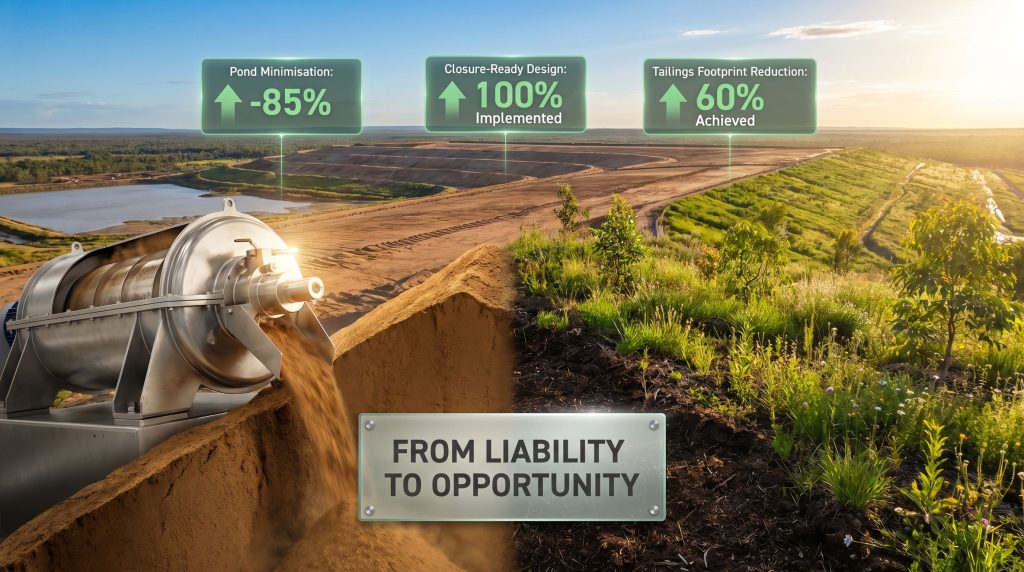
Large-scale centrifugation represents one of the most structurally significant advances in tailings management in recent decades. Rather than directing slurry into a storage pond and waiting for gravity-driven separation over months or years, centrifugal decanter systems mechanically dewater tailings at the point of production, generating a stackable solid material and a recoverable process water stream.
Flottweg, a German engineering firm specialising in separation technology, has been shortlisted in the 2026 Mining Magazine Awards tailings innovation category for its centrifuge-based approach to pond elimination. The practical implication is significant: where conventional tailings management creates long-lived wet impoundments with ongoing seepage, stability, and closure risks, centrifugal processing removes the liquid phase upstream.
This converts the liability profile of the facility from dynamic to static. Furthermore, from an investment perspective, the capital intensity of centrifugal systems is considerable, but the long-term operating cost reduction and liability elimination can generate a compelling total cost of ownership case, particularly as regulatory scrutiny continues to intensify globally.
Filtered and Dry Stack Tailings: Balancing Risk and Resource Efficiency
Filtered tailings technology — which uses high-pressure filtration to reduce moisture content before deposition — has gained substantial traction in water-scarce jurisdictions where reducing process water consumption is both an environmental necessity and an operational priority. Dry-stacked tailings facilities carry meaningfully lower geotechnical failure risk than conventional wet impoundments.
This factor has become increasingly material to project insurers, lenders, and regulators following several high-profile dam failures in the prior decade. The operational complexity of filtered tailings varies significantly by ore type. Fine-grained ores can present challenges for filtration efficiency, while coarser materials in gold and copper operations tend to filter more predictably. Consequently, filtered tailings is not a universal solution but a contextually powerful one.
Biological and Phytoremediation Approaches to Land Recovery
Beyond engineering, biology is emerging as a meaningful tailings management tool. Phytoremediation — the use of specific plant species to extract, immobilise, or degrade contaminants in tailings-affected soils — has demonstrated measurable effectiveness in stabilising heavy metal concentrations in post-mining landscapes. Certain plant species, including members of the Thlaspi and Sedum genera, are known hyperaccumulators.
These species are capable of concentrating metals like zinc, cadmium, and nickel in their above-ground biomass at levels orders of magnitude above surrounding soil concentrations. This capability creates an intriguing secondary value proposition. In theory, harvested biomass from hyperaccumulating plants grown on nickel or cobalt-bearing tailings could be processed to recover trace metal content, effectively creating a bio-mining loop.
Slag Valorisation and Soil Amelioration: Harita Nickel's Circular Approach
One of the most compelling case studies in the 2026 shortlist involves Harita Nickel's application of nickel processing slag as a soil ameliorant in post-mining land reclamation programmes. Slag — the glassy or crystalline residue generated during pyrometallurgical smelting — has historically been stockpiled as an inert waste product. Harita's approach reframes it as a functional soil input, reflecting the broader push for mine reclamation innovation across the sector.
Nickel slag contains elevated concentrations of magnesium and silica, both of which can improve the physical structure and pH balance of degraded soils. When applied appropriately and following agronomic testing, it can accelerate revegetation timelines and support biodiversity recovery on land that would otherwise remain biologically inert for years or decades. This approach reflects the circular economy logic now being applied across the minerals processing sector.
Digital Monitoring and Real-Time Tailings Risk Intelligence
The integration of sensor networks, satellite-based deformation monitoring, and machine learning-driven anomaly detection into tailings facility management represents a lower-capital but high-impact category of innovation. Real-time monitoring platforms can detect millimetre-scale movement in embankment walls weeks before conventional inspection methods would identify a developing instability.
The Global Industry Standard on Tailings Management (GISTM), published in 2020 and now widely referenced by institutional investors and project financiers, emphasises independent monitoring, transparent reporting, and engineer-of-record accountability. Digital monitoring systems that generate auditable, time-stamped data streams are increasingly viewed as essential infrastructure for GISTM alignment.
"Digital tailings monitoring is no longer a premium option for well-capitalised majors. As data costs fall and sensor miniaturisation continues, it is becoming baseline expectation for any facility where a failure would have material consequence for communities or ecosystems downstream."
The 2026 Tailings Innovation Shortlist: What the Entries Signal
The 2026 shortlisted entrants reflect a discernible pattern. None are optimising legacy approaches at the margin. Each is attacking the tailings problem from a fundamentally different conceptual position — whether by eliminating ponds entirely, converting waste streams into ecological inputs, or embedding closure thinking into day-one operational design.
| Approach Type | Primary Benefit | Environmental Outcome | Operational Complexity |
|---|---|---|---|
| Large-Scale Centrifugation | Eliminates liquid tailings ponds | Dramatically reduced seepage and contamination risk | High capital, lower long-term operating cost |
| Slag-to-Soil Conversion | Repurposes industrial byproduct | Supports revegetation and post-mining biodiversity | Moderate, requires agronomic testing |
| Dry Stack / Filtered Tailings | Reduces water consumption | Lower geotechnical failure risk | Moderate-to-high depending on ore type |
| Real-Time Digital Monitoring | Early hazard detection | Prevents catastrophic failures | Low-to-moderate integration cost |
What separates shortlisted entrants from routine industry practice is not merely technological novelty. It is the integration of environmental, financial, and social outcomes into a coherent system — where waste reduction, liability management, and value creation are treated as simultaneous objectives rather than competing trade-offs.
ESG, Regulation, and the Investment Case for Tailings Innovation
Why the Regulatory Environment Is Tightening
The collapse of the Fundão tailings dam in Brazil in 2015 and the Brumadinho failure in 2019 fundamentally altered the global regulatory landscape for tailings management. Together, these events resulted in hundreds of fatalities, widespread riverine contamination, and billions of dollars in liability for the companies involved. They also triggered a wave of regulatory reform across multiple jurisdictions and catalysed the development of the GISTM.
Countries including Canada, Chile, Australia, and members of the European Union have all moved to tighten tailings-specific regulations in the years since, with requirements increasingly focused on independent engineering review, public disclosure, and emergency preparedness planning. In addition, the broader mining sustainability transformation underway across the industry is amplifying pressure on operators to demonstrate genuine environmental accountability.
The ESG Investor Dimension
Institutional capital allocators and ESG-focused funds have elevated tailings governance to a tier-one screening criterion. The logic is straightforward: a single tailings facility failure can destroy asset value, trigger regulatory shutdown of associated operations, generate multi-generational remediation liabilities, and permanently damage a company's social licence across entire jurisdictions.
"Institutional investors are increasingly treating tailings governance quality not as an ESG checkbox but as a direct proxy for management competence and long-term capital discipline."
Recognition in the Mining Magazine Awards tailings innovation category functions as a verifiable, independently assessed signal of performance quality. For companies building sustainability reports or engaging with ESG ratings agencies, award shortlisting provides third-party validation that their tailings approaches meet a rigorous, technically informed standard. Furthermore, understanding natural capital in mining is increasingly central to how investors assess long-term asset value.
Tailings as a Secondary Resource: The Critical Mineral Opportunity
Reprocessing Legacy Tailings for Battery and Technology Metals
Perhaps the most structurally underappreciated dimension of the tailings innovation conversation is the potential for legacy tailings facilities to serve as secondary resources for critical minerals. Decades of mining activity using less efficient metallurgical processes have left significant concentrations of cobalt, lithium, scandium, rare earth elements, and other technology metals in historical tailings deposits worldwide.
Modern hydrometallurgical and sensor-based sorting technologies can in many cases recover these residual values economically, particularly as commodity prices for battery-relevant metals have risen. A mid-tier copper operation whose tailings contain even modest cobalt concentrations may find, at current cobalt pricing, that reprocessing generates meaningful secondary revenue while simultaneously reducing the long-term footprint and liability of the storage facility.
This dual-value proposition is attracting a new category of project financing. Impact-oriented capital providers and circular economy-focused investors are increasingly willing to fund tailings reprocessing projects under frameworks that would not apply to conventional greenfield mining, partly because the environmental narrative is positive and partly because the ore risk is substantially reduced when working with characterised material.
Leading Regions for Tailings Reprocessing Investment
- Southern Africa: Legacy gold tailings on the Witwatersrand contain residual gold and uranium concentrations that continue to attract reprocessing investment.
- South America: Copper tailings across Chile and Peru are being evaluated for residual molybdenum, rhenium, and cobalt content.
- Eastern Europe: Historical industrial mining in countries including Poland and Romania has left complex tailings deposits under renewed scrutiny for rare earth and base metal recovery.
- Southeast Asia: Nickel laterite processing in Indonesia and the Philippines generates slag and tailings streams now being assessed for secondary value.
The next major ASX story will hit our subscribers first
Design-for-Closure: Embedding the End Game From Day One
The Shift From Closure Planning to Closure Design
Conventional mining practice historically treated closure planning as a late-stage exercise — something addressed once reserves were nearly depleted. The emerging best practice inverts this entirely. Design-for-closure principles require that post-mining land use objectives, rehabilitation outcomes, and long-term geotechnical stability targets are established before infrastructure is built, with every operational decision evaluated against those long-term endpoints.
For tailings facilities specifically, this means:
- Selecting facility geometry and liner systems based on long-term stability modelling, not just short-term operational convenience.
- Scheduling progressive rehabilitation of inactive tailings cells rather than treating the entire facility as a post-closure problem.
- Integrating community consultation on post-mining land use into facility planning from the feasibility stage.
- Ensuring closure cost provisions in financial statements reflect realistic rehabilitation timelines and technology costs.
Community Engagement and Social Licence Considerations
Social licence considerations around tailings management extend well beyond the operational period. Communities located downstream or downwind of tailings facilities have legitimate long-term interests in closure outcomes, and in many jurisdictions those communities now have formal legal standing in planning and approval processes.
Mining companies that treat post-mining land use as a genuine community design process — rather than a compliance exercise — consistently report better social licence outcomes and lower regulatory friction. Efforts to accelerate progress in this area are further supported by decarbonising mining operations and embedding sustainability into every stage of the mine lifecycle.
Frequently Asked Questions: Mining Magazine Awards Tailings Innovation
What is the Mining Magazine Awards Tailings Innovation category?
The Tailings Innovation category recognises mining operators and technology providers that have achieved measurable, verifiable advances in how mine tailings are managed, stored, repurposed, or eliminated. Entrants are assessed against criteria spanning environmental impact reduction, technological originality, operational accountability, and long-term site closure planning.
What types of companies are eligible to enter the Tailings Innovation award?
Both mining operators and METS companies are eligible. This dual eligibility reflects the collaborative nature of modern tailings innovation, where technology developers and operational teams frequently co-design solutions across the full mine lifecycle.
What technologies are most commonly recognised in the Tailings Innovation category?
Technologies that minimise or eliminate conventional tailings ponds — including large-scale centrifuges, filtered tailings systems, and dry stacking methods — are frequently highlighted. Biological remediation approaches and digital monitoring platforms are also gaining recognition as the definition of innovation continues to broaden.
Why is tailings innovation increasingly important to ESG performance?
Tailings storage facilities represent one of the most significant environmental and geotechnical liabilities in the mining sector. Demonstrable innovation in this area directly improves ESG scoring across multiple pillars, including environmental stewardship, community relations, and risk governance, making it a material factor in investor due diligence and project financing assessments.
What is the Global Industry Standard on Tailings Management?
The GISTM is an independently developed framework published in 2020 that establishes performance requirements for tailings facility design, operation, and closure. It is now widely referenced by major lenders, insurance providers, and institutional investors as a baseline governance expectation for mining operations with tailings storage facilities of any significant scale.
What the 2026 Shortlist Signals for the Broader Industry
The entries recognised in the Mining Magazine Awards tailings innovation category collectively point toward an emerging industry consensus: best practice now means treating tailings management as a value creation exercise, not a containment problem. Companies that continue to operate under legacy waste management frameworks face compounding risks — tightening regulation, reduced access to institutional capital, increasing insurance costs, and exposure to community and legal challenge.
For companies not yet investing in tailings innovation, the competitive pressure is becoming structural rather than reputational. Lenders applying GISTM-aligned covenants, insurers pricing geotechnical risk with greater granularity, and equity investors screening for tailings governance quality are all creating financial incentives that reinforce the operational and ethical case for innovation. In addition, the shift toward renewable mining solutions is further reshaping how operators approach environmental performance across all asset types.
Award recognition in a programme as technically credible as the Mining Magazine Awards provides something that internal reporting cannot: an externally verified, peer-assessed marker of performance quality. For ESG communications, investor relations, and social licence purposes, that distinction is becoming meaningfully valuable. Readers seeking further context on tailings management standards, ESG benchmarking, and mining innovation recognition can explore editorial coverage and technical reporting at Mining Magazine via miningmagazine.com, which has covered the global mining industry since 1909 and provides ongoing analysis across sustainability, technology, and operational excellence.
Want to Catch the Next Major ASX Mineral Discovery Before the Market Does?
Discovery Alert's proprietary Discovery IQ model delivers real-time alerts on significant ASX mineral discoveries, turning complex geological data into actionable insights for both short-term traders and long-term investors — explore the historic returns major discoveries have generated and begin your 14-day free trial today to position yourself ahead of the broader market.