August 6, 2026
The Sovereign Capital Offensive: Understanding ADNOC's Place in a Fracturing Global Oil Order
Every major commodity supercycle eventually reaches a moment where the structural constraints suppressing supply are removed — not gradually, but decisively. When that removal coincides with concentrated capital firepower, a compressed execution timeline, and a producer sitting on one of the world's largest reserve bases, the market implications extend well beyond a single announcement. That is the context in which the ADNOC $55 billion projects UAE oil growth strategy must be understood.
This is not simply a capital expenditure announcement. It is the financial translation of a sovereign energy policy transformation, one triggered by the UAE's formal departure from OPEC in early May 2026 and designed to close a production gap that quota constraints had artificially maintained for years.
When big ASX news breaks, our subscribers know first
From Quota Prison to Production Ambition: The Strategic Logic of Timing
For decades, OPEC's quota allocation system functioned as a production ceiling for member states, irrespective of their actual reserve base or technical capacity. Understanding OPEC's market influence helps clarify why member countries received individual production allocations set at OPEC ministerial conferences, and why exceeding those limits risked undermining the cartel's collective pricing discipline.
The UAE, holding proven crude oil reserves of approximately 97.8 billion barrels (roughly 8% of global proven reserves), had long operated under constraints that bore little relationship to what its geology and infrastructure could actually support.
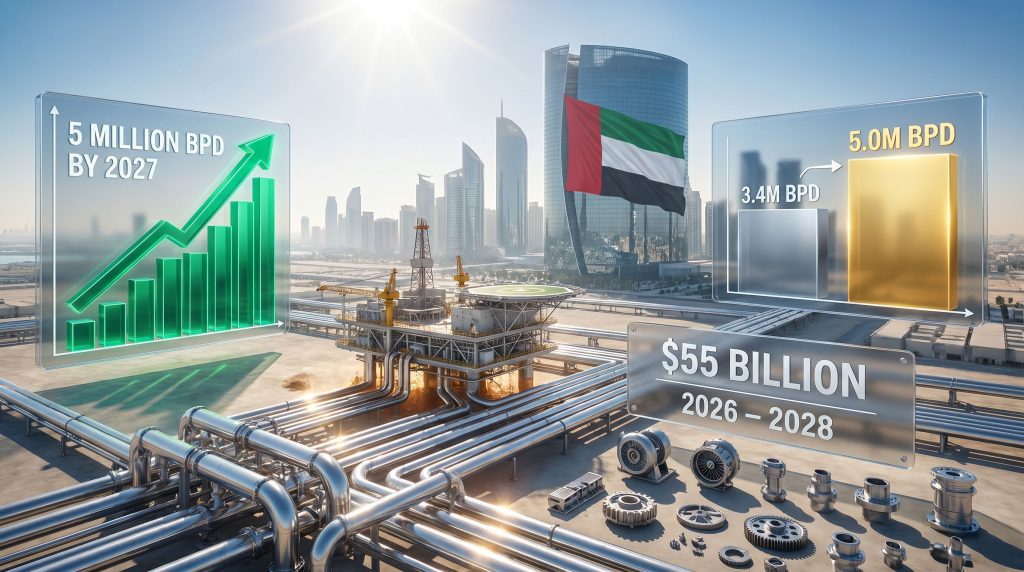
The previous OPEC-imposed ceiling sat at approximately 3.4 million barrels per day (bpd). ADNOC's publicly stated production target is 5 million bpd by 2027. That gap of roughly 1.6 million bpd is not a marginal increment. Annualised at benchmark crude prices near $70–80 per barrel, closing that gap translates to somewhere between $41 billion and $47 billion in additional annual revenue, depending on realised pricing.
What makes the timing strategically significant is that the $55 billion project award programme was announced within days of the UAE's formal OPEC exit. Capital deployment was not being planned in response to the exit; it was pre-positioned to activate immediately upon removal of the quota constraint. This sequencing signals institutional readiness rather than reactive planning.
"The UAE's post-OPEC production ambition represents one of the largest single-country capacity expansion targets among established producers. It is a structural supply event that global commodity markets have not yet fully priced in."
Breaking Down ADNOC's $55 Billion Project Awards: Scope, Structure, and Scale
The ADNOC $55 billion projects UAE oil growth strategy operates as a procurement and contracting mechanism rather than a single infrastructure announcement. ADNOC has confirmed plans to award up to $55 billion in project contracts across 2026 to 2028, spanning both upstream oil and gas capacity expansion and downstream processing and industrial development.
Understanding the programme's architecture requires distinguishing between three related but distinct concepts:
- Project Award — The issuance of engineering, procurement, and construction (EPC) contracts to selected firms, triggering contractor mobilisation.
- Capital Commitment — The financial obligation created when a contract is signed, recorded on balance sheets as a forward expenditure liability.
- Capital Deployment — The actual disbursement of funds as physical construction progresses, typically lagging awards by 12–24 months.
This distinction matters for market analysis. A $55 billion award window covering 2026–2028 will generate capital spending cascading into 2027–2030 as individual projects progress through design, procurement, construction, and commissioning phases. The production impact timeline will similarly extend beyond the 2027 target for later-stage project awards.
| Category | Detail |
|---|---|
| Total Award Value | Up to $55 billion USD |
| Award Window | 2026 to 2028 |
| Average Annual Award Rate | Approximately $18.3 billion per year |
| Production Target | 5 million bpd by 2027 |
| Previous OPEC Quota | Approximately 3.4 million bpd |
| Capacity Gap Being Closed | Approximately 1.6 million bpd |
| Portfolio Coverage | Upstream and downstream assets |
| UAE OPEC Exit Date | May 1, 2026 |
| Programme Framework | Part of ADNOC's five-year capex plan |
| Local Manufacturers Engaged | 70 (via Make it With ADNOC Forum) |
How ADNOC Compares to the World's Most Ambitious National Oil Companies
NOC Capital Programmes in a High-Investment Cycle
Situating the ADNOC $55 billion projects within a broader peer landscape reveals just how aggressive this execution cadence truly is. At an average annual award rate of approximately $18.3 billion, ADNOC's programme represents a 50–100% acceleration versus its historical capital deployment norms, which typically ranged between $8–12 billion annually based on Gulf NOC industry benchmarks.
By comparison, Saudi Aramco has maintained annual capex programmes of $30–40 billion, but that figure covers a vastly larger production base of approximately 12–13 million bpd. QatarEnergy's LNG expansion programmes have required roughly $20–30 billion annually through the mid-2020s for its North Field buildout. Iraq, despite holding massive reserves, remains limited to $5–8 billion per year due to chronic infrastructure gaps and institutional constraints.
The critical differentiator between National Oil Company investment decisions and those of International Oil Companies (IOCs) such as Shell, BP, and ExxonMobil lies in the governing mandate. NOCs operate under sovereign directives to maximise production volume and national revenue, while IOCs must balance capital allocation against shareholder return optimisation, debt management, and increasingly, ESG scoring frameworks.
Furthermore, as Western majors reduced upstream capital commitments through the early-to-mid 2020s in response to energy transition pressures, they created a structural void in traditional upstream investment that producers like ADNOC are uniquely positioned to fill.
Spare Capacity as a Geopolitical and Commercial Tool
One of the least discussed dimensions of ADNOC's expansion programme is what the resulting spare capacity actually means beyond its revenue implications. Spare production capacity functions simultaneously as a market stabilisation mechanism and a geopolitical instrument.
Producers holding deployable spare capacity can respond to supply disruptions, exert price influence, and offer security assurances to consuming nations — all of which carry strategic value far exceeding their immediate commercial utility. In addition, the broader geopolitical trade tensions reshaping global energy flows make this spare capacity positioning particularly consequential.
| Producer | Estimated Spare Capacity | Post-2025 Expansion Plans |
|---|---|---|
| Saudi Arabia | ~2.0 to 2.5 million bpd | Sustaining Aramco capacity targets |
| UAE (ADNOC) | ~1.5 to 1.6 million bpd (post-quota) | 5 million bpd target by 2027 |
| Iraq | Limited | Infrastructure-constrained growth |
| Kuwait | Moderate | Gradual, politically constrained expansion |
The UAE's repositioning as a quota-free holder of the second-largest deployable spare capacity block among established producers reshapes its standing in energy diplomacy discussions, independent of the direct production revenue calculus.
The "Local+" Industrial Strategy: When Energy Investment Becomes Economic Policy
Make it With ADNOC: Supply Chain Mobilisation at Scale
One of the more consequential but underreported dimensions of the ADNOC programme is its deliberate integration of national industrial development objectives into what would otherwise be a pure upstream investment cycle. The "Make it With ADNOC" Forum connected major international EPC contractors with 70 UAE-based manufacturers, establishing the local supply chain infrastructure needed to execute the project pipeline at the announced pace.
This is not a philanthropic gesture toward domestic businesses. It is a calculated supply chain resilience strategy. In a global EPC market already stretched by competing energy infrastructure demands, procurement lead times for critical equipment and materials have extended significantly. By integrating UAE-based manufacturers into the project delivery ecosystem, ADNOC reduces its exposure to global supply chain disruptions and compresses the time between contract award and first steel in the ground.
In-Country Value Programmes: The Economics of Domestic Retention
ADNOC's In-Country Value (ICV) programme mandates that a meaningful proportion of project value be delivered through UAE-based manufacturers and service providers. ICV frameworks, now common across Gulf NOC procurement systems, operate on a straightforward economic logic: every dollar of project value retained within the domestic economy generates additional multiplier effects — employment, industrial capability development, and tax receipts — that compound over time.
For international EPC contractors seeking participation in the $55 billion award pipeline, compliance with ICV requirements is not optional but a competitive qualification criterion. Consequently, this creates a powerful incentive for global engineering and construction firms to establish or expand UAE manufacturing and fabrication partnerships before the award cycle intensifies.
"ADNOC's industrial integration strategy transforms what would otherwise be a pure upstream spending announcement into a national economic development programme, with consequences for UAE manufacturing, employment, and long-term industrial competitiveness extending well beyond the energy sector."
Global Supply Implications: What 1.6 Million Extra Barrels Per Day Means for Markets
Supply Timing Against Demand Growth Trajectories
The net market impact of ADNOC's expansion will depend on the interaction between the pace of UAE production growth and concurrent global demand trajectories. Asia-Pacific demand centres, particularly China, India, and Southeast Asia, represent the primary destination markets for incremental Gulf crude volumes. These markets have shown structural demand growth through the early 2020s, driven by rising vehicle ownership, industrial activity, and petrochemical feedstock requirements.
Monitoring crude oil price trends becomes particularly important here, as the critical dynamic is the asymmetry between demand signals (which can shift rapidly in response to economic cycles) and supply responses (which require multi-year capital programmes to materialise). ADNOC's compressed execution timeline is explicitly designed to capture demand windows before market conditions shift.
The phrase describing ADNOC's approach as driven by "scale, pace and laser-focus on delivery", as reported by World Oil, reflects institutional awareness that the revenue-maximisation window for quota-free expansion may not remain indefinitely open.
OPEC+ Fragmentation and Benchmark Pricing Risks
The UAE's departure creates a precedent that deserves careful analysis. Other quota-constrained OPEC+ members — particularly Iraq and Kuwait, both holding significant but underutilised reserve bases — may interpret the UAE's exit as evidence that individual production growth ambitions can be pursued outside the cartel framework without catastrophic geopolitical consequences.
Furthermore, the Russian oil sanctions impact on global supply flows has already contributed to OPEC+ fragmentation pressures, making the pricing environment even more complex. If multiple producers follow the UAE's precedent, OPEC+'s collective pricing discipline would erode further, creating structural downward pressure on WTI and Brent benchmarks.
The net price impact of ADNOC's specific 1.6 million bpd capacity addition will depend on:
- The pace at which individual projects reach first production (2027–2030 timeline)
- Concurrent production decisions by remaining OPEC+ members
- Global demand growth realisation across Asia-Pacific markets
- The degree to which Western IOC upstream investment gaps are filled by other producers
- Macroeconomic conditions affecting energy consumption in major importing economies
At current global consumption of approximately 102–103 million bpd, a 1.6 million bpd addition represents roughly 1.5% of global supply — a volume sufficient to exert measurable price dampening effect if delivered rapidly into a market without compensating demand growth.
The next major ASX story will hit our subscribers first
Execution Architecture: How ADNOC Plans to Deliver at This Velocity
EPC Contractor Ecosystem and Procurement Friction
Translating $55 billion in project awards into operational infrastructure requires a deep and capable EPC contractor ecosystem. The global EPC market in 2026 faces competing demand from energy transition projects (offshore wind, hydrogen infrastructure, battery storage manufacturing) alongside conventional hydrocarbon projects, creating capacity constraints among leading engineering firms and specialist equipment manufacturers.
ADNOC's pre-positioning of contractor relationships through forums and early engagement programmes is designed to reduce procurement friction before the formal award cycle intensifies. According to ADNOC's announced strategy, by establishing preferred supplier networks and local manufacturing partnerships ahead of competitive bidding, ADNOC can compress the period between award decision and project mobilisation.
Digital Technology as an Execution Accelerator
ADNOC has developed a track record of deploying advanced operational technologies across its asset base, including AI-assisted project management platforms, digital twin modelling for facility design optimisation, and automation systems for construction monitoring. These capabilities provide a meaningful execution advantage in a compressed timeline scenario.
Digital twin technology, in particular, allows ADNOC to simulate full facility operations before physical construction commences, identifying engineering conflicts, optimising equipment layouts, and reducing costly on-site design modifications. When deployed across multiple simultaneous projects in a $55 billion award programme, these efficiency gains can translate to material schedule compression and cost avoidance.
Key Risk Factors Investors and Analysts Should Monitor
Despite the strategic clarity of ADNOC's execution ambition, several risk vectors warrant careful attention:
- Cost inflation exposure: A global construction environment stretched by competing infrastructure demands creates upward pressure on materials, skilled labour, and specialised equipment costs. Historical NOC mega-projects have experienced cost overruns of 20–30% relative to initial estimates.
- Schedule compression risks: Delivering a 1.6 million bpd capacity expansion by 2027 while simultaneously executing awards across 2026–2028 creates timeline overlap challenges, where earlier projects may compete with later awards for the same contractor and equipment resources.
- Benchmark price sensitivity: If crude oil prices fall materially below $60 per barrel, the economic justification for accelerated capital deployment weakens, potentially triggering deferrals or scope reductions.
- Geopolitical factors: Regional tensions in the broader Middle East can affect contractor mobilisation logistics, insurance availability, and supply chain routing.
Reconciling Expansion with Climate Commitments
ADNOC's hydrocarbon expansion ambitions exist in acknowledged tension with the UAE's international climate commitments, including its Net Zero by 2050 pledge and the country's role hosting COP28 in 2023. The company has sought to navigate this tension through parallel investments in carbon capture and storage (CCS) technology, clean hydrogen development, and emissions reduction programmes across its upstream asset base.
The underlying strategic logic is one of hydrocarbon monetisation velocity: maximise revenue extraction from existing fossil fuel assets within the remaining commercial window before energy transition dynamics fundamentally reshape demand, while simultaneously building positions in lower-carbon energy technologies. This approach reflects a pragmatic assessment that global oil demand, particularly in Asia-Pacific markets, will remain substantial through at least the mid-2030s even under accelerated transition scenarios.
However, whether this dual-track strategy satisfies international investors, financing institutions, and sustainability-focused stakeholders will depend heavily on the credibility and pace of ADNOC's decarbonisation investments relative to its upstream expansion commitments.
Frequently Asked Questions: ADNOC's $55 Billion Investment Programme
What is ADNOC planning to spend $55 billion on?
ADNOC has confirmed plans to award up to $55 billion in project contracts between 2026 and 2028, covering upstream oil and gas capacity expansion alongside downstream processing and industrial development. The awards form part of the company's existing multi-year capital expenditure programme and are structured to accelerate production growth toward a 5 million bpd target by 2027, as reported by World Oil on May 3, 2026.
Why did the UAE leave OPEC, and how does this relate to the investment programme?
The UAE's formal departure from OPEC in early May 2026 removed the production quota constraints that had previously capped Emirati output at approximately 3.4 million bpd — well below the country's technical production potential given its reserve base. Without quota limitations, ADNOC can pursue its full capacity ambitions commercially. The ADNOC $55 billion projects UAE oil growth strategy was pre-positioned to activate immediately upon exit, signalling that capital deployment planning preceded the formal OPEC departure.
How does ADNOC's local manufacturing strategy connect to the project awards?
ADNOC's In-Country Value (ICV) programme and "Local+" initiative require meaningful domestic supplier participation across its contractor ecosystem. The Make it With ADNOC Forum connected 70 UAE-based manufacturers with major international EPC contractors, establishing the local supply chain infrastructure necessary to support delivery of the project pipeline while retaining a larger share of project value within the UAE's domestic economy.
What are the implications for global oil prices?
The addition of up to 1.6 million bpd of incremental UAE production capacity, representing approximately 1.5% of current global supply, would exert measurable price pressure if delivered rapidly without corresponding demand growth. The net pricing impact remains dependent on the pace of actual production arrival, concurrent OPEC+ decisions, and macroeconomic demand conditions across Asia-Pacific consuming markets. This represents forward-looking analysis subject to significant uncertainty; it should not be interpreted as investment advice.
What does this mean for international service companies and EPC contractors?
A concentrated $55 billion award window over three years represents a significant revenue opportunity for global engineering, construction, and oilfield services firms. However, participation will likely require demonstrated compliance with ADNOC's ICV requirements, established UAE manufacturing or fabrication partnerships, and the organisational capacity to mobilise at pace within a compressed competitive bidding cycle.
This article is based on information reported by World Oil (worldoil.com) on May 3, 2026, supplemented with industry context from publicly available energy sector data. Forward-looking statements regarding production targets, price impacts, and capital deployment timelines involve inherent uncertainty and should not be construed as investment advice. Readers should conduct independent due diligence before making financial decisions based on this content.
Want to Capitalise on the Resource Discoveries Driving the Next Major Commodity Cycle?
While ADNOC's $55 billion expansion signals transformative shifts across global energy markets, Discovery Alert's proprietary Discovery IQ model delivers real-time alerts on significant ASX mineral discoveries, instantly translating complex resource data into actionable investment insights — explore historic discovery returns to understand the scale of opportunity, and begin your 14-day free trial today to position yourself ahead of the broader market.