August 6, 2026
The Economics of Aluminium Vertical Integration: When Restarts and Greenfields Collide
Running two of the most capital-intensive operational programmes in North American manufacturing simultaneously is not a strategy most industrial companies attempt within a single fiscal year. Yet that is precisely the position Novelis finds itself in during FY2027, balancing the graduated recovery of its Novelis Oswego restart with the concurrent commissioning of the Bay Minette aluminium project in Alabama. The Novelis Oswego restart and Bay Minette project together represent one of the most ambitious dual-track strategies in modern aluminium manufacturing. Understanding the financial and strategic logic behind this approach requires more than reading a quarterly earnings summary.
It demands a close examination of how aluminium rolling economics actually work, what flat-rolled supply chain stress looks like from the inside, and why the margin numbers in Q1 FY2027 tell a more nuanced story than the headline figures suggest.
When big ASX news breaks, our subscribers know first
How Profitability Rose While Volumes Fell: The Counterintuitive Q1 FY2027 Story
There is a widely misunderstood dynamic in aluminium rolling: higher shipment volumes do not automatically translate into superior margins. When input costs shift, pricing power strengthens, and operational efficiency improves, a producer can generate meaningfully better financial outcomes from fewer tonnes shipped. That is exactly what the Q1 FY2027 results demonstrate.
Rolled product shipments contracted by 5% year-on-year to 916,000 tonnes, with an estimated 33,000-tonne shortfall directly attributable to fire-related production disruptions at the Oswego facility during FY2026. However, across every profitability metric, the quarter marked a significant recovery.
| Financial Metric | Q1 FY2027 | Q1 FY2026 | Change |
|---|---|---|---|
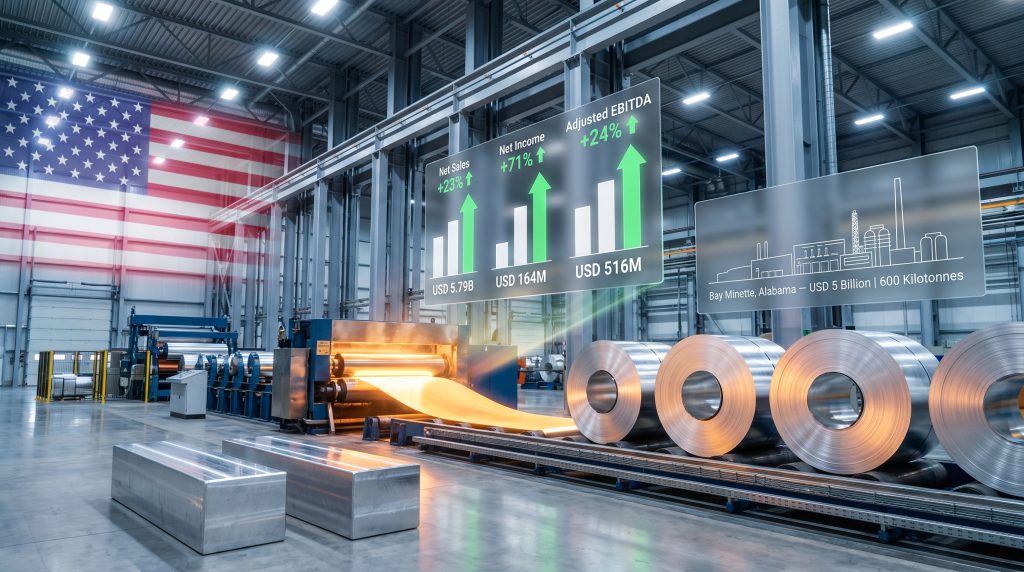
| Net Sales | USD 5.79 billion | USD 4.70 billion | +23% |
| Net Income (to common shareholders) | USD 164 million | USD 96 million | +71% |
| Net Income (excl. special items) | USD 265 million | N/A | +128% |
| Adjusted EBITDA | USD 516 million | USD 416 million | +24% |
| Adjusted EBITDA per Tonne | USD 563 | USD 432 | +30% |
| Adjusted Free Cash Flow | -USD 1.1 billion | -USD 295 million | Widened |
| Rolled Product Shipments | 916,000 tonnes | ~964,000 tonnes (est.) | -5% |
Three converging forces drove this profitability expansion despite the volume decline:
- Elevated aluminium spot prices provided the primary revenue lift, with the 23% net sales increase being substantially price-driven rather than volume-driven
- Lower aluminium scrap input costs improved margins at the operational level, particularly meaningful for a company whose business model is built around recycled content
- Operational efficiency gains demonstrated that cost discipline during a recovery phase can preserve margin quality even when throughput is constrained
What partially offset these tailwinds was tariff-related pressure, which weighed on results during the quarter. Furthermore, higher working capital requirements, driven by elevated aluminium prices and the residual financial effects of the Oswego fires, also continued to affect operating cash flow even as insurance recovery proceeds began to flow through.
The EBITDA per tonne metric is arguably the most instructive number in the entire Q1 FY2027 result. At USD 563 per tonne shipped compared to USD 432 in the prior year period, it signals that the underlying business generates considerably more value per unit of output today than it did twelve months ago, independent of volume.
The Oswego Restart: Understanding What Recovery Really Means in Aluminium Rolling
Why the Oswego Facility Occupies a Unique Position in North American Aluminium
The Oswego hot mill in New York State is not simply a large production asset. It is one of the highest-throughput aluminium rolling facilities on the continent, historically serving as a critical supply node for automotive-grade flat-rolled sheet. When fire damage forced it offline across FY2025 and FY2026, the supply gap it created extended well beyond Novelis' own order book, compressing availability across the North American market for specific product grades.
This context matters because it explains the nature of the recovery now underway. The Novelis Oswego restart and Bay Minette project are not straightforward switch-on events. Hot mill restarts in aluminium rolling involve a sequential process: the furnaces must reach operating temperature and stability, rolling mill rolls require conditioning, metallurgical process parameters need validation against product specifications, and quality certification requirements for automotive customers must be re-met before shipments can resume at full commercial volume.
The Restart Timeline at a Glance
| Milestone | Period |
|---|---|
| Initial fire damage at Oswego | FY2025 |
| Secondary fire disruption | FY2026 |
| Revised restart guidance issued | Q4 FY2026 |
| Hot mill restart confirmed | 10 June 2026 |
| Cold mill and heat treatment resumption | June 2026 |
| Volume ramp-up phase | Q1 FY2027 onwards |
The fact that both the cold mill and heat treatment operations resumed alongside the hot mill is a technically significant detail. A hot mill restart in isolation would mean Novelis could produce aluminium coil but could not deliver finished, temper-controlled products that meet automotive and industrial specifications. The simultaneous resumption of downstream processing steps signals a full-process recovery rather than a partial restart, which is precisely what automotive supply chain customers require before they can restore qualified supply relationships.
According to Novelis' official press release, the Oswego hot mill restart was confirmed on 10 June 2026, ahead of some revised schedule estimates, reflecting the accelerated efforts to restore operational capacity following the disruptions.
The Pent-Up Demand Factor
One underappreciated aspect of the Oswego situation is the accumulated demand backlog that built during the extended outage. Automotive manufacturers and other high-specification customers who depended on Oswego-sourced material were forced to source alternative supply, often at premium pricing or with lead-time penalties.
As Oswego restores output and re-qualifies product grades, the ramp-up is expected to absorb this pent-up demand progressively through FY2027, providing a volume tailwind that does not rely purely on new market share gains. Production is consequently scaling upward on a graduated basis, and the financial contribution of full Oswego output normalisation is expected to become progressively more visible in shipment data through the remainder of the fiscal year.
Bay Minette Aluminium Project: The USD 5 Billion Structural Bet on Domestic Supply
What Makes Bay Minette Different From a Standard Capacity Expansion?
Most aluminium capacity expansions involve adding rolling capacity to existing sites, leveraging established infrastructure, workforce, and supply chain relationships. Bay Minette is a fundamentally different undertaking. It is a purpose-built greenfield facility in Alabama, designed from the ground up to integrate aluminium rolling with large-scale recycling in a single production ecosystem.
This integrated design philosophy has direct cost and sustainability implications. By co-locating recycling and rolling operations, Novelis can reduce the logistics costs and quality variability associated with transporting scrap to separate processing facilities before it enters the rolling process. The facility is engineered to consume post-consumer aluminium scrap at industrial scale, which aligns closely with modern battery recycling process principles, and positions it to operate with a structurally lower carbon footprint per tonne of finished product compared with primary aluminium-based rolling.
Bay Minette Project Specifications
| Parameter | Detail |
|---|---|
| Location | Bay Minette, Alabama, USA |
| Total Investment | USD 5 billion |
| Designed Annual Capacity | 600 kilotonnes finished product |
| Employment Target | Up to 1,000 direct jobs |
| Facility Type | Greenfield rolling and recycling plant |
| Commissioning Target | Second half of 2026 |
| Current Status (Q1 FY2027) | Initial commissioning of key assets underway |
The capital cost trajectory deserves specific attention. The Bay Minette budget has been revised upward on multiple occasions, moving from an initial figure of approximately USD 2.5 billion, to USD 4.1 billion, and finally to the current USD 5 billion commitment. This progression reflects a combination of scope expansion as the facility's design was refined, and the inflationary pressures that have characterised large-scale industrial construction in the United States over recent years.
Cash Flow Implications and the Path Back to Positive Territory
The USD 1.1 billion adjusted free cash flow outflow recorded in Q1 FY2027 is the direct result of Bay Minette's capital expenditure demands during the commissioning phase. This is the financial signature of a company investing through a cycle rather than optimising short-term cash returns.
Management has articulated a clear three-pillar pathway back to positive free cash flow by Q4 FY2027:
- Oswego volume recovery restoring shipment tonnes that were lost during the fire-related outage, improving revenue without proportional cost increases
- Bay Minette capex normalisation as construction gives way to operational activity and the peak capital expenditure phase transitions to ongoing production costs
- Insurance recovery proceeds from fire-related claims providing meaningful cash inflows that partially offset the operational and financial costs accumulated during the Oswego outage
The company's CFO has indicated that once Bay Minette reaches operational status and capital spending normalises, Novelis expects to begin reducing its debt burden. This deleveraging signal is significant for credit market participants monitoring the company's balance sheet trajectory.
Balance Sheet Reality: Liquidity, Leverage, and What the Numbers Mean
Novelis Liquidity Position as of 30 June 2026
| Metric | Value |
|---|---|
| Net Leverage Ratio | 4.5x |
| Total Liquidity | USD 2.1 billion |
| Cash and Cash Equivalents | USD 1.1 billion |
| Available Committed Credit Facilities | USD 1.0 billion |
A 4.5x net leverage ratio is elevated but not uncommon for an industrial company executing two simultaneous major capital programmes. The critical question for analysts and credit market participants is not whether the leverage is high today — which it clearly is — but whether the operational milestones required to reduce it will materialise on the guided timeline.
The USD 2.1 billion liquidity buffer provides sufficient runway to execute through the Bay Minette commissioning process and the Oswego ramp-up simultaneously without requiring additional capital markets activity in the near term, assuming no further operational disruptions occur.
The combination of USD 1.1 billion in cash and a USD 1.0 billion committed credit facility creates meaningful flexibility. Committed credit facilities, as distinct from uncommitted lines, cannot be withdrawn at the lender's discretion under normal circumstances, providing a degree of certainty to the liquidity position that simple cash balances alone cannot.
Market Dynamics and Competitive Implications for North American Flat-Rolled Aluminium
What 600 Kilotonnes of New Domestic Capacity Actually Means
The North American flat-rolled aluminium market is characterised by relatively concentrated supply, with a small number of top aluminium companies dominating capacity for automotive and packaging-grade sheet. The addition of 600 kilotonnes per year of new domestic rolling capacity through Bay Minette represents a material structural shift in supply availability.
For context, 600 kilotonnes per year is roughly equivalent to the annual aluminium sheet requirements of several major automotive assembly programmes combined. The facility's commissioning will progressively reduce the degree to which North American manufacturers depend on imported flat-rolled products or stretched domestic supply networks to meet procurement requirements.
Domestic competitors and international importers who filled supply gaps during the Oswego outage period are likely to face increased competitive pressure as Bay Minette reaches full production capacity. The recycling-integrated design provides Novelis with a structural cost advantage in scrap-intensive production environments, particularly relevant given the volatility in commodity price impact on primary aluminium pricing observed in recent years.
The Scrap Premium Dynamic: An Underappreciated Margin Driver
One aspect of Novelis' business model that receives less coverage than it warrants is the relationship between scrap availability, scrap pricing, and rolling margins. When aluminium scrap costs decline relative to primary metal prices, recycling-focused producers capture a margin expansion that does not appear in volume data. This scrap-to-primary spread is a critical variable in Novelis' profitability equation, and the lower scrap input costs that contributed to Q1 FY2027's margin improvement illustrate exactly this mechanism.
Bay Minette's recycling integration positions the facility to benefit from this dynamic at scale. In addition, a facility designed to process post-consumer scrap efficiently is structurally positioned to capture margin when scrap is abundant, while also reducing exposure to primary aluminium price volatility on the input cost side.
Tariff Sensitivity: A Variable That Cannot Be Ignored
The tariff headwinds that partially offset Q1 FY2027's efficiency gains highlight an important sensitivity in Novelis' cost structure. As a producer with operations across multiple geographies, including North America, Europe, Asia, and South America, the company is exposed to US aluminium tariffs that can affect both input costs for imported materials and competitive dynamics with foreign producers serving the same end markets.
Furthermore, the broader steel and aluminum tariffs environment creates both risks and opportunities for domestic producers. While tariffs on imported flat-rolled aluminium products can protect domestic producers from lower-cost foreign competition, tariffs on upstream inputs or processing equipment can increase capital and operating costs. Novelis' experience in Q1 FY2027 suggests the net effect of tariffs during the quarter was negative, though the magnitude appears to have been more than offset by pricing and efficiency gains.
The next major ASX story will hit our subscribers first
Key Strategic Takeaways for Industry Observers
The intersection of the Novelis Oswego restart and Bay Minette project represents one of the most complex strategic execution challenges in the North American aluminium sector in recent years. Several observations are worth carrying forward:
- Profitability and volume can diverge significantly in aluminium rolling when pricing, input costs, and efficiency move in the producer's favour, as Q1 FY2027 clearly demonstrates
- Operational restarts in aluminium rolling are graduated processes, not binary events, and the full financial contribution of the Oswego recovery will build progressively across FY2027
- USD 5 billion of committed greenfield capital represents an extraordinary long-term conviction in North American flat-rolled aluminium demand, with the recycling integration element adding a structural competitive dimension beyond simple capacity addition
- The Q4 FY2027 free cash flow target is the pivotal near-term milestone that will determine whether the dual-track investment strategy is assessed as disciplined capital allocation or as an overextension
- Leverage at 4.5x requires both operational milestones to materialise on schedule; any further disruption to either Oswego's ramp-up or Bay Minette's commissioning timeline would put the deleveraging narrative under meaningful pressure
Disclaimer: This article is intended for informational purposes only and does not constitute financial advice. Forward-looking statements regarding timelines, financial targets, and operational outcomes are based on company guidance and publicly available information. Actual results may differ materially from projections due to operational, market, or macroeconomic factors. Readers should conduct their own due diligence before making investment decisions.
Want To Spot the Next Major Mineral Discovery Before the Market Does?
While Novelis executes its ambitious dual-track aluminium strategy, Discovery Alert's proprietary Discovery IQ model scans the ASX in real time to instantly identify significant mineral discoveries — including in aluminium and other critical commodities — delivering actionable alerts directly to subscribers before the broader market reacts. Explore historic examples of what major discoveries can return and begin your 14-day free trial at Discovery Alert to position yourself ahead of the next transformative find.