
August 6, 2026
The Structural Shift Reshaping Middle East Oil Strategy
For decades, the architecture of global oil production was built around collective constraint. National oil companies operated within quota frameworks that prioritised price stability over individual output growth, often leaving capable producers unable to fully monetise their reserve endowments. That architecture is now fracturing. The UAE's exit from OPEC after nearly five decades of membership represents one of the most consequential structural shifts in Middle East energy policy in a generation, and the ADNOC $55 billion projects commitment is its most visible commercial expression.
Understanding what this capital deployment truly means requires looking beyond the headline figure. This is not simply a spending announcement. It is the operational activation of a post-quota growth strategy built on one of the world's largest hydrocarbon reserve bases, executed by a state-owned company that has been systematically preparing for exactly this moment.
When big ASX news breaks, our subscribers know first
Why Leaving OPEC Changed Everything for ADNOC
The UAE formally withdrew from OPEC in October 2022, ending approximately 52 years of membership that had shaped how the country managed, priced, and exported its crude. For much of that period, the UAE operated under collectively negotiated production ceilings that constrained output regardless of what its technical infrastructure could actually deliver.
This is a critically underappreciated point. OPEC quota allocations are determined through political negotiation, not engineering assessment. A country may hold hundreds of billions of barrels in proved reserves and possess the drilling capacity, processing infrastructure, and export terminals to dramatically increase production, and yet remain bound by a quota set during a prior negotiating cycle. The UAE found itself in precisely this position for years before its withdrawal.
The exit removes that ceiling entirely. Furthermore, OPEC's market influence had long constrained the ambitions of producers whose reserve endowments and technical capabilities far exceeded their allocated output ceilings. ADNOC now operates as an independent producer with no binding external output restriction, free to pursue its own production targets based on technical capability, market conditions, and strategic intent. The UAE oil growth strategy that follows is therefore not a response to OPEC's departure but a pre-planned expansion that OPEC membership had been delaying.
The strategic logic is straightforward: a producer with 111 billion barrels of proved reserves, low extraction costs, and mature infrastructure should not be producing at the same rate as countries with a fraction of those assets simply because a collective agreement demands it.
Decoding the $55 Billion Commitment
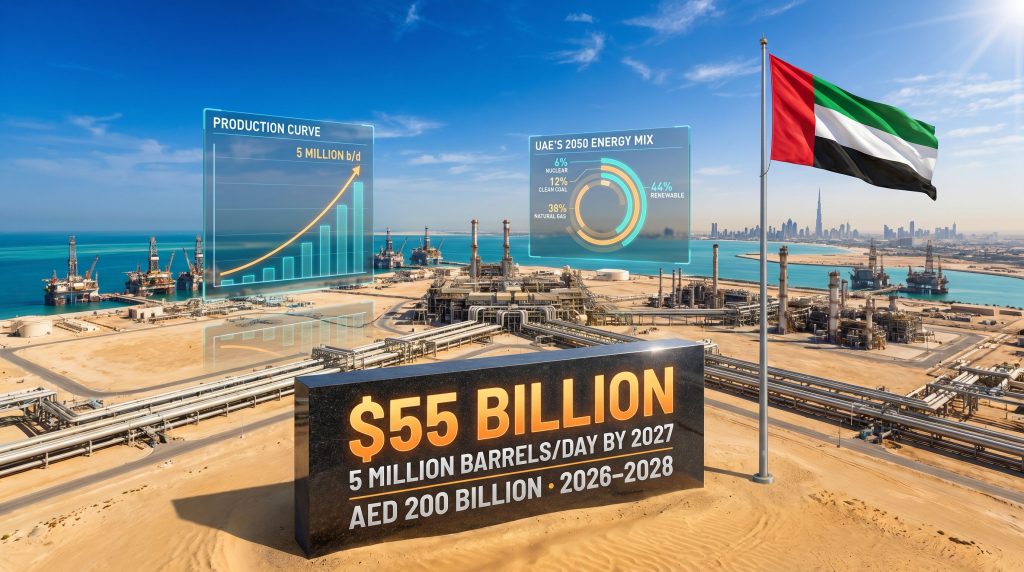
ADNOC has outlined plans to award projects valued at AED 200 billion, equivalent to approximately USD $55 billion, across the 2026 to 2028 period. These awards sit within the company's broader five-year capital expenditure programme totalling USD $150 billion across 2023 to 2027, making the three-year award window represent roughly 37% of the total programme value.
The following table summarises the key investment metrics disclosed:
| Investment Metric | Figure |
|---|---|
| Project Awards Window | 2026–2028 |
| Total Award Value (AED) | AED 200 billion |
| Total Award Value (USD) | ~USD $55 billion |
| Broader Five-Year CAPEX Program | USD $150 billion (2023–2027) |
| Production Capacity Target | 5 million barrels/day by 2027 |
| Current Production Range | ~3–4.4 million barrels/day |
| Projected Sector CAGR | 8–8.4% through 2030 |
| UAE Proved Reserves (2023) | ~111 billion barrels |
The AED-to-USD conversion uses the UAE dirham's fixed peg of AED 3.6725 per USD 1.00, a rate maintained by the UAE Central Bank since 1997. This currency stability eliminates exchange rate risk from investment planning calculations, a structural advantage that distinguishes UAE-based capital programmes from those in countries with floating currencies.
What the average annual implied figure reveals is significant. Spread across three years, the award programme implies approximately USD $18.3 billion per year in new project contracts. At a sustained pace, this would represent one of the largest annual project award programmes of any single national oil company globally outside of Saudi Aramco.
ADNOC's leadership characterised the company as entering a defining execution phase in its strategy, driven by scale, pace, and a precise focus on delivery. This framing is not marketing language. It signals that engineering studies, environmental assessments, contractor pre-qualification, and project design work have already been completed, and that the 2026 to 2028 window is mobilisation, not planning.
Benchmarking ADNOC Against Global NOC Peers
To contextualise the UAE oil growth strategy, it helps to compare ADNOC's expansion ambitions against other major state-owned producers pursuing capacity growth in the same timeframe.
| National Oil Company | Country | Capacity Target | Timeline |
|---|---|---|---|
| ADNOC | UAE | 5 million b/d | By 2027 |
| Saudi Aramco | Saudi Arabia | ~12 million b/d (sustained) | Ongoing |
| Iraq NOC | Iraq | ~6 million b/d | By 2027 |
| QatarEnergy | Qatar | LNG-focused expansion | 2026–2030 |
ADNOC's 5 million barrels per day target by 2027 represents an expansion of approximately 14% to 42% above its current production range, depending on which baseline figure is used. Achieving this within a compressed timeline compared to the original 2030 objective demands rapid execution across multiple simultaneous field development programmes.
Saudi Aramco's sustained capacity of approximately 12 million barrels per day establishes a scale benchmark that ADNOC has no near-term ambition to match. However, the more relevant competitive dynamic is not direct volume parity but strategic positioning as a swing producer. This capability requires not only high production volumes but also meaningful spare capacity, which ADNOC is deliberately building.
In a global supply environment where Western integrated majors face capital discipline constraints and ESG-related investment pressures, state-backed producers with access to sovereign capital and deep reserve endowments occupy a structurally distinct competitive position. They are able to deploy capital at a pace and scale that listed, dividend-constrained counterparts cannot easily replicate.
Inside the Investment: Upstream, Downstream, and Industrial Ecosystem
The $55 billion programme is not a single-sector upstream spending initiative. It spans the full energy value chain, with distinct objectives at each stage:
Upstream: Exploration and field expansion programmes are underway across Abu Dhabi, Sharjah, and Ras Al Khaimah. Brownfield developments at existing fields benefit from compressed lead times, as existing wells, platforms, and processing infrastructure can be augmented rather than built from scratch. Greenfield developments targeting new reservoirs carry longer timelines but underpin the post-2027 production plateau.
Downstream: Refining capacity expansion and petrochemical integration allow ADNOC to capture greater value from each barrel produced rather than exporting crude at commodity prices. Petrochemical derivatives command premium pricing and serve industrial demand across Asia, Europe, and the Americas.
Industrial ecosystem: The project award process is being structured around a deliberate industrial policy objective. By convening engineering, procurement, and construction (EPC) contractors alongside domestic manufacturers through forums like the Make It With ADNOC initiative, the company is embedding supply chain development directly into its capital deployment architecture. More than 70 local manufacturers are being integrated into project procurement pipelines.
This last point distinguishes the current capital cycle from prior generations of Gulf hydrocarbon investment, which historically directed project contracts predominantly to international contractors. The current model prioritises domestic industrial participation, consequently reducing import dependency while simultaneously building long-term manufacturing capability within the UAE.
The Local+ Framework: Petrodollars Redirected Inward
At the core of ADNOC's procurement philosophy is its In-Country Value (ICV) programme, and specifically the Local+ initiative. This framework mandates that UAE-manufactured goods and services receive preferential consideration in project procurement decisions, effectively channelling a portion of each capital project's spend into domestic industry.
The dual objective is explicit:
- Accelerate project timelines by reducing reliance on imported materials with long supply chains and extended delivery windows.
- Build long-term industrial capacity within the UAE by creating sustained demand for domestically manufactured goods across oil and gas project categories.
For global contractors competing for ADNOC work, compliance with ICV requirements is not optional. Companies seeking inclusion in ADNOC's contractor base must demonstrate meaningful local content in their project delivery models. This creates incentives for international manufacturers to establish UAE-based production facilities, which further deepens the domestic industrial base over time.
The macroeconomic logic mirrors policies employed by Norway (through Equinor's local content requirements), Brazil (through Petrobras's nationalisation-era procurement rules), and Saudi Arabia (through the Aramco In-Kingdom Total Value Add programme). The UAE's approach reflects a broader recognition among resource-rich states that hydrocarbon revenues create a one-time opportunity to fund industrial diversification.
The next major ASX story will hit our subscribers first
Reconciling Expansion With the UAE's Energy Transition Commitments
One of the most frequently misunderstood aspects of ADNOC's growth strategy is its relationship to the UAE's stated sustainability and energy transition dynamics. The apparent contradiction between expanding hydrocarbon production and pursuing decarbonisation targets requires careful disaggregation.
The UAE has committed to a 2050 energy mix structured as follows:
| Energy Source | Target Share by 2050 |
|---|---|
| Alternative and Renewable Energy | 44% |
| Natural Gas | 38% |
| Clean Coal | 12% |
| Nuclear | 6% |
Notably, nuclear energy already contributes approximately 25% of the UAE's current electricity generation through the Barakah Nuclear Power Plant, placing the country ahead of schedule on its low-carbon electricity transition. This context is rarely acknowledged in critiques of Gulf state energy policy. In addition, the broader renewable energy transformation sweeping global markets adds further urgency to ADNOC's dual-track approach.
ADNOC's approach to reconciling hydrocarbon expansion with climate commitments rests on three pillars:
- Carbon Capture, Utilisation, and Storage (CCUS): ADNOC operates the largest carbon capture and utilisation facility in the MENA region, currently storing approximately 1.5 million tonnes of CO₂ annually. This facility has been operational since 2016 and is targeted for a sixfold capacity increase by 2030, which would place annual capture volumes at approximately 9 million tonnes.
- Hydrogen production: ADNOC is developing hydrogen production capabilities as part of its long-term portfolio transition. Blue hydrogen, produced from natural gas with carbon capture, leverages the country's existing hydrocarbon infrastructure while reducing net emissions intensity.
- Emissions intensity reduction: Expanding production while simultaneously reducing emissions per barrel produced allows ADNOC to grow output without proportionally growing its carbon footprint. Lower-carbon barrels compete more favourably as importing nations introduce carbon border adjustment mechanisms.
The UAE's position is that hydrocarbons will remain essential to global energy security through the mid-century transition, and that producing them at lower emissions intensity is preferable to leaving demand to be met by higher-carbon producers.
What This Means for Global Oil Supply and Price Dynamics
The implications of the ADNOC $55 billion projects programme for global crude markets extend well beyond the UAE's borders. Several dynamics warrant consideration, particularly in relation to WTI and Brent futures and the broader signals they carry for energy investors.
Tight market timing: ADNOC's accelerated spending occurs at a point when global oil markets remain supply-constrained relative to demand growth projections, particularly from non-OECD economies. Producers with spare capacity and committed investment programmes occupy a structurally advantaged position in this environment.
Price trajectory influence: Additional supply from ADNOC's expanded capacity has the potential to moderate upward crude oil price trends from 2027 onward. However, the volume contribution from ADNOC's incremental capacity expansion (approximately 0.6 to 1.5 million barrels per day above current levels) represents a modest addition relative to global demand of approximately 103 to 106 million barrels per day, limiting its direct price impact.
Geopolitical dimension: The UAE's position as a politically stable, Western-aligned producer with low extraction costs and significant reserve depth makes its exports attractive to energy-importing nations seeking supply security. In this sense, ADNOC's capacity expansion functions as a geopolitical asset as much as a commercial one.
Competition for Asian demand: The primary target markets for ADNOC's incremental production are likely in Asia, where India, China, Japan, and South Korea collectively represent the largest oil-importing bloc globally. Competing for this demand against Saudi Arabia, Russia, and Iraq requires competitive pricing, reliable supply, and established refinery compatibility.
Execution Risk and Capital Structure
Committing to USD $18+ billion per year in project awards across three consecutive years requires confidence in several operational prerequisites that deserve scrutiny:
EPC contractor capacity: Global engineering, procurement, and construction contractors capable of executing complex oil and gas projects are a limited resource. ADNOC's project award volumes, combined with similar programmes in Saudi Arabia, Iraq, and Qatar during the same period, create competitive demand for the same contractor base. Schedule delays from contractor oversubscription represent a material execution risk.
Digital efficiency integration: ADNOC has positioned artificial intelligence and digital infrastructure as cost and timeline optimisation tools within its project delivery model. AI-assisted design, predictive maintenance modelling, and automated procurement systems can compress engineering timelines and reduce error rates in complex project management. However, whether this translates to measurable cost savings at the scale of a USD $55 billion programme remains to be proven in execution.
Funding structure: The investment is framed as drawing on ADNOC's existing five-year CAPEX framework, suggesting it is largely self-funded through operating cash flows rather than requiring external debt issuance. With oil prices supporting strong cash generation at current ADNOC production volumes, the financial mechanics of sustaining this capital programme appear structurally sound under a range of price scenarios above approximately USD $50 to $60 per barrel.
Frequently Asked Questions: ADNOC's Project Pipeline and UAE Oil Strategy
What is the total value of ADNOC's planned project awards between 2026 and 2028?
ADNOC has disclosed plans to award contracts totalling AED 200 billion, approximately USD $55 billion, across its upstream and downstream portfolio during the 2026 to 2028 period. This three-year award programme forms part of a larger USD $150 billion five-year capital expenditure framework covering 2023 to 2027.
Why did the UAE exit OPEC, and what does it mean for production?
The UAE departed from OPEC in October 2022 following disputes over production quota allocations that the UAE viewed as incompatible with its reserve base and production capacity. Exiting removes the externally imposed output ceiling that had constrained ADNOC's growth, enabling the company to pursue its 5 million barrels per day capacity target by 2027 without reference to collectively negotiated limits.
What is ADNOC's production capacity target and when does it aim to achieve it?
ADNOC is targeting production capacity of 5 million barrels per day by 2027, a timeline accelerated from an original 2030 objective. This target represents an increase of approximately 14% to 42% above the company's current estimated production range.
How does ADNOC's expansion align with the UAE's sustainability commitments?
ADNOC pursues a dual-track strategy, simultaneously expanding hydrocarbon production and scaling carbon capture infrastructure, hydrogen production capabilities, and contributions toward the UAE's 2050 energy mix targets, which include a 44% share for alternative and renewable energy sources. The MENA region's largest carbon capture facility, operated by ADNOC since 2016, is targeted for a sixfold capacity increase by 2030.
What is the Local+ initiative?
Local+ is a procurement policy framework within ADNOC's broader In-Country Value (ICV) programme that prioritises UAE-manufactured goods and services in project supply chains. It is designed to redirect capital expenditure into domestic industrial development and reduce the UAE's dependency on imported materials and equipment across the oil and gas project lifecycle.
What sectors does the $55 billion investment cover?
The investment spans upstream exploration and production, downstream refining and petrochemicals, industrial manufacturing partnerships, and digital infrastructure integration, reflecting ADNOC's ambition to operate as a fully integrated energy and industrial enterprise rather than a single-function crude producer.
Key Takeaways: The Strategic Architecture Behind the Numbers
- The ADNOC $55 billion projects programme is the execution phase of a multi-year strategy built around a post-OPEC production mandate, not an isolated spending decision
- UAE proved reserves of 111 billion barrels provide a technically credible foundation for sustained production growth beyond the 2027 capacity target
- The projected 8–8.4% sector CAGR through 2030 implies production ambitions that potentially extend well beyond the 5 million barrel per day interim target
- ADNOC's industrial policy integration through ICV programmes and local manufacturer engagement distinguishes this capital cycle from conventional upstream spending
- The convergence of OPEC exit, accelerated capacity timelines, and large-scale project mobilisation positions the UAE as one of the most consequential independent producers in global crude markets through the remainder of this decade
This article contains forward-looking statements regarding production targets, investment timelines, and market conditions. These projections are based on publicly disclosed information and third-party analysis and do not constitute financial advice. Actual outcomes may differ materially from those described. Readers should conduct independent due diligence before making investment decisions.
Want To Stay Ahead of Major Commodity and Energy Market Shifts?
Discovery Alert's proprietary Discovery IQ model delivers real-time alerts on significant ASX mineral discoveries, instantly translating complex geological and market data into actionable investment opportunities — the same kind of structural shifts discussed in this article can create substantial returns for well-positioned investors. Explore how historic discoveries have generated exceptional outcomes on Discovery Alert's dedicated discoveries page, and begin your 14-day free trial today to secure a market-leading advantage.