August 8, 2026
The Strait of Hormuz Is the World's Most Dangerous Energy Bottleneck
Few geographic features shape global commodity markets quite like a narrow strip of water measuring roughly 33 kilometres at its slimmest navigable point. The Strait of Hormuz, connecting the Persian Gulf to the Gulf of Oman, functions as the central nervous system of world oil supply. When that system comes under sustained attack, the consequences radiate outward far beyond the region itself, touching fuel prices, insurance markets, diplomatic relationships, and the energy security calculations of nations thousands of kilometres away.
Understanding why the current situation involving ADNOC attacks on vessels in the Strait of Hormuz carries such weight requires more than tracking individual incidents. It demands an appreciation of the structural geography, the commercial architecture, and the geopolitical stakes that make this waterway uniquely irreplaceable in the global energy system. For broader context on oil price trends, the upstream drivers behind these disruptions matter enormously.
When big ASX news breaks, our subscribers know first
Why the Strait of Hormuz Has No Real Alternative
The Mathematics of Dependency
Roughly 20 to 21 percent of all petroleum liquids traded globally pass through the Strait of Hormuz on any given day. That figure, routinely cited in energy security literature, understates the strategic exposure it represents. The waterway is not merely a convenient shipping lane. It is the only maritime exit point for crude exports originating in the UAE, Saudi Arabia, Kuwait, Iraq, and Iran.
Bypass infrastructure does exist, but its capacity is limited in ways that matter enormously under stress conditions:
- Saudi Arabia's East-West Pipeline (Petroline) can move approximately 5 million barrels per day (bpd) toward Red Sea terminals, but operates below that ceiling under normal conditions
- The UAE's Abu Dhabi Crude Oil Pipeline (ADCOP) carries an operational capacity of roughly 1.5 million bpd to the port of Fujairah, bypassing Hormuz entirely
- Neither pipeline comes close to absorbing the full volume of Persian Gulf crude exports, which collectively represent the backbone of supply for Asian importing nations
The arithmetic is unforgiving. A sustained disruption to Strait transit does not create a logistical inconvenience that bypass routes can quietly absorb. It creates a structural supply gap with no complete solution on the existing infrastructure map.
Why State-Owned Operators Carry Amplified Risk
National oil companies (NOCs) occupy a fundamentally different risk position than private tanker operators in contested maritime zones. A privately owned vessel is a commercial asset. An NOC-operated tanker is simultaneously a commercial asset, a national economic instrument, and a symbolic representation of state power.
This dual identity transforms NOC fleets into disproportionately attractive targets during periods of regional conflict escalation. Striking an NOC vessel sends a message that extends beyond the commercial disruption it creates. It signals capacity and intent to a state actor whose economic lifeline runs through a waterway the attacking party seeks to contest. Furthermore, OPEC's market influence over Gulf production decisions means that sustained attacks on NOC assets carry consequences that reverberate across global supply balances.
Fifteen Vessels: Documenting the Escalation Pattern
From Isolated Incidents to Sustained Campaign
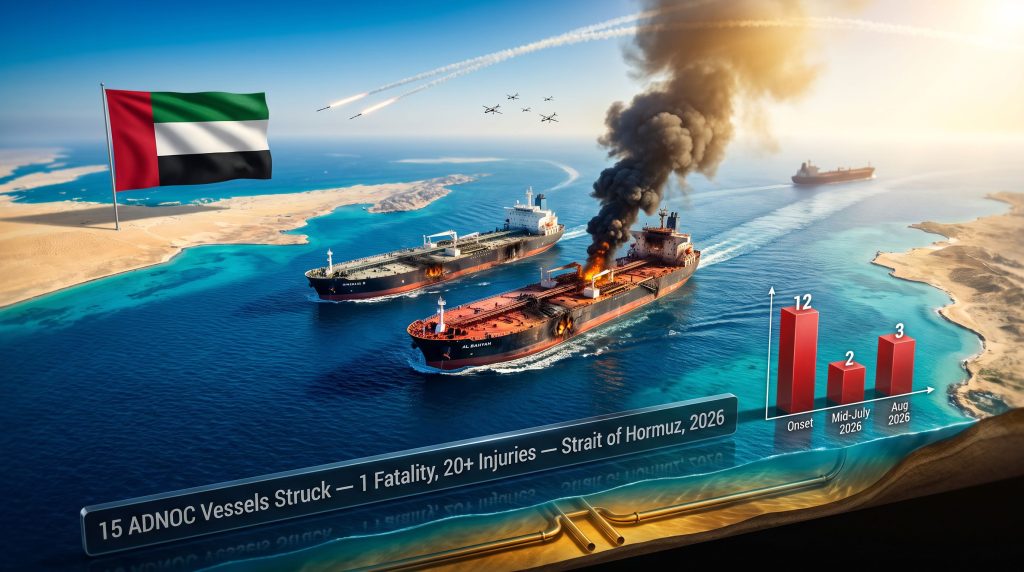
The ADNOC attacks on vessels in the Strait of Hormuz since the current conflict began constitute something qualitatively different from the periodic maritime harassment that energy security analysts had come to treat as background noise in the Gulf region. The documented pattern now involves 15 ADNOC-operated vessels struck by missiles or drone weapons since hostilities commenced, with the attack pace intensifying rather than plateauing.
The acceleration is the detail that matters most to analysts assessing operational risk. Three vessels were targeted within a single week in early August 2026. This tempo suggests an adversary with ongoing operational capacity, clear targeting doctrine, and no apparent willingness to negotiate a ceasefire on maritime terms.
The Mid-July Incidents: Precision Targeting of Named Commercial Assets
The mid-July 2026 strikes on two ADNOC-linked tankers represent a particularly significant escalation threshold. The vessels identified as Al Bahyah and Mombasa B sustained substantial structural damage in separate engagements. UAE defense authorities confirmed that one Indian crew member lost their life and eight additional crew members were wounded during those specific incidents.
Several aspects of these strikes warrant closer analysis:
- The targeting of vessels by name, rather than vessels of opportunity, implies prior intelligence gathering and deliberate mission planning
- The use of precision-guided munitions, as suggested by damage assessments, indicates a level of technical sophistication that distinguishes this campaign from opportunistic interdiction
- The death of a foreign national introduces a diplomatic dimension that draws additional stakeholders into a conflict that might otherwise remain a bilateral dispute
Cumulative Incident Record
| Period | Vessels Struck | Casualties |
|---|---|---|
| Conflict onset to mid-July 2026 | 12 vessels | Partial reporting |
| Mid-July 2026 | 2 vessels (Al Bahyah, Mombasa B) | 1 killed, 8 injured |
| First week of August 2026 | 3 vessels | Additional injuries confirmed |
| Cumulative total | 15 vessels | 1 fatality, 20+ injuries |
How ADNOC Is Responding Under Active Threat Conditions
Operational Continuity as a Strategic Priority
ADNOC has publicly confirmed being significantly impacted by the ongoing attacks, language that represents a notable departure from the measured, commercially cautious communication style that Gulf NOCs typically maintain in public statements. The company has simultaneously affirmed its commitment to meeting customer delivery obligations, signalling that supply continuity remains a corporate priority even as the operational environment deteriorates.
The coordination of protective measures with UAE governmental and military authorities indicates that tanker operations have effectively transitioned from a purely commercial logistics function into an activity that requires active security management. This shift has operational implications that cascade through scheduling, routing, crew recruitment, and counterparty contract management.
War-Risk Insurance: The Invisible Economic Weapon
One of the least publicly discussed but most commercially consequential dimensions of the ADNOC attacks on vessels in the Strait of Hormuz is the effect on marine war-risk insurance markets. When precision-guided weapons are used against named tankers in a major transit corridor, underwriters respond quickly and decisively.
Historical precedent provides a useful reference framework:
- During the 2019 Gulf of Oman tanker incidents involving suspected limpet mine attacks, war-risk premiums for Hormuz transits rose sharply within days
- The 2023-2024 Red Sea shipping crisis triggered by Houthi missile and drone campaigns produced war-risk surcharges that added an estimated 200 to 400 percent to freight costs for vessels willing to continue transiting the affected corridor
- Some tanker operators elected to turn back entirely rather than accept the combined risk of physical attack and prohibitive insurance costs
The 2026 situation differs from the Red Sea crisis in one critical respect. The Red Sea attacks primarily affected vessels carrying cargo toward European markets. However, the Hormuz attacks target the export origin point itself, meaning the disruption occurs at the source of supply rather than downstream in the distribution chain. This geographical distinction makes the current crisis structurally more severe in its potential supply-side impact. Consequently, the global crude market outlook has deteriorated sharply in response to these compounding pressures.
International Law, Freedom of Navigation, and Diplomatic Fallout
The UNCLOS Framework Under Pressure
The United Nations Convention on the Law of the Sea (UNCLOS) establishes the Strait of Hormuz as an international strait subject to the right of transit passage, a stronger navigational entitlement than the innocent passage rights that apply in territorial seas. Under this framework, all vessels, regardless of flag or cargo, hold a legally recognised right to transit without interference.
Attacks on commercial vessels exercising that right constitute violations of customary international law. The UAE government has formally condemned the strikes as threats to both freedom of navigation and regional energy security, framing the issue in terms that invite international solidarity rather than positioning it as a bilateral dispute.
The Indian Dimension: Broadening the Stakeholder Map
The death of an Indian crew member during the mid-July attacks adds a layer of diplomatic complexity that extends well beyond Gulf regional politics. India is simultaneously one of the world's largest consumers of Gulf crude, a significant source of maritime labour for global tanker operations, and an increasingly influential strategic actor in the Indian Ocean region.
New Delhi's response to the death of its national in an attack on a commercial vessel in international waters represents a test case for how non-Gulf powers engage with Hormuz security governance. The incident creates pressure on Indian foreign policy to take a more active stance on maritime security frameworks in a region where its energy and economic interests are directly exposed.
Comparing 2026 to Previous Gulf Maritime Crises
A Historical Perspective on Hormuz Instability
The Strait of Hormuz has been a theatre of maritime conflict before, and the historical record offers both reassurance and warning in roughly equal measure.
| Crisis Period | Threat Type | Scale | International Response |
|---|---|---|---|
| Tanker War (1984-1988) | Iraqi and Iranian attacks on Gulf shipping | 400+ vessels over four years | US Navy convoy operations under Operation Earnest Will |
| Gulf of Oman Incidents (2019) | Suspected limpet mine attacks | 6 vessels | International condemnation, limited naval mobilisation |
| Red Sea Crisis (2023-2024) | Houthi missile and drone campaign | 100+ vessels diverted | Operation Prosperity Guardian, insurance market crisis |
| Strait of Hormuz (2026) | Missile and drone strikes on named NOC tankers | 15 vessels, ongoing | UAE governmental coordination, international diplomatic engagement |
The Tanker War of the 1980s is often cited as the closest historical analogue to the current situation. That conflict eventually prompted direct US naval intervention in the form of convoy escort operations. The critical difference in 2026 is the nature of the weapons being deployed. Precision-guided drone munitions and modern anti-ship missiles represent a categorically more capable threat environment than the mines and unguided rockets that characterised 1980s-era maritime interdiction.
What the Attack Acceleration Signals
Three vessels struck within a single week in early August 2026 is not simply a statistical footnote. Operational tempo in asymmetric maritime conflict is a strategic signal. An adversary capable of sustaining or increasing attack frequency despite international pressure and defensive countermeasures is communicating that its operational capacity has not been meaningfully degraded. That signal matters to tanker operators, insurers, and importing nations making routing and procurement decisions in real time.
In addition, the oil geopolitics analysis surrounding the broader regional conflict strongly suggests that these attacks are not isolated acts of opportunism but components of a deliberate strategic campaign.
The next major ASX story will hit our subscribers first
Downstream Risks: Asian Importers and Energy Market Exposure
Who Faces the Greatest Supply Vulnerability
The geographic reality of Gulf crude dependency creates an uneven distribution of exposure across importing nations. Asian buyers face the sharpest vulnerability for a straightforward structural reason: the majority of their crude imports cannot be easily redirected to alternative sources on short timelines.
The nations with the most concentrated exposure include:
- India, which sources a substantial share of its crude requirements from Gulf producers and has limited short-term substitution capacity
- China, the world's largest crude importer, with deeply integrated supply chains linked to Gulf NOC production
- Japan and South Korea, which depend heavily on Gulf crude to feed refining systems designed around specific crude grades that cannot be easily replaced with Atlantic Basin alternatives
A prolonged effective constraint on Hormuz transit would force these nations into spot markets, alternative origin purchases at premium prices, and drawdowns of strategic petroleum reserves. All of which apply upward pressure on global oil prices well before any actual physical supply shortfall materialises.
Infrastructure Vulnerability Beyond the Waterway
Maritime interdiction represents only one layer of the risk profile facing Gulf hydrocarbon systems. The concentration of UAE offshore production infrastructure in Abu Dhabi's prolific offshore fields places significant producing capacity within potential strike range during periods of active regional conflict. Subsea pipelines, offshore processing platforms, and onshore terminal facilities all represent nodes in a system designed for commercial efficiency rather than conflict resilience.
Energy security analysts have long flagged the structural vulnerability of Gulf hydrocarbon infrastructure to asymmetric attack methodologies. Particularly relevant is the threat from drone swarms and precision-guided munitions, which can be deployed at relatively low cost compared to the damage they are capable of inflicting on high-value energy assets. Furthermore, this oil market disruption compounds existing volatility already driven by trade tensions and demand uncertainty.
The deeper strategic reality is that the cost asymmetry between attacking and defending energy infrastructure in the Gulf has shifted in favour of the attacker. Modern precision munitions are cheap to produce relative to the economic damage they cause when directed at tankers, terminals, or offshore platforms.
Frequently Asked Questions
How many ADNOC vessels have been attacked in the Strait of Hormuz?
As of early August 2026, 15 ADNOC vessels have been struck by missiles or drones while transiting the Strait of Hormuz since the onset of the current conflict. The most recent escalation saw three vessels attacked within a single week.
Were there fatalities among crew members?
Yes. Across all documented incidents, one crew member has been killed and 20 have been injured. The mid-July 2026 strikes on the tankers Al Bahyah and Mombasa B resulted in the death of one Indian national and injuries to eight additional crew members.
Is ADNOC maintaining oil deliveries despite the disruptions?
ADNOC has stated it is working to fulfil customer obligations while acknowledging it is operating under significantly impacted conditions. Protective measures are being coordinated with UAE governmental and military authorities to maintain operations where possible.
Can Hormuz transit be bypassed if attacks continue?
Only partially. The UAE's ADCOP pipeline offers approximately 1.5 million bpd of bypass capacity to the port of Fujairah, and Saudi Arabia's Petroline provides an alternative Red Sea routing. Neither option, individually or combined, can fully replace the volume that transits the Strait under normal operating conditions, leaving a structural supply gap that cannot be resolved through existing alternative infrastructure alone.
What does international law say about these attacks?
Under UNCLOS, the Strait of Hormuz carries transit passage rights for all vessels navigating international straits. Attacks on commercial shipping exercising those rights constitute violations of established international maritime law, a position the UAE government has formally articulated in its condemnation of the strikes.
Disclaimer: This article contains forward-looking assessments and analysis of ongoing geopolitical and market developments. Conditions in the Strait of Hormuz remain fluid and subject to rapid change. Readers should not rely on this content as the basis for trading, investment, or supply chain decisions without consulting current intelligence and professional advisers.
Want to Stay Ahead of the Commodity Market Disruptions Driving Energy Volatility?
When geopolitical crises like the Strait of Hormuz attacks reshape global supply chains, the ripple effects reach deep into commodity and resource markets — and Discovery Alert's proprietary Discovery IQ model scans ASX announcements in real time, delivering instant alerts on significant mineral discoveries so investors can act before the broader market catches on. Begin your 14-day free trial at Discovery Alert today, or explore the discoveries page to see how historic ASX mineral finds have generated substantial returns even amid periods of profound market uncertainty.