August 7, 2026
Global LNG Trade Is Rewiring Itself Around Geopolitical Fault Lines
The global liquefied natural gas market has never operated in isolation from the political forces shaping the world around it. US emerges as India's largest LNG supplier is no longer a speculative headline — it is the defining commercial reality of 2026. Historically, long-term supply agreements defined trade flows for decades, with buyers locked into relationships with established exporters through fixed-volume contracts and narrow pricing bands. That model is now under accelerating pressure. Conflict, sanctions, transit risks, and the rise of destination-free flexible contracts have collectively shifted power toward buyers with the financial depth and infrastructure to redirect cargoes at short notice. Nowhere is this transformation more visible than in India's LNG import market, where a single quarter of geopolitical disruption has redrawn the supplier map in ways that would have seemed implausible just eighteen months ago. Understanding the global LNG supply outlook is essential context for interpreting just how significant this shift truly is.
When big ASX news breaks, our subscribers know first
India's LNG Import Volume: Growth That Goes Beyond the Cycle
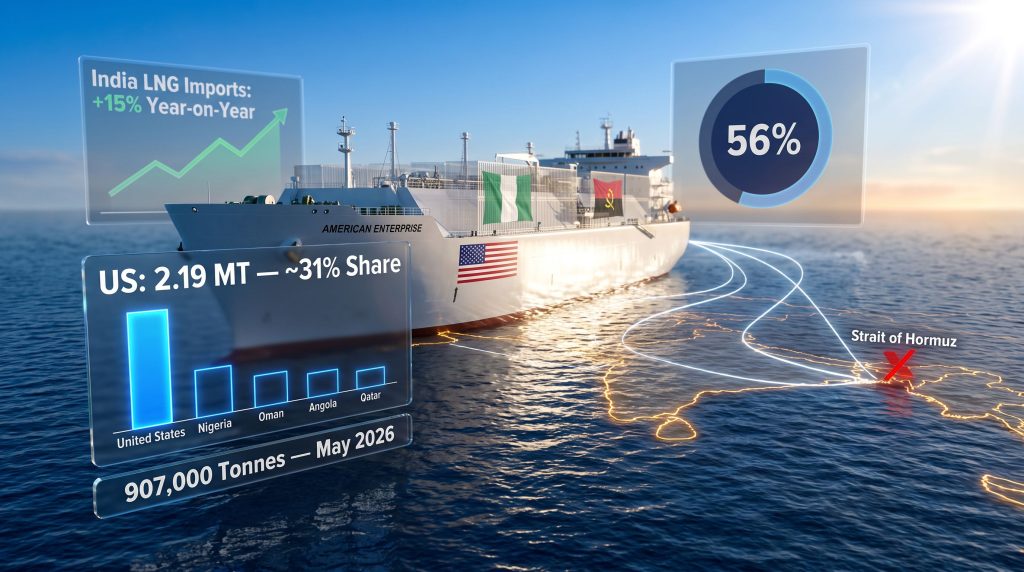
India's natural gas consumption profile has fundamentally changed over the past decade. The country now imports approximately 56% of its total natural gas requirements through LNG, with domestic production holding steady at around 87 million metric standard cubic metres per day (mmscmd). This import dependency is not a temporary feature of a supply shortfall; it reflects a structural gap between rising demand and the geological limits of India's domestic gas basins.
During the May to July 2026 window, India imported approximately 7.08 million tonnes (MT) of LNG, representing a 15% increase year-on-year. LNG berth arrivals remained elevated throughout the period: 2.4 MT in May, 2.3 MT in June, and provisional July arrivals of 2.1 MT, bringing total first-quarter FY27 arrivals to 6.2 MT. Crucially, this volume held firm even as Asian spot LNG prices climbed above $20 per million British thermal units (mmbtu), signalling that the demand driving these imports is structural rather than opportunistic.
The sector-level breakdown reveals why this demand is so durable:
- City Gas Distribution (CGD): 58 mmscmd
- Fertiliser sector: 55 mmscmd
- Miscellaneous industries: 41 mmscmd
- Power sector: 21 mmscmd
- Refinery demand: 15 mmscmd
- Petrochemicals: 7 mmscmd (though still 48% below year-on-year levels, representing a significant upside risk if it recovers)
The breadth of this demand base is significant. India is not relying on a single sector to drive LNG consumption growth; rather, it is being pulled upward by industrial diversification across CGD networks, agriculture-linked fertiliser production, and refining operations simultaneously. Furthermore, India's LNG import tax structure plays a meaningful role in shaping which suppliers can competitively access this growing market.
The Strait of Hormuz Shock and Its Supply Chain Consequences
Few chokepoints in global energy trade carry the systemic risk of the Strait of Hormuz. Approximately 20% of global LNG trade transits this narrow waterway, with Qatar as its dominant user. When geopolitical conflict escalated in West Asia during 2026, the reliability of Gulf-origin LNG flows to India deteriorated sharply, and the consequences for Qatar's position in India's import basket were severe.
Qatar, which had long functioned as India's primary LNG source and historically anchored the country's long-term supply agreements, saw its volumes to India collapse by 91% year-on-year during the May to July 2026 period. Total Qatari deliveries over those three months amounted to just 0.23 MT, compared to its previously dominant position.
This wasn't simply a matter of lost cargoes. It exposed a vulnerability that energy security planners and procurement teams at Indian state-owned entities had long understood theoretically but had rarely been forced to manage in real time: single-corridor dependency amplifies supply risk disproportionately during geopolitical shocks. The Strait of Hormuz is a narrow geographic bottleneck with no alternative routing option for Gulf LNG exporters. When that corridor becomes unreliable, the entire supplier relationship becomes unreliable by extension.
The 2026 disruption may ultimately prove more instructive for long-term energy policy than any theoretical risk model. It demonstrated that supply diversification is not merely a strategic preference but an operational necessity for large emerging market importers.
The New Supplier Hierarchy: Who Filled the Gap?
When Qatari volumes fell away, Indian importers turned to a combination of US, African, and non-Qatari Middle Eastern sources with remarkable speed. The pace of this reorientation reflects both the availability of flexible cargo structures in the US LNG market and the growing depth of trading relationships between India and West African producers. According to reporting by CNBC, the US has firmly established itself at the top of India's supplier rankings in this period.
India's LNG Supplier Rankings: May to July 2026
| Rank | Supplier Country | Volume (MT) | Approximate Share |
|---|---|---|---|
| 1 | United States | 2.19 MT | ~31% |
| 2 | Nigeria | 1.31 MT | ~18% |
| 3 | Oman | 1.22 MT | ~17% |
| 4 | Angola | 0.80 MT | ~11% |
| 5 | Qatar | 0.23 MT | ~3% |
The US supplied 2.19 MT across the three-month window, with May alone representing approximately 907,000 tonnes, accounting for roughly 41% of India's total LNG imports for that month. For context, during the March to May 2026 period, the US delivered 1.5 MT versus Qatar's 0.1 MT, illustrating that the transition was already well underway before July's figures were consolidated.
It is worth noting that the US had already risen to become India's second-largest LNG supplier as early as 2023, positioning it as the natural backstop supplier when Gulf flows became unreliable. This was not a relationship built overnight; it was an existing commercial partnership that scaled rapidly under pressure. As Hellenic Shipping News has reported, the Iran conflict's disruption to Gulf supply was a critical catalyst for this acceleration.
Nigeria and Angola collectively contributed 2.11 MT over the same window, making Africa's combined contribution to India's LNG supply basket nearly equal to that of the United States. This is a development that deserves more analytical attention than it typically receives. West African LNG has historically been viewed as opportunistic spot supply for European buyers; its emergence as a structural component of India's import portfolio signals a meaningful shift in Atlantic Basin cargo routing.
Is the US Displacement of Qatar Permanent or Cyclical?
This is the central strategic question facing both buyers and sellers in the India LNG market. The answer is neither simple nor binary.
Arguments supporting a durable US position:
- US LNG export infrastructure is expanding significantly, with multiple new liquefaction trains scheduled to enter commercial service through 2026 to 2028, increasing the volume of flexible supply available to Asian buyers.
- US LNG contracts are typically structured as destination-free agreements, giving Indian importers routing flexibility that Qatari long-term contracts have historically not provided.
- India's broader energy security framework increasingly emphasises geographic diversification to reduce single-origin exposure, a policy direction reinforced by the events of 2026.
- The US-India bilateral relationship encompasses defence, technology, and trade dimensions that create a supportive commercial environment for long-term energy partnerships.
Arguments for a partial reversal toward Qatar:
- Qatar holds long-standing supply agreements with Indian state-owned entities, including Petronet LNG, that carry contractual obligations not easily unwound.
- Once Strait of Hormuz transit conditions normalise, Qatari volumes are expected to partially recover toward contracted levels.
- Asian spot LNG prices above $20 per mmbtu may moderate the pace of discretionary spot purchases from the US, particularly for volumes beyond contracted quantities.
- Seasonal demand softness in August, driven by lower industrial activity in the Morbi ceramic cluster and reduced power-sector gas burn, is expected to compress overall import volumes temporarily.
The most accurate characterisation of the current dynamic is structural diversification rather than permanent displacement. The US has secured a durable position in India's top-tier supplier bracket, but Qatar's contractual foundation ensures residual relevance over the medium term.
June 2026 Consumption Recovery: Reading the Sectoral Signals
India's total natural gas consumption reached 197 mmscmd in June 2026, up 7% month-on-month and 2% year-on-year, according to Equirus Securities analysis. Excluding power-sector demand, consumption climbed to 176 mmscmd, approaching pre-disruption baselines. LNG-specific consumption rose to 110 mmscmd, a 13% month-on-month and 10% year-on-year gain.
Sector Performance Snapshot: June 2026
| Sector | June 2026 Demand (mmscmd) | Trend |
|---|---|---|
| City Gas Distribution | 58 | Recovering |
| Fertiliser | 55 | Stable |
| Miscellaneous Industry | 41 | Recovering |
| Power | 21 | Softening |
| Refinery | 15 | Stable |
| Petrochemicals | 7 | -48% year-on-year |
The petrochemical sector's 48% year-on-year deficit warrants particular attention. This is not a sector in structural decline; rather, the gap reflects disruption-related curtailments that, once resolved, represent a material upside catalyst for overall consumption. A full recovery in petrochemical gas demand could add several mmscmd to India's baseline consumption, tightening the supply-demand balance and potentially supporting sustained LNG import volumes even as spot prices remain elevated.
The next major ASX story will hit our subscribers first
Global LNG Market Pressures: The Competition India Is Navigating
India's procurement success in securing alternative supply during the May to July 2026 period occurred against a tightening global LNG backdrop. Two forces are making this environment increasingly competitive.
Chinese demand recovery: China's LNG imports climbed above seasonal averages in 2026 following a subdued start to the year. A resurgent Chinese buyer competing for the same flexible Atlantic Basin and US cargoes that India is now relying upon creates direct price and volume competition. The broader US-China trade war impacts are, moreover, reshaping cargo routing decisions across the entire LNG market. This dynamic is a primary contributor to Asian spot prices breaching the $20 per mmbtu threshold.
European storage deficit: European gas storage levels stood at just 58% of capacity ahead of the 2026-27 winter season, well below historical averages. European buyers, with their ability to pay premium prices for Atlantic Basin LNG, are competing aggressively for US cargoes that might otherwise flow to Asian buyers. This creates a structural tension for Indian importers: the US supply that has replaced Qatari volumes is simultaneously being competed for by European buyers with deeper price tolerance in winter procurement seasons.
Global LNG trade volumes remained broadly flat during the period, meaning India's import growth was achieved through cargo reorientation rather than net new supply entering the market. That distinction matters: in a flat-volume global market, every additional cargo secured by one buyer comes at the expense of another.
What This Shift Signals for Energy Geopolitics
The Strategic Value of Flexible Supply Architecture
The speed with which India redirected its LNG import basket during the 2026 disruption period demonstrates something important that is often underappreciated in energy security discussions: the value of maintaining diverse, pre-existing supplier relationships is realised not in normal times but in crisis conditions. India's ability to scale US LNG imports to 41% of monthly requirements within a single month was possible only because the commercial and logistical frameworks were already in place from prior years of engagement. Indeed, the geopolitical fault lines in commodities that have reshaped metals and mining markets are now reshaping energy trade in precisely the same fashion.
Africa's Quiet Rise as an LNG Supplier to Asia
Nigeria and Angola's combined 2.11 MT contribution during May to July 2026 reflects a gradual but meaningful shift in West African LNG cargo routing. Traditionally, West African producers have preferentially supplied European buyers given proximity and contract structures. The growing flow of Nigerian and Angolan LNG into India suggests that Asian buyers are offering competitive enough pricing to attract cargoes from the Atlantic Basin on a sustained basis, not merely during spot-price spikes.
QatarEnergy's Strategic Calculus
Qatar's 91% volume decline to India during this period is a data point that Doha will examine carefully. Qatar is currently executing one of the largest LNG expansion programmes in history, targeting a production increase from approximately 77 million tonnes per annum (mtpa) to 142 mtpa by 2030. Securing stable, long-term offtake commitments from major Asian buyers including India is central to the commercial logic of that expansion.
The 2026 disruption has demonstrated India's capacity to substitute Qatari supply rapidly, which modestly reduces India's leverage-weakness in future contract renegotiations and may prompt QatarEnergy to offer more competitive pricing or flexibility to retain priority customer status. Furthermore, the way that oil price moves in trade war environments has shown that commodity pricing is never divorced from the geopolitical context surrounding it.
Near-Term Outlook: What to Watch Through Late 2026
Several dynamics will determine whether India's elevated LNG import volumes persist or moderate in the months ahead. The fact that US emerges as India's largest LNG supplier marks a structural inflection, but the durability of that position depends on how several key variables evolve:
- Strait of Hormuz conditions: A normalisation of Gulf transit routes would begin to restore Qatari volumes toward contracted levels, modestly reducing the share captured by US and African suppliers.
- Petrochemical demand recovery: A rebound from the 48% year-on-year deficit would be the single largest upside driver for India's overall gas consumption trajectory.
- Asian spot price trajectory: Sustained prices above $20 per mmbtu will test the economics of discretionary spot purchases and may prompt Indian buyers to draw more heavily on contracted volumes.
- Seasonal softness: August demand is expected to moderate, driven by reduced Morbi industrial activity and lower power-sector gas burn, before recovering into the winter procurement cycle.
- Chinese competition: The pace of China's LNG demand recovery will directly influence the availability and pricing of flexible cargoes accessible to Indian importers.
Disclaimer: This article is intended for informational purposes only and does not constitute financial or investment advice. Demand forecasts, price projections, and supply estimates are subject to material uncertainty and should not be relied upon for investment decisions. Readers are encouraged to consult independent sources and professional advisers before acting on any information contained herein.
For ongoing coverage of India's LNG market, oil and gas developments, and broader energy sector dynamics, ET EnergyWorld at energy.economictimes.indiatimes.com provides detailed sector reporting and analysis.
Want to Stay Ahead of the Next Major Resource Discovery Reshaping Global Markets?
As geopolitical fault lines continue to rewire energy and commodity trade flows, Discovery Alert's proprietary Discovery IQ model scans ASX announcements in real time, instantly identifying significant mineral discoveries with the potential to deliver substantial returns — explore historic examples of exceptional discovery outcomes and begin your 14-day free trial today to position yourself ahead of the broader market.