July 27, 2026
The Mechanics Behind ADNOC's Accelerating Spot Market Push
When national oil companies pivot from their traditional playbooks, the shift rarely happens without reason. Across global energy markets, state-backed producers have long favoured the predictability of long-term term contracts over the volatility of spot pricing. That model offers revenue certainty, established buyer relationships, and logistical consistency. So when a major Gulf producer begins compressing its tender cycle, issuing multiple spot offerings within weeks of each other, it is rarely a sign of routine commercial activity.
It is a signal that something structural has changed, either in supply conditions, geopolitical risk, logistics, or all three simultaneously. Understanding the crude oil market dynamics helps contextualise why this acceleration is so significant.
That is precisely the dynamic unfolding in the Middle East crude market today, with the ADNOC crude oil tender since June activity emerging as one of the most analytically significant developments in Gulf energy trade in recent memory.
When big ASX news breaks, our subscribers know first
Why Spot Tenders Are Gaining Ground Over Term Contracts
The Architecture of ADNOC's Traditional Sales Model
For decades, Abu Dhabi National Oil Company has operated through a term contract framework that allocates fixed volumes to established buyers, typically Asian refiners, at predetermined differentials linked to benchmark prices. This approach provides supply security for buyers and volume predictability for ADNOC. It is the bedrock of Gulf crude marketing.
Spot tenders disrupt that model deliberately. Rather than committing volumes to a single buyer at a negotiated differential over time, a tender invites competitive bids across a range of buyers for specific cargoes and loading windows. The result is price discovery in real time, with ADNOC capturing whatever the market will bear at that moment.
The distinction matters enormously for price signals. When ADNOC issues a tender and rejects below-market bids, it is not simply conducting commercial negotiations. It is broadcasting its view of where supply and demand stand.
Market Conditions Fuelling the Shift
Three converging forces appear to be accelerating ADNOC's movement toward spot channels in 2026:
- Geopolitical disruption to Strait of Hormuz transit routes, raising the cost and complexity of conventional crude logistics.
- Elevated spot premiums for Middle Eastern crude grades, making spot sales financially advantageous relative to term contract differentials.
- Logistical innovation around alternative loading routes and ship-to-ship transfer arrangements that have expanded ADNOC's ability to service non-traditional buyers flexibly.
A Compressed Tender Timeline: Seven Rounds Since June
Volume and Velocity
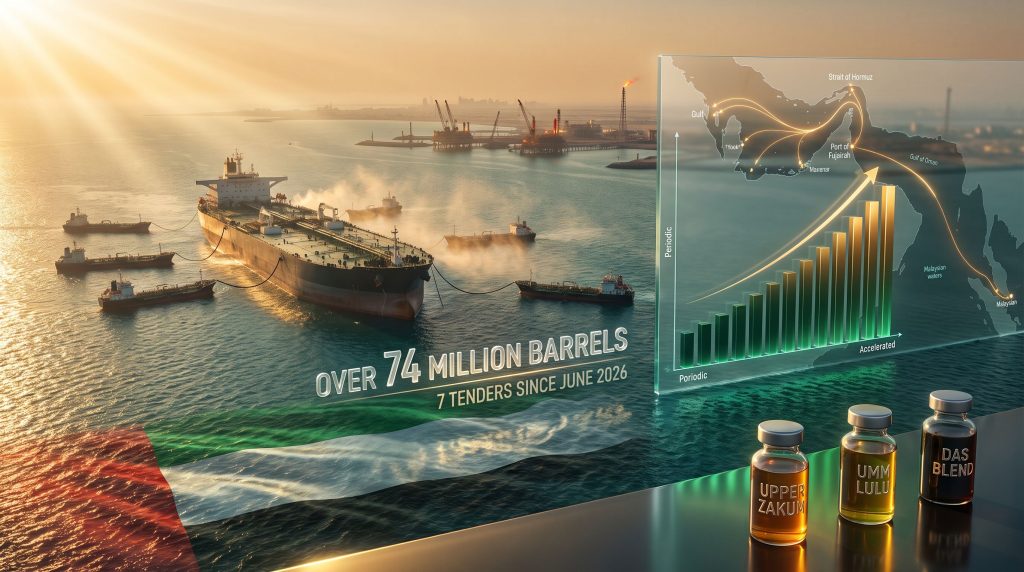
The pace of ADNOC's recent tender issuance is historically notable. At least seven crude oil tenders have been issued since the start of June 2026, representing a level of spot market engagement that compresses into under two months what would ordinarily be distributed across an entire quarter or more.
Cumulative spot sales across the tender series have now surpassed 74 million barrels, distributed across multiple crude grades, loading ports, and delivery windows extending from August through October 2026.
To contextualise that figure: 74 million barrels is roughly equivalent to approximately three-quarters of a day's worth of global oil consumption compressed into a single tender cycle, according to International Energy Agency global demand estimates. It is a substantial volume to move through competitive bidding rather than pre-allocated term channels. Furthermore, current crude oil prices have played a key role in making this spot strategy commercially attractive.
Bid Mechanics and Submission Windows
The most recent tender in this series had bid submission due on 27 July 2026, with validity extending to at least 29 July 2026. According to Reuters, ADNOC has specified that any bid submitted at a discounted differential will face automatic rejection, a condition that functions as a formal price floor rather than a negotiating posture.
This is not a minor technical detail. Automatic rejection of discounted bids removes ambiguity from the process. It tells potential buyers that ADNOC is not testing demand at reduced prices; it is asserting that full-differential pricing is the only acceptable entry point.
Crude Grades, Loading Ports, and the Logistics Matrix
Grades Featured in the 2026 Tender Series
| Crude Grade | Key Characteristics | Market Position |
|---|---|---|
| Upper Zakum | Medium sour, large-volume UAE offshore grade | Backbone of ADNOC's export portfolio |
| Umm Lulu | Light sweet, premium API gravity | Attracts premium-seeking Asian refiners |
| Das Blend | Condensate-rich, export-focused blend | Appeals to complex refinery configurations |
Each of these grades occupies a distinct position in refinery procurement decisions. Upper Zakum's medium sour profile suits hydrocracking-intensive refineries common across East Asia. Umm Lulu and Das Blend, with their lighter, sweeter characteristics, attract refiners optimised for high-value product yield.
Loading Infrastructure Options
What makes this tender series logistically complex is the breadth of loading options being offered simultaneously:
- Zirku Island — a deepwater loading terminal operating within the Arabian Gulf, suited for large crude carriers transiting the Strait of Hormuz.
- Das Island — an offshore loading hub serving Upper Zakum and Das Blend exports, positioned further offshore within the Gulf.
- Port of Fujairah — located on the UAE's eastern coastline outside the Strait of Hormuz, providing direct Indian Ocean access without requiring Hormuz transit.
- Ship-to-Ship (STS) transfers offshore Fujairah — enabling transhipment to larger vessels positioned in open water beyond the Strait.
- STS transfers near Malaysian waters — a more geographically distant option that signals ADNOC's willingness to support cargo handovers far outside the immediate conflict zone.
Why the Malaysia STS Option Deserves Attention
The inclusion of ship-to-ship transfer options near Malaysia is not a standard feature of Gulf crude tenders. As Baird Maritime reports, this arrangement essentially allows ADNOC to deliver crude onto a buyer's vessel in a neutral, lower-risk maritime environment thousands of kilometres from the conflict zone. For Asian refiners reluctant to send their own vessels into elevated-risk waters, this reduces their exposure while preserving access to UAE crude supply.
If this option becomes structurally embedded in future ADNOC tenders, it would represent a meaningful reconfiguration of how Middle Eastern crude reaches Asian markets, bypassing the Hormuz chokepoint not just operationally but commercially.
The Strait of Hormuz Factor: Risk, Shuttle Fleets, and Pricing Power
How ADNOC Has Been Moving Crude Quietly
To maintain export continuity despite elevated Hormuz transit risk, ADNOC has deployed a shuttle fleet model. Under this arrangement, smaller vessels load crude at Gulf terminals and transfer it to larger tankers positioned in the Gulf of Oman, effectively keeping the larger vessels out of contested waters entirely.
This approach mirrors tactics used by producers facing maritime chokepoint constraints historically, though the scale and systematisation of ADNOC's shuttle operations reflect a more sophisticated logistical response than ad hoc workarounds.
The Viability Question
The shuttle fleet strategy is not without risk. At least two Emirati tankers have reportedly been attacked while transiting the Strait of Hormuz as hostilities between the United States and Iran have intensified. This development introduces genuine uncertainty about whether the shuttle model can continue functioning at the scale required to maintain tender commitments.
The uncertainty surrounding shuttle fleet operations creates a compounding pressure: ADNOC must continue selling to maintain revenue flows while simultaneously managing the physical risk of moving crude through one of the world's most contested maritime corridors.
Spot Premium Rally and Its Implications
Despite, or arguably because of, the disruption, spot premiums for Middle Eastern crude have rallied to more than one-month highs during the current conflict escalation period. This counterintuitive dynamic reflects a fundamental market reality: tightened supply availability drives buyers to compete more aggressively for available cargoes, which pushes differentials upward.
| Market Metric | Pre-Escalation | Post-Escalation |
|---|---|---|
| Spot Premiums | Moderate, stable | One-month highs |
| Tender Frequency | Periodic | Seven rounds since June |
| Shuttle Fleet Status | Fully operational | Viability under review |
| STS Transfer Geography | Fujairah offshore | Fujairah + Malaysia |
| Cumulative Spot Volume | Distributed over quarters | 74+ million barrels in weeks |
What the Pricing Posture Reveals About Supply Dynamics
Reading the Automatic Rejection Clause
Procurement specialists and trading desk analysts who regularly participate in ADNOC tenders will recognise the automatic rejection of discounted bids as a meaningful escalation of pricing confidence. In a buyer's market, producers typically allow some flexibility in differential negotiations to secure volume commitments. Removing that flexibility entirely suggests ADNOC has assessed that demand from competing buyers is sufficient to absorb available volumes at full-differential pricing.
This is a significant finding for the broader market. It implies that Asian refiner demand for Middle Eastern crude remains robust enough that ADNOC does not need to offer concessions to clear its tender volumes, even under geopolitical duress.
Competitive Positioning Among Gulf Producers
ADNOC's aggressive spot marketing also places competitive pressure on other Middle Eastern producers. When one major Gulf supplier floods the spot market with volume while simultaneously commanding full premiums, it narrows the pricing flexibility available to competing producers attempting to place their own cargoes.
Saudi Aramco, Kuwait Petroleum Corporation, and Iraq's SOMO all compete for the same pool of Asian refinery capacity. ADNOC's accelerated tender cadence, combined with its pricing discipline, positions UAE crude as both abundant and premium — a combination that is commercially unusual and strategically powerful. In addition, OPEC market influence continues to shape how these competitive dynamics play out across the broader Gulf producer landscape.
The next major ASX story will hit our subscribers first
Asian Refiner Demand and the Buyer Landscape
Who Is Participating in ADNOC's 2026 Tenders
The primary buyer base across this tender series reflects the established demand geography for Middle Eastern crude:
- South and East Asian refiners represent the dominant buyer category, driven by proximity and refinery configuration compatibility with UAE crude grades.
- Singapore-based trading desks have maintained active monitoring and participation in the bidding process, reflecting the city-state's role as the regional crude trading hub.
- Independent refiners in India, South Korea, Japan, and China continue to express consistent demand for Upper Zakum and lighter UAE grades that complement their hydrocracking and fluid catalytic cracking configurations.
The spot market participation pattern also reflects a broader trend toward greater flexibility in refinery procurement strategies. Asian refiners that previously relied almost exclusively on term contracts are increasingly supplementing with spot purchases to capture grade diversity and pricing opportunities.
Scenario Pathways: What Comes Next
Two Possible Market Trajectories
The evolution of ADNOC's spot tender strategy will depend heavily on how the geopolitical environment resolves. The geopolitical trade tensions currently reshaping global energy corridors will be central to which of these scenarios unfolds.
Scenario A: De-escalation pathway. If hostilities between the United States and Iran moderate and Strait of Hormuz transit risk normalises, the shuttle fleet model likely resumes full operations. Term contract allocations stabilise, tender frequency moderates, and spot premiums gradually compress back toward historical norms. In this scenario, the 2026 tender surge becomes a temporary anomaly rather than a structural shift.
Scenario B: Sustained conflict environment. If hostilities persist or intensify, STS transfers in Malaysian waters transition from an emergency option to a structural feature of ADNOC's export architecture. Fujairah's role as an alternative export corridor deepens materially. Spot premiums remain elevated through the third quarter of 2026 and potentially beyond. The ADNOC crude oil tender since June pace becomes the new baseline rather than an exception.
The commercial and infrastructural implications of Scenario B are considerably more significant, as they would require physical investment in terminal capacity at Fujairah, tanker fleet arrangements for ongoing STS operations, and renegotiation of buyer delivery expectations across ADNOC's customer base.
Fujairah's Rising Strategic Importance
Fujairah's emergence as a preferred loading alternative in this tender series is not accidental. The port already hosts one of the world's largest ship bunkering hubs and holds significant crude and refined product storage capacity. Its position on the Gulf of Oman coast means vessels loading there bypass the Strait of Hormuz entirely, connecting directly to Indian Ocean shipping lanes that reach Asian markets without traversing contested waters.
Furthermore, the oil market trade impacts of sustained Hormuz disruption could accelerate investment decisions at Fujairah well beyond current timelines. If the current conflict environment persists, Fujairah's role in regional energy logistics is likely to expand well beyond its current capacity, both as a loading terminal and as a storage buffer for ADNOC's growing spot volumes.
Frequently Asked Questions: ADNOC Crude Oil Tenders Since June
What is an ADNOC crude oil tender?
A crude oil tender is a competitive bidding mechanism through which ADNOC invites refiners and trading houses to submit purchase offers for specific crude volumes across defined grades and loading windows. Unlike long-term supply contracts, tenders operate on a spot basis, enabling flexible volume allocation and real-time price discovery.
How many ADNOC tenders have been issued since June 2026?
At least seven tenders have been issued since the start of June 2026, marking one of the most concentrated periods of spot crude marketing activity in recent ADNOC commercial history. This ADNOC crude oil tender since June activity has attracted significant interest from Asian refinery buyers operating across multiple procurement strategies.
Why does ADNOC automatically reject discounted bids?
Automatic rejection of below-market bids functions as a formal price floor mechanism, signalling that ADNOC assesses current supply tightness as sufficient to command full-differential pricing from competing buyers without needing to offer concessions.
How is ADNOC managing crude exports given Strait of Hormuz risks?
ADNOC has employed a shuttle fleet model to transfer crude onto larger tankers in the Gulf of Oman, and has also offered loading from Fujairah and ship-to-ship transfer arrangements near Malaysian waters, providing buyers with access to UAE crude without requiring Hormuz transit.
What crude grades have been offered across the 2026 tender series?
The tender series has featured Upper Zakum, Umm Lulu, and Das Blend across multiple rounds, with loading windows spanning August through October 2026.
What is the total volume sold through ADNOC spot tenders since June?
Cumulative sales across the tender series have exceeded 74 million barrels, distributed among refiners and trading entities operating primarily in Asian markets.
Key Takeaways
- Seven tenders issued since June 2026 represent an historically elevated pace of spot crude marketing activity for ADNOC.
- Cumulative volumes exceeding 74 million barrels underscore the material scale of this spot market engagement.
- Logistics innovation, including shuttle fleet operations and Malaysian STS transfer arrangements, reflects deliberate adaptation to Hormuz transit risk.
- The automatic rejection of discounted bids signals genuine producer confidence in demand conditions, not desperation to move volume.
- Middle Eastern crude spot premiums reaching one-month highs validates ADNOC's pricing discipline and confirms supply tightness perceptions in the market.
- Fujairah's structural role as an alternative export corridor is being materially reinforced by the current conflict environment, with long-term infrastructure implications that extend beyond the immediate crisis.
- The Malaysia STS option, if it becomes a permanent feature, could represent a foundational shift in how Middle Eastern crude reaches East Asian refinery systems.
This article is intended for informational purposes only and does not constitute financial or investment advice. Forecasts, scenario projections, and market assessments are based on publicly available information and involve inherent uncertainty. Readers should conduct independent analysis before making any investment or commercial decisions.
Want to Stay Ahead of Major Resource Discoveries Driving Global Commodity Markets?
While ADNOC's accelerating spot tender activity signals structural shifts in global energy supply chains, the real wealth-creation opportunities for investors often lie in identifying significant mineral discoveries the moment they are announced — precisely what Discovery Alert's proprietary Discovery IQ model is built to deliver, scanning ASX announcements in real time and converting complex commodity data across 30-plus sectors into clear, actionable insights. Explore historic discoveries and their market returns to understand the scale of opportunity, then begin a 14-day free trial of Discovery Alert to position yourself ahead of the broader market.