July 27, 2026
The Architecture of Alliance Strategy: Why OPEC+ Is Unwinding Its Supply Discipline
Global oil alliances rarely operate in straight lines. The decision to cut production is almost always followed, eventually, by the decision to reverse it. What matters to energy markets is not the reversal itself, but the timing, the pace, and the conditions under which it happens. Right now, the seven core producers within OPEC+ are navigating one of the most complex environments in recent memory: a deliberate, structured effort to OPEC+ raise oil output targets from September is colliding with a geopolitical landscape that is actively preventing those barrels from reaching the market.
Understanding why this tension exists, and what it means for crude benchmarks through the remainder of 2025 and into 2026, requires stepping back from the headlines and examining the mechanics of how the alliance actually functions.
When big ASX news breaks, our subscribers know first
The Strategic Pivot: From Restraint to Volume Competition
Rewinding to the 2023 Supply Cut Agreement
In 2023, OPEC+ agreed to a collective supply reduction of 1.65 million barrels per day. At the time, the rationale was straightforward: global demand signals were uncertain, and the alliance chose price support over market share defence. The United Arab Emirates was still a full OPEC member and participated in that agreement.
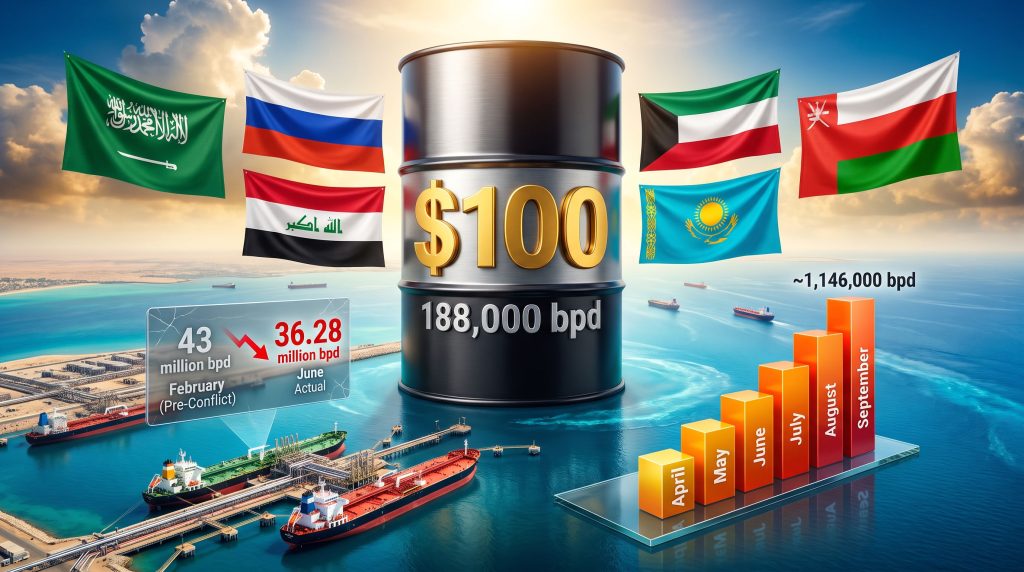
Fast forward to 2025, and the strategic calculus has shifted. The UAE formally departed from OPEC in May, altering the baseline arithmetic for what a full unwind of the 2023 cut would actually look like. The seven remaining core producers — Saudi Arabia, Russia, Iraq, Kuwait, Algeria, Kazakhstan, and Oman — have been methodically rolling back that agreement since April, with each month delivering an identical increment of approximately 188,000 barrels per day.
This is not an impulsive response to short-term market conditions. It is a coordinated, pre-planned strategy to recapture market share that the alliance believes will be available once Gulf export disruptions linked to the Iran conflict eventually subside. The broader OPEC market influence on pricing sentiment remains substantial, even as physical delivery constraints complicate the picture.
Monthly Quota Increases: The Running Tally
The scale of the cumulative shift is significant when viewed across the full timeline:
| Month | Incremental Increase (bpd) | Cumulative Increase (bpd) |
|---|---|---|
| April | ~188,000 | ~188,000 |
| May | ~188,000 | ~376,000 |
| June | ~188,000 | ~564,000 |
| July | ~188,000 | ~752,000 |
| August | ~188,000 | ~958,000 |
| September (proposed) | ~188,000 | ~1,146,000 |
A further increase of approximately 188,000 bpd for September, subject to a vote at the August 2 ministerial meeting, would effectively complete the full unwind of the 2023 supply agreement when adjusted for the UAE's exit. Three sources familiar with internal discussions confirmed to Reuters that this outcome is the most likely result of that meeting, though no final decision had been reached as of reporting.
Structural Inflection Point: The proposed September hike is not simply another incremental step. If approved, it mathematically closes the chapter on the 2023 production restraint era. The alliance would formally transition from managed supply discipline back to volume-led competition, a posture last seen before the pandemic-era coordination agreements reshaped the group's collective behaviour.
The Execution Gap: Where Quota Targets Diverge from Physical Reality
What the Production Data Actually Shows
Here is where the real complexity lies. While the alliance is voting to raise output quotas on paper, the physical barrels available to global markets tell a very different story.
OPEC's own figures show that the group produced approximately 36.28 million barrels per day in June, compared to nearly 43 million bpd in February, before active conflict involving Iran disrupted Gulf export flows. That is a shortfall of roughly 6.7 million bpd relative to pre-war production levels, dwarfing the incremental hikes the alliance is approving each month.
This distinction between quota-setting and physical delivery is one of the most important, and least discussed, dynamics in the current oil market. When OPEC+ announces a production increase, energy traders are increasingly required to discount that announcement against their assessment of what volume is actually deliverable. Furthermore, the OPEC output increase strategy being pursued reflects long-term market share ambitions rather than a short-term response to demand signals.
Why Member Nations Face Uneven Execution Barriers
The challenges are not uniformly distributed across the alliance. Each major producer faces a distinct set of constraints:
| Member Country | Key Production Challenge | Estimated Impact |
|---|---|---|
| Iran | Active conflict, sanctions, export blockages | Significant |
| Iraq | Infrastructure vulnerability, Gulf route reliance | Moderate to High |
| Saudi Arabia | Red Sea tanker disruptions, Houthi threat | Moderate |
| Kazakhstan | Caspian pipeline bottlenecks | Low to Moderate |
| Russia | Western sanctions, alternative routing complexity | Moderate |
For Iraq, the dependence on Gulf export routes creates a structural vulnerability that cannot be resolved through quota decisions alone. Saudi Arabia faces a newer and more operationally specific threat: Houthi attacks on Saudi oil tankers in the Red Sea, which has disrupted the primary bypass route used when Strait of Hormuz flows are constrained. This is a meaningful development because the Red Sea corridor had previously functioned as a contingency lifeline for Gulf producers navigating Hormuz disruptions.
The Strait of Hormuz: The Chokepoint That Defines Market Pricing
Why This Waterway Commands a Permanent Risk Premium
Few geographic features carry the weight of the Strait of Hormuz in global energy pricing. This narrow passage between the Persian Gulf and the Gulf of Oman handles an extraordinary share of the world's seaborne crude oil exports, making it functionally irreplaceable for the Gulf producers that dominate OPEC+ membership.
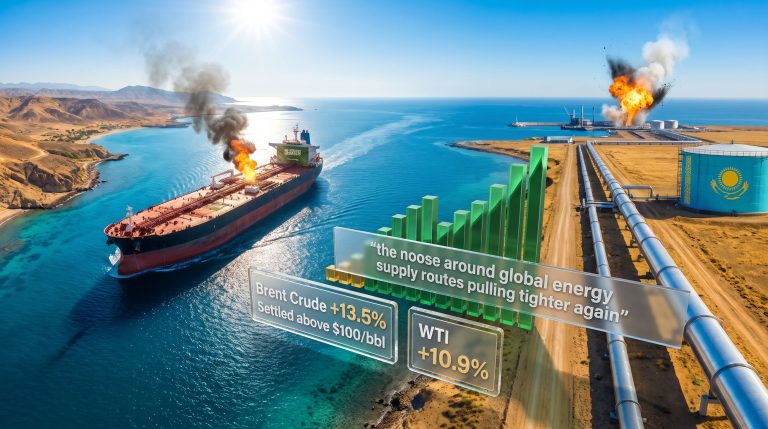
When the preliminary U.S.-Iran peace agreement was in place, tanker traffic through the strait had been recovering, giving markets some confidence that physical supply would improve. The collapse of that agreement removed that reassurance almost immediately, and crude benchmarks responded, climbing back toward the $100 per barrel level as a geopolitical risk premium was repriced into the market. Consequently, oil price geopolitics have become inseparable from the alliance's production strategy in ways that were not anticipated when the quota unwind began.
Why has oil risen toward $100 per barrel? The primary driver is renewed uncertainty over Gulf export continuity following the breakdown of a preliminary diplomatic framework between the United States and Iran. With tanker traffic through the Strait of Hormuz under renewed threat, and Houthi attacks targeting Saudi vessels in the Red Sea, the market is simultaneously processing physical supply constraints and elevated forward risk. The combination has compressed the gap between supply and demand in ways that benchmark pricing reflects directly.
The Red Sea Dimension: A Secondary Front Opening
The Houthi campaign against Saudi Arabian tankers in the Red Sea introduces a layer of supply chain risk that was not a dominant feature of earlier conflict cycles. Saudi Arabia had been relying more heavily on Red Sea routing as an alternative to Gulf transit precisely because Hormuz risks were elevated. The targeting of those alternative routes means the kingdom now faces compression from two directions simultaneously, limiting the real-world volume it can reliably export regardless of what its quota allocation says.
Market Psychology and the Quota Signal Problem
How Traders Are Processing the Announcement-Reality Divergence
One of the more nuanced dynamics in the current environment involves investor and trader psychology around OPEC+ announcements. Historically, a production increase announcement from the alliance was interpreted as a bearish signal for prices, since more supply implies downward pressure on crude benchmarks. That conventional logic is being tested in 2025.
Because the gap between announced targets and deliverable barrels is so substantial, and because the geopolitical conditions suppressing actual output show no clear resolution timeline, traders are increasingly treating quota increases as forward positioning statements rather than near-term supply signals. The market is not pricing in the incremental 188,000 bpd because it does not expect those barrels to materialise under current conditions.
This psychological shift has important implications for how oil markets will respond to resolution scenarios. If Gulf hostilities were to ease substantially and Iranian export capacity recovered, the translation of existing quota levels into actual production could generate a significant and rapid supply overhang, potentially pushing prices sharply lower from their current elevated levels. In addition, ongoing oil market disruptions stemming from broader trade tensions continue to complicate the demand-side outlook for producers.
Three Forward Scenarios Through Q4 2026
The range of credible outcomes for oil markets over the next six quarters is unusually wide. The following framework captures the key variables and their likely price implications:
| Scenario | Conditions | Likely Price Impact |
|---|---|---|
| Full September hike approved, conflict persists | Quotas raised but physical output remains constrained | Prices remain near $100/bbl |
| Hike approved, ceasefire or diplomatic resolution reached | Targets raised and progressively deliverable | Moderate correction toward $80 to $85/bbl |
| Hike delayed or reversed, renewed supply discipline | Alliance steps back from volume strategy | Spike potential above $105/bbl |
The middle scenario — where diplomatic progress reduces conflict intensity and gradually allows Gulf export infrastructure to recover — would be the most consequential for downstream markets including refinery margins, fuel pricing, and industrial input costs. A normalisation of Gulf flows combined with accumulated quota increases could shift the market from perceived tightness to genuine surplus within a relatively short timeframe.
The next major ASX story will hit our subscribers first
Frequently Asked Questions: OPEC+ and the September Output Decision
What is OPEC+ planning for oil output from September?
Seven core members of the alliance are expected to vote on August 2 to raise collective output targets by approximately 188,000 barrels per day for September, continuing the monthly increase cadence that began in April 2025. If approved, this would mark the sixth consecutive month of quota increases as part of the OPEC+ raise oil output targets from September strategy.
Why is OPEC+ raising targets when actual output has fallen so sharply?
The alliance is pursuing a deliberate market share recovery strategy tied to the phased rollback of its 2023 supply agreement. The quota increases are positioned as preparation for when export disruptions caused by Gulf conflict eventually ease, rather than as an immediate production stimulus.
Has the September increase been formally confirmed?
No. As of the reporting period, sources indicated no final decision had been reached. The August 2 ministerial meeting will determine the outcome.
What is the gap between OPEC+ quotas and actual production?
OPEC data shows June production at approximately 36.28 million bpd, compared to nearly 43 million bpd in February before conflict-related disruptions intensified. That represents a shortfall of roughly 6.7 million bpd below pre-war output levels.
Why did the UAE leave OPEC, and what does it mean for the production unwind?
The UAE formally exited OPEC in May. Its departure changes the baseline against which the 2023 supply cut unwind is calculated. When accounting for the UAE's exit, the proposed September increase of approximately 188,000 bpd would complete the mathematical reversal of the 2023 reduction agreement for the remaining seven core producers.
What role does the Strait of Hormuz play in current oil pricing?
The strait is the world's most critical oil transit chokepoint. Any disruption to tanker traffic through this passage — whether from conflict, enforcement actions, or diplomatic breakdown — creates immediate upward pressure on global crude benchmarks. The collapse of the preliminary U.S.-Iran framework removed a key stabilising signal that markets had been relying on. Furthermore, OPEC demand forecasts have been revised in response to these evolving supply dynamics, adding another layer of uncertainty to price projections.
What Analysts Are Watching Into the August Meeting
Several variables will determine whether the September hike proceeds as expected and how markets interpret the outcome:
- Whether any ceasefire or diplomatic signalling emerges before August 2 that changes the alliance's calculus
- The pace of Houthi activity targeting Red Sea shipping in the days leading into the meeting
- Whether Kazakhstan or Iraq signal any willingness to push back on the quota increase timeline given their infrastructure constraints
- Any revision to OPEC's own demand forecasts that might shift the alliance's view on absorption capacity for additional supply
- How Brent crude pricing behaves in the week before August 2, since price levels often influence the confidence with which the alliance announces output changes
The interplay between a structurally committed volume recovery strategy and a geopolitical environment that continues to suppress deliverable supply makes the OPEC+ raise oil output targets from September decision one of the more consequential near-term events for global energy markets. However, regardless of what the headline quota number turns out to be, the fundamental question of physical deliverability will remain the critical variable for traders and analysts alike. CNBC's energy coverage has similarly highlighted the market share dimensions of this strategic shift, underscoring just how broadly this development is being tracked across financial media.
This article contains forward-looking analysis and scenario projections that are inherently uncertain. Oil market outcomes depend on geopolitical, operational, and diplomatic variables that are subject to rapid change. Nothing in this article constitutes financial or investment advice.
Want to Capitalise on the Market Movements Driven by Major Commodity Discoveries?
While geopolitical forces reshape global oil supply chains, the next significant mineral discovery on the ASX could represent an equally compelling opportunity — and Discovery Alert's proprietary Discovery IQ model ensures subscribers receive real-time alerts the moment those discoveries are announced, turning complex data across 30-plus commodities into clear, actionable insights. Explore the historic returns generated by major mineral discoveries and begin a 14-day free trial to position yourself ahead of the broader market.