July 27, 2026
Floating Infrastructure and the New Logic of Levant Energy Security
Across the Middle East and North Africa, a quiet but consequential transformation is underway in how nations source, store, and distribute natural gas. The era of absolute pipeline dependency is giving way to a more flexible, modular approach to gas supply, one where floating infrastructure plays an increasingly central role. This shift is not driven by ideology but by arithmetic: peak summer demand in densely populated, rapidly urbanising countries like Egypt now outpaces what fixed domestic production and bilateral pipeline arrangements can reliably deliver. The result is a growing reliance on seaborne liquefied natural gas, and the floating terminals capable of converting it back into a usable form at speed.
Against this backdrop, the Excelerate Energy Aqaba FSRU gas supply to Egypt and Jordan represents more than a seasonal logistics arrangement. It signals a structural evolution in regional energy architecture, one where geography, geopolitics, and grid reliability intersect in ways that fixed infrastructure alone cannot resolve. Furthermore, understanding this shift requires examining both the mechanics of floating regasification and the broader energy market volatility shaping procurement decisions across the region.
When big ASX news breaks, our subscribers know first
Understanding the FSRU Model Before Examining the Aqaba Deployment
To appreciate the significance of what is happening at Jordan's Aqaba port, it helps to understand what a floating storage and regasification unit actually does and why it has become the preferred solution in markets facing urgent, scalable import needs.
An FSRU is a purpose-built vessel that fulfils two functions simultaneously. It acts as a receiving terminal for LNG carrier ships, accepting cargoes of liquefied natural gas at extremely low temperatures, typically around minus 162 degrees Celsius. It then converts that LNG back into its gaseous state through a regasification process and injects the output directly into onshore pipeline infrastructure.
The critical advantage of this model is speed. While a conventional onshore LNG import terminal requires years of engineering, permitting, and construction, an FSRU can be mobilised, connected, and brought into service in a matter of months, making it uniquely suited to markets where demand has outpaced supply planning cycles.
The key distinctions between FSRUs and fixed terminals extend beyond construction timelines:
- FSRUs are mobile assets that can be redeployed to different markets when demand conditions change
- They eliminate the need for permanent coastal infrastructure investment at the receiving end
- Charter arrangements allow governments to access regasification capacity without committing to decades-long capital expenditure
- They can be scaled up or down by modifying charter terms rather than building or decommissioning fixed plant
These characteristics make FSRUs particularly attractive to energy-deficit nations operating in volatile geopolitical and fiscal environments.
The Excelerate Acadia: A Modern Vessel at a Strategic Location
The specific asset deployed at Aqaba is the Excelerate Acadia, a recently commissioned FSRU operated by Texas-headquartered Excelerate Energy, a specialist in floating regasification with a global fleet spanning multiple continents. The Acadia represents the newer generation of FSRU vessels, incorporating improved regasification efficiency and connection flexibility compared to earlier units in the operator's fleet.
At the time of reporting, the Acadia was in the process of being connected to port facilities at Aqaba and undergoing commissioning tests ahead of operational commencement. The arrangement underpinning its deployment is a time charter agreement between Excelerate Energy and Jordan's National Electric Power Company, known as NEPCO, with the contract running through December 2026.
The choice of Aqaba as the host location is not incidental. Jordan's only coastal access is through this narrow Gulf of Aqaba corridor, which sits at a critical juncture between Gulf LNG supply routes and the Levant's overland pipeline network. Crucially, existing pipeline connectivity between Jordan and Egypt, including the Arab Gas Pipeline system, means that regasified LNG received at Aqaba can be transmitted westward into Egypt's national gas grid without the need for new cross-border infrastructure.
How the Gas Volumes Are Divided Between Egypt and Jordan
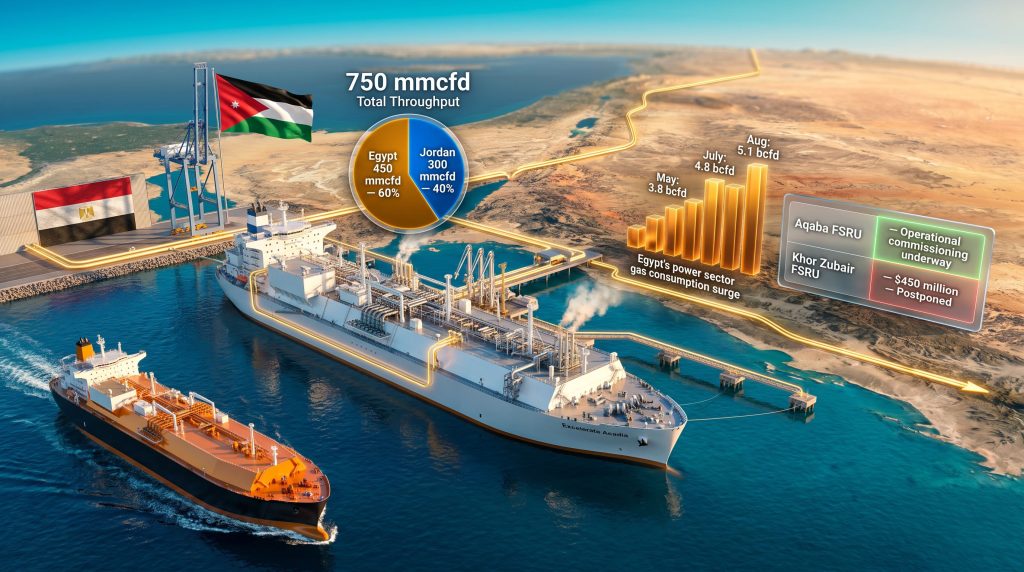
The intergovernmental agreement formalising the Aqaba FSRU arrangement splits the vessel's total throughput capacity of 750 million cubic feet of gas per day (mmcfd) between the two countries according to the following allocation:
| Recipient Country | Daily Gas Allocation | Share of Total FSRU Capacity |
|---|---|---|
| Egypt | 450 mmcfd | 60% |
| Jordan | 300 mmcfd | 40% |
| Total FSRU Throughput | 750 mmcfd | 100% |
Egypt's dominant share of the arrangement reflects the scale of the demand challenge it faces. Power sector gas consumption in Egypt rose from 3.8 billion cubic feet per day (bcfd) in May to 4.8 bcfd by July, with projections pointing to approximately 5.1 bcfd in August driven by extreme heat and the air conditioning loads it generates across Egypt's densely populated cities.
At the national level, total gas demand across all sectors is forecast to rise from 7.2 bcfd in August of the prior year to approximately 7.9 bcfd in August 2026, representing a year-on-year increase that underscores the urgency of supplementary import arrangements. Egypt has also separately contracted 23 individual LNG shipments for July to help bridge the gap between domestic production and peak consumption requirements.
The power sector demand increase between May and August 2026 alone represents a roughly 34% seasonal surge, a figure that illustrates why short-duration, flexible import solutions like the Aqaba FSRU are indispensable tools in Egypt's energy management toolkit.
Jordan's 300 mmcfd allocation, while smaller in absolute terms, carries outsized strategic importance for the kingdom. Jordan has one of the highest per-capita energy import dependencies in the region, with limited domestic hydrocarbon resources and a grid that is highly sensitive to supply disruptions. The NEPCO charter arrangement introduces a new, non-pipeline gas supply vector at a moment when reliance on any single source carries elevated geopolitical risk.
The Gas Flow Pathway: From LNG Carrier to Egyptian Power Grid
Understanding how gas physically travels from the Aqaba FSRU to end consumers in Egypt requires tracing a multi-stage supply chain that spans international shipping lanes, floating infrastructure, and overland pipeline networks.
The sequence works as follows:
- International LNG suppliers load cargoes onto LNG carrier vessels at export terminals, typically in Qatar, the United States, or other producing nations
- LNG carriers deliver cargoes to the Excelerate Acadia at Aqaba, where the liquefied gas is transferred into the FSRU's storage tanks
- The Acadia's onboard regasification systems convert the LNG back into natural gas and inject it at pipeline pressure into Aqaba's onshore receiving infrastructure
- Regasified gas enters Jordan's domestic pipeline network and is transmitted through the country's overland grid
- Gas allocated to Egypt crosses the Jordanian-Egyptian border via cross-border interconnectors, including segments of the Arab Gas Pipeline system, and enters Egypt's national transmission network
- Egyptian grid operators distribute the gas to power stations, industrial consumers, and residential supply networks according to demand priorities
The Arab Gas Pipeline, originally conceived as a regional integration project connecting Egypt, Jordan, Syria, and Lebanon, remains a critical piece of enabling infrastructure for this arrangement, even though it has operated below its original design ambitions due to regional instability in segments further north. In addition, the Eastern Mediterranean energy dynamics shaping this corridor continue to evolve rapidly, with implications for how gas flows are structured across the Levant region more broadly.
Excelerate Energy's Middle East Footprint: Aqaba in Context
The Aqaba deployment sits within a broader regional strategy for Excelerate Energy, which has positioned itself as one of the leading FSRU operators in frontier and emerging LNG import markets. The company's Middle East portfolio now includes two significant project engagements, though their respective trajectories differ markedly.
| Project | Location | Contract Value | Current Status |
|---|---|---|---|
| Aqaba FSRU (Excelerate Acadia) | Aqaba, Jordan | Undisclosed charter | Commissioning underway |
| Khor Zubair FSRU | Southern Iraq | $450 million | Postponed due to regional tensions |
The Iraq contract, signed in October 2025, targeted a mid-2026 deployment at the port of Khor Zubair in southern Iraq but was subsequently postponed due to regional geopolitical pressures. The contrast between the two projects is instructive. While both were conceived within similar timeframes and target similar demand dynamics, the Aqaba deployment has progressed to commissioning while the Iraq project remains stalled.
This divergence highlights a core risk factor in FSRU project execution across the MENA region: geopolitical stability is as important a determinant of project delivery as technical readiness or commercial terms. Aqaba's relative political stability, combined with Jordan's established port infrastructure and existing pipeline links to Egypt, created conditions that allowed rapid mobilisation. Iraq's security environment introduced delays that no amount of commercial urgency could overcome.
For energy planners and infrastructure investors evaluating FSRU opportunities across the region, the lesson from this contrast is clear: project viability assessments must weight political risk and port infrastructure maturity as primary, not secondary, considerations.
The next major ASX story will hit our subscribers first
Energy Security Calculus: What Both Countries Are Really Solving For
The Aqaba FSRU arrangement addresses immediate supply gaps, but it also reflects deeper, longer-term energy security concerns in both Egypt and Jordan. Furthermore, these concerns do not exist in isolation — they are shaped by shifting natural gas price trends and evolving dynamics in global LNG supply that affect procurement strategies across the region.
Egypt's Domestic Production Ambitions and the Import Bridge
Egypt's current import dependency is, at least officially, a transitional condition. The country has articulated ambitions to scale up domestic natural gas production significantly and has also set a target to double oil output by 2030, which would carry implications for associated gas availability. However, the gap between current domestic supply capacity and peak demand is real and growing in the near term.
This means FSRU-based imports will remain a critical demand-management tool through at least the mid-2020s regardless of longer-term production trajectories. Egypt's parallel procurement of 23 LNG shipments for July 2026, alongside the Aqaba FSRU arrangement, suggests a multi-channel import strategy designed to avoid over-reliance on any single supply mechanism — a prudent approach given LNG price volatility and shipping availability constraints in global markets.
Jordan's Strategic Case for Supply Diversification
Jordan currently imports gas from Israel and other regional suppliers, with pipeline-based delivery forming the backbone of its gas supply. This concentration creates vulnerability: any disruption to pipeline flows, whether technical, political, or security-related, can have immediate consequences for Jordan's power generation capacity.
The Aqaba FSRU introduces a seaborne LNG supply vector that operates independently of any single bilateral pipeline arrangement. This diversification, even on a seasonal basis, improves Jordan's supply resilience and provides NEPCO with greater flexibility in managing its procurement portfolio. The geopolitical risk landscape across the broader MENA region makes this kind of supply redundancy increasingly valuable for smaller economies with limited domestic resources.
Frequently Asked Questions: Excelerate Energy Aqaba FSRU and Gas Supply to Egypt and Jordan
What is the Excelerate Energy Aqaba FSRU and what does it do?
The Excelerate Acadia is a floating storage and regasification unit deployed at Jordan's Aqaba port by Texas-based Excelerate Energy. It receives LNG cargoes from international carrier vessels, converts the liquefied gas back into its gaseous form, and injects the output into onshore pipeline networks serving both Jordan and Egypt.
How much gas will Egypt receive from the Aqaba FSRU?
Under the bilateral intergovernmental agreement, Egypt is allocated 450 million cubic feet of gas per day, representing 60% of the Acadia's total throughput capacity of 750 mmcfd.
How long will the Aqaba FSRU operate?
The operating contract runs through December 2026, spanning Jordan's peak summer demand period and extending into the autumn months. Commissioning tests were underway at Aqaba port at the time the arrangement was reported.
Why is Jordan hosting the FSRU rather than Egypt directly?
Aqaba's geographic position at the northern tip of the Red Sea, its existing port infrastructure capable of receiving LNG carriers, and its established pipeline connectivity to Egyptian networks via the Arab Gas Pipeline corridor make it a logistically efficient entry point for regasified LNG destined for both countries. A direct Egyptian coastal deployment would require a separate FSRU, separate port facilities, and independent procurement arrangements.
What other FSRU projects does Excelerate Energy have in the Middle East?
Excelerate Energy holds a $450 million contract for an FSRU deployment at the port of Khor Zubair in southern Iraq, originally targeting a mid-2026 commissioning date. That project has been postponed due to regional geopolitical tensions, placing it in stark contrast with the advancing Aqaba deployment.
What the Aqaba Deployment Reveals About the Future of Regional Gas Markets
Several broader conclusions emerge from examining the Excelerate Energy Aqaba FSRU gas supply to Egypt and Jordan, and the wider energy dynamics it serves:
- The seasonal demand curve in Egypt's power sector, rising by roughly a third between spring and peak summer, is severe enough to justify dedicated floating import infrastructure on a multi-month charter basis
- Jordan's willingness to host a regional FSRU serving both its own grid and a larger neighbouring country reflects the economic logic of shared infrastructure and the diplomatic value of bilateral energy cooperation
- The 750 mmcfd total throughput of the Aqaba FSRU, while substantial, represents a partial solution to Egypt's projected 7.9 bcfd August demand requirement, confirming that no single import mechanism is sufficient and that multi-channel procurement strategies are essential
- Excelerate Energy's ability to mobilise a modern FSRU to operational readiness at Aqaba, while its Iraq project remains stalled, demonstrates that project execution speed in this sector is determined as much by the host country environment as by the operator's technical capability
- Both Egypt and Jordan face a structural tension between the immediate necessity of import-dependent demand management and longer-term political and economic pressures to reduce that dependency through domestic production growth
- The US gas price forecast remains a key variable influencing the cost of LNG cargoes sourced from American export terminals, consequently affecting the economics of the Aqaba arrangement itself
Disclaimer: This article is intended for informational purposes only and does not constitute financial, investment, or energy market advice. Forward-looking figures including demand projections and production targets are based on available reporting and are subject to change. Readers should conduct independent research before making decisions based on the information contained herein.
Want to Stay Ahead of the Next Major Resource Discovery?
Discovery Alert's proprietary Discovery IQ model delivers real-time alerts on significant ASX mineral discoveries, instantly transforming complex data across 30-plus commodities into clear, actionable investment insights — explore the historic returns major discoveries have generated and begin your 14-day free trial today to secure a market-leading edge.