July 27, 2026
Asia's Strategic Energy Storage Race: Why Underground Caverns Are Becoming the New Frontier
For decades, the geopolitics of energy security has been fought primarily above ground — through pipeline negotiations, tanker routes, and long-term supply contracts. Yet the next phase of that competition is increasingly playing out beneath the earth's surface, inside vast underground rock caverns capable of holding tens of millions of barrels of crude oil. As global supply chains grow more fragile and producer nations recalibrate their commercial strategies, the question of where oil is stored has become just as consequential as where it originates.
Nowhere is this dynamic more visible than in the deepening relationship between India and the United Arab Emirates, where ADNOC crude storage in India is now evolving from a modest bilateral experiment into a potentially transformative pillar of Asian energy architecture.
When big ASX news breaks, our subscribers know first
India's Strategic Petroleum Reserve: Built for a Different Era
India's Strategic Petroleum Reserve (SPR) programme was conceived in the early 2000s following the oil price shocks of the 1990s and the sobering realisation that the country's import dependency left its economy acutely exposed. With over 85% of its crude oil requirements sourced from overseas, India set about constructing a network of underground storage caverns at three coastal locations: Visakhapatnam in Andhra Pradesh, and Mangalore and Padur in Karnataka.
Together, these three sites hold 5.3 million tonnes (MT) of crude, equivalent to approximately 38 million barrels. On paper, that sounds substantial. In practice, it covers only around 9 to 12 days of national crude consumption — a figure that sits far below the International Energy Agency's benchmark recommendation of 90 days of import coverage for member and partner nations.
The structural gap is significant. India's refinery system is among the largest in Asia, processing multiple grades of crude to serve both domestic fuel demand and export markets. A prolonged disruption to Middle Eastern supply — whether caused by Strait of Hormuz transit restrictions, conflict escalation, or sanctions-related trade rerouting — would have immediate and cascading consequences for refinery throughput across the country. Furthermore, crude oil price volatility compounds the pressure on India's import-dependent energy framework.
India's existing reserve buffer provides a narrow window of supply resilience. Closing that gap requires not just more storage capacity, but a more commercially integrated approach to how that capacity is filled and managed.
What Makes ADNOC's Role in India's Caverns Structurally Unique
When ADNOC first leased storage capacity at the Mangalore underground cavern in 2018, it marked a genuinely novel development in global energy infrastructure. Abu Dhabi's national oil company became the only foreign entity authorised to store crude within India's sovereign cavern network — a distinction that carries both diplomatic and commercial significance. You can find further background on the ADNOC-ISPRL storage agreement that formalised this arrangement.
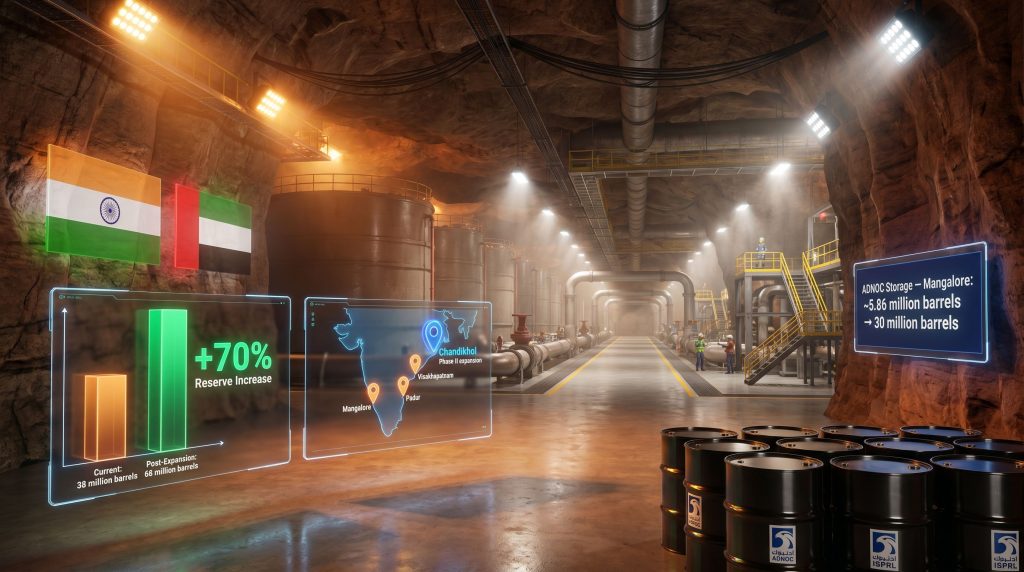
Under the Mangalore arrangement, ADNOC maintains approximately 5.86 million barrels of crude, or roughly 800,000 tonnes, at the site. Critically, India also extended ADNOC the right to re-export crude stored in Indian caverns — a commercially meaningful concession that transformed the arrangement from a purely strategic diplomatic gesture into a functioning part of ADNOC's regional logistics and trading infrastructure.
This re-export provision is less well understood but arguably more consequential than the storage volumes themselves. It means ADNOC can use Indian cavern space as part of its own commercial supply chain — positioning Mangalore not just as a diplomatic goodwill gesture, but as an operational node in ADNOC's broader Asian market strategy. India, in effect, was offering something closer to a regional crude storage hub model rather than simply granting a foreign partner access to emergency reserves.
The Scale of the Proposed Expansion: What a 70% Reserve Increase Actually Means
The latest agreement between ADNOC and Indian Strategic Petroleum Reserves Limited (ISPRL) takes this relationship to an entirely different level. Under the framework, ADNOC is set to ramp up its storage volume within Indian caverns from approximately 6 million barrels to as much as 30 million barrels — a fivefold increase.
The arithmetic of what this means for India's overall reserve position is striking.
| Metric | Current Position | Post-Expansion Projection |
|---|---|---|
| ADNOC storage at Mangalore | Up to 30 million barrels | |
| India's total SPR capacity | ~38 million barrels (5.3 MT) | |
| Reserve increase | Baseline | Approximately +70% |
| Additional crude volume | Baseline | Over 4 million tonnes |
| Estimated days of import cover | ~9-12 days | ~18-22 days (projected) |
Adding over 4 million tonnes of ADNOC-held crude to India's accessible reserve count lifts the total buffer by approximately 70% from the existing 5.3 MT baseline. While this still leaves India well short of the IEA's 90-day coverage target, it represents a meaningful step forward in national energy resilience — and does so without requiring India to fund the additional crude volumes directly from its own fiscal resources.
That last point deserves emphasis. Because ADNOC bears the cost of the crude it stores, India effectively gains the energy security benefit of a substantially larger buffer without the capital outlay that would otherwise be required to fill that additional capacity. It is a structurally efficient arrangement for India's balance sheet, even as it serves ADNOC's commercial interests in maintaining a strategically located crude inventory close to one of Asia's largest refining markets.
India's SPR Phase II Expansion: The Infrastructure Backdrop
The ADNOC expansion sits within a broader buildout of India's underground storage network. In July 2021, the government approved a Phase II expansion targeting an additional 6.5 million tonnes of capacity across two new sites:
- Chandikhol, Odisha: A new commercial-cum-strategic reserve to be developed under a Public-Private Partnership (PPP) framework.
- Padur Phase II, Karnataka: Additional capacity at the existing Padur site, also under the PPP model.
The shift toward a PPP-based development model for Phase II is not incidental. It reflects a deliberate policy evolution in how India thinks about strategic reserve management — moving away from purely sovereign-funded infrastructure toward frameworks that can accommodate commercial operator participation. This architectural shift is what makes large-scale foreign storage agreements like ADNOC's structurally feasible within India's regulatory environment.
The PPP model for Phase II sites creates the institutional scaffolding necessary for long-term foreign participation in India's energy security infrastructure, without compromising sovereign control over the cavern assets themselves.
Beyond Crude: LPG, LNG, and the Reciprocal Storage Dimension
ADNOC crude storage in India is only one dimension of a significantly broader energy partnership that has expanded rapidly across multiple fuel classes.
LPG Supply and Long-Term Contracting
ADNOC has signed an agreement with Indian Oil Corporation (IOC) to expand LPG supply and trading arrangements. This deal extends an existing LPG term contract signed between the two companies in 2023, with the stated intention of evolving toward a long-term LPG sale and purchase agreement (SPA). The timing is relevant: India is simultaneously exploring the establishment of a 20 to 30-day strategic reserve for LPG — a fuel class that is not merely commercially important but socially critical, given its role as the primary cooking energy source for hundreds of millions of Indian households.
LNG Storage Discussions
Both governments have initiated preliminary discussions on LNG storage possibilities within India. The LNG supply outlook for the region adds further context to these talks, as the UAE already holds long-term natural gas supply contracts with India. Consequently, this conversation represents a deepening of an existing supply relationship rather than a new commercial direction. In addition, India LNG import taxes remain a key policy lever shaping how these storage and supply discussions ultimately translate into commercial agreements.
Reciprocal Crude Storage in Fujairah
Perhaps the most strategically novel element of the current agreement architecture is the discussion underway for India to store crude in Fujairah as part of its own SPR framework. This reciprocal arrangement would give India offshore reserve access positioned directly within the Gulf — reducing transit time in any supply emergency scenario and creating a geographically distributed reserve buffer that no other major Asian importer currently possesses.
If operationalised, India would become the first major Asian crude importer to hold strategic reserves on both ends of the supply chain: domestically within underground caverns, and at a Gulf waypoint within days of the source.
The next major ASX story will hit our subscribers first
How the UAE's OPEC Exit Reshapes India's Long-Term Supply Options
The timing of this expanded storage and supply architecture is inseparable from a major structural development in global oil markets: the UAE's announcement of its exit from OPEC. The broader question of OPEC market influence on Asian supply dynamics remains central to understanding why India is moving so decisively to lock in Gulf partnerships at the infrastructure level.
| Production Metric | Current Level | 2027 Target |
|---|---|---|
| UAE crude production | ~3.0-3.2 million barrels/day | 5 million barrels/day |
| Production growth | Baseline | +56-67% increase |
| OPEC quota constraint | Previously binding | Removed post-exit |
With OPEC quota constraints removed, ADNOC's stated ambition to increase output from approximately 3.0 to 3.2 million barrels per day toward 5 million barrels per day by 2027 becomes commercially viable in a way that was previously constrained. Abu Dhabi holds among the lowest production cost structures of any major oil producer globally, and ADNOC has consistently articulated the need to monetise its hydrocarbon reserves at scale before long-term energy transition dynamics reduce their commercial value.
For India, this creates a structural opportunity. A UAE producing 5 million barrels per day needs large, committed offtake markets. India, as one of the world's fastest-growing crude importers, represents exactly that. The storage expansion agreement — combined with long-term LPG and LNG supply arrangements — functions as a mechanism to lock in preferential access to rising UAE crude volumes before competing Asian importers, particularly China, establish similarly deep institutional arrangements.
India's SPR Model Compared to Other Asian Energy Importers
India's approach to strategic reserves is distinctive among major Asian economies, particularly in its willingness to incorporate foreign commercial operators into sovereign infrastructure.
| Country | SPR Coverage (Days of Imports) | Foreign Operator Access | Reciprocal Storage |
|---|---|---|---|
| United States | ~90 days | No | Limited |
| Japan | ~150+ days | Restricted | Some bilateral |
| South Korea | ~90 days | Limited | Regional |
| China | ~90 days (estimated) | No | No |
| India (current) | ~9-12 days | Yes (ADNOC only) | In development |
| India (post-expansion) | ~18-22 days (projected) | Yes (expanding) | Yes (Fujairah) |
What this comparison reveals is both India's relative vulnerability and the innovative nature of its chosen response. Rather than attempting to match Japan's reserve depth through purely sovereign means — a fiscally prohibitive path given India's fiscal constraints — India has pioneered a commercially integrated model that leverages foreign national oil company capital to extend its effective reserve buffer.
The risk, of course, is one of dependency symmetry: the crude that ADNOC stores in Indian caverns belongs to ADNOC, not India. In a genuine supply emergency, the re-export provision means that ADNOC could theoretically redirect that crude commercially rather than making it available to Indian refineries at regulated prices. The governance frameworks governing access priority under emergency conditions are therefore a critical, if less publicly discussed, dimension of the ISPRL-ADNOC arrangements.
The Geopolitical Calculus: Why This Agreement Matters Now
The acceleration of ADNOC crude storage in India cannot be understood without reference to the ongoing West Asia conflict, which has materially elevated the risk premium attached to Strait of Hormuz-dependent supply routes. India sources a large proportion of its crude from the Gulf region, and any sustained transit disruption would immediately stress refinery throughput and domestic fuel availability. However, oil market disruptions driven by geopolitical tensions extend well beyond the Gulf corridor, adding further urgency to India's infrastructure-level energy diplomacy.
At the same time, the broader MoU architecture within which this storage agreement sits reflects a deliberate effort by both governments to institutionalise their energy relationship at an infrastructure level — moving beyond transactional spot market purchases toward durable, multi-decade commitments that are difficult to unwind regardless of shifting geopolitical conditions.
This institutionalisation dynamic is worth noting from an energy security theory perspective. Academic literature on resource dependency distinguishes between transactional supply relationships, which remain price-sensitive and reversible, and infrastructural relationships, which create mutual dependency through shared physical assets. The ADNOC cavern arrangement, the Fujairah reciprocal storage discussions, and the IOC-ADNOC LPG SPA collectively move India and the UAE firmly into the second category.
Frequently Asked Questions: ADNOC Crude Storage in India
What is ADNOC's current crude storage volume in India?
ADNOC currently holds approximately 5.86 million barrels (around 800,000 tonnes) of crude oil under a leased storage arrangement at the Mangalore underground cavern, which has been operational since 2018. The Indian government's official press release provides further detail on the policy framework underpinning this arrangement.
How much will ADNOC's storage in India increase under the new agreement?
The proposed expansion targets a volume of up to 30 million barrels — a fivefold increase from current levels — adding over 4 million tonnes to India's total accessible strategic reserve count and lifting the overall buffer by approximately 70%.
What is India's total SPR capacity today?
India's three existing SPR sites at Visakhapatnam, Mangalore, and Padur hold a combined capacity of 5.3 million tonnes (approximately 38 million barrels). Phase II developments at Chandikhol and Padur under the PPP model target an additional 6.5 million tonnes.
Is ADNOC the only foreign company with storage rights in India's caverns?
Yes. ADNOC is currently the sole overseas entity authorised to store crude within India's sovereign underground cavern infrastructure. It also holds re-export rights — an arrangement that has no direct equivalent among other major Asian SPR programmes.
What other energy commodities are covered under the India-UAE bilateral framework?
The agreements encompass LPG supply expansion through an ADNOC-IOC arrangement building on the 2023 term contract, preliminary LNG storage discussions, and exploratory talks on India storing crude in Fujairah as part of its own SPR diversification strategy.
What does the UAE's OPEC exit mean for India's crude supply outlook?
Removing quota constraints allows the UAE to pursue its target of increasing crude output from approximately 3.0 to 3.2 million barrels per day toward 5 million barrels per day by 2027. For India, this creates a structural pathway to access larger, long-term UAE crude volumes under commercially integrated arrangements rather than through spot market purchases.
Key Takeaways: What This Means for India's Energy Future
The ADNOC crude storage expansion in India represents more than a bilateral storage deal. It signals a fundamental transition in how India conceptualises and operationalises energy security. Several broader conclusions follow from the analysis above:
- India's SPR architecture is shifting from a purely sovereign reserve model toward a commercially co-funded, bilaterally integrated framework — a structurally novel approach with few global precedents.
- The 70% increase in accessible reserve volumes, if fully realised, meaningfully improves India's short-term supply resilience, though the country would still hold well under half of the IEA's recommended 90-day coverage benchmark.
- The Fujairah reciprocal arrangement, if operationalised, would represent a genuine structural innovation in developing-economy energy security strategy — the first instance of a major Asian importer holding distributed strategic reserves within the Gulf itself.
- ADNOC's expanding presence in India's energy infrastructure reflects a broader commercial trend: producer-nation NOCs are seeking downstream footholds in major import markets as a hedging strategy against long-term demand uncertainty and energy transition risks.
- The governance frameworks governing access priority to commercially-held crude during supply emergencies remain a key area where additional transparency would strengthen the resilience argument for India's hybrid reserve model.
Disclaimer: This article contains forward-looking assessments regarding production targets, storage expansion timelines, and reserve coverage projections. These are based on publicly available information and reported agreements as of the time of writing. Actual outcomes may differ materially. Nothing in this article constitutes financial or investment advice.
Want To Stay Ahead of the Next Major Resource Discovery?
Discovery Alert's proprietary Discovery IQ model delivers real-time alerts on significant ASX mineral discoveries, transforming complex geological and commodities data into actionable investment insights — explore historic examples of exceptional discovery returns to understand the scale of opportunity, then begin your 14-day free trial at Discovery Alert to position yourself ahead of the broader market.