August 5, 2026
The Iron Ore Supply Landscape Is Shifting Beneath the Feet of Every Steel Market Participant
For decades, the global seaborne iron ore trade operated with a predictable geography. Two anchor regions, Australia's Pilbara and Brazil's Carajás, shaped the rhythms of pricing, shipping, and procurement strategy for steelmakers worldwide. That structural stability is now being tested by a deposit that spent thirty years trapped between geopolitical complexity, infrastructure gaps, and contested ownership before finally producing its first commercial cargo.
The Guinea Simandou iron ore project exports surge recorded in May 2026 is not simply an operational milestone. It represents the moment a project long discussed in hypothetical terms began asserting itself as a real, measurable variable in global commodity markets. Understanding what that means requires looking beyond the headline tonnage figures and into the geology, logistics architecture, market mechanics, and economic development dynamics that make Simandou unlike any other mining project currently in production anywhere on Earth.
When big ASX news breaks, our subscribers know first
Key Project Statistics at a Glance
Before examining the mechanics of the ramp-up, a structured overview of the project's core parameters provides essential context.
| Metric | Detail |
|---|---|
| Total Project Investment | ~$23 billion USD |
| First Shipment Date | December 2025 |
| May 2026 Export Volume | 2.2 million tonnes |
| April 2026 Export Volume | 1.3 million tonnes |
| Early 2026 Monthly Run Rate | Below 600,000 tonnes/month |
| Full Annual Capacity Target | Up to 120 million tonnes per annum |
| Ramp-Up Timeline (Rio Tinto guidance) | ~30 months from infrastructure commissioning |
| Primary Export Destination | China |
Why Simandou Took Nearly Thirty Years to Reach Production
The Simandou mountain range in southeastern Guinea was identified as a world-class iron ore resource during the 1990s, yet the path from discovery to first shipment was anything but linear. The deposit's remote location in a country with limited existing infrastructure created a fundamental challenge: the ore could not be moved to port without constructing an entirely new rail and port system from scratch, representing a capital commitment rarely seen outside of sovereign infrastructure programmes.
Ownership disputes compounded the delay significantly. Portions of the concession changed hands multiple times, attracting regulatory scrutiny and litigation that froze development planning across multiple ownership cycles. Political instability within Guinea added further uncertainty, making long-term capital allocation decisions extremely difficult for potential investors.
What ultimately unlocked the project was a combination of Chinese industrial appetite and the involvement of Rio Tinto's engineering and development expertise, structured across two separate consortia sharing a single logistics corridor. The $23 billion total capital commitment required to bring Simandou online stands as one of the largest private infrastructure investments ever undertaken on the African continent.
How the Project Is Structured: The Dual-Consortium Model
Simandou's ownership and operational architecture is more complex than a typical single-operator mine, and that complexity has real implications for the ramp-up trajectory.
BWCS and Simfer: Separate Operations, Shared Infrastructure
The project operates under a split-block structure involving two independent joint ventures:
- BWCS (Baowu Winning Consortium Simandou): Backed by Baowu Steel Group, the world's largest steelmaker by production volume, combined with Singapore-linked Winning International Group. This consortium brings both industrial end-use demand and Asian trading network capabilities directly into the project's ownership structure.
- Simfer: A joint venture between Rio Tinto, one of the world's most experienced large-scale iron ore operators, and Chinalco, a Chinese state-owned metals enterprise. Rio Tinto's operations at Simandou represent a major institutional investment that draws on the company's deep knowledge of Pilbara-scale development.
Both consortia mine separate blocks but share the common-use rail corridor and the Morebaya port export terminal. This shared-infrastructure model is operationally efficient in theory but introduces coordination complexity that has measurably affected early throughput performance. Scheduling conflicts between two independently managed operations using the same logistics assets represent a friction point that does not exist at single-operator projects of comparable scale.
Infrastructure as the Governing Constraint
The permanent rail-to-port infrastructure is still in the process of being fully commissioned. Current export volumes are flowing through interim logistics arrangements, which inherently cap throughput below what the permanent system will ultimately support.
Rio Tinto has guided that the Simfer component alone could reach approximately 60 million tonnes per annum within 30 months of permanent infrastructure commissioning, though some market analysts believe the actual timeline will extend beyond that window given the complexity of coordinating dual-operator logistics at scale.
What the Export Surge Data Actually Reveals
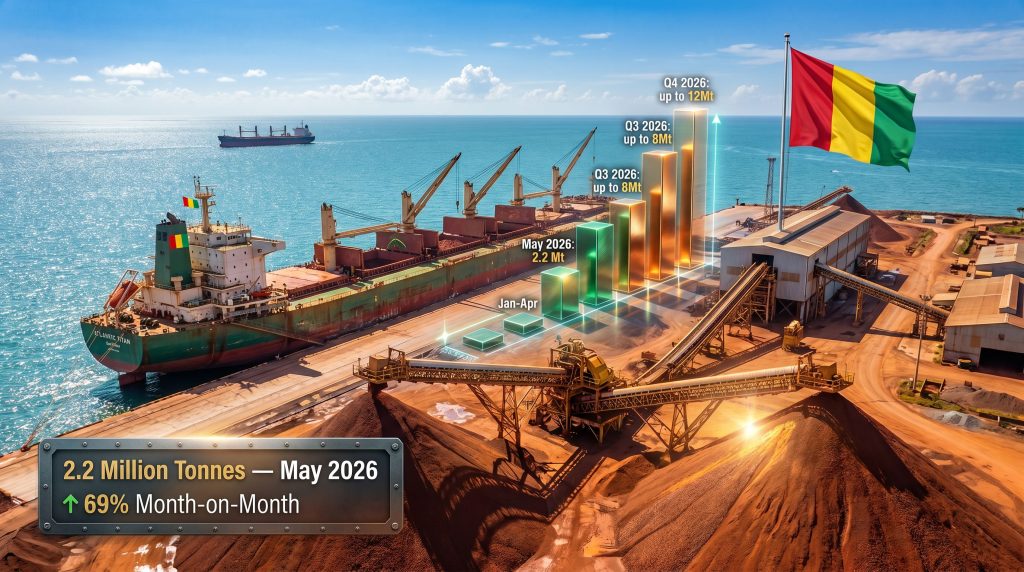
Ship-tracking data compiled by commodity analytics firm Kpler and reported through Bloomberg shows Simandou's Morebaya port dispatching 2.2 million tonnes in May 2026, up from 1.3 million tonnes in April and a dramatic acceleration from the sub-600,000 tonne monthly volumes recorded in the first quarter of 2026. That represents a 69% month-on-month increase between April and May alone.
The pattern is consistent with what mining engineers describe as the logistics learning curve in large-scale ramp-ups. Early-stage operations at new mines typically underperform theoretical capacity as port loading procedures, rail scheduling, and inter-operator coordination are calibrated through live operational experience. The April-to-May jump suggests those calibration processes are now yielding tangible efficiency gains at Morebaya.
Furthermore, Guinea's Simandou iron exports surging just six months after the first ore shipment underscores how quickly the project has progressed through its initial operational learning curve, which is a notable achievement given the infrastructure challenges it has faced.
"A single month's data cannot confirm a durable trend, but the magnitude of the May volume, combined with forward projections pointing toward 8 million tonnes in Q3 and 12 million tonnes in Q4, indicates Simandou has crossed an operational threshold where volume growth begins to self-reinforce as systems mature."
Forward Export Projections
| Period | Projected Export Volume |
|---|---|
| May 2026 (actual) | 2.2 million tonnes/month |
| Q3 2026 (forecast) | Up to 8 million tonnes (quarterly) |
| Q4 2026 (forecast) | Up to 12 million tonnes (quarterly) |
| Full Capacity (eventual) | 120 million tonnes per annum |
Disclaimer: Forward projections are based on analyst forecasts and operational guidance. Actual volumes may differ materially depending on infrastructure commissioning timelines, labour conditions, and demand absorption in Chinese steel markets.
The Geology Behind the Hype: Why Simandou's Ore Grade Matters
Iron ore is not a uniform commodity. Grade, which refers to the percentage of iron content in the ore, is the single most important quality determinant for steel mill procurement decisions. Higher-grade ores require less energy to process, generate less slag, and produce superior steel yield per tonne of input material.
Simandou's deposits are estimated to carry iron content at or above 65% Fe, placing them in the same premium quality tier as Brazil's Carajás system. This grade profile is meaningfully higher than the benchmark 62% Fe fines standard against which global iron ore price trends are typically measured, and considerably above the average grade profile of many Pilbara producers.
The practical implications for steel mills are significant:
- Higher-grade inputs reduce the volume of ore needed per tonne of steel produced
- Lower gangue content means reduced slag generation and lower blast furnace energy consumption
- Environmental compliance costs for steel mills improve with higher-grade inputs, a growing consideration as emissions regulations tighten across Asian steel markets
In a steel industry increasingly focused on decarbonisation, high-grade ores like Simandou's represent a structural advantage that extends beyond simple price competitiveness. This is a dimension that is frequently underappreciated in coverage focused purely on volume metrics.
The next major ASX story will hit our subscribers first
Competitive Positioning: Simandou vs. Pilbara vs. Carajás
| Dimension | Simandou (Guinea) | Pilbara (Australia) | Carajás (Brazil) |
|---|---|---|---|
| Ore Grade | High (~65%+ Fe) | Moderate-High (57-62% Fe) | High (65%+ Fe) |
| Annual Capacity at Maturity | ~120 Mtpa | ~900 Mtpa (combined) | ~350 Mtpa |
| Shipping Distance to China | ~20,000 km | ~7,000-8,000 km | ~22,000 km |
| Infrastructure Maturity | Under development | Fully established | Established |
| Primary Market | China | China, Japan, Korea | China, Europe |
The "Pilbara Killer" framing that has circulated in commodity media circles significantly overstates Simandou's near-term displacement potential. Even at full capacity, 120 million tonnes annually would represent a meaningful but far from dominant share of a seaborne market that transacts well above 1.5 billion tonnes per year. Australia's iron ore advantage lies in deeply embedded logistics networks, established offtake relationships, and a freight distance advantage of roughly 12,000 kilometres compared to the Guinea-to-China shipping route.
The more accurate framing is that Simandou introduces a third high-grade pillar into a market previously anchored by two, creating incremental competitive pressure on premium pricing dynamics rather than threatening the Pilbara's volume dominance.
Operational Setbacks During Ramp-Up: Three Risk Categories
The path from first shipment in December 2025 to the Guinea Simandou iron ore project exports surge recorded in May 2026 has not been without serious disruptions.
1. Infrastructure and Logistics Bottlenecks
The absence of fully commissioned permanent rail-to-port infrastructure has been the most persistent constraint on throughput. Operating through interim logistics arrangements limits the system's ability to run at design capacity, and the shared-infrastructure model between BWCS and Simfer introduces scheduling conflicts that would not exist under single-operator management.
2. Workplace Safety Incident
A fatal workplace accident occurred in February 2026, triggering mandatory operational reviews and procedural audits that imposed temporary throughput penalties. At projects of this scale and complexity, such incidents require thorough investigation under both host-country regulatory frameworks and the internal safety governance systems of international operators like Rio Tinto.
3. Labour Relations Disruptions
Strike action at BWCS operations during May 2026 added a human capital risk dimension to the ramp-up profile. Labour disputes at large-scale mining operations in West Africa often reflect structural tensions between international operators and local workforces around compensation benchmarks, working conditions, and community benefit-sharing expectations. As Simandou scales toward full capacity and its workforce grows, labour relations management will become an increasingly material operational variable.
"Investors and market participants tracking Simandou's ramp-up trajectory should treat labour relations and infrastructure commissioning timelines as the two highest-probability variables capable of materially delaying Q3 and Q4 2026 export projections."
How Simandou's Growth Is Affecting Global Iron Ore Markets
The China Absorption Question
Virtually all of Simandou's early export volumes have been directed to Chinese steel mills, which reflects China's structural position as the world's dominant iron ore consumer. However, China steel demand is navigating a period of genuine softness, with ongoing contraction in property development suppressing construction steel demand and elevated inventory levels at major port facilities reducing the urgency of incremental purchasing.
The critical unresolved question is whether Simandou's high-grade volumes are displacing lower-grade purchases within existing procurement budgets, or whether they are flowing into an already well-supplied system and contributing to downward price pressure on iron ore benchmarks. The answer will not be clear until volumes reach a scale where their market impact becomes statistically distinguishable from normal price volatility.
Freight Market Dynamics
Capesize bulk carriers, the vessel class used on the Guinea-to-China trade lane, have shown limited spot market reaction to Simandou's early export volumes, primarily because those volumes remained modest enough to be absorbed without visibly tightening vessel availability. However, forward freight agreement markets have begun pricing in the trajectory of volume growth ahead of the anticipated Q3 and Q4 acceleration.
A sustained quarterly volume of 8 to 12 million tonnes would represent a meaningful addition to Capesize demand on a route that currently carries far less cargo than the dominant Australia-to-China corridor. The long-term effect on West Africa-China freight rates is likely to be upward as Simandou approaches full operational capacity. Consequently, the broader iron ore market impacts from this new supply source extend well into freight and logistics dynamics.
Iron Ore Price Sensitivity: Two Diverging Scenarios
- If Chinese demand recovers: Stimulus-driven steel demand growth could absorb Simandou's incremental high-grade supply without significant benchmark price disruption, while high-grade premiums over 62% Fe fines could compress as supply increases.
- If Chinese demand remains subdued: Simandou's volume ramp adds to an already evolving picture of iron ore surplus risks, placing downward pressure on benchmark prices and potentially widening the discount for lower-grade Pilbara fines relative to premium products.
Guinea's Economic Development Dimension
Simandou's significance for Guinea extends well beyond export statistics. The country possesses some of the world's largest untapped bauxite and iron ore reserves but has historically struggled to translate that mineral endowment into broad economic development outcomes.
The infrastructure legacy of the Simandou project, specifically the rail corridor and Morebaya port facility constructed to service the mine, represents a fixed asset base that could serve economic functions beyond iron ore export. Agricultural commodities, manufacturing inputs, and passenger transport are all potential beneficiaries of infrastructure originally built for mining logistics. This pattern has been documented in other African resource corridors where port and rail investments have generated downstream economic multipliers.
Guinea's ability to negotiate and enforce favourable fiscal terms with the BWCS and Simfer consortia, including royalty rates, local content requirements, and community development obligations, will ultimately determine how much of Simandou's value is captured domestically rather than flowing exclusively to international shareholders.
Strategic Outlook: Three Scenarios for Simandou's Market Impact Through 2027
Scenario 1: Accelerated Ramp-Up (Bull Case)
- Permanent infrastructure commissioned ahead of Rio Tinto's 30-month guidance
- Q4 2026 exports meet or exceed 12 million tonnes; full-capacity trajectory becomes credible within the guided window
- Capesize freight rates on the West Africa-China lane rise materially; high-grade premiums compress as supply increases
- Simandou establishes pricing relevance in spot markets by mid-2027
Scenario 2: Base Case Progression
- Ramp-up proceeds broadly in line with current analyst projections
- Chinese steel mills absorb incremental volumes without significant price disruption
- Simandou becomes a reliable third pillar of seaborne supply alongside Australia and Brazil by late 2027
- Infrastructure commissioning completes within or slightly beyond the 30-month window
Scenario 3: Delayed Ramp-Up (Bear Case)
- Additional labour disputes, infrastructure delays, or regulatory complications slow volumes below Q3-Q4 projections
- Market impact remains minimal through 2026; Simandou's structural significance is deferred to 2028 and beyond
- Pilbara and Carajás producers retain pricing power; high-grade premiums remain stable
- Guinea's fiscal benefit timeline extends, creating pressure on domestic development expectations
In addition, the latest Simandou shipment data continues to highlight the project's ramp-up milestone status, reinforcing that the base case trajectory remains the most probable outcome for market participants monitoring West African supply growth.
Frequently Asked Questions: Guinea Simandou Iron Ore Project
How much iron ore does Simandou export per month in 2026?
According to ship-tracking data from Kpler, Simandou exported approximately 2.2 million tonnes in May 2026, rising sharply from 1.3 million tonnes in April and from below 600,000 tonnes per month in the earlier part of the year. Analyst forecasts project exports reaching up to 8 million tonnes across Q3 2026 and up to 12 million tonnes in Q4 2026.
When did Simandou's first iron ore shipment depart Guinea?
The inaugural iron ore cargo departed Guinea in December 2025, marking the operational commencement of a project nearly three decades in the making.
Who are the owners of the Simandou project?
Simandou is split between BWCS, backed by Baowu Steel Group and Winning International Group, and Simfer, a joint venture between Rio Tinto and Chinalco. Both consortia share common rail and port infrastructure.
What is Simandou's full production capacity target?
At full operational maturity, Simandou is projected to export up to 120 million tonnes of iron ore annually. Rio Tinto has guided that the Simfer component alone could reach approximately 60 million tonnes per annum within 30 months of permanent infrastructure commissioning.
Will Simandou replace Australian Pilbara iron ore exports?
Replacement of Pilbara volumes is not a realistic near or medium-term scenario. Australia's combined Pilbara producers operate at roughly 900 million tonnes per annum of total capacity with fully established logistics infrastructure and a shipping distance to China approximately 12,000 kilometres shorter than the Guinea route. However, the Guinea Simandou iron ore project exports surge does signal the beginning of a more competitive high-grade supply environment. The project's competitive relevance lies in high-grade quality differentiation rather than volume displacement, as iron ore price trends continue to evolve in response to this new supply dynamic.
Disclaimer: This article contains forward-looking projections and analyst forecasts that are subject to material uncertainty. Nothing in this article constitutes financial or investment advice. Readers should conduct independent research before making any investment decisions related to companies or commodities discussed herein.
Want to Stay Ahead of the Next Major Mineral Discovery on the ASX?
Discovery Alert's proprietary Discovery IQ model delivers real-time alerts on significant ASX mineral discoveries across iron ore and more than 30 other commodities, translating complex geological data into clear, actionable insights for investors at every level. Explore Discovery Alert's dedicated discoveries page to understand how historic mineral discoveries have generated substantial market returns, and begin your 14-day free trial today to position yourself ahead of the broader market.