July 27, 2026
The New Geography of Oil: Why Storing Crude Inside Consumer Nations Is Becoming the Defining Strategy of Gulf Energy Producers
The global oil market has entered a phase where physical proximity to demand is becoming as strategically valuable as production capacity itself. For decades, the dominant model was straightforward: produce at source, transport on demand, and manage supply relationships through long-term contracts or spot-market sales. That model is now being systematically dismantled by a combination of maritime vulnerability, accelerating Asian demand growth, and the rising use of energy infrastructure as a tool of bilateral diplomacy.
Nowhere is this shift more visible than in the expanding programme of ADNOC crude storage in India, where the UAE's national energy champion is pursuing a target of up to 30 million barrels of crude stored within Indian territory. To understand the full significance of that number, it is necessary to first grasp what cross-border petroleum storage actually means, and why it has become one of the most consequential instruments in the modern energy security toolkit.
When big ASX news breaks, our subscribers know first
Understanding Cross-Border Crude Storage: More Than a Logistics Decision
Strategic petroleum reserves have traditionally been understood as a domestic policy instrument. A country builds underground storage, fills it with crude, and draws on it during supply disruptions. The International Energy Agency's long-standing recommendation of a 90-day import buffer reflects this national-sovereign framing of energy security.
Cross-border storage arrangements fundamentally complicate this picture. When a producing-nation company stores crude inside a consuming country's strategic reserve infrastructure, the arrangement creates a layered set of interests that are simultaneously commercial, diplomatic, and operational. The key distinction lies in title and access rights:
- The producing company retains legal ownership of the stored barrels
- The host country gains access to those barrels under pre-agreed emergency conditions
- Both parties benefit from the physical presence of the inventory within the consumer nation's territory
- The arrangement creates a structural interdependency that extends well beyond a standard purchase-and-sale relationship
This model has become increasingly attractive to Gulf national oil companies (NOCs) precisely because it transforms a transactional crude supply relationship into an infrastructure-anchored partnership. Once storage is established and operationally integrated, the cost of switching suppliers rises materially for the consumer nation.
India's Strategic Petroleum Reserve System: Current Capacity and the Coverage Gap
India's underground strategic petroleum reserve network, managed by Indian Strategic Petroleum Reserves Limited (ISPRL), currently operates across three primary locations. The system uses rock cavern storage technology, which provides significant advantages over above-ground tankage, including natural thermal insulation, lower evaporation losses, and considerably enhanced physical security against both accidents and deliberate interference.
| Storage Site | Location | Approximate Capacity | Operational Status |
|---|---|---|---|
| Mangalore | Karnataka, South India | ~9.75 million barrels | Operational |
| Visakhapatnam | Andhra Pradesh | ~9.75 million barrels | Operational |
| Chandikhol | Odisha | ~12.5 million barrels | Under development |
| Total SPR Capacity | Multiple states | ~33 million barrels | Partial |
India imports approximately 4.5 to 5 million barrels of crude per day, making its current SPR capacity equivalent to roughly 6 to 7 days of total import cover at full utilisation. This falls substantially short of the IEA's 90-day benchmark, though India is not an IEA member and operates under its own energy security framework. The gap between strategic adequacy and current reality is precisely the context into which ADNOC's expanded storage programme fits.
From 6 Million to 30 Million Barrels: Quantifying the Strategic Shift
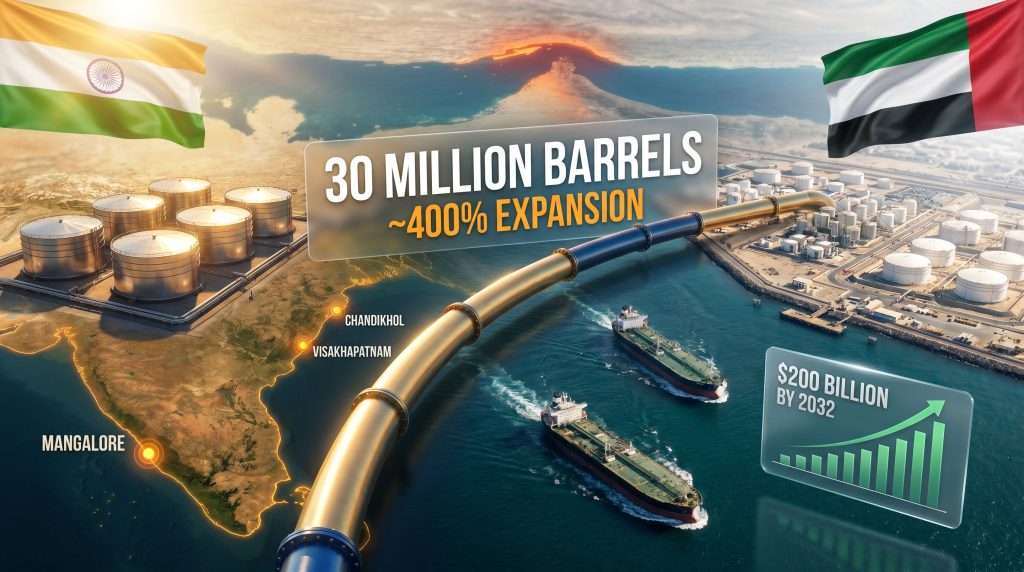
ADNOC already holds approximately 6 million barrels of crude at the Mangalore underground facility, established through prior cooperation between the two nations. According to S&P Global, the proposed expansion to up to 30 million barrels across Mangalore, Visakhapatnam, and Chandikhol represents a roughly 400% increase in ADNOC-held crude within Indian territory.
To contextualise that volume against India's actual consumption profile:
- At India's current import rate of approximately 4.5 to 5 million barrels per day, 30 million barrels represents approximately 6 to 7 days of full import replacement
- Combined with India's domestically owned SPR volumes, the addition of ADNOC-designated storage could contribute meaningfully to closing the gap toward strategic adequacy benchmarks
- The multi-site distribution across India's eastern and western coastlines reduces single-point vulnerability, a consideration that is far from theoretical given recent regional security dynamics
Strategic Insight: The geographic logic of distributing storage across both coastlines is significant. Visakhapatnam on the Bay of Bengal and Mangalore on the Arabian Sea face fundamentally different maritime risk profiles, meaning disruption to one shipping corridor does not simultaneously threaten both reserve nodes.
Visakhapatnam's capacity to accommodate Very Large Crude Carriers (VLCCs) directly from Gulf loading terminals makes it particularly well-suited as a primary node for ADNOC-origin crude. VLCCs can carry approximately 2 million barrels per voyage, meaning a single vessel can deliver cargo that fills a meaningful portion of a storage cavern in a single call. Chandikhol, meanwhile, functions as an inland buffer node in Odisha, adding depth to the eastern coastal storage cluster.
The Fujairah Dimension: Reciprocal Storage and Distributed Reserve Architecture
One of the least-discussed aspects of the ADNOC-ISPRL collaboration is its reciprocal dimension. The agreement explores the possibility of India storing a portion of its own strategic crude reserve at Fujairah in the UAE. This creates something considerably more sophisticated than a one-directional storage deal.
Fujairah is already one of the world's most significant oil storage and bunkering hubs. Its tank storage capacity exceeds 14 million cubic metres, and its position outside the Strait of Hormuz makes it uniquely valuable as a pre-positioning location for crude that needs to bypass the Gulf's primary chokepoint. If Indian-designated crude were stored at Fujairah, it could theoretically be available to Indian refiners even in a scenario where Hormuz transit was severely disrupted, provided alternative delivery routes were accessible.
This reciprocal architecture creates what energy security analysts sometimes describe as a geographically distributed reserve system: Indian crude stored in the UAE, UAE crude stored in India, with both parties holding emergency access rights to volumes situated in each other's territory. The mutual dependency this creates functions as a structural deterrent against either party unilaterally disrupting the arrangement.
Maritime Chokepoint Risk: The Operational Rationale Behind the Expansion
The strategic logic of the ADNOC crude storage in India expansion cannot be fully understood without accounting for the maritime risk environment that is actively reshaping Gulf-Asia supply chains. Furthermore, current crude oil prices and market dynamics add additional urgency to securing pre-positioned inventory buffers.
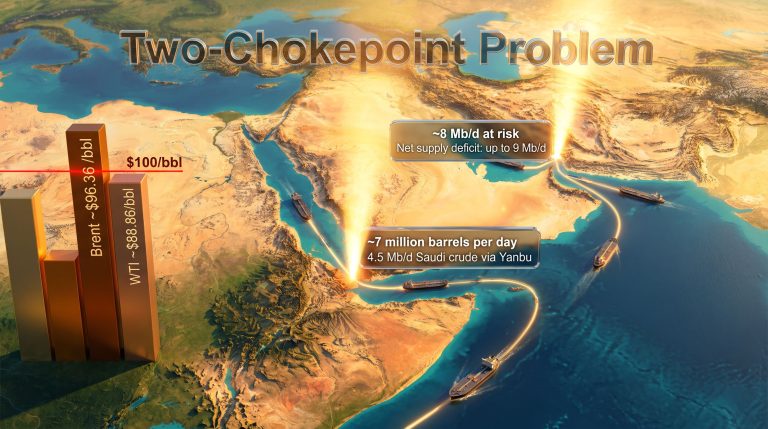
The Strait of Hormuz remains the world's single most critical oil transit corridor. Approximately 20 to 21 million barrels per day have transited the strait in recent years, representing close to 20% of total global oil trade. The consequences of a sustained Hormuz disruption for India, which sources a substantial share of its crude from Gulf producers, would be immediate and severe without adequate pre-positioned reserves.
The Red Sea disruption beginning in late 2023 and extending through 2024 and 2025 provided a real-world demonstration of what maritime route dependency costs. Houthi attacks on commercial shipping forced widespread rerouting around the Cape of Good Hope, adding significant time and freight cost to crude deliveries. The episode underscored a critical point: pre-positioning crude in consumer-nation storage eliminates transit risk for the stored volumes entirely, regardless of what happens to shipping routes between the point of production and the point of consumption.
Consider the scenario modelling across three disruption scenarios:
Scenario A: Short-Term Hormuz Disruption (7 to 14 days)
- Without expanded reserves, Indian refiners face immediate supply rationing and sharp price spikes
- With 30 million barrels of ADNOC-designated storage operational, the buffer covers approximately 6 to 7 days of full import replacement, substantially absorbing the initial shock
Scenario B: Prolonged Disruption (30 or more days)
- Reserve buffers alone are insufficient for sustained disruptions
- LPG and LNG storage diversification, including through the ADNOC-Indian Oil Corporation collaboration, provides complementary fuel security
- The layered approach of crude plus gas reserves creates a more resilient total energy buffer
Scenario C: Freight and Insurance Cost Spikes
- During periods of heightened maritime risk, VLCC freight rates can surge by $3 to $8 per barrel in extreme scenarios
- Pre-positioned crude eliminates freight cost exposure for stored volumes, delivering direct commercial savings to Indian refiners who access domestic inventory rather than placing spot-market import orders during price spikes
The next major ASX story will hit our subscribers first
LPG Cooperation: The Indian Oil Corporation Partnership
Alongside the storage expansion, ADNOC has formalised a strategic collaboration agreement with Indian Oil Corporation (IOC) to deepen LPG supply and trading cooperation. The two companies have maintained an LPG term contract since 2023, and the new agreement builds toward a potential long-term LPG Sale and Purchase Agreement through ADNOC Global Trading.
The market context for this cooperation is substantial. India is among the world's largest LPG consumers, driven significantly by the Pradhan Mantri Ujjwala Yojana (PMUY) programme, which has extended cooking fuel access to tens of millions of lower-income households across the country. This programme has structurally elevated India's baseline LPG consumption, creating sustained long-term demand growth that is largely insensitive to economic cycles.
For ADNOC, securing a long-term LPG SPA with IOC would represent the conversion of an existing term contract relationship into a durable infrastructure-anchored supply commitment, mirroring the same logic driving the crude storage expansion. In addition, Asian nations facing LNG tariff pressures are increasingly motivated to lock in long-term supply arrangements rather than rely on volatile spot markets.
The UAE-India CEPA Framework: Energy as a Structural Pillar
These energy arrangements exist within a broader bilateral architecture. PM Modi's landmark UAE visit helped lay the groundwork for the UAE-India Comprehensive Economic Partnership Agreement (CEPA), which entered into force in 2022 and established a framework for expanded bilateral trade with a stated target of reaching $200 billion by 2032, up from approximately $85 billion in recent years.
India's position in the global energy demand hierarchy makes it uniquely attractive as a long-term partner for any major producer:
| Metric | India's Global Standing | Context |
|---|---|---|
| Crude oil import volume | 3rd largest globally | Behind only China and the United States |
| Projected demand growth (2024 to 2040) | Among top 2 globally | IEA projects India adds more absolute demand growth than any other nation |
| Population driving consumption | 1.4+ billion | Rapid urbanisation and industrial expansion underway |
| Refining capacity | Major ongoing expansion | New greenfield refineries planned through 2030 |
India's consumption trajectory is not a cyclical phenomenon. It is structurally embedded in demographic and economic dynamics that will sustain elevated energy demand growth for decades. For Gulf producers competing for dominant market share in Asia, establishing deep infrastructure ties with India now is the equivalent of locking in long-term offtake security through non-price mechanisms.
The NOC Playbook: Infrastructure Presence as Market Share Strategy
ADNOC's India storage expansion reflects a broader strategic shift among Gulf NOCs away from purely transactional supply relationships toward infrastructure-anchored market positions. Consequently, OPEC's influence on global oil markets is increasingly complemented by these bilateral infrastructure arrangements that operate outside the traditional production-quota framework.
| Producer | Key Asian Infrastructure Moves | Primary Target Markets |
|---|---|---|
| UAE (ADNOC) | India SPR storage, LPG/LNG cooperation | India, East Asia |
| Saudi Arabia (Aramco) | Refinery equity stakes in India, China, South Korea | India, China, South Korea |
| Qatar (QatarEnergy) | Long-term LNG sale and purchase agreements | India, Japan, South Korea, China |
Storage rights in consumer nations confer a form of first-call advantage that price competition cannot easily replicate. During supply crunches, a producer with physical inventory inside the consumer market is structurally better positioned than one relying entirely on seaborne delivery. This dynamic is well understood by Aramco, which has pursued refinery equity stakes across Asia as a complementary mechanism for securing offtake.
The ADNOC approach, centred on SPR storage rights combined with LPG supply agreements, represents a distinct but equally durable form of market anchoring. Rather than acquiring equity in downstream refining, the strategy embeds ADNOC crude physically within India's national security infrastructure, creating a relationship that is considerably harder for either party to unwind than a standard commercial supply contract. Furthermore, oil price movements shaped by trade war dynamics make these infrastructure-anchored relationships even more valuable as a hedge against market volatility.
Frequently Asked Questions: ADNOC Crude Storage in India
What is the ADNOC crude storage deal with India?
A strategic collaboration between ADNOC and ISPRL targeting expansion of UAE crude storage in India to up to 30 million barrels, across Mangalore, Visakhapatnam, and Chandikhol, with Fujairah identified as a potential reciprocal storage node.
How much crude does ADNOC currently store in India?
Approximately 6 million barrels, held at the Mangalore underground cavern. The 30 million barrel target represents roughly a 400% expansion from the current position.
What is ISPRL?
Indian Strategic Petroleum Reserves Limited is the government entity responsible for managing India's underground strategic crude storage programme across multiple coastal states.
How does this connect to the UAE-India CEPA?
The CEPA, which entered into force in 2022, established a bilateral trade target of $200 billion by 2032, with energy cooperation forming a core structural pillar of the agreement.
Why store rather than simply sell?
Storage-in-country arrangements give ADNOC guaranteed market access, first-call positioning during demand surges, and embedded strategic influence within India's energy security architecture — benefits that extend far beyond any individual commercial transaction. However, the broader trade war impact on oil prices also reinforces the commercial logic of having pre-positioned inventory that insulates both parties from sudden supply cost shocks.
Forward Outlook: Three Scenarios for UAE-India Energy Integration Through 2032
Bull Case: All three storage sites reach full operational capacity, reciprocal Fujairah storage is formalised, and a long-term LPG SPA is concluded, creating one of the most deeply integrated bilateral energy partnerships between a Gulf producer and an Asian consumer nation in history.
Base Case: Mangalore and Visakhapatnam storage expand materially, Chandikhol development proceeds broadly on schedule, and LPG cooperation deepens through ADNOC Global Trading, with Fujairah reciprocal storage remaining under active negotiation through the late 2020s.
Bear Case: Infrastructure bottlenecks, competing crude supply relationships, or shifts in the bilateral political environment slow the expansion timeline, with ADNOC-held volumes remaining below 20 million barrels through 2028.
The direction of travel is clear regardless of which scenario materialises. India's energy demand growth is non-negotiable. Its maritime vulnerability is structural rather than temporary. And ADNOC's commitment to deepening its presence inside Indian energy infrastructure reflects a strategic calculation that the value of that presence will compound over time. The 30 million barrel target is not simply a storage figure. It is the quantified expression of a new kind of Gulf-Asia energy architecture — one built on physical presence rather than transactional proximity.
Disclaimer: This article is intended for informational purposes only and does not constitute financial or investment advice. Figures relating to storage capacities, freight rates, trade volumes, and demand projections are drawn from publicly available sources and are subject to revision. Scenario projections represent analytical frameworks rather than confirmed outcomes. Readers should conduct independent research before making any investment or commercial decisions.
Want to Stay Ahead of the Next Major Resource Discovery Shaping Global Energy Markets?
Discovery Alert's proprietary Discovery IQ model delivers real-time alerts on significant ASX mineral discoveries — instantly converting complex resource data into actionable investment insights for both short-term traders and long-term investors. Explore how historic discoveries have generated substantial returns on Discovery Alert's dedicated discoveries page, and begin your 14-day free trial today to secure your market-leading edge.