May 18, 2026
When Quota Ceilings Become Revenue Ceilings: The Economics Behind the UAE's OPEC+ Exit
Every voluntary production alliance carries within it the seed of its own eventual fragmentation. The logic is straightforward: nations that invest aggressively in upstream capacity do so because they intend to use it. When the gap between installed capability and permitted output widens year after year, the financial cost of remaining inside a quota-based framework shifts from manageable to structurally untenable. This is not a novel observation in energy economics, but the moment it becomes operationally relevant for a producer of the UAE's scale, the consequences ripple far beyond bilateral diplomacy.
The UAE exits OPEC+ following an announcement in late April 2026, with the withdrawal effective from May 1. UAE Energy Minister Suhail Al Mazrouei characterised the move as a sovereign and strategic determination grounded in a thorough review of the country's production capabilities and long-term energy policy direction. He was explicit that the decision carried no political motivation and reflected no rupture with partners. Yet regardless of the diplomatic framing, the structural reality is clear: when a nation exits a production restraint coalition at a moment of unprecedented regional energy disruption, the market implications extend well beyond the language used to announce it.
When big ASX news breaks, our subscribers know first
Why OPEC+'s Internal Cohesion Has Always Been Fragile
The Structural Tension Between Collective Quotas and National Capacity Ambitions
OPEC's market influence does not rest on a treaty-bound institution with enforcement mechanisms. It functions as a voluntary coordination framework, sustained by a shared interest in price stability and the diplomatic weight of its largest members. This distinction matters enormously because it means that compliance is always contingent on self-interest rather than legal obligation.
The coalition's core tension is architectural. Nations invest in upstream infrastructure to grow productive capacity over time. Yet collective quota systems work by suppressing output relative to that capacity. For producers operating at or near their installed ceiling, this creates only moderate friction. For those with large proven reserves, low extraction costs, and ambitious expansion programmes, the calculus shifts dramatically.
Historical patterns support this reading. OPEC has been plagued by quota overproduction since its earliest decades, with members routinely exceeding their allocations through side deals, definitional disputes over condensates and natural gas liquids, and outright underreporting. The most visible modern example was the 2020 Saudi-Russia price war, triggered when Russia declined to extend coordinated cuts, prompting Saudi Arabia to flood markets with supply. Within weeks, Brent and WTI futures fell below $20 per barrel, demonstrating how rapidly discipline can dissolve when a major producer concludes that restraint no longer serves national interest.
The UAE's Production Trajectory and Why Quotas Became a Strategic Constraint
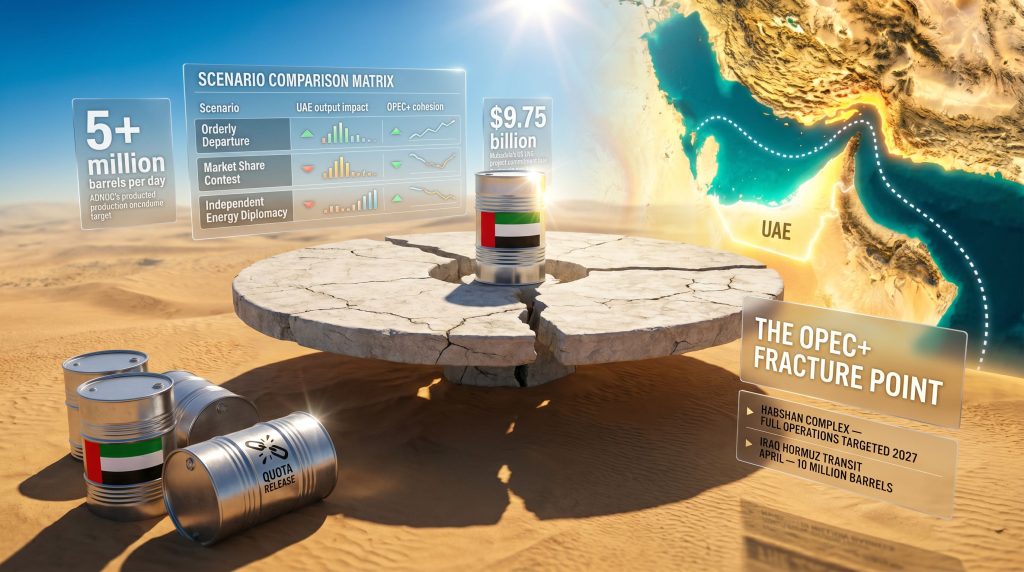
Abu Dhabi's national oil company, ADNOC, has been executing one of the most ambitious upstream expansion programmes among any OPEC+ member. Its stated production target exceeds 5 million barrels per day, and ADNOC Drilling has publicly confirmed readiness to expand capacity beyond that threshold if directed by government policy. This is a remarkable signal: the operational infrastructure already exists, or is being developed, to produce at levels that OPEC+ quota frameworks have never permitted.
The Habshan gas complex, a critical node in ADNOC's integrated upstream network, is targeted for full operational resumption in 2027. Meanwhile, the UAE has accelerated development of an oil pipeline specifically designed to route export flows around the Strait of Hormuz, providing Abu Dhabi with export flexibility that operates independently of the waterway through which the majority of Gulf crude transits.
The UAE's Hormuz bypass pipeline is not merely an infrastructure investment. It represents a philosophical declaration that Abu Dhabi intends to control its own supply chain from wellhead to destination, without dependence on shared chokepoints or collective institutional frameworks.
This infrastructure logic, combined with Mubadala Energy's commitment of $9.75 billion in project financing for a US liquefied natural gas facility, paints a coherent picture of a nation deliberately diversifying its energy footprint across geographies, fuel types, and market relationships. These are not the investment patterns of a state that views its future through the lens of OPEC+ membership. For broader context on how these dynamics intersect with current oil geopolitics analysis, the regional picture has rarely been more complex.
A Scenario Framework: Three Futures Following the UAE's Exit
Analysing what happens next requires moving beyond the announcement itself and examining the conditional pathways along which global oil markets could evolve.
Scenario 1: Orderly Departure with Informal Coordination Preserved
In this pathway, the UAE phases production increases gradually, maintaining informal dialogue with Saudi Arabia through GCC channels. Markets absorb the additional supply without significant volatility, and OPEC+ retains functional cohesion among its remaining membership. Saudi Arabia reasserts leadership, potentially offsetting UAE production gains with modest cuts from compliant members.
The probability of this scenario depends on the strength of diplomatic relationships and whether both governments manage the messaging with consistency. Shared GCC economic interests, including coordinated sovereign wealth fund activities and Vision-aligned investment partnerships, provide meaningful incentive for continued informal alignment even outside the formal OPEC+ structure.
Scenario 2: Accelerated Output Expansion Triggers a Market Share Contest
A more disruptive pathway opens if the UAE moves aggressively toward its production ceiling following exit. Other fiscally pressured members, including Iraq, Kazakhstan, and Nigeria, may interpret the UAE's departure as implicit permission to exceed their own quotas. Saudi Arabia then faces a binary strategic choice: defend price through continued restraint while ceding market share, or defend market share through volume while accepting lower prices.
The 2020 price war offers a sobering reference point for how quickly this dynamic can compound. At that time, the collapse of coordination between Saudi Arabia and Russia sent prices into freefall within a matter of weeks. A repeat scenario, catalysed by the UAE's exit rather than a Russian withdrawal, could produce similarly sharp downward price pressure on Brent benchmarks. Furthermore, the trade war oil prices dynamic adds another layer of complexity to how demand destruction could amplify any supply-side shock.
Scenario 3: Independent Energy Diplomacy as Geopolitical Strategy
The third and arguably most consequential scenario involves the UAE leveraging its exit to construct a network of bilateral supply agreements with major Asian importers, unconstrained by OPEC+ pricing architecture. India, China, South Korea, and Japan collectively represent the world's largest pool of crude import demand. ADNOC has already announced strategic collaboration agreements with Indian partners, signalling that this diplomatic repositioning is underway.
| Scenario | UAE Output Impact | OPEC+ Cohesion | Oil Price Trajectory | Geopolitical Consequence |
|---|---|---|---|---|
| Orderly Departure | Gradual +0.5 to 1M bpd | Maintained | Modest downward pressure | Limited disruption |
| Market Share Contest | Aggressive +1 to 2M bpd | Severely weakened | Sharp decline risk | Intra-Gulf tensions |
| Independent Energy Diplomacy | Strategic +1M bpd | Structurally altered | Mixed, demand-driven | UAE geopolitical leverage gains |
The Iran Conflict Variable: Regional Instability as a Catalyst
The UAE exits OPEC+ against a backdrop of significant geopolitical trade tensions that have fundamentally altered the risk calculus for every Gulf producer. The Iran war has made Strait of Hormuz transit risk, long treated as a theoretical concern, operationally material. Iraq's export of 10 million barrels through the Strait in April 2026 demonstrates that flows have continued, but the associated risk premium has elevated the strategic value of bypass infrastructure and diversified export routes.
For the UAE specifically, regional conflict simultaneously increases the value of its production capacity as a reliable alternative supply source and reduces its tolerance for output restrictions that prevent it from capitalising on that value. When supply security is at a premium globally, a producer with 5 million barrels per day of capacity sitting idle under quota constraints is forgoing both revenue and geopolitical leverage.
The acceleration of the UAE's Hormuz bypass pipeline project in this context is therefore not coincidental. It reflects a strategic recognition that supply continuity and export flexibility have become foundational national security assets, not merely commercial considerations.
OPEC+'s Diminished Institutional Weight
What the UAE's Exit Costs the Cartel Beyond Volume
The UAE is one of OPEC+'s most significant producers by volume. Losing a high-capacity, low-cost member reduces the coalition's theoretical supply ceiling. However, the more consequential loss is institutional credibility. A cartel's influence over global prices rests on the market's belief that it can credibly threaten to withhold or release supply. When a major producer exits, that belief weakens, regardless of whether remaining members maintain full compliance. Reuters reported that the UAE's formal statement confirmed the withdrawal with immediate effect, leaving little ambiguity about the permanence of the decision.
Historical Analogies and What They Reveal
Qatar's 2019 departure from OPEC provides the closest structural parallel to the current situation. Qatar exited specifically because its LNG expansion ambitions were incompatible with the constraints of cartel membership, even though OPEC did not formally regulate gas production. The principle was identical to what now confronts the UAE: when membership constrains the commercial and strategic logic of expansion, the institution loses its hold.
The critical difference is scale. Qatar produced roughly 600,000 barrels per day of crude when it departed. The UAE's production target exceeds 5 million barrels per day. The credibility impact on OPEC+ is therefore proportionally far larger.
Ecuador's two exits from OPEC, in 1992 and again in 2020, offer a contrasting lesson. Smaller producers can cycle in and out of membership without structurally altering the cartel. The UAE cannot be categorised in the same way. Its exit establishes a precedent that producers of genuine weight can and will choose national production doctrine over collective restraint.
Which Members Are Most Likely to Reassess Membership Next?
The precedent effect of a high-profile exit is never immediate, but it is rarely contained. Three members face the most acute structural incentive to seek greater flexibility:
-
Iraq has chronically overproduced relative to its quota, driven by fiscal dependence on oil revenues and a fragmented political economy that makes compliance enforcement domestically difficult.
-
Kazakhstan maintains consistent compliance challenges due to its Western-linked production infrastructure, including the Tengiz field operated under international joint venture agreements that make output adjustments technically and contractually complex.
-
Nigeria has underproduced relative to its quota for years, not from compliance discipline but from infrastructure deterioration. However, any future production recovery creates political motivation to seek quota flexibility rather than remain capped below operational capacity.
None of these members has indicated imminent departure. But the UAE's exit establishes that the question of whether to remain inside OPEC+ is now openly contestable territory for any major producer. Al Jazeera's analysis of what the departure means for Gulf energy markets and beyond underscores just how broadly this precedent is being interpreted across the region.
The next major ASX story will hit our subscribers first
Global Market Implications and the Asian Dimension
Short-Term Price Sensitivity
Oil futures markets are anticipatory instruments. Much of the UAE's production ambition has been signalled through ADNOC's public statements over recent years, meaning sophisticated market participants have likely incorporated some portion of this trajectory into positioning. The immediate price impact of the formal exit may therefore be more muted than the scale of the event would suggest in isolation.
The more important price sensitivity question relates to the pace of UAE output increases. A gradual ramp toward 4.5 million barrels per day would apply steady but manageable downward pressure on Brent. A rapid push toward or beyond 5 million barrels per day, particularly if it coincides with compliance deterioration among other members, could produce a sharper repricing.
The Asian Importer Opportunity
For energy-importing economies in Asia, the UAE exits OPEC+ creating a potentially significant structural benefit. Bilateral supply agreements negotiated outside OPEC+ pricing frameworks could offer more competitive terms, longer-duration contracts, and supply chain certainty that multilateral price-setting mechanisms cannot provide.
ADNOC's collaboration agreements with Indian partners represent an early signal of this reorientation. India, which has been strategically expanding its supplier diversification away from any single producing bloc, is a natural beneficiary. China's appetite for long-term supply security and South Korea and Japan's sensitivity to Hormuz transit risk all create similar alignment with a UAE positioned as a high-capacity, independent supplier.
| UAE Energy Capacity Context | Detail |
|---|---|
| ADNOC Production Target | 5+ million barrels per day |
| Mubadala US LNG Financing | $9.75 billion project commitment |
| Habshan Complex Full Operations | Targeted for 2027 |
| Hormuz Bypass Pipeline | Accelerated development underway |
| Iraq Hormuz Transit (April 2026) | 10 million barrels exported |
Frequently Asked Questions: UAE Exits OPEC+
Why did the UAE decide to exit OPEC and OPEC+?
Abu Dhabi's departure reflects a comprehensive assessment of its national production capacity and long-term energy strategy. With ADNOC targeting output well in excess of 5 million barrels per day and significant upstream infrastructure already in place or under development, continued membership in a quota-based restraint framework carried an increasing opportunity cost that Abu Dhabi's government determined was no longer consistent with its national interests.
When did the UAE announce its OPEC+ exit?
The announcement was made in late April 2026, with the formal withdrawal taking effect on May 1, 2026.
How much oil does the UAE produce, and why does its exit matter?
The UAE is among OPEC+'s largest producers, with ADNOC pursuing a capacity target exceeding 5 million barrels per day. Its exit reduces the cartel's collective production weight and, more significantly, its institutional credibility as a supply management body.
Will the UAE immediately ramp up oil production after its exit?
Not necessarily on an immediate basis. However, the removal of quota constraints creates the conditions for a phased production increase aligned with ADNOC's existing expansion timeline and the operational readiness of facilities including the Habshan complex, which targets full operations in 2027.
How will the UAE's OPEC+ exit affect global oil prices?
Price impact will depend on the pace of UAE output increases, the response of remaining OPEC+ members, and prevailing global demand conditions. The greatest downward pressure risk materialises if the UAE's departure triggers a wider compliance breakdown across other members facing fiscal pressure.
Could other OPEC+ members follow the UAE and exit the alliance?
Iraq, Kazakhstan, and Nigeria are the members most frequently identified as having structural incentives to seek greater production flexibility. None has signalled imminent departure, but the UAE's precedent makes the question of continued membership openly contestable in a way it has not previously been.
The Structural Lesson for Multilateral Energy Institutions
What the UAE's departure from OPEC+ ultimately demonstrates is that voluntary production alliances carry an inherent contradiction: they require members to constrain the very assets they are simultaneously investing to expand. When the gap between national ambition and collective permission becomes wide enough, institutional loyalty yields to economic logic.
The future architecture of global oil supply management may increasingly resemble a web of bilateral supply agreements, sovereign wealth fund-linked investment partnerships, and producer-to-importer relationships that operate outside any centralised coordination framework. OPEC+ retains influence and will likely retain relevance, particularly if Saudi Arabia can anchor a smaller, more compliant core coalition. But its role as the uncontested arbiter of global supply has been materially diminished by the departure of one of its most capable producers.
For energy market participants, the most important variable to monitor is not the UAE's exit itself but the response it elicits from Riyadh, Baghdad, and Nur-Sultan in the months that follow. The precedent has been set. How others choose to interpret it will define the shape of OPEC+ for the decade ahead.
This article reflects publicly available information and analytical frameworks as of the date of publication. It contains forward-looking scenario analysis and should not be construed as financial or investment advice. Oil market dynamics are subject to rapid change based on geopolitical, macroeconomic, and supply-side variables. Readers should conduct independent research before making any investment decisions.
Want to Stay Ahead of the Market Moves Driven by Major Commodity Shifts?
When seismic events like the UAE's OPEC+ exit reshape global energy markets, the ripple effects can unlock significant opportunities across ASX-listed resource and energy stocks — and Discovery Alert's proprietary Discovery IQ model ensures subscribers receive real-time alerts the moment significant mineral discoveries hit the ASX, turning complex market signals into actionable investment insights. Explore historic discoveries and their market-moving returns to understand the scale of opportunity, then begin your 14-day free trial at Discovery Alert to position yourself ahead of the market.