August 6, 2026
The Chemical Backbone of Modern Civilisation Is Breaking Down
Every industrial economy on earth rests on a foundation most people have never thought about. Not crude oil. Not copper. Not lithium. The single most consumed industrial chemical in the world, sulphuric acid, flows silently through the veins of global manufacturing, agriculture, and mining at a scale that dwarfs nearly every other commodity in terms of systemic dependency. And right now, that supply is fracturing under pressure from two simultaneous shocks that the mainstream financial press has almost entirely overlooked.
Understanding why the global sulphur and sulphuric acid shortage of 2025 matters requires stepping back from the familiar narratives of energy markets and central bank policy, and looking instead at the physical infrastructure that makes industrial civilisation function in the first place.
When big ASX news breaks, our subscribers know first
Why Sulphuric Acid Is the Invisible Backbone of the Global Economy
The Chemical That Runs Everything
Sulphuric acid occupies a unique position in industrial chemistry. It is not a finished product. It is a processing agent, a digestive mechanism that breaks down raw materials into usable industrial inputs across an extraordinary range of applications. From phosphate fertiliser production to copper leaching, from petroleum refining to pharmaceutical synthesis, sulphuric acid is present at the foundational stage of production chains that feed, power, and supply the modern world.
The global production of sulphuric acid exceeds 270 million metric tonnes per year, making it the world's highest-volume industrial chemical by a significant margin. No other substance comes close in terms of industrial ubiquity.
What makes this particularly significant from a risk perspective is that sulphuric acid cannot be easily stockpiled. Its highly corrosive properties demand specialised containment infrastructure, making large-scale storage economically and logistically prohibitive. It cannot be substituted in most applications without fundamental process redesign. And it cannot be rapidly manufactured on demand because new production capacity requires years of permitting, engineering, and commissioning.
From Fertilisers to EV Batteries: The Full Demand Chain
The consumption profile of sulphuric acid reveals just how deeply embedded it is across the global economy:
- Fertiliser production: Approximately 60% of all sulphuric acid consumed globally is directed toward producing phosphate-based fertilisers, the primary nutrient inputs for global crop yields.
- Copper extraction: Solvent Extraction-Electrowinning (SX-EW) heap leach operations, which account for a substantial share of global copper output, are intensively acid-dependent.
- Nickel processing: High-Pressure Acid Leach (HPAL) technology, the dominant method for processing laterite nickel ores into battery-grade nickel sulphate, consumes enormous volumes of sulphuric acid per tonne of output.
- Lithium refining: Hard-rock spodumene processing in Australia relies on sulphuric acid at the conversion stage, transforming spodumene concentrate into lithium hydroxide or lithium carbonate.
- Industrial chemicals and pharmaceuticals: Petrochemical refining, industrial cleaning, and pharmaceutical synthesis all require acid inputs across multiple production steps.
When a single chemical underpins food security, copper supply, EV battery production, and industrial manufacturing simultaneously, a shortage is not a sector-specific inconvenience. It is a systemic civilisational bottleneck.
How Sulphur Is Produced and Why Supply Cannot Simply Be Switched On
Understanding the supply constraint requires understanding where sulphuric acid actually comes from. There are two primary sources:
- Recovered sulphur from oil and gas refining: Sulphur is a byproduct of hydrocarbon processing, recovered under environmental regulations that prevent its release into the atmosphere. As refinery throughput declines globally, so does recovered sulphur output.
- Smelter acid from base metals processing: Copper and zinc smelting generates sulphur dioxide as a byproduct, which is captured and converted into sulphuric acid. When metals processing slows, this supply stream contracts correspondingly.
Neither source can be rapidly scaled. Both are structurally dependent on the activity levels of entirely separate industries, meaning sulphuric acid supply is inherently reactive rather than proactive, and deeply vulnerable to upstream disruptions.
What Is Causing the 2025 Global Sulphur and Sulphuric Acid Shortage?
A Dual Supply Shock of Historic Proportions
The global sulphur and sulphuric acid shortage is not the result of a single event. It is the convergence of two independent structural disruptions hitting simultaneously, compounded by pre-existing feedstock tightness across global refining and smelting operations.
Geopolitical Disruption: The Strait of Hormuz Chokepoint
The Middle East occupies a dominant position in global seaborne sulphur trade, controlling close to half of all shipborne sulphur volumes globally. The effective disruption of key shipping corridors through this region has frozen access to this supply at a stroke.
The consequences extend well beyond simple freight delays:
- Spot market volatility for elemental sulphur has become extreme, with price discovery functioning poorly in a market characterised by physical unavailability rather than price signalling.
- No rerouting solution exists at sufficient scale to offset the volume displacement. The infrastructure to shift these flows to alternative corridors simply does not exist at the required capacity.
- The uncertainty premium embedded in freight costs for any sulphur that does move has added a significant additional layer of cost to delivered pricing globally.
Furthermore, global sulfur prices have surged dramatically on the back of these Middle East disruptions, compounding the pressure on downstream industrial users worldwide.
China's Export Halt: Removing the World's Largest Acid Supplier
China is the world's dominant sulphuric acid producer, a function of its enormous base metals smelting complex and chemical manufacturing infrastructure. From May 2025, China imposed export restrictions on sulphuric acid to protect domestic fertiliser production and food security.
The cascading effects have been severe:
- Asian buyers who relied on Chinese export volumes have been forced into an already-stressed spot market with no adequate alternative source.
- European spot markets have been described by industry participants as effectively sold out in the near term, with no meaningful restocking pathway visible.
- Canadian supply volumes, while available, are insufficient in scale to offset the combined loss of Chinese and Middle Eastern flows.
- The policy logic behind China's decision is straightforward: domestic agricultural production and food price stability take precedence over export revenue, and this prioritisation is unlikely to reverse quickly given current global food security pressures.
Indeed, China's sulphuric acid export halt has sent shockwaves through agricultural and industrial supply chains across Asia and beyond.
Feedstock Tightness: The Third Layer of Pressure
Beneath these two headline shocks sits a third structural pressure that has received almost no coverage:
- Global refinery throughput has declined as oil demand growth slows, reducing recovered sulphur output from the world's largest primary source.
- Base metals smelting activity has moderated in multiple jurisdictions, contracting smelter-acid supply correspondingly.
- These feedstock trends were already tightening the market before the geopolitical shocks hit, meaning the system had very little buffer when the major disruptions arrived.
How Severe Is the Price Spike? Key Data Points Explained
Sulphuric Acid and Sulphur Price Surge: A Statistical Breakdown
The price data available for the current shortage is extraordinary in its magnitude and speed of movement.
| Metric | Pre-Crisis Level | Post-Crisis Level | Change |
|---|---|---|---|
| Sulphuric Acid CFR US Gulf (S&P Global) | ~$155/mt (Feb 2025) | ~$400/mt (May 2025) | +158% |
| FOB US Gulf Elemental Sulphur | ~$650/mt (early April) | ~$1,060/mt | +63% |
| Sulphuric Acid CFR Brazil | Pre-disruption baseline | ~$1,150/mt | >+100% |
| Global Sulphur Price Index (reported) | Baseline | Up ~500% | Extreme volatility |
| Phosphate Fertiliser Costs | Baseline | +25%+ | Structural uplift |
Source: S&P Global Commodity Insights; industry market reports. Note: These figures represent reported spot market data points and should be verified against current market conditions. Past price movements are not indicative of future pricing.
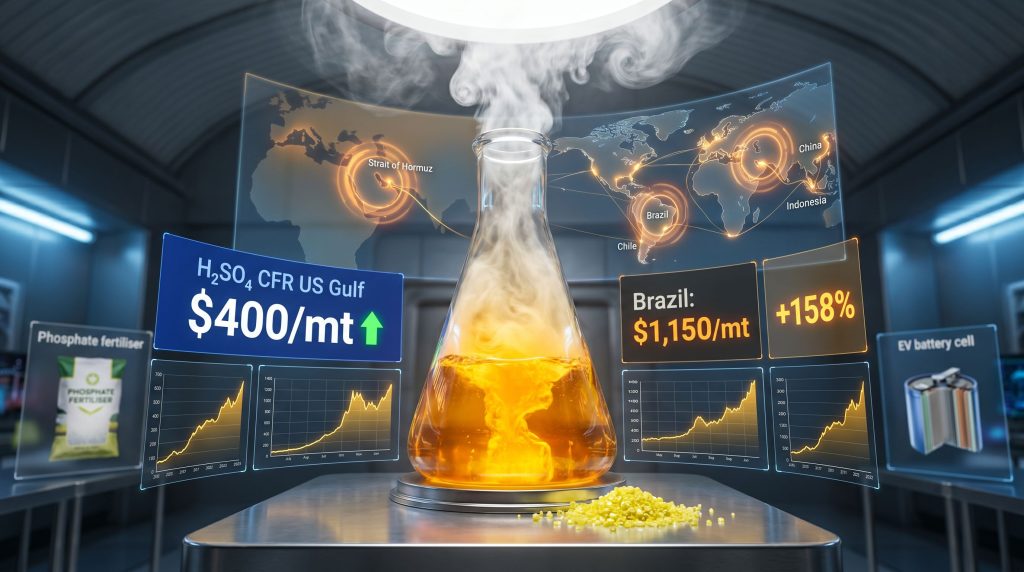
Sulphuric acid prices at the US Gulf reached approximately $400 per metric tonne in early May 2025, more than doubling from $155/mt recorded in late February, according to S&P Global Commodity Insights data. Brazilian delivered prices exceeded $1,150/mt, reflecting the compounding effect of freight costs, supply scarcity, and geographic isolation from alternative sources.
Why Prices Cannot Quickly Normalise
Several structural characteristics prevent rapid price correction even if geopolitical conditions improve:
- Building new sulphuric acid production facilities or regeneration plants takes between three and seven years from initial permitting to commissioning, depending on jurisdiction and scale.
- Demand across the fertiliser, mining, and chemicals sectors is fundamentally inelastic in the short to medium term. Industrial users cannot simply reduce consumption without curtailing output.
- Geographic arbitrage, the normal market mechanism for balancing regional price differentials, is severely constrained by the corrosive transport requirements of sulphuric acid, which demands specialised tankers, storage vessels, and port infrastructure.
- The shortage reflects a physical supply deficit, not a demand-side anomaly that can be corrected through price signals alone.
Which Industries Face the Greatest Exposure to the Sulphuric Acid Crisis?
The Fertiliser Industry: The Most Acute Threat to Global Food Security
With approximately 60% of global sulphuric acid consumption directed toward phosphate fertiliser production, the agricultural sector bears the most immediate and severe burden from the current shortage.
The transmission mechanism from acid shortage to food security threat is direct and rapid:
- Higher acid costs increase the production cost of diammonium phosphate (DAP) and monoammonium phosphate (MAP), the two most widely used phosphate fertilisers globally.
- A 25%+ spike in fertiliser input costs flows through to agricultural operating budgets within a single growing season.
- Farmers facing higher input costs either reduce application rates, cutting yields, or pass costs through to food prices, generating inflationary pressure at the supermarket level.
- The effect is not evenly distributed. Import-dependent agricultural economies face acute exposure, while nations with domestic acid production capacity are relatively insulated.
The sulphuric acid crisis is not merely an industrial commodities story. When acid prices rise, fertiliser costs rise. When fertiliser costs rise, food prices follow. This is a direct, quantifiable transmission mechanism from industrial commodity markets to household grocery bills, operating within a single agricultural cycle.
The Critical Minerals and Energy Transition Supply Chain
The energy transition supply chains have a sulphuric acid dependency that is rarely discussed in coverage of battery metals and electric vehicles. The step-by-step mechanism is as follows:
- Sulphuric acid volumes tighten and spot prices surge across global markets.
- HPAL nickel processing costs escalate sharply in Indonesia and the Philippines, the two dominant producers of battery-grade nickel.
- Nickel sulphate production costs increase, flowing through to battery cathode manufacturing input costs.
- Battery cell manufacturers absorb higher raw material costs, compressing margins or raising cell pricing.
- EV production economics deteriorate, slowing adoption rates relative to current projections.
- Energy transition timelines extend beyond current consensus forecasts, with implications for climate commitments and grid decarbonisation schedules.
This sequence is not speculative. It is an operational reality already affecting processing margins in Indonesia and the Philippines, where nickel laterite processing is structurally acid-intensive by nature of the ore type.
Mining Operations: Copper, Nickel, and Base Metals Processing
The impact on mining operations extends well beyond nickel:
- Chile's copper sector is facing sharply higher acid costs for SX-EW heap leach operations, which account for roughly 20% of global copper production and are among the most acid-intensive mining processes in existence.
- Indonesian nickel processing hubs carry a dual exposure: both through direct acid consumption in HPAL circuits and through dependence on imported sulphur to generate on-site acid.
- Sub-Saharan African mining operations are reportedly receiving delivered acid at prices that represent a fundamental disruption to operating cost models, with limited alternatives available given the region's geographic isolation from major production centres.
- Australian hard-rock lithium processors converting spodumene concentrate to battery-grade chemicals face meaningful cost escalation, with flow-on effects for project economics across the Pilbara and broader Western Australian lithium belt.
Industrial Chemicals and Manufacturing
Beyond the headline sectors, sulphuric acid shortages ripple through:
- Petrochemical alkylation processes, where acid acts as a catalyst.
- Pharmaceutical API synthesis, where sulphuric acid is used in esterification and purification steps.
- Steel pickling operations, where acid removes scale from rolled steel surfaces.
- Water treatment chemical production, dependent on acid for alum and related coagulant synthesis.
Operators with long-term supply contracts negotiated before the price spike carry partial insulation. However, those exposed to spot markets face immediate and severe margin compression.
Which Countries Are Most Vulnerable to the Global Sulphur Shortage?
Geographic Exposure Map: Country-by-Country Risk Assessment
| Country | Primary Exposure | Vulnerability Driver | Sector Most at Risk |
|---|---|---|---|
| Brazil | Acute | Heavy fertiliser import dependence; active planting window | Agriculture / Phosphate |
| Chile | High | Copper SX-EW acid consumption | Mining / Copper |
| Indonesia | High | HPAL nickel processing; sulphur import reliance | Mining / EV Battery Supply |
| India | Elevated | Import dependence; tightening Asian supply | Fertilisers / Chemicals |
| Sub-Saharan Africa | Severe | Delivered acid prices at record highs; limited alternatives | Mining / Industrial |
| Australia | Moderate-High | Hard-rock lithium and base metals processing | Critical Minerals / Mining |
Why Brazil Represents the Most Immediate Crisis Point
Brazil's exposure is more acute than any other major economy for several compounding reasons:
- Brazil is structurally dependent on imported phosphate fertilisers, with domestic production unable to meet agricultural demand.
- Delivered sulphuric acid prices in Brazil have exceeded $1,150 per metric tonne, more than double pre-disruption levels.
- The timing of the price spike coincides with critical agricultural planning and input purchasing cycles, leaving farmers and fertiliser distributors with limited ability to defer purchasing decisions or seek alternatives.
- Brazil's domestic acid production capacity is insufficient to substitute meaningfully for import shortfalls, and new capacity cannot be built within any timeframe relevant to the current agricultural cycle.
The next major ASX story will hit our subscribers first
Is There a Way Around the Sulphuric Acid Bottleneck? Emerging Alternatives and Strategic Responses
Why Substitution Is Harder Than It Sounds
The chemical properties that make sulphuric acid so effective — its ability to protonate and dissolve metal compounds at industrial scales with high selectivity and efficiency — are precisely what make it so difficult to replace. Alternative leaching reagents such as hydrochloric acid or ammonium sulphate exist in laboratory and niche industrial settings, but none approach the combination of cost, effectiveness, and commercial availability that sulphuric acid provides at scale.
Furthermore, the corrosive nature of sulphuric acid that limits its transport and storage is equally characteristic of most viable chemical alternatives, meaning substitution does not resolve the logistics constraint.
Direct Lithium Extraction: A Strategic Hedge Against Acid Dependency
One of the most significant strategic implications of the current crisis is its differential impact across lithium processing technologies.
Conventional hard-rock spodumene processing in Australia follows a pathway that is structurally dependent on sulphuric acid. Spodumene concentrate must be roasted and then leached with sulphuric acid to produce lithium sulphate solution, from which battery-grade lithium chemicals are ultimately derived. Every tonne of lithium hydroxide produced via this route carries a substantial acid input cost that is now exposed to the most severe price spike in recent industrial history.
Direct Lithium Extraction technology, applied to lithium brine deposits in South America's lithium triangle, follows an entirely different pathway. DLE processes extract lithium directly from brine using adsorption, ion exchange, or membrane-based technologies, bypassing conventional evaporation ponds entirely and eliminating the acid-intensive conversion steps that define hard-rock processing.
In a high-acid-cost environment, brine-based DLE projects carry a meaningful and quantifiable structural cost advantage over conventional hard-rock processing operations. This advantage widens proportionally with every dollar increase in sulphuric acid spot prices.
This distinction has material implications for project economics, competitive positioning, and investor valuation frameworks across the lithium sector. Consequently, as sulphuric acid prices remain elevated, the cost differential between DLE brine processing and conventional spodumene conversion widens, potentially reshaping the relative competitiveness of different lithium supply sources over the medium term. Indeed, lithium brine projects in Argentina and across the broader lithium triangle are increasingly positioned as structural beneficiaries of the sustained acid price environment.
What the Mining Industry Is Doing to Manage Exposure
Industrial operators are responding to the shortage through several strategies:
- Renegotiating long-term acid supply contracts at higher fixed prices to secure volume certainty.
- Evaluating on-site sulphuric acid generation from smelter byproducts where processing infrastructure supports it.
- Investigating alternative processing routes for lower-grade ores that may require less acid per tonne of output.
- Increasing strategic buffer stocks within the limits of existing storage infrastructure.
- Engaging with national governments on potential strategic reserves or emergency supply mechanisms.
None of these responses address the fundamental supply deficit. They represent cost management and risk mitigation, not solutions.
How Long Will the Global Sulphuric Acid Shortage Last?
Why This Is Not a Temporary Market Blip
Several structural factors point to the shortage persisting well beyond a single market cycle:
- New sulphuric acid production or regeneration facilities require between three and seven years to permit, engineer, and commission, depending on jurisdiction and scale.
- Geopolitical resolution of Middle East shipping corridor disruptions carries significant uncertainty and is not a market mechanism that can be accelerated through price signals.
- China's domestic fertiliser protection policy reflects a strategic prioritisation of food security that is structurally durable, not a temporary administrative measure.
- European spot markets are reportedly sold out in the near term with no clear restocking timeline visible.
- The underlying structural mismatch between inelastic demand growth and constrained supply capacity was developing before the geopolitical triggers hit, meaning partial resolution of the immediate shocks will not return the market to pre-2025 equilibrium.
Scenarios for Market Resolution
Scenario 1 — Prolonged Disruption (Base Case)
Middle East shipping restrictions persist through 2025 and into 2026. China maintains export controls to protect domestic food security. Prices remain elevated across all major import regions, with industrial operators absorbing sustained cost pressure.
Scenario 2 — Partial Recovery (Moderate Case)
Geopolitical de-escalation allows partial resumption of Middle Eastern sulphur flows by late 2025. China selectively eases export restrictions for non-fertiliser industrial applications. Prices stabilise at a structurally higher level than pre-crisis norms, reflecting the underlying feedstock tightness that predates the geopolitical shocks.
Scenario 3 — Accelerated Supply Response (Optimistic Case)
Emergency regulatory frameworks in North America and Europe fast-track permitting for new acid production capacity. Alternative sulphur recovery from refinery operations scales more rapidly than historical precedent suggests is feasible. Prices gradually normalise over an 18 to 24 month period, though not to pre-2025 levels.
Even under the most optimistic scenario modelled, the global sulphuric acid market faces a structural deficit that cannot be resolved within a single agricultural or industrial planning cycle. The physical constraints are simply too rigid.
The Macro Context: Why the Sulphur Crisis Is a Systemic Industrial Risk
The Convergence of Climate, Geopolitics, and Supply Chain Fragility
The global sulphur and sulphuric acid shortage does not exist in isolation. It intersects with several other structural macro pressures simultaneously:
- Weather pattern disruption: Anomalous descending air currents over South Asia are projected by early meteorological models to reduce Indian monsoon volumes below long-term averages in 2025. The Indian monsoon functions as a planetary thermodynamic engine, releasing enormous quantities of latent heat into the upper troposphere. Disruptions to monsoon intensity create downstream blocking patterns that generate extreme heat events and unseasonal droughts across East Asia, Europe, and North America. A below-average monsoon compounds agricultural demand for fertiliser inputs precisely when those inputs are most expensive, tightening the food security risk further.
- Geopolitical supply chain fragmentation: The decoupling of commodity supply chains along geopolitical fault lines is accelerating, reducing the resilience of just-in-time industrial procurement models that have dominated for three decades.
- Energy transition demand acceleration: The same geopolitical pressures driving energy transition investment are simultaneously creating new acid-intensive demand streams through HPAL nickel and lithium processing expansion, adding demand pressure to a market already facing structural supply constraints.
Why the Financial Media Has Underestimated This Crisis
The systematic underpricing of sulphuric acid risk by mainstream financial commentary reflects several institutional biases:
- Sulphur and sulphuric acid are not traded on major public exchanges with retail-visible price discovery. The market operates through bilateral contracts and specialist commodity indices that receive minimal media coverage.
- The cross-sector analytical framework required to fully appreciate the shortage's implications spans agriculture, mining, chemical manufacturing, and energy transition supply chains simultaneously, exceeding the typical single-sector focus of financial journalism.
- Coverage has remained concentrated on crude oil volatility and central bank policy, which carry higher retail investor engagement but represent only one dimension of the industrial cost pressure environment.
The global sulphuric acid shortage is not a niche commodity story. It represents a simultaneous fundamental threat to agricultural output, critical minerals processing, and the physical infrastructure of the energy transition. Industrial operators and investors who fail to model this exposure face significant unpriced risk across multiple portfolio positions.
What Does the Sulphuric Acid Crisis Mean for Commodity Investors?
Investment Implications Across the Commodity Complex
The current price environment creates differentiated winners and losers across the industrial complex:
- Phosphate fertiliser producers with vertically integrated acid supply chains gain competitive advantage as spot buyers face margin compression.
- Copper miners using SX-EW processing face meaningful operating cost headwinds that may not be fully reflected in current equity valuations.
- HPAL nickel projects face the most severe combined exposure, given that HPAL is among the most acid-intensive processing methods in mining and the projects are typically located in import-dependent jurisdictions.
- Lithium projects using DLE brine technology carry a structural cost advantage versus hard-rock peers that widens proportionally with acid price elevation.
- Sulphur recovery assets attached to oil sands operations and large-scale refinery complexes may attract renewed capital interest as the strategic value of captive sulphur supply becomes more widely appreciated.
Operational Risk Management: What Industrial Buyers Should Be Doing Now
Industrial operators exposed to sulphuric acid inputs should be working through the following framework immediately:
- Conduct a full audit of current sulphuric acid inventory levels and forward contract coverage.
- Map precise supply chain exposure to spot acid pricing, identifying which cost centres carry unhedged spot exposure.
- Evaluate technical feasibility of alternative processing routes where engineering and capital timelines permit.
- Engage proactively with long-term contract suppliers to negotiate forward volume commitments before the supply picture tightens further.
- Monitor Middle East shipping corridor developments and Chinese export policy signals on a weekly basis.
- Build detailed cost scenario models under acid price assumptions of $400/mt, $600/mt, and $1,000/mt or above, to stress-test project economics and operational viability.
Frequently Asked Questions: Global Sulphur and Sulphuric Acid Shortage
What is causing the global sulphuric acid shortage in 2025?
The shortage is driven by two simultaneous supply shocks: disruptions to seaborne sulphur trade through Middle Eastern shipping corridors, and China's decision to halt sulphuric acid exports from May 2025 to protect its domestic fertiliser supply chain. These factors compound pre-existing feedstock tightness from lower global refinery and smelter throughput.
Which industries are most affected by the sulphuric acid shortage?
The fertiliser industry carries the most acute exposure, consuming approximately 60% of global sulphuric acid output. Mining operations, particularly copper SX-EW and HPAL nickel processing, are significantly impacted, along with industrial chemical manufacturing, pharmaceutical synthesis, and steel processing.
How much have sulphuric acid prices increased?
Sulphuric acid prices at the US Gulf reached approximately $400 per metric tonne in May 2025, rising from around $155/mt in late February, according to S&P Global Commodity Insights data. Brazilian delivered prices exceeded $1,150/mt. Global sulphur prices have reportedly surged approximately 500% from pre-disruption levels, though precise figures vary by grade and delivery point.
Which countries are most exposed to the sulphur shortage?
Brazil faces the most acute near-term exposure due to its dependence on imported phosphate fertilisers during active agricultural cycles. Chile, Indonesia, India, and sub-Saharan African nations also face severe exposure through mining and agricultural dependencies.
Can sulphuric acid be easily replaced or substituted?
No. Sulphuric acid's chemical properties make it uniquely effective at industrial scales, and its corrosive nature makes the logistics of any substitute equally challenging. Alternative reagents exist in niche applications but are not commercially proven at the volumes required to offset current shortfalls.
How long is the sulphuric acid shortage expected to last?
Given that new production infrastructure requires years to build and the geopolitical drivers of the shortage remain unresolved, analysts and industry observers do not expect rapid normalisation. The shortage reflects structural rather than cyclical factors, and elevated prices are considered likely to persist through at least 2025 to 2026 under base case scenarios.
What is Direct Lithium Extraction and why does it matter in this context?
Direct Lithium Extraction is a processing technology applied to lithium brine deposits that bypasses conventional evaporation ponds and eliminates the acid-intensive conversion steps required in hard-rock spodumene refining. In a sustained high-acid-cost environment, brine-based DLE projects carry a quantifiable structural cost advantage over conventional hard-rock processing peers.
Key Takeaways: Understanding the Global Sulphur and Sulphuric Acid Shortage
- The 2025 global sulphur and sulphuric acid shortage is driven by a dual supply shock combining Middle East shipping disruptions with China's export restrictions.
- US Gulf acid prices have risen more than 158% from late February to May 2025, while Brazilian delivered prices have exceeded $1,150/mt.
- The fertiliser sector carries the most immediate threat, with direct transmission to global food prices through a 25%+ spike in phosphate fertiliser input costs.
- Critical minerals processing including copper, nickel, and hard-rock lithium faces significant cost headwinds that may not be fully reflected in current market valuations.
- Brazil, Chile, Indonesia, India, and sub-Saharan Africa represent the most geographically exposed regions.
- The shortage is structural and multi-year in nature. New production capacity cannot be built within timeframes relevant to the current agricultural or industrial planning cycle.
- DLE brine-based lithium processing carries a structural hedge against acid chain dependency that becomes more valuable as acid prices remain elevated.
- Industrial operators and investors must urgently build scenario models incorporating acid price assumptions across a wide range to stress-test exposure and develop credible contingency strategies.
Disclaimer: This article is general in nature and does not constitute financial product advice. The price data and scenario projections referenced represent publicly reported market information and analyst commentary as at the time of writing. Readers should conduct their own research and seek independent financial advice before making investment decisions. Forward-looking statements involve uncertainty and actual outcomes may differ materially from those described.
For broader market analysis and critical minerals commentary, SmallCaps.com.au publishes ongoing coverage at the intersection of industrial inputs, commodity supply chains, and ASX-listed resource companies.
Want to Stay Ahead of the Next Major Mineral Discovery Before the Market Catches On?
The sulphuric acid crisis is reshaping cost structures across copper, nickel, and lithium supply chains — and the ASX-listed companies best positioned to capitalise may already be announcing significant discoveries. Discovery Alert's proprietary Discovery IQ model delivers real-time alerts on significant ASX mineral discoveries, cutting through complex commodity data to surface actionable opportunities the moment they emerge — explore historic examples of major discovery returns and begin your 14-day free trial today.