June 8, 2026
Why Benchmark Precision Matters in Battery Chemical Markets
The global transition toward electrified transportation has quietly elevated a class of specialty chemicals from industrial obscurity to strategic importance. Among these, nickel sulfate occupies a particularly critical position. Unlike exchange-traded base metals, which trade in standardised forms against a single global reference price, battery-grade nickel sulfate is assessed through a layered pricing architecture that reflects purity specifications, regional logistics, and downstream demand conditions simultaneously. Furthermore, understanding how this pricing system works, and what it signals about the broader battery supply chain, has become essential knowledge for anyone operating across the energy transition value chain.
At the centre of this architecture sits the nickel sulfate premium CIF Japan and Korea, a benchmark that has quietly become one of the most consequential reference points in battery raw materials market dynamics.
When big ASX news breaks, our subscribers know first
What the MB-NI-0247 Assessment Actually Measures
The Fastmarkets benchmark designated MB-NI-0247 does not represent a standalone commodity price. It functions as a differential assessed on top of the London Metal Exchange (LME) nickel cash price, capturing the additional value attributed to battery-grade chemical purity, Northeast Asian delivery logistics, and the specific supply-demand dynamics of the cathode precursor manufacturing sector.
To qualify for inclusion in this assessment, nickel sulfate must meet strict technical thresholds:
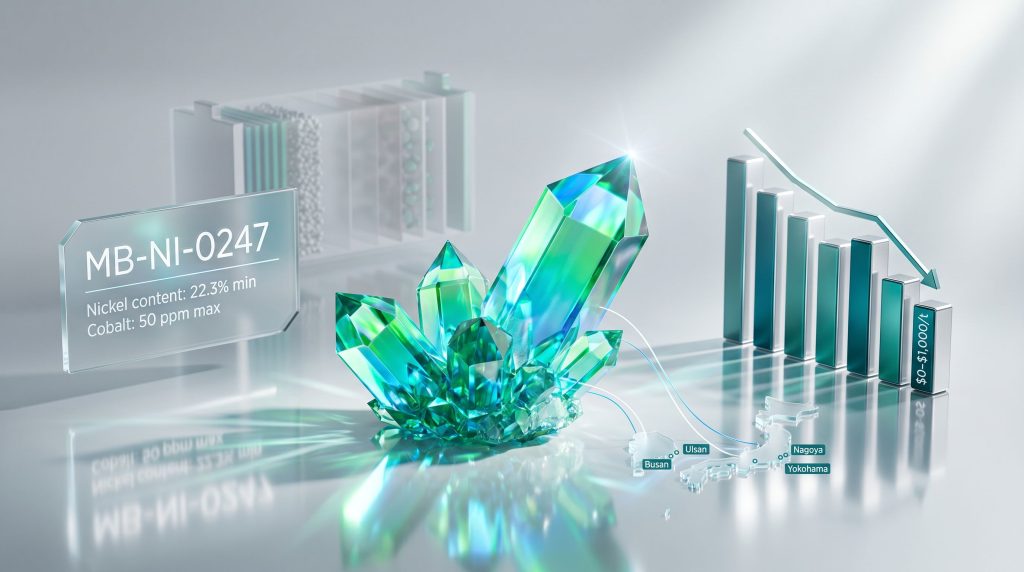
- Minimum nickel content of 22.3%
- Cobalt impurity ceiling of no more than 50 parts per million (ppm)
- Minimum tradeable lot size of 1 tonne
- Delivery within 60 days of the assessment date, on a cost, insurance, and freight (CIF) basis to major Japanese and Korean ports
These specifications are not arbitrary. They reflect the precise material quality requirements of cathode active material (CAM) and precursor (pCAM) manufacturers operating in Japan and Korea. Cobalt contamination beyond 50 ppm, for example, can interfere with the electrochemical performance of NMC and NCA cathode formulations, making strict impurity control a non-negotiable commercial requirement rather than a marketing designation.
The distinction between the LME nickel price and the nickel sulfate premium is fundamental. The LME references exchange-deliverable nickel metal at a minimum purity of 99.8%, in registered physical forms. The sulfate premium sits above this reference, reflecting chemical conversion costs, purity processing, and regional supply-demand balances that the base metal exchange cannot capture.
The assessment window runs from 5:00 to 6:00 pm China Standard Time on publication days, with Fastmarkets collecting solicited bids, offers, and confirmed transaction data from verified market participants before deriving a published range. The benchmark is published on a fortnightly basis, a frequency that reflects the relatively low transaction volume characteristic of specialty battery chemical markets compared to bulk commodities.
Northeast Asia as the Gravitational Centre of Nickel Sulfate Trade
Why Japan and Korea Define Regional Benchmark Dynamics
The selection of Japan and Korea as the geographic anchor for this benchmark is not incidental. These two nations house the largest concentration of cathode active material processing capacity outside of China, with South Korean battery cell manufacturers supplying major global EV platforms across North America, Europe, and Asia. Japan's role extends further into precision chemical processing and secondary cathode supply, giving it a distinct function within the regional supply architecture.
Key port facilities receiving nickel sulfate shipments include terminals at Ulsan, Busan, Yokohama, and Nagoya, each serving different segments of the domestic battery manufacturing ecosystem. For assessments involving deliveries to ports outside these primary locations, Fastmarkets applies a normalisation methodology to ensure geographic comparability across the benchmark.
The freight economics connecting production regions to Northeast Asian ports represent a meaningful component of the premium's structure. Three primary supply corridors shape these dynamics:
- Chinese nickel sulfate refineries converting nickel intermediates for direct export to Korean and Japanese cathode producers
- Philippine-derived nickel intermediates (primarily mixed hydroxide precipitate) processed through Chinese or Indonesian facilities before onward shipment
- Indonesian High-Pressure Acid Leach (HPAL) projects producing battery-grade nickel sulfate or mixed hydroxide precipitate for Northeast Asian delivery
Each corridor carries distinct freight cost structures, transit times, and quality consistency profiles, all of which feed into the premium spread observed in the Fastmarkets assessment.
The Invisible Layer: Why CIF Terms Create Pricing Complexity
CIF (Cost, Insurance, and Freight) delivery terms place the burden of shipping costs and insurance on the seller up to the point of destination port arrival. For buyers in Japan and Korea, this structure provides cost certainty and simplifies procurement planning. For sellers, however, CIF pricing requires accurate freight cost modelling against volatile shipping rates, insurance premium fluctuations, and currency exposures across the JPY, KRW, and USD.
This complexity creates a situation where two nominally identical shipments of battery-grade nickel sulfate, carrying the same chemical specification, may command different effective premiums depending on the origin port, vessel availability, and prevailing freight indices at the time of shipment. Understanding this layering is critical for procurement teams seeking to evaluate whether spot market offers represent genuine value relative to the benchmark.
How the Premium Is Assessed: Price Discovery in a Thinly Traded Market
From Market Inputs to Published Range
Price discovery in specialty battery chemical markets differs substantially from the continuous auction mechanisms that define exchange-traded commodity pricing. Nickel sulfate does not trade on a central exchange. Instead, price information is gathered by Fastmarkets through a structured data collection process involving solicited market inputs from qualified participants, including producers, traders, buyers, and intermediaries.
This methodology is designed to ensure that the published assessment reflects genuine market conditions rather than any single participant's position or interest. The process is governed by formal methodology documentation, with governance frameworks that include data integrity protocols, conflict-of-interest management, and correction procedures.
The Shift to Range-Based Assessment Format
One of the less widely understood structural features of MB-NI-0247 is its range-based output format, which publishes both a lower bound and an upper bound for the premium rather than a single-point midpoint value. This methodology better reflects the genuine bid-offer spread present in illiquid specialty chemical markets, where the difference between a buyer's maximum acceptable price and a seller's minimum acceptable price may span a meaningful width.
For contract indexation purposes, this range format introduces additional complexity. Buyers and sellers referencing MB-NI-0247 in long-term supply agreements must agree on whether to index against the range midpoint, the lower bound, or the upper bound. Each carries different risk implications depending on whether a participant is net long or net short on nickel sulfate exposure.
In thinly traded specialty chemical markets, range-based assessments represent best practice among price reporting agencies precisely because single-point values can create a false sense of precision. A range transparently communicates the uncertainty inherent in price discovery when transaction volumes are limited.
Correction Protocols and Governance Standards
The rigour of a price reporting agency's correction process is one of the clearest indicators of its governance quality. In June 2026, Fastmarkets published a correction notice for the MB-NI-0247 assessment that had been published on June 5, 2026. The published rationale had incorrectly described the premium movement as flat from the previous assessment when the actual direction of movement was down from the previous assessment.
The price range itself, published at $0-$1,000 per tonne, remained unchanged; only the directional characterisation within the written rationale required amendment. This distinction matters more than it might initially appear. For market participants using the assessment rationale to inform procurement decisions, inventory management, or strategic planning, the difference between a flat and declining premium carries meaningful information about supply-demand balance.
A correction that updates directional language without altering the price range demonstrates that the underlying assessment data was accurate, but the written interpretation contained a reporting error. The correction was issued on June 8, 2026, three days after the original publication. Fastmarkets maintains open feedback channels through which qualified market participants can submit price information, provide comments on assessments, or flag potential errors.
Supply and Demand Forces That Move the Premium
The Indonesian HPAL Effect on Global Nickel Sulfate Supply
The most structurally significant supply-side development affecting the nickel sulfate premium CIF Japan and Korea over the medium term is the progressive commissioning of Indonesian HPAL (High-Pressure Acid Leach) processing facilities. HPAL technology extracts nickel and cobalt from low-grade laterite ore deposits that were previously uneconomic to process using conventional smelting routes, producing mixed hydroxide precipitate or nickel sulfate directly suitable for battery chemical applications.
Indonesian nickel industry growth has consequently added meaningful new volumes of battery-grade nickel into the global system, shifting the structural supply balance. When HPAL output reaches Northeast Asian ports at competitive CIF prices, it places downward pressure on the premium differential, compressing the additional value that battery-grade purity and regional delivery previously commanded.
The declining premium direction noted in the corrected June 2026 Fastmarkets assessment is consistent with this structural supply expansion narrative, though directional movements in any single assessment period should not be extrapolated into definitive trend conclusions. Furthermore, Indonesian nickel price trends remain a key variable that analysts must monitor alongside the CIF Japan and Korea premium assessments.
Battery Chemistry Transitions and Their Demand Implications
Demand for nickel sulfate is not homogeneous. It is concentrated in cathode chemistries that require high nickel loadings, specifically:
| Cathode Chemistry | Nickel Content | Nickel Sulfate Demand Intensity |
|---|---|---|
| NMC 811 (Nickel Manganese Cobalt) | ~80% nickel | Very High |
| NMC 622 | ~60% nickel | High |
| NCA (Nickel Cobalt Aluminium) | ~80-85% nickel | Very High |
| NMC 532 | ~50% nickel | Moderate |
| LFP (Lithium Iron Phosphate) | 0% nickel | None |
The accelerating market share gains of LFP battery chemistry, particularly in Chinese EV models and grid-scale battery storage expansion applications, represent a structural demand headwind for nickel sulfate. When automakers or cell manufacturers shift procurement toward LFP chemistry for cost reasons, they exit the nickel sulfate market entirely rather than simply purchasing smaller quantities.
This binary demand characteristic makes nickel sulfate particularly sensitive to chemistry mix shifts within the broader battery market. Conversely, high-performance EV segments targeting energy density remain committed to nickel-rich cathode chemistries, sustaining demand from South Korean cell manufacturers supplying premium automotive platforms globally.
Conversion Economics: When Is It Profitable to Make Nickel Sulfate?
A less widely understood dynamic shaping the nickel sulfate premium is the conversion economics calculation that determines when it is financially rational for a nickel producer to convert refined nickel metal into nickel sulfate rather than selling the metal directly into LME-registered warehouses.
The conversion spread is determined by the relationship between:
- The LME nickel cash price (the value of the raw material input)
- The all-in price of nickel sulfate in the spot market
- The cost of chemical conversion (sulfuric acid, energy, processing, quality verification)
- Applicable freight and logistics costs to deliver to CIF Northeast Asian ports
When the nickel sulfate all-in price offers a sufficient premium above LME nickel plus conversion costs, producers are incentivised to route material through chemical processing. When the premium compresses, however, the conversion spread narrows, potentially making direct LME metal sales more attractive. This creates a natural supply elasticity mechanism within the nickel sulfate market that partially self-corrects extreme premium dislocations, though the speed of this adjustment is constrained by processing capacity availability and contract commitments.
Regional Benchmark Comparison: Where MB-NI-0247 Fits
| Benchmark | Geographic Basis | Delivery Terms | Publication Frequency | Key Differentiator |
|---|---|---|---|---|
| MB-NI-0247 (Fastmarkets) | Japan and Korea major ports | CIF | Fortnightly | Battery-grade spec, range format |
| China domestic nickel sulfate | Ex-works China | EXW/DAP | Weekly | Reflects internal Chinese market dynamics |
| LME Nickel Cash | Global reference | Not applicable | Daily | Base metal reference, not battery-grade specific |
The premium spread between Chinese domestic nickel sulfate pricing and the CIF Japan and Korea assessment provides traders with a visible arbitrage indicator. When Chinese domestic prices are sufficiently depressed relative to CIF Northeast Asia levels after accounting for freight, there is a financial incentive to export. When the relationship narrows, domestic Chinese consumption absorbs supply that would otherwise flow to export markets, tightening the regional availability picture.
The next major ASX story will hit our subscribers first
Practical Applications Across the Value Chain
How Different Market Participants Engage With This Benchmark
Battery manufacturers and cathode producers use MB-NI-0247 primarily as a contract indexation reference. Long-term nickel sulfate supply agreements typically incorporate price review mechanisms tied to published benchmarks, with quarterly or semi-annual adjustments based on assessment movements. The fortnightly publication frequency requires that contract terms specify whether the indexation reference point uses a single assessment date, an average of multiple assessments within a pricing period, or a lagged reference structure.
Nickel sulfate producers and specialist traders use the premium range as a benchmarking tool for spot export offers into Northeast Asian markets. When spot offer levels fall within the published range, market participants can assess competitiveness. When offers fall outside the range in either direction, this signals either exceptionally competitive pricing or quality and logistical factors warranting further scrutiny.
Financial analysts and strategic investors treat premium trend direction as a leading indicator of battery supply chain health. A sustained decline in the nickel sulfate premium CIF Japan and Korea, particularly when occurring simultaneously with broad LME nickel price weakness, can suggest structural oversupply conditions. In addition, monitoring nickel price momentum alongside the sulfate premium provides a more complete picture of conditions with implications for the investment case supporting new nickel sulfate production capacity globally.
Analysts monitoring battery raw material supply chains should treat the nickel sulfate premium direction as one input within a broader framework that also considers lithium carbonate spreads, cobalt sulfate premiums, and manganese sulfate pricing to assess overall cathode precursor market conditions holistically.
Forward-Looking Considerations for Nickel Sulfate Markets
Several structural forces will shape the trajectory of the nickel sulfate premium CIF Japan and Korea over the coming years:
- Indonesian HPAL project commissioning timelines will determine the pace at which new battery-grade supply enters the market, with additional capacity additions likely to maintain downward pressure on premiums relative to the elevated levels seen during supply-constrained periods
- Solid-state battery development represents a long-term wildcard for nickel sulfate demand; if solid-state chemistries adopt different precursor formats or purity requirements at commercial scale, existing benchmark specifications may require methodological review
- Battery recycling infrastructure expansion, particularly black mass processing capable of producing secondary nickel sulfate, will create a new supply category that competes with primary production on quality grounds as recycling volumes scale
- Bilateral critical mineral frameworks between Japan, Korea, and resource-producing nations may reshape trade flow patterns and logistics economics, with downstream implications for freight cost components embedded in the CIF premium
- LFP versus NMC chemistry mix evolution in major EV markets will exert the most immediate demand-side influence, with each percentage point of market share shifting between chemistries representing a discrete demand signal for nickel sulfate consumption
Disclaimer: This article contains forward-looking analysis, market observations, and structural assessments based on publicly available information. It does not constitute financial advice or investment recommendations. Commodity markets are subject to rapid change, and past premium trends should not be relied upon as predictors of future price movements. Readers should conduct independent due diligence and consult qualified advisers before making any investment or commercial procurement decisions.
Want to Stay Ahead of Major ASX Mineral Discoveries in the Battery Metals Space?
Discovery Alert's proprietary Discovery IQ model delivers real-time alerts on significant ASX mineral discoveries — including battery metals such as nickel — instantly translating complex data into actionable investment insights for both short-term traders and long-term investors. Explore historic examples of extraordinary discovery returns and begin your 14-day free trial today to position yourself ahead of the broader market.