June 8, 2026
The Hidden Architecture of an Oil Price Shock: When Geopolitics Overrides Supply Fundamentals
Most commodity price dislocations can be explained through the familiar lens of supply and demand. Production outages, inventory draws, demand surges from emerging markets — these are the variables that textbook energy economists reach for first. But the more than $4 single-session surge in crude prices on June 8, 2026 cannot be understood through that framework alone. This was not a supply shock in the conventional sense. It was a geopolitical repricing event — one that exposed how comprehensively traditional market stabilisation mechanisms have been rendered ineffective by sustained regional conflict.
To understand why oil prices after Israeli strikes on Iran and Lebanon responded so dramatically, you need to examine not just what happened militarily, but why the architecture of global oil market resilience has been systematically dismantled since late February 2026. Furthermore, the geopolitical oil price drivers at play here go well beyond the immediate theatre of conflict.
When big ASX news breaks, our subscribers know first
Understanding the Price Trajectory: Sixty Percent in Less Than Four Months
Crude prices do not move in a straight line during wartime. They oscillate between escalation-driven spikes and de-escalation-driven retreats, creating a volatile but directionally upward trajectory that reflects persistent structural tightness rather than temporary sentiment swings.
The price data tells this story clearly:
| Benchmark | March 2026 Peak | Pre-Strike Close (June 6) | Post-Strike (June 8) | Single-Session Gain |
|---|---|---|---|---|
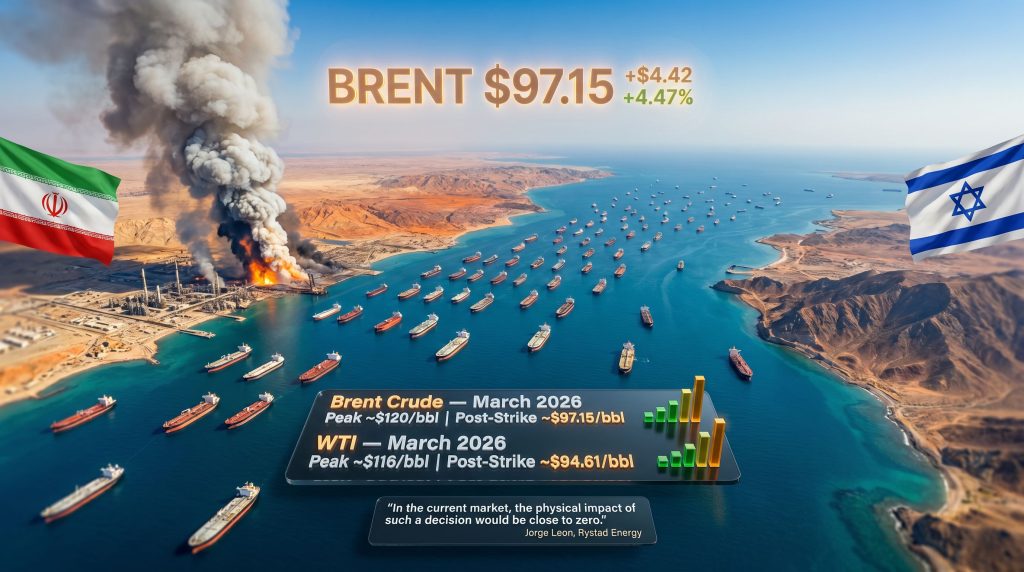
| Brent Crude | ~$120/bbl | ~$92.73/bbl | ~$97.15/bbl | +$4.42 (+4.47%) |
| WTI (U.S. Crude) | ~$116/bbl | ~$90.54/bbl | ~$94.61/bbl | +$4.07 (+4.50%) |
Source: Reuters market data, June 8, 2026
Since the conflict's outbreak in late February 2026, Brent crude has climbed roughly 60% in cumulative terms. Yet prices remain well below the March 2026 extremes, when Brent briefly approached $120 per barrel — a ceiling that reflected the initial shock of a full-scale regional war rather than a calculated repricing of sustained supply disruption.
Monday's session erased all of Friday's losses in a single trading day. Friday had seen prices soften on hopes that diplomatic channels were advancing. Those hopes collapsed entirely overnight, and the market's speed of reversal — recovering all prior session losses within hours — reveals something important about the current trading environment: sentiment, not fundamentals, is the dominant pricing mechanism.
The June 8 Strike Complex: Why Targeting Energy Infrastructure Changed the Calculus
The Mahshahr Complex and the Threshold That Was Crossed
Not all military strikes affect energy markets equally. The targeting of Iranian military positions is one thing; the targeting of energy production infrastructure is an entirely different category of escalation. On June 8, 2026, Israel confirmed strikes against the Mahshahr petrochemical complex in southwestern Iran — marking the first direct attack on an Iranian energy facility since the April 8, 2026 ceasefire.
This distinction carries significant weight for several reasons:
- Mahshahr sits within Khuzestan province, Iran's petrochemical and refining heartland, where a substantial proportion of the country's downstream chemical processing capacity is concentrated
- The April 8 ceasefire had created an implicit understanding that energy infrastructure would remain off-limits — a norm that Monday's strikes demolished
- Damage was confirmed by a provincial official cited through Iran's semi-official Fars news agency, lending credibility to the market's rapid repricing
- The strikes proceeded despite reported communications from U.S. President Donald Trump urging Israeli Prime Minister Benjamin Netanyahu to exercise restraint
That last point is particularly significant from a market psychology perspective. If Israeli military operations are proceeding despite U.S. pressure to pause, traders are forced to conclude that American diplomatic leverage over Israeli operational decisions is limited — which removes a key de-escalation backstop from the market's calculus. Consequently, the oil market trade war impact on sentiment has only compounded this uncertainty.
Lebanon: The Second Theatre Reopens Within Days of a Ceasefire
Simultaneously with the Iranian strikes, Israeli military operations resumed against targets in Lebanon. This was not merely a geographic expansion of conflict — it was a diplomatic catastrophe with direct energy market consequences.
Lebanon and Israel had formally announced a ceasefire on June 3, 2026, following Washington-mediated negotiations. The resumption of strikes within days of that agreement carries a specific market implication: if a U.S.-brokered ceasefire between Lebanon and Israel cannot hold for even a week, the probability of a broader, durable diplomatic resolution involving Iran and the Strait of Hormuz collapses significantly.
Iran has made a Lebanon ceasefire a prerequisite for any comprehensive peace framework with Washington. That conditional structure creates a direct feedback loop between military activity in Lebanon and global crude pricing. Oil prices after Israeli strikes on Iran and Lebanon have demonstrated precisely how quickly that feedback loop can materialise.
Iran's Retaliatory Missile Salvo: The Tit-for-Tat That Markets Are Now Pricing as Permanent
On Sunday, June 7, Iran launched a missile barrage targeting Israeli positions in response to the Lebanon strikes. This exchange — Israeli strikes on Lebanon, Iranian missile retaliation, followed by Israeli strikes on Iranian energy infrastructure — represents a conflict pattern that energy traders are no longer treating as episodic. It is being priced as structural and self-reinforcing.
The critical market shift since March 2026 is not the level of violence but its predictability. Traders have learned that de-escalation rallies will be followed by renewed escalation. Each ceasefire announcement now generates smaller and shorter-lived price declines, as the market discounts the probability of durable peace at progressively lower levels.
The Strait of Hormuz: The World's Most Consequential Chokepoint Under a New Governance Regime
Why This Narrow Waterway Holds the Global Economy Hostage
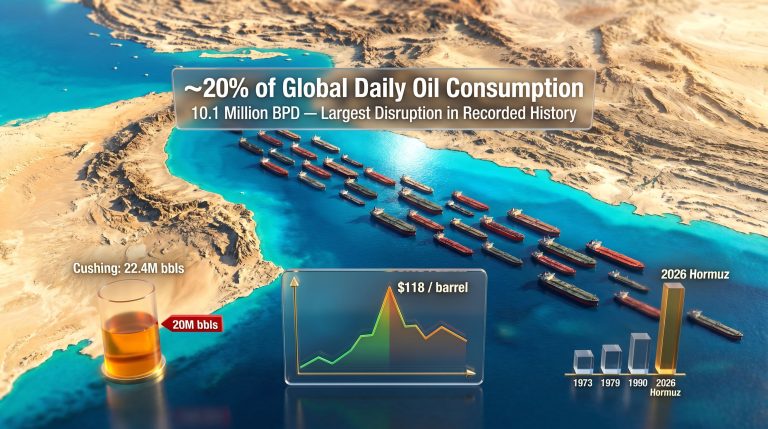
The Strait of Hormuz is a passage approximately 21 nautical miles wide at its narrowest point between Iran and Oman. Under pre-conflict conditions, it served as the transit corridor for roughly one-fifth of the world's oil and liquefied natural gas flows — a volume representing millions of barrels of crude daily that feeds refineries across Asia, Europe, and beyond.
Since the conflict's escalation, two parallel blockades have effectively halted normal transit:
- Iran's shipping restrictions have severely curtailed commercial vessel passage through the strait, cutting off the primary export route for Gulf producers
- Washington's counter-blockade of Iranian port access has added a second layer of supply disruption, compounding the physical constraints on global oil delivery
The combined effect is a near-total breakdown of the transit system that global energy markets have relied upon for decades.
Iran's Proposed Transit Fee Framework: A Structural Transformation of Global Oil Pricing
A development that has received insufficient attention from mainstream energy commentary is Iran's proposed framework for eventually reopening the strait — but under fundamentally altered governance terms. Iran's Ambassador to Moscow, Kazem Jalali, indicated on June 8 that the waterway would reopen under new conditions to be jointly determined by Iranian and Omani authorities, including the imposition of a transit fee on vessels using the passage. This statement was published in the Russian newspaper Izvestia.
The implications of this proposed framework extend far beyond the current conflict:
- A transit fee mechanism would introduce a permanent structural cost into the economics of every oil shipment passing through the strait, regardless of whether the current military conflict is resolved
- Oman's elevation to a co-regulator of the world's most critical energy chokepoint represents a significant geopolitical realignment — transforming a historically neutral transit state into an active governance participant
- Markets would need to price not just the current supply disruption, but the long-term cost implications of a fee-based transit regime that could persist for years beyond any ceasefire
- The proposal creates a new category of geopolitical risk: the permanent monetisation of chokepoint leverage by a state that has historically exercised it only during periods of acute confrontation
From an investor perspective, the transit fee proposal is arguably more significant than the immediate price spike. A one-time military event creates a temporary risk premium. A permanently restructured transit regime creates a structural floor under global oil prices.
Why OPEC+ Output Pledges Are Essentially Meaningless in the Current Environment
The Paradox of Production Commitments When Delivery Infrastructure Is Broken
In a functioning global oil market, an OPEC+ agreement to increase output would typically create downward pressure on prices by signalling additional supply. However, the group's fourth consecutive monthly output increase, announced on Sunday June 8, produced almost no market impact whatsoever. Indeed, OPEC's market influence has rarely looked so constrained by circumstances beyond its direct control.
The reason is a fundamental distinction between production capacity and delivery capacity. OPEC+ members can pledge to pump more oil. What they cannot do is deliver those barrels to global markets when the primary export corridors are blocked or severely constrained.
| OPEC+ Action | Normal Market Response | Current Market Response |
|---|---|---|
| 4th consecutive monthly output increase | Bearish price pressure | Near-zero impact |
| Production pledge from Gulf members | Supply signal registered | Barrels cannot reach market via Hormuz |
| Russia volume contribution | Partial offset available | Infrastructure damage limits capacity |
Rystad Energy's head of geopolitical analysis, Jorge Leon, assessed in a client note on June 8 that the physical impact of the OPEC+ decision on actual market supply would be close to zero given prevailing conditions. This reflects a broader analytical framework that energy market participants need to internalise: in a blockaded market, output pledges are policy theatre, not market-moving information.
Russia's situation compounds the problem. Progressive infrastructure degradation from attacks on its energy production and export systems has eroded Moscow's ability to serve as a swing supplier, removing what would normally be a secondary compensation mechanism for Gulf supply shortfalls.
The Circular Diplomacy Problem: Why Peace Keeps Failing to Materialise
A Self-Reinforcing Conflict Loop With No Easy Exit
The diplomatic architecture surrounding this conflict contains a structural flaw that makes resolution exceptionally difficult to achieve. Iran has established a firm conditional linkage: durable peace with Washington requires a stable Lebanon ceasefire first. But Israeli military operations in Lebanon have repeatedly disrupted ceasefire arrangements before they can consolidate.
The resulting dependency chain works as follows:
- Israel conducts strikes in Lebanon
- Lebanon ceasefire collapses or is destabilised
- Iran loses its prerequisite condition for broader peace negotiations
- Hormuz blockade conditions persist
- Global oil supply remains constrained
- Oil prices stay elevated
- Conflict economics reinforce the strategic value of energy leverage for all parties
Each military action in Lebanon feeds directly back into global crude pricing through this transmission mechanism. Furthermore, the broader dynamics of trade wars and oil prices have added another layer of complexity to an already fraught diplomatic environment. Energy traders have now fully mapped this loop into their risk models, which is why Lebanese military developments generate immediate oil market responses even when they appear geographically distant from the strait.
The next major ASX story will hit our subscribers first
Scenario Framework: Three Paths for Crude Prices From Here
Modelling the Range of Outcomes
Disclaimer: The following scenario analysis is speculative and based on current market conditions and analyst assessments. It does not constitute investment advice. Oil market forecasting involves substantial uncertainty, and actual price outcomes may differ materially from the ranges presented below.
| Scenario | Required Conditions | Brent Range | Assessment |
|---|---|---|---|
| Escalation Deepens | Additional strikes on Iranian energy infrastructure; Hormuz closure hardens | $105-$120/bbl | Elevated near-term risk |
| Diplomatic Breakthrough | Lebanon ceasefire holds; U.S.-Iran framework agreed; Hormuz reopens | $75-$85/bbl | Lower probability in short term |
| Managed Stalemate | Conflict continues at current intensity; Hormuz partially reopens under fee regime | $90-$100/bbl | Current base case |
The base case of a managed stalemate reflects the observation that both escalation and resolution require significant political decisions that neither party has yet committed to. The conflict appears likely to persist at roughly its current intensity, with intermittent strikes, incomplete ceasefires, and partial transit restrictions defining the operating environment for global energy markets through the medium term.
Downstream Consequences: Inflation, Central Banks, and Emerging Market Stress
The Macro Transmission Channels That Most Energy Coverage Ignores
Sustained crude prices in the $90-$100+ range do not stay contained within the energy sector. They propagate through the global economy via multiple transmission channels that compound over time:
- Consumer price inflation rises as transportation, logistics, and manufacturing energy costs increase, with the effect lagging crude price movements by approximately six to twelve weeks
- Central bank policy dilemmas intensify as oil-driven inflation complicates the rate environment — raising rates to combat inflation risks dampening already-slowing growth in an environment where geopolitical uncertainty is already suppressing investment
- Emerging market currency pressure intensifies as oil-importing nations face deteriorating trade balances and accelerating capital outflows, with the most vulnerable economies in South and Southeast Asia facing the greatest strain
- Aviation and maritime shipping margins compress as bunker fuel and jet fuel costs surge, with the effect eventually passing through to consumer prices for goods and travel
The GCC economies occupy an ambiguous position in this environment. Higher oil prices deliver significant fiscal revenue benefits to Saudi Arabia, Kuwait, the UAE, and Qatar. Yet the same conflict that generates those revenues creates security risks, dampens foreign investment appetite, and destabilises regional financial markets. Reports indicate that regional bond markets are struggling to attract buyers amid the ongoing conflict environment, with GCC sovereign debt issuances and real estate financing instruments already showing signs of stress.
What Traders and Investors Need to Monitor Going Forward
The Five Variables That Will Determine Oil Price Direction
For market participants seeking to navigate this environment, the following indicators carry the highest signal value:
- Lebanon ceasefire durability — Any further breakdown in the June 3 agreement directly resets Iran's prerequisites for broader peace negotiations and sustains Hormuz blockade conditions
- Additional Iranian energy infrastructure targeting — Each new strike on Iranian oil, gas, or petrochemical assets raises the escalation ceiling and the probability of Iran hardening its transit restrictions further
- Hormuz transit fee negotiation progress — The Iran-Oman governance framework proposal introduces a structural variable that could persist long after the current military conflict subsides
- OPEC+ actual production versus pledged output — Real delivery figures will reveal the true extent of supply disruption that production pledges are masking
- U.S.-Iran diplomatic channel credibility — Any verifiable back-channel progress toward a comprehensive framework agreement would be the single most powerful bearish catalyst available in the current market
The broader context of oil trade and geopolitics makes clear that the oil prices after Israeli strikes on Iran and Lebanon represent more than a short-term spike — they signal a fundamental repricing of long-term supply risk. Until the Strait of Hormuz returns to normal operation under a stable governance framework, the structural floor under global crude prices will remain substantially elevated compared to pre-conflict norms.
This article is intended for informational purposes only and does not constitute financial or investment advice. Oil market conditions are subject to rapid change. Readers should conduct their own due diligence before making any investment decisions based on the information presented here.
Want To Stay Ahead Of The Next Major Market-Moving Discovery?
While geopolitical shocks drive oil prices, transformative mineral discoveries on the ASX can generate equally dramatic returns — and Discovery Alert's proprietary Discovery IQ model delivers real-time alerts the moment significant discoveries are announced, turning complex data into actionable opportunities. Explore how historic discoveries have rewarded early investors on Discovery Alert's dedicated discoveries page, and begin your 14-day free trial today to ensure you're positioned ahead of the broader market.