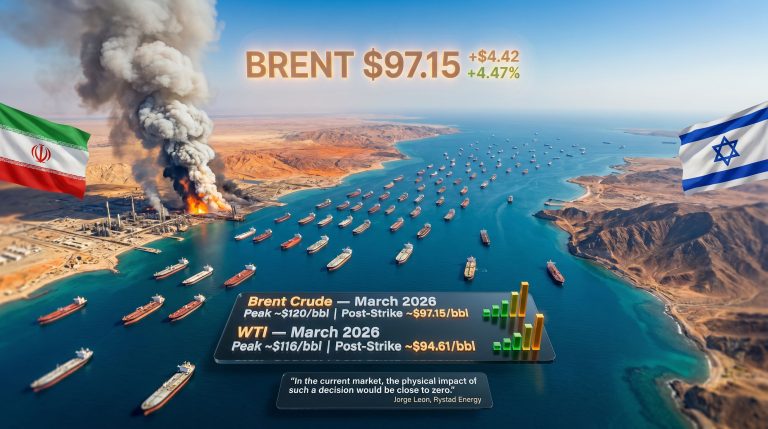
June 8, 2026
The Geopolitical Architecture of Oil Price Risk
Commodity markets have always assigned a price to uncertainty, but nowhere is this dynamic more visceral than in crude oil during periods of active military conflict. The Iran Israel conflict oil prices relationship demonstrates precisely this principle — long before a single barrel is physically prevented from reaching its destination, futures traders begin adjusting their positions based on probabilistic assessments of what might happen next. This forward-pricing behaviour is the engine behind what analysts call the geopolitical risk premium, and it is currently operating at full throttle across global energy benchmarks.
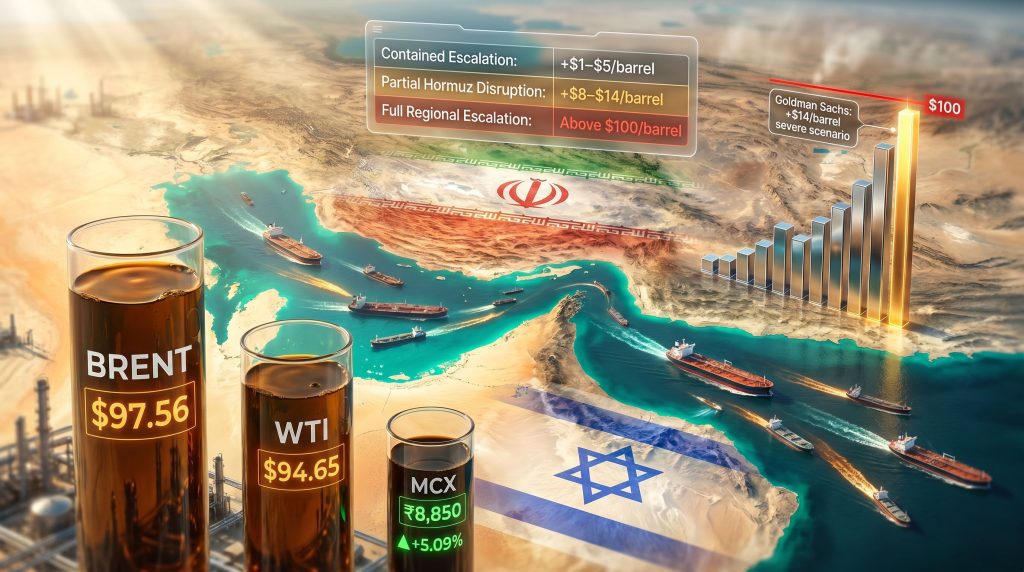
When Iran launched missile strikes against Tel Aviv in retaliation for Israeli military operations in Lebanon, the response in global crude markets was immediate and substantial. On June 8, 2026, Brent crude climbed 4.80% to $97.56 per barrel, WTI rose 4.54% to $94.65 per barrel, and India's MCX crude futures for July delivery surged 5.09% to ₹8,850 per barrel — all within a single trading session. These are not marginal moves. They represent billions of dollars in repriced contracts across global exchanges, triggered not by a confirmed supply outage but by the heightened probability of one.
| Benchmark | Price Level | Single-Session Change |
|---|---|---|
| Brent Crude | $97.56/barrel | +4.80% |
| WTI Crude | $94.65/barrel | +4.54% |
| MCX Crude (India, July delivery) | ₹8,850/barrel | +5.09% |
The Iran-Israel conflict oil prices relationship is fundamentally about anticipation, not confirmation. Markets price the probability of disruption, not just its occurrence, which means price moves can be both faster and larger than underlying physical realities would otherwise warrant.
Understanding why this happens requires grasping a core principle of futures markets: oil contracts are priced based on expected future supply and demand conditions, not just current ones. When conflict escalates near critical oil infrastructure, traders increase the probability weighting assigned to adverse supply scenarios and embed that assessment into every forward contract. Furthermore, the result is a rapid repricing that can amplify short-term volatility far beyond what physical supply data alone would justify. Tracking oil volatility trends helps contextualise just how unusual these single-session moves are relative to historical norms.
When big ASX news breaks, our subscribers know first
The Strait of Hormuz: A 21-Mile Bottleneck Holding the World's Energy System Hostage
Why Geography Creates an Irreplaceable Vulnerability
The global energy system has many moving parts, but it has one irreplaceable bottleneck: the Strait of Hormuz. This 21-mile-wide passage connecting the Persian Gulf to the Arabian Sea is not merely an important trade route — it is the single most consequential chokepoint in the entire global energy infrastructure. Approximately 18 to 21 million barrels per day of oil and petroleum products transit this waterway, representing roughly one-fifth of total global daily supply.
The nations whose export economics depend almost entirely on this passage include some of the world's largest producers:
- Saudi Arabia exports approximately 6.5 million barrels per day through the Strait
- Iraq relies on Hormuz for approximately 3.5 million barrels per day of seaborne exports
- The UAE transits around 2.5 million barrels per day through this waterway
- Kuwait and Iran itself are similarly dependent, with Iran's export volumes constrained by existing sanctions
The physical geography of the Persian Gulf offers no natural alternative. Unlike the Mediterranean or the North Sea, the Gulf is essentially a closed body of water with a single maritime outlet. This creates what energy security researchers describe as a structural concentration risk with no engineering solution available at scale.
Pipeline Alternatives and Their Critical Limitations
Two pipeline systems are often cited as potential bypass routes during Strait disruptions: Saudi Arabia's East-West Pipeline running from the Eastern Province to the Red Sea port of Yanbu, and the UAE's Habshan-Fujairah pipeline connecting oil fields directly to the Gulf of Oman. However, their combined throughput capacity falls dramatically short of what normally transits the Strait.
| Alternative Route | Operator | Maximum Capacity | Practical Limitation |
|---|---|---|---|
| East-West Pipeline (Petroline) | Saudi Aramco | ~5 mb/d theoretical | Operational constraints limit actual flow to 3-4 mb/d |
| Habshan-Fujairah Pipeline | ADNOC | ~1.5 mb/d | Covers UAE exports only |
| Combined Alternative Capacity | Multiple | ~4.5-5.5 mb/d | Less than 30% of normal Strait throughput |
Even operating at theoretical maximum, these alternatives would leave the majority of Gulf exports without viable rerouting options during a serious Strait disruption. Redirecting oil around the Cape of Good Hope as an alternative adds approximately 4,000 nautical miles and 10 to 14 additional days of transit time, dramatically increasing costs and straining global tanker capacity.
The Strait of Hormuz has never been fully closed in the modern era of global oil trade. Yet the credible threat of closure has historically been sufficient to generate significant price dislocations across futures markets — a reflection of the market's rational acknowledgement that no adequate substitute exists at the required scale and speed.
It is worth noting that the insurance dimension of Strait risk is often underappreciated. War risk premiums on tanker insurance can multiply several-fold during periods of heightened regional tension, even before a single vessel is physically obstructed. These elevated insurance costs translate directly into higher transportation expenses that flow through the supply chain and ultimately reach end consumers. Geopolitical oil prices analysis confirms this insurance dynamic has historically preceded confirmed disruption by weeks.
Scenario-Based Analysis: How Much Can the Iran-Israel Conflict Add to Oil Prices?
Quantifying the Risk Premium Across Escalation Levels
Investment bank modelling — including frameworks developed by Goldman Sachs — suggests that the conflict-related risk premium currently embedded in crude oil prices could amount to approximately $14 per barrel in a severe disruption scenario. Across a broader range of conflict trajectories, the estimated premium spans $1 to $15 per barrel, depending on scale, duration, and the geographic extent of any supply constraints.
The following scenario framework provides a structured way to assess how different conflict trajectories translate into price outcomes:
| Scenario | Description | Estimated Brent Impact |
|---|---|---|
| Contained Escalation | Missile exchanges without physical supply disruption | +$1-$5/barrel risk premium |
| Partial Hormuz Disruption | Tanker traffic restricted, rerouted, or subject to elevated risk | +$8-$14/barrel |
| Full Regional Escalation | Broad conflict involving multiple Gulf producers or sustained Strait restrictions | Potential breach of $100/barrel |
Each scenario carries materially different implications for duration as well as magnitude. A contained escalation scenario tends to generate price spikes that reverse relatively quickly once markets assess that physical flows remain uninterrupted. A partial Hormuz disruption, however, would likely sustain elevated prices for weeks or months as logistics chains adjust, insurance costs reprice, and alternative routes operate at elevated utilisation.
The Probability Weighting Mechanism Behind Futures Pricing
A less widely understood aspect of how geopolitical conflict affects oil prices is the mechanics of probability weighting in forward curve construction. Traders do not simply bet on whether disruption will occur — they assign continuous probabilities to a range of scenarios and price contracts accordingly. This means that as escalation rhetoric intensifies, the probability weight assigned to adverse scenarios increases incrementally, pushing prices upward even when nothing has yet physically changed.
This mechanism explains why oil prices can move sharply on news of missile strikes that have no direct connection to oil infrastructure. The news event itself shifts the probability distribution of future outcomes, and markets reprice instantly in response. Furthermore, algorithmic trading systems accelerate this process, translating headline events into contract adjustments within milliseconds. Brent and WTI futures pricing structures reflect this probability-weighted approach most transparently in their forward curve behaviour during escalation events.
What Forces Could Push Oil Prices Back Down?
The Counterbalancing Dynamics in the Current Market
Despite the sharp initial price surge, several structural forces exist that could act as pressure valves to limit or reverse the geopolitical risk premium over time. These counterbalancing dynamics are important for investors and policymakers to understand because they determine whether the current price spike represents a sustained structural shift or a temporary volatility event.
Key factors that could dampen or reverse the Iran Israel conflict oil prices dynamic include:
- Physical supply continuity — If actual oil flows through the Strait of Hormuz remain uninterrupted, the probability weighting of disruption scenarios decreases and risk premiums deflate. History shows this deflation can happen rapidly.
- OPEC+ spare capacity deployment — Member nations with available swing production capacity could choose to increase output to stabilise prices, providing additional supply to offset fear-driven demand. The scale of OPEC market influence means even partial deployment could meaningfully dampen the premium.
- Strategic Petroleum Reserve releases — Coordinated drawdowns by IEA member nations can provide a short-term buffer. The United States holds approximately 350 million barrels in its SPR, while China's strategic reserves are estimated at 400 to 500 million barrels.
- Demand destruction at elevated prices — As oil prices approach $100 per barrel, demand sensitivity increases in price-elastic economies, naturally limiting upside momentum.
- U.S. shale production responsiveness — American producers have demonstrated an ability to increase output relatively quickly when sustained higher prices improve well economics, adding non-OPEC supply over a 6-to-12-month timeframe.
Strategic petroleum reserves represent a meaningful short-term buffer but not a structural solution. At global consumption rates exceeding 100 million barrels per day, even large coordinated SPR releases provide only weeks of supply cushion before physical market rebalancing becomes unavoidable.
The Fear Premium Lifecycle
Geopolitical risk premiums in oil markets follow a recognisable lifecycle. Escalation triggers rapid initial repricing as markets embed higher disruption probabilities. If the conflict fails to produce confirmed physical disruption, the premium gradually deflates as uncertainty resolves. If de-escalation signals emerge, the reversal can be as swift as the initial spike.
This lifecycle pattern explains why many geopolitical oil price spikes, including the 2023 Hamas-Israel conflict reaction, prove relatively short-lived. The key variable determining whether the current escalation produces a lasting or temporary price impact is whether the conflict directly affects oil production, export infrastructure, or Strait of Hormuz transit. Without confirmed physical disruption, historical precedent strongly suggests eventual normalisation.
How the Iran-Israel Conflict Affects Global Oil Consumers
Downstream Exposure Across Major Importing Economies
The consumer-level consequences of sustained oil price elevation extend well beyond the forecourt. A $10 per barrel increase in crude oil benchmarks translates to approximately $0.08 to $0.12 per litre at retail fuel pumps, depending on refining margins, local taxation structures, and currency exchange rates. For major importing economies, this represents a significant transfer of purchasing power to energy-exporting nations.
Each major importing region faces its own vulnerability profile:
- India is one of the world's largest crude importers and is acutely exposed to West Asian supply disruptions. MCX futures pricing reflects domestic pressure in near real-time, as evidenced by the 5.09% single-session surge recorded on June 8, 2026. India's import bill increases significantly with every sustained $10 rise in crude, creating pressure on the current account and the rupee.
- Europe is navigating an already-complex energy security landscape following the restructuring of supply chains post-Ukraine conflict. Any sustained increase in crude costs compounds existing inflationary pressures across the bloc.
- Asia-Pacific collectively represents the largest bloc of Hormuz-dependent oil importers, with China, Japan, and South Korea together accounting for a substantial share of all oil transiting the Strait. A disruption scenario would hit this region with particular severity.
- The United States, while now a net oil exporter, is not insulated from the effects of elevated global benchmarks. Domestic gasoline prices remain linked to Brent and WTI, meaning American consumers feel the impact at the pump even as domestic producers benefit from higher wellhead prices.
Inflationary Knock-On Effects and the Central Bank Dilemma
Energy cost increases do not remain confined to the fuel sector. Oil underpins transportation, manufacturing inputs, agricultural production, and logistics across every supply chain. A sustained increase in crude prices generates inflationary pressure that propagates through entire economies over weeks and months. Food prices rise as agricultural and distribution costs increase. Manufacturing input costs climb. Freight rates move higher.
This creates a particularly difficult policy environment for central banks navigating rate-cutting cycles in major economies. As noted by Al Jazeera, the Iran conflict threatens a prolonged impact on energy markets, and oil-driven inflation differs from demand-pull inflation in an important respect: it cannot be easily addressed through monetary tightening without imposing additional economic pain on consumers already facing higher energy costs. The Iran Israel conflict oil prices dynamic therefore adds meaningful complexity to monetary policy deliberations in the United States, Europe, India, and across the Asia-Pacific region.
Iran's Oil Production Capacity and Its Structural Role in Global Supply
Sanctions, Conflict, and the Constrained Producer
Iran occupies a unique position in the global oil market as a significant producer whose output has been deliberately suppressed through successive rounds of international sanctions. Iran's crude production capacity is estimated at approximately 3.2 to 3.5 million barrels per day, though sanctioned export volumes have constrained actual market flows to a fraction of theoretical capacity. The primary buyer of Iranian crude under existing sanctions-era arrangements has been China, which has absorbed significant volumes at discounted prices through informal channels.
Active military conflict introduces a second layer of supply constraint beyond the existing sanctions framework. Even if sanctions were to remain unchanged, the conflict could impair Iranian export infrastructure, disrupt the logistical arrangements sustaining sanctioned flows, or trigger additional financial and shipping restrictions from Western governments. Each of these pathways would further reduce the volume of Iranian crude reaching global markets.
The intersection of existing sanctions with potential conflict damage creates a complex supply calculus:
- Sanctioned Iranian exports are already excluded from Western market calculations, meaning their removal would primarily affect Chinese refining economics rather than global supply balances directly
- However, any reduction in Iranian volumes that currently reach markets through informal channels would tighten actual global supply relative to current consumption patterns
- The greater risk to global pricing stems not from Iranian production itself but from Iran's capacity to threaten Strait of Hormuz transit, which would affect all regional producers simultaneously
The next major ASX story will hit our subscribers first
What History Reveals About Oil Prices and Middle East Conflicts
A Comparative Analysis of Conflict-Driven Price Responses
The historical record of oil price responses to Middle East conflicts reveals a consistent and instructive pattern: the magnitude and duration of price disruption correlates strongly with how close the conflict comes to physically impairing oil production or transportation infrastructure.
| Conflict Event | Year | Brent Price Response | Duration of Elevated Pricing |
|---|---|---|---|
| Gulf War (Iraq invasion of Kuwait) | 1990-91 | Prices doubled briefly, reaching ~$40/barrel | Approximately 6 months |
| Iraq War (U.S.-led invasion) | 2003 | Moderate immediate rise, then gradual multi-year increase | Multi-year structural shift |
| Arab Spring uprisings | 2011 | +$20-$30/barrel sustained | Approximately 12 months |
| Iran Nuclear Deal collapse | 2018-19 | +$10-$15/barrel | Approximately 6 months |
| Hamas-Israel conflict outbreak | 2023 | Modest initial spike, rapid reversal | Weeks |
The 2023 Hamas-Israel conflict is particularly instructive as a comparative case. Despite its significant humanitarian and geopolitical dimensions, the market impact was limited and short-lived because Iran did not directly enter the conflict and the Strait of Hormuz was never credibly threatened. The current Iran-Israel escalation is fundamentally different in this regard: Iran is a direct party to hostilities, which materially increases the probability that oil infrastructure and transit routes face genuine risk. This structural distinction explains why market participants are assigning a substantially larger risk premium in 2026 than they did in late 2023.
The critical lesson from five decades of Middle East conflict analysis is that proximity to oil infrastructure matters more than conflict intensity. Wars that occur far from the Gulf, however brutal, generate limited sustained price impact. Wars that credibly threaten the Strait of Hormuz generate structural market anxiety that persists regardless of whether physical disruption ultimately materialises.
Consequently, understanding the oil price shock factors that compound geopolitical risk — including trade policy disruptions and demand-side pressures — is essential for a complete picture of the current pricing environment. Furthermore, The Economist's analysis of what the Israel-Iran war means for oil prices reinforces the view that proximity to Gulf infrastructure is the defining variable in assessing price impact duration.
Strategic Implications for Energy Policy and Market Positioning
What Policymakers, Producers, and Consumers Should Be Watching
The current escalation between Iran and Israel creates a multi-dimensional monitoring challenge for market participants across the energy ecosystem. Several leading indicators carry particular analytical value as the situation evolves:
- Tanker insurance war risk premiums serve as a real-time signal of how shipping market participants are assessing Strait disruption probability. Multiplying premiums indicate deteriorating risk assessments before any physical closure occurs.
- OPEC+ production policy signals will indicate whether major producers intend to use available spare capacity to stabilise prices or maintain existing quotas. The group's response function is critical to the price trajectory in a sustained escalation scenario.
- IEA strategic reserve coordination thresholds represent a potential market intervention mechanism. Coordinated SPR releases among member nations can temporarily suppress risk premiums if deployed at sufficient scale.
- Currency market interactions create additional complexity for emerging market oil importers. As global oil prices rise in dollar terms, nations with weaker currencies face amplified local-currency price increases, intensifying domestic inflationary pressures.
- Forward curve structure in crude oil futures provides continuous market intelligence on how traders are assessing the duration of elevated prices versus the likelihood of near-term de-escalation.
Periods of acute geopolitical oil price stress have historically generated a secondary long-term effect that extends well beyond the immediate conflict period. Import-dependent nations tend to accelerate investment in domestic energy production, LNG import infrastructure diversification, and renewable energy capacity when sustained price spikes make the cost of import dependency viscerally apparent. This dynamic is likely to inform strategic energy planning across heavily import-dependent economies in Asia and beyond in response to the current escalation.
Frequently Asked Questions: Iran-Israel Conflict and Oil Prices
Why Do Iran-Israel Tensions Cause Oil Prices to Rise?
Oil markets are fundamentally forward-looking. When hostilities escalate between Iran and Israel, traders immediately increase the probability weighting assigned to potential supply disruptions — particularly any scenario involving constraints on tanker traffic through the Strait of Hormuz. This repricing of anticipated risk is embedded into futures contracts before any physical supply is affected, driving benchmark prices higher in response to possibility rather than confirmed disruption.
How High Could Oil Prices Go If the Conflict Escalates Further?
In a severe escalation scenario involving meaningful Strait of Hormuz transit disruption, investment bank modelling indicates that Brent crude could breach the $100 per barrel threshold. The geopolitical risk premium component alone is estimated at up to $14 to $15 per barrel above baseline pricing in the most adverse scenario.
Does the Iran-Israel Conflict Directly Affect Oil Production?
Not necessarily in the immediate term. Much of the market reaction reflects transit risk rather than production disruption. Iran is a significant producer, but existing sanctions already constrain its market exports. If the conflict were to damage Iranian export infrastructure or trigger broader Gulf instability affecting multiple producers, production-level impacts would become a more direct and sustained market factor.
What Would Bring Oil Prices Back Down?
The most effective de-escalation triggers for the current premium include: confirmed Hormuz transit continuity, credible ceasefire signals between the parties, coordinated strategic reserve releases by IEA member nations, or meaningful demand-side softening in major importing economies. Any combination of these factors would allow the probability-weighted risk premium to deflate.
How Does the Iran-Israel Conflict Affect Petrol Prices for Consumers?
A sustained $10 per barrel increase in global crude benchmarks typically flows through to approximately $0.08 to $0.12 per litre at retail pumps, depending on local refining margins, taxation structures, and prevailing currency exchange rates in each importing country.
Key Takeaways: Iran-Israel Conflict and the Oil Price Outlook
The following summary captures the most critical analytical points from this assessment:
- Brent crude reached $97.56/barrel and WTI hit $94.65/barrel on June 8, 2026, with MCX crude futures in India surging 5.09% to ₹8,850/barrel following fresh Iran-Israel missile exchanges
- The primary supply risk mechanism runs through the Strait of Hormuz, which handles 18 to 21 million barrels per day — approximately one-fifth of global daily oil supply — with no adequate alternative route available at scale
- Geopolitical risk premiums are currently estimated at $1 to $15 per barrel, with Goldman Sachs modelling suggesting a $14/barrel addition in severe disruption scenarios
- A full regional escalation carries the potential for Brent crude to breach the psychologically significant $100/barrel level
- Historical precedent strongly indicates that price spikes reverse quickly when physical supply flows remain uninterrupted — but the current conflict involves Iran as a direct party, creating materially higher disruption risk than the 2023 Hamas-Israel episode
- The conflict adds significant complexity to central bank monetary policy globally, as oil-driven inflation complicates rate-cutting cycles across major economies including the United States, Europe, and India
- Long-term strategic responses are likely to include accelerated investment in energy import diversification, LNG infrastructure, and renewable capacity among heavily import-dependent nations
Disclaimer: This article is for informational purposes only and does not constitute financial or investment advice. Oil price forecasts, scenario analyses, and risk premium estimates involve significant uncertainty and are subject to rapid change as geopolitical conditions evolve. Readers should conduct independent research and consult qualified financial professionals before making any investment decisions. Readers seeking further context on global oil market dynamics may find value in reviewing energy market analysis published by the International Energy Agency at iea.org.
Want to Stay Ahead of the Next Major Resource Discovery Triggered by Shifting Energy Markets?
Whilst geopolitical tensions reshape commodity pricing in real time, Discovery Alert's proprietary Discovery IQ model scans ASX announcements daily to deliver instant alerts on significant mineral discoveries — turning complex market signals into actionable opportunities for investors at every level. Explore how historic discoveries have generated exceptional returns and begin your 14-day free trial today to position yourself ahead of the broader market.