May 12, 2026
From Quota Compliance to Sovereign Ambition: Understanding the UAE's New Production Logic
Across the global oil industry, the gap between installed production capacity and actual commercial output has long functioned as an invisible lever of geopolitical power. For decades, producer nations belonging to OPEC operated those levers collectively, accepting self-imposed ceilings on what they could commercially deploy in exchange for price stability and cartel solidarity. The architecture of quota management was never purely economic — it was a political compact, and like all political compacts, it carried a cost. For the UAE, that cost was the systematic undermonetisation of a growing infrastructure base that was quietly outpacing the limits its membership allowed.
That calculus changed fundamentally on May 1, 2026, when the UAE formally exited OPEC, freeing itself from the production quota constraints that had previously capped what it could bring to market. The departure transformed the nature of ADNOC Drilling's mandate overnight. What had been an expansion program operating within institutional boundaries became an unconstrained sovereign growth strategy — one where the ceiling is no longer set by a cartel agreement, but by physical infrastructure, reservoir geology, and commercial demand.
The implications of that shift are still being absorbed by energy markets, and the full picture requires understanding not just what the UAE is doing, but why the 5 million barrels per day target only marks the beginning of a far larger ambition. Indeed, ADNOC Drilling expand UAE oil capacity beyond 5 million bpd — and potentially toward 6 million bpd and beyond — has become a defining strategic objective for the nation.
When big ASX news breaks, our subscribers know first
The Architecture Behind the 5 Million bpd Target
Nameplate, Sustainable, and Actual: Why the Distinctions Matter
In petroleum engineering, three distinct capacity concepts govern how production targets are set and communicated to markets. Nameplate capacity refers to the theoretical maximum output a field or system can produce under ideal conditions. Sustainable capacity reflects what can be maintained consistently over time without degrading reservoir integrity. Actual production output is what physically flows through the pipeline on any given day.
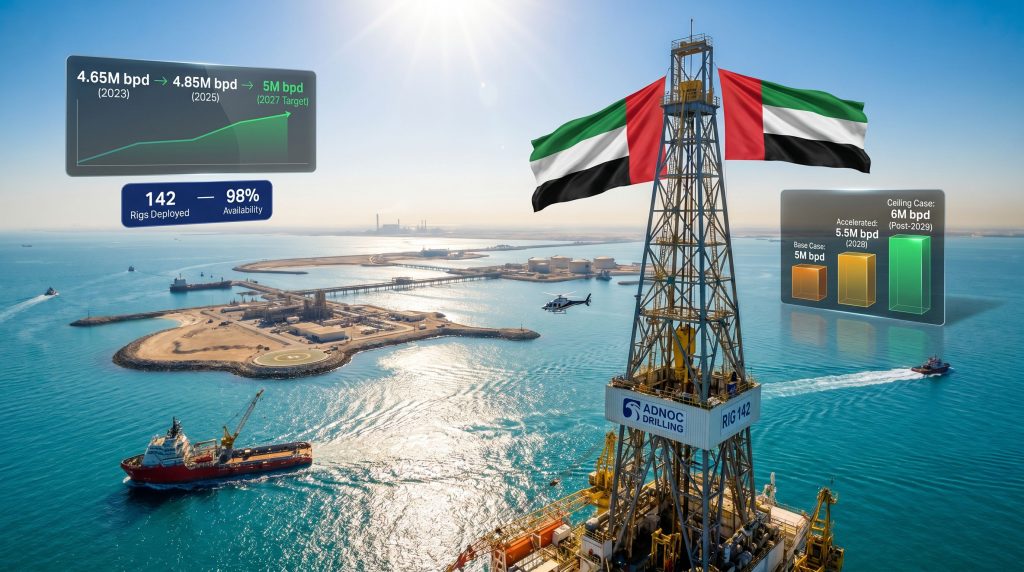
For investors and analysts tracking the UAE's progress, these distinctions matter enormously. OPEC+ quota allocations historically anchored UAE production at approximately 3.5 million bpd — a figure that bore little relationship to the country's actual installed capacity, which had already reached approximately 4.65 million bpd by the end of 2023 and climbed to roughly 4.85 million bpd by mid-2025. The 5 million bpd target, originally scheduled for 2027, represents the next sustainable threshold, not a theoretical ceiling. Furthermore, understanding crude oil price trends helps contextualise why the UAE is pushing to maximise output now.
The Fields Driving Incremental Gains
Two offshore development programs are central to bridging the gap between current output and the 5 million bpd milestone:
-
Satah Al Razboot (SARB): This offshore field has undergone significant capacity enhancement, with infrastructure upgrades delivering a 25% uplift in productive capacity toward 140,000 barrels per day, supported by advanced reservoir management techniques.
-
Upper Zakum: One of the world's largest offshore oil fields, Upper Zakum operates through a network of artificial islands that serve as drilling and well-intervention platforms. This island-based infrastructure enables sustained well servicing operations without conventional floating rig dependency, making the field particularly well-suited to rigless services expansion.
Rigless services — a term covering well intervention techniques such as coiled tubing operations, wireline services, and workover programs conducted without mobilising a full drilling rig — are critical to cost-efficient brownfield optimisation. In mature offshore environments like Upper Zakum, these services can restore and enhance well productivity at a fraction of the capital intensity required for new well drilling, making them disproportionately valuable in the context of incremental capacity additions.
Rig Deployment as a Forward Indicator
Perhaps the most concrete evidence that ADNOC Drilling's capacity ambitions are grounded in physical reality rather than policy aspiration is the pace of rig deployment. According to Reuters reporting, ADNOC Drilling's CFO Youssef Salem confirmed that the company reached 142 deployed rigs by 2025, substantially ahead of a previous target of 127 rigs by 2030. This represents not a marginal acceleration but a structural compression of the deployment timeline by more than five years.
| Metric | Previous Target | Status as of 2025 | Strategic Implication |
|---|---|---|---|
| Deployed Rigs | 127 by 2030 | 142 by 2025 | 5+ years ahead of schedule |
| Rig Availability Rate | Baseline | 98% in Q1 2026 | Near-zero operational downtime |
| Unconventional Wells Completed | Pilot phase | ~100 first-phase wells | Commercial-scale proof of concept |
| Hydraulically Fractured Wells | Early development | 60+ completed | Unconventional viability confirmed |
The 98% rig availability rate recorded in Q1 2026 deserves particular attention. Maintaining near-perfect operational continuity during a period of active regional tension in the Gulf speaks to supply chain engineering of considerable sophistication, not fortunate timing.
Operational Resilience: How ADNOC Drilling Insulates Capacity Growth
The Strait of Hormuz Risk Calculus
For any Gulf-based energy operator, the Strait of Hormuz represents an existential logistical vulnerability. Approximately 20% of global oil supplies transit the strait, and any significant disruption creates immediate operational and commercial consequences for producers dependent on that route. ADNOC Drilling has spent years engineering around this vulnerability through a three-layer logistics model:
-
Land-based routing for equipment and materials that bypasses maritime chokepoints entirely.
-
Port of Fujairah on the UAE's east coast, which faces the Indian Ocean rather than the Persian Gulf, providing a maritime alternative that avoids strait dependency.
-
A two-to-three-month inventory buffer of critical materials and equipment pre-positioned to absorb supply chain disruptions without operational interruption.
The validation of this approach came during Q1 2026, when Youssef Salem confirmed to Reuters that operations were entirely unaffected by regional events, with 98% of the rig fleet maintained at full availability throughout the period. This is not a trivial achievement. It reflects years of deliberate strategic investment in supply chain redundancy and demonstrates that ADNOC Drilling's capacity commitments carry genuine operational credibility.
"For investors and international offtake partners evaluating UAE production risk, the combination of Fujairah bypass routing, land-based logistics, and forward inventory positioning fundamentally changes the risk calculus associated with Gulf-origin production. Supply reliability, historically discounted by a geopolitical risk premium, is increasingly becoming a commercial differentiator."
Multi-Vendor Technology Architecture
Equally deliberate is ADNOC Drilling's approach to technology and equipment sourcing. Rather than concentrating critical capability within a single vendor relationship, the company has built redundant technical partnerships spanning multiple jurisdictions and service providers. Salem confirmed relationships spanning rig suppliers from China and international markets alongside technology partnerships with Baker Hughes, SLB (formerly Schlumberger), Patterson, and others.
This multi-source strategy serves two functions simultaneously. It insulates operations from single-vendor supply constraints, and it ensures access to best-in-class technologies across different service categories rather than being locked into one provider's portfolio. In the context of rapid scaling toward and potentially beyond 5 million bpd, this flexibility is structurally important.
Three Scenarios for UAE Production Capacity Through 2030
Modelling the Pathway from 5 to 6 Million bpd
Note: The following scenarios represent analytical projections based on publicly reported operational data and stated strategic objectives. They are not forecasts or investment advice. Actual production outcomes will depend on market conditions, technical execution, and sovereign decision-making.
Scenario 1 — Base Case: 5 Million bpd Sustained
The 5 million bpd target, originally anchored to a 2027 deadline, appears well-supported by current infrastructure deployment trajectories. Under this scenario, the UAE sustains output at the 5 million bpd threshold while unconventional projects move through Final Investment Decision (FID) and early production phases. The OPEC exit removes quota friction, allowing actual production to converge gradually toward installed capacity.
Scenario 2 — Accelerated Case: 5.5 Million bpd by 2028
This pathway requires FIDs on both the unconventional gas project (developed with TotalEnergies) and the unconventional oil project (with EOG Resources and Petronas) to proceed in 2026, with early production contributions materialising by 2027–2028. Infill drilling programs in existing offshore fields provide additional brownfield volumes, while technology transfer through international partnerships compresses well completion timelines.
Scenario 3 — Ceiling Case: 6 Million bpd Post-2029
UAE Energy Minister Suhail al-Mazrouei has publicly indicated that 6 million bpd is achievable if global market conditions justify the investment, according to Reuters reporting. This ceiling scenario requires sustained oil price support to underwrite the capital programs needed, full commercialisation of unconventional resources, and continued rig fleet expansion beyond current deployment levels. It also requires that global demand growth absorbs incremental Gulf supply without triggering prolonged price weakness.
| Scenario | Required Conditions | Primary Risk Factor |
|---|---|---|
| Base Case (5M bpd) | Current drilling pace maintained | Reservoir depletion in mature fields |
| Accelerated (5.5M bpd) | Unconventional FIDs completed in 2026 | Technology and cost overruns in hydraulic fracturing |
| Ceiling Case (6M bpd) | Sustained demand and price environment | Global demand plateau or energy transition acceleration |
The Unconventional Frontier: ADNOC's Next Production Growth Engine
Why Unconventional Resources Change the Long-Term Equation
Conventional reservoir development has inherent constraints tied to geology. As fields mature, natural production decline rates accelerate, and maintaining output requires progressively more intensive intervention. The UAE's conventional resource base, while substantial, faces the same fundamental physics affecting all ageing producing regions. Unconventional resources — shale-type formations requiring hydraulic fracturing to release hydrocarbons — represent a structurally different production profile with different decline characteristics.
ADNOC is advancing two flagship unconventional programs simultaneously, and ADNOC's unconventional gas plans are particularly central to this growth strategy:
-
Unconventional Gas Project with TotalEnergies: ADNOC Upstream CEO Musabbeh al-Kaabi confirmed to Reuters that the company expects a Final Investment Decision on this project in 2026, with approximately 100 first-phase wells already completed to validate the resource.
-
Unconventional Oil Project with EOG Resources and Petronas: A separate FID is expected to follow the gas project decision. Notably, EOG Resources' decision to join the program after reviewing initial results was characterised as a positive commercial signal, reflecting third-party technical confidence in the project economics.
The significance of EOG's participation deserves emphasis. EOG Resources built its identity as a pioneer of U.S. unconventional oil development, particularly in shale plays where technical complexity and capital discipline are essential. Its willingness to commit to UAE unconventional development after reviewing early-phase results carries implicit technical validation that extends beyond promotional statements.
Comparing UAE Unconventional Development to Global Benchmarks
The U.S. shale industry provides the most relevant reference point for unconventional development at scale. However, key differences in the UAE context create both advantages and unique challenges:
| Factor | U.S. Shale Model | UAE Unconventional Context |
|---|---|---|
| Capital Allocation | Market-driven, fragmented operators | State-directed, single sovereign sponsor |
| Existing Infrastructure | Built progressively over decades | Pipeline, processing, export terminals already in place |
| Political Risk | Low, stable regulatory environment | Low, strong sovereign commitment |
| Technical Track Record | Fully established | Early-stage, currently in validation |
| Decline Rates | High initial production, rapid decline | Under assessment through current well program |
The pre-existing infrastructure advantage is particularly significant and frequently underappreciated. U.S. shale development required enormous parallel investment in gathering systems, processing facilities, and export terminals alongside the wellbore drilling itself. The UAE's existing offshore and onshore infrastructure dramatically reduces the capital intensity of unconventional scale-up, potentially compressing development timelines relative to frontier unconventional markets.
Global Supply Implications of a Post-OPEC UAE
What 1.5 to 2.5 Million bpd of Incremental Supply Means for Markets
The arithmetic of the UAE's OPEC departure is straightforward, but its market implications are complex. Under OPEC+ quota arrangements, UAE output was anchored at approximately 3.5 million bpd despite installed capacity substantially exceeding that level. As capacity moves toward 5 million bpd and potentially 6 million bpd over the multi-year horizon, the incremental supply available to global markets grows by 1.5 to 2.5 million bpd relative to the former quota baseline.
This supply increment does not enter markets instantaneously. Production ramp-up tracks infrastructure deployment, which takes time. However, the trajectory is now unambiguously oriented toward capacity maximisation rather than quota compliance, which changes how markets should model UAE supply contributions through the 2030s. Consequently, the OPEC global market influence framework is being recalibrated as major Gulf producers reassert sovereign production priorities.
The competitive implications for other Gulf producers operating within remaining OPEC+ frameworks are material. Saudi Arabia's capacity position remains categorically different in scale, with Saudi Aramco's CEO having confirmed the ability to reach approximately 12 million bpd of production capacity within three weeks if directed, according to Reuters reporting. Furthermore, the oil market trade risks associated with shifting geopolitical alignments add another layer of uncertainty to how this incremental Gulf supply is absorbed globally.
| Producer | Current Capacity | Near-Term Target | Long-Term Ceiling |
|---|---|---|---|
| UAE (ADNOC) | ~4.85M bpd | 5M bpd (2027 target) | 6M bpd (post-2029, conditional) |
| Saudi Arabia (Aramco) | ~12M bpd | Maintained at ~12M bpd | 12M bpd on demand |
The next major ASX story will hit our subscribers first
Investment and Commercial Signals from ADNOC Drilling's Expansion
Reading Operational Milestones as Financial Indicators
For investors tracking ADNOC Drilling through its Abu Dhabi listing, the operational metrics now driving capacity expansion function simultaneously as leading indicators of financial performance. Rig deployment pace, well delivery growth rates, and utilisation rates all translate directly into contract revenue and earnings visibility. In addition, WTI and Brent futures provide a broader pricing context that shapes the commercial environment in which ADNOC Drilling is expanding.
The long-cycle nature of drilling contracts tied to multi-year capacity programs provides the kind of earnings predictability that differentiates ADNOC Drilling from more cyclically exposed oilfield services peers. When capacity targets are sovereign priorities backed by state capital allocation, contract continuity risk is fundamentally different from commercial drilling markets driven by private operator capex cycles.
Key metrics worth monitoring on a quarterly basis include:
-
Year-on-year growth in well delivery volumes, which signals program acceleration or deceleration.
-
Rig fleet availability rates, with the 98% Q1 2026 benchmark establishing a high operational standard against which future quarters will be measured.
-
Contract award pipeline for unconventional drilling, rigless services, and infill programs, which provides forward visibility into revenue growth.
-
FID timelines for the TotalEnergies and EOG/Petronas unconventional projects, which function as demand triggers for additional drilling capacity deployment.
Moreover, the US-China oil demand impact on global consumption trajectories remains a key variable in determining whether incremental UAE supply finds ready demand, or contributes to a more competitive pricing environment.
This article is intended for informational purposes only and does not constitute financial advice. Investments in energy sector equities involve significant risk, including commodity price volatility, geopolitical risk, and execution uncertainty. Past operational performance does not guarantee future financial outcomes. Readers should conduct independent due diligence before making any investment decisions.
Frequently Asked Questions: ADNOC Drilling and UAE Oil Capacity Beyond 5 Million bpd
What is ADNOC Drilling's current production infrastructure status?
As of 2025, ADNOC Drilling had deployed 142 rigs, significantly ahead of a prior target of 127 rigs by 2030. Quarterly well deliveries rose year-on-year in Q1 2026, and rig availability held at 98% throughout the quarter despite regional geopolitical tensions.
Why did the UAE leave OPEC in May 2026?
The UAE's departure from OPEC on May 1, 2026 was driven by the desire to remove production quota constraints that limited commercial deployment of its growing installed capacity. As a non-OPEC producer, the UAE can now align output decisions with sovereign economic and commercial objectives rather than cartel quota frameworks.
What is the 6 million bpd target and how credible is it?
UAE Energy Minister Suhail al-Mazrouei has indicated that 6 million bpd is achievable if global market conditions justify the investment, according to Reuters. This is a conditional ambition requiring successful unconventional resource commercialisation, sustained brownfield development, and continued rig fleet expansion. It is a stated strategic ceiling, not a firm commitment with a defined timeline.
How does ADNOC Drilling protect operations from Strait of Hormuz disruptions?
The company operates a three-layer logistics resilience model: land-based equipment routing, the east-coast Port of Fujairah as a maritime bypass terminal, and a two-to-three-month pre-positioned inventory buffer. This architecture maintained 98% rig availability throughout Q1 2026 despite active regional tensions.
What role do unconventional resources play in future UAE capacity growth?
Unconventional oil and gas projects with TotalEnergies, EOG Resources, and Petronas represent the next structural growth layer beyond conventional reservoir optimisation. With approximately 100 first-phase wells completed and more than 60 hydraulically fractured, these programs are advancing toward Final Investment Decisions expected in 2026 and represent a meaningful extension of the UAE's production growth runway beyond conventional depletion curves.
Want to Track the Next Major Energy Discovery Before the Market Does?
Discovery Alert's proprietary Discovery IQ model delivers real-time alerts on significant ASX mineral discoveries — cutting through complex data across 30+ commodities to surface actionable opportunities the moment they hit the exchange. Explore historic discoveries and their extraordinary returns to understand what's possible, then begin your 14-day free trial to position yourself ahead of the broader market.