May 18, 2026
The Infrastructure Turn: How Gulf Energy Exporters Are Rewiring Their Asia Strategy
For most of the past four decades, the relationship between Gulf oil producers and Asian energy importers operated on a relatively straightforward axis: hydrocarbons flowed east in exchange for capital flowing west. The architecture was transactional, cargo-based, and price-sensitive. What is unfolding now is something categorically different. Major Gulf national oil companies are no longer content to function purely as upstream suppliers.
They are embedding themselves into the storage networks, reserve systems, and supply chains of their most important customers, transforming commercial relationships into structural interdependencies that are far harder to unwind.
The ADNOC India energy storage and LNG agreements formalised in May 2026 represent one of the clearest expressions of this shift yet seen. Signed during Indian Prime Minister Narendra Modi's visit to the UAE and witnessed by UAE President Sheikh Mohamed bin Zayed Al Nahyan, these deals do not simply extend existing supply volumes. They reach into the physical infrastructure of India's energy security system, creating a partnership architecture that will shape Gulf-South Asia energy flows for decades.
When big ASX news breaks, our subscribers know first
India's Demand Trajectory and Why It Reorders Global Supply Priorities
Understanding why ADNOC has invested so heavily in deepening its India relationship requires appreciating just how exceptional India's energy demand growth profile is within the global landscape. India is widely recognised as one of the world's fastest-growing major energy consumers, with rising demand across crude oil, natural gas, and LPG driven by a confluence of structural forces: rapid urbanisation, accelerating industrial activity, a population surpassing 1.4 billion, and ambitious government targets to expand household energy access.
What distinguishes India from other large emerging markets is the breadth of its demand across multiple energy products simultaneously. While China's demand growth has moderated as its economy matures, India sits at an earlier and steeper point on the consumption curve. This dynamic has not gone unnoticed among Gulf producers, who increasingly view long-term supply relationships with Indian counterparts not merely as revenue streams but as strategic anchors for their own export market stability.
The UAE-India Comprehensive Economic Partnership Agreement (CEPA), which entered into force in 2022, provided the diplomatic and commercial framework that made deeper energy infrastructure cooperation structurally possible. By lowering trade barriers and establishing stronger institutional linkages between the two economies, CEPA created a runway for agreements that go well beyond conventional commodity supply contracts. Furthermore, India's supply security strategy has consistently prioritised diversifying both suppliers and storage geographies, making these arrangements a natural fit for its long-term policy goals.
Breaking Down the Two Core Collaboration Frameworks
The May 2026 agreements encompass two distinct but complementary arrangements, each targeting a different dimension of India's energy infrastructure needs.
Agreement One: ADNOC and Indian Strategic Petroleum Reserves Limited
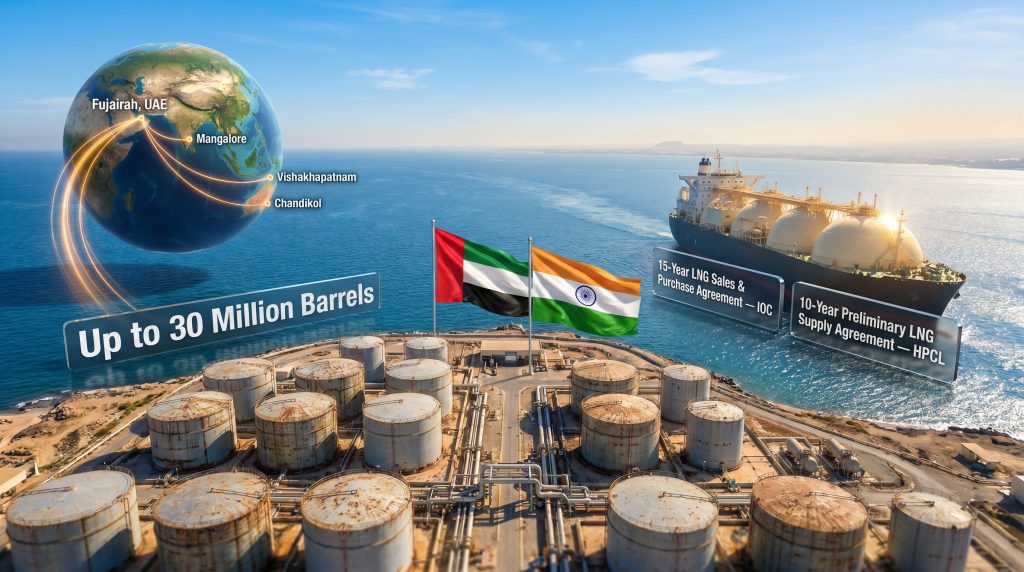
The first agreement, between ADNOC and Indian Strategic Petroleum Reserves Limited (ISPRL), targets the physical storage layer of India's energy security system. The scope is ambitious, covering crude oil, LNG, and LPG storage infrastructure with an evaluation of expanding ADNOC's crude storage footprint in India to as much as 30 million barrels.
The existing anchor for this arrangement is the Mangalore storage facility on India's southwestern coast, which already hosts ADNOC-linked crude reserves. The framework under evaluation would extend this presence to two additional prospective sites:
- Vishakhapatnam on India's eastern coast, a major port city with existing refinery and terminal infrastructure
- Chandikol in Odisha, a landlocked storage location that would add geographic diversification to India's reserve distribution
Perhaps the most strategically novel element is the cross-border dimension: discussions are underway regarding the possibility of storing crude oil at Fujairah in the UAE as a component of India's strategic petroleum reserve system. This would allow India to maintain accessible offshore reserves at one of the world's most important oil storage and transshipment hubs, positioned directly adjacent to major Gulf shipping routes.
| Storage Location | Status | Strategic Role |
|---|---|---|
| Mangalore, India | Existing ADNOC facility | Expansion under evaluation |
| Vishakhapatnam, India | Prospective new site | Under consideration |
| Chandikol, India | Prospective new site | Under consideration |
| Fujairah, UAE | Cross-border SPR linkage | Offshore India-linked reserve |
Agreement Two: ADNOC and Indian Oil Corporation
The second agreement, between ADNOC and Indian Oil Corporation (IOC), focuses on the LPG supply dimension. Built on an LPG term supply contract that has been in place since 2023, the expanded collaboration targets a formal long-term LPG sale and purchase agreement supported by ADNOC Global Trading, the commercial execution arm of the ADNOC group.
This matters for reasons that extend well beyond volume. LPG is not simply a commodity in the Indian context. It is the primary cooking fuel for hundreds of millions of Indian households, making supply continuity a politically and socially sensitive policy priority. Locking in long-term LPG supply arrangements with a reliable Gulf counterpart reduces India's exposure to spot market volatility and provides planners with greater certainty in the household energy access programmes the government has championed in recent years.
What Strategic Petroleum Reserves Actually Do, and Why the ADNOC Model Is Unusual
Strategic petroleum reserves are government-held emergency crude oil stockpiles designed to cushion the economy against supply disruptions. India's SPR programme, managed through ISPRL, currently operates underground rock cavern storage facilities at Vishakhapatnam, Mangalore, and Padur, with a combined capacity of approximately 5.33 million metric tonnes, or roughly 39 million barrels.
Most national SPR frameworks are funded and controlled entirely by the host government, with foreign producers playing no role in the storage infrastructure itself. What makes the ADNOC-ISPRL model structurally unusual is the integration of a foreign national oil company's storage capacity into the domestic reserve network. Under this arrangement, ADNOC retains commercial use of stored crude during non-emergency periods, while India benefits from expanded storage capacity it does not need to finance entirely itself.
This dual-benefit structure has precedent in arrangements between the International Energy Agency and certain member states, but it remains relatively rare in Asia. In addition, the LNG supply outlook for the region further reinforces the strategic logic of embedding supply security into physical infrastructure rather than relying solely on spot market procurement.
The concept of a producer nation holding reserves in the consumer nation's infrastructure inverts the traditional SPR logic. Rather than purely defensive stockpiling, it creates a shared commercial and strategic interest in maintaining supply chain integrity on both sides of the arrangement.
The cross-border Fujairah element takes this further still. Holding Indian SPR-linked reserves at Fujairah would give India rapid-access reserves positioned at a hub through which a substantial share of global oil trade already transits, reducing the risk that domestic storage capacity constraints could delay emergency drawdowns.
ADNOC's Broader India Relationship: A Timeline of Deepening Commitment
The May 2026 agreements do not emerge from a standing start. They layer additional infrastructure depth onto a relationship that has been methodically constructed over several years:
- 2023: ADNOC and IOC establish an LPG term supply contract, the commercial foundation for the expanded LPG arrangements now under negotiation
- Prior to 2026: ADNOC and IOC finalise a 15-year LNG sales and purchase agreement, cementing ADNOC's position as a long-term LNG supplier to India's largest oil and gas company
- Prior to 2026: ADNOC and Hindustan Petroleum Corporation Limited (HPCL) execute a 10-year preliminary LNG supply agreement, broadening the relationship beyond a single Indian counterpart
- May 2026: ADNOC and ISPRL sign the storage cooperation agreement; ADNOC and IOC sign the expanded LPG collaboration framework
This progression illustrates a deliberate strategic pattern. ADNOC has moved systematically from establishing supply volumes, to extending contract tenors, to embedding itself in physical infrastructure. The result is a web of contractual and operational interdependencies that substantially raises the cost of switching to alternative suppliers for Indian energy companies.
How the Gulf's Three Major Producers Are Competing for India's Long-Term Business
ADNOC is not the only Gulf producer pursuing deeper integration with Indian energy entities. Saudi Aramco and QatarEnergy have both pursued distinct but parallel strategies, creating a competitive dynamic that ultimately works in India's favour as a buyer with genuine leverage. Consequently, commodity trading giants are paying close attention to how these bilateral infrastructure arrangements reshape the competitive landscape for energy flows into South Asia.
| Counterparty | Key Indian Partners | Primary Focus | Differentiation Strategy |
|---|---|---|---|
| ADNOC (UAE) | ISPRL, IOC, HPCL | Crude storage, LNG, LPG | SPR infrastructure integration + multi-product long-term supply |
| Saudi Aramco | IOCL, BPCL, HPCL | Crude oil, refining | Equity participation in Indian refinery projects |
| QatarEnergy | Petronet LNG | LNG | Long-term LNG volume contracts |
What distinguishes ADNOC's approach is the combination of storage infrastructure co-investment with long-term supply contracts across multiple product categories. By positioning itself as a participant in India's physical reserve architecture rather than simply a cargo supplier, ADNOC is creating a form of structural lock-in that equity stakes in refineries cannot easily replicate. The storage relationship creates operational dependencies; the supply contracts create commercial ones. Together, they constitute a durable competitive moat.
The next major ASX story will hit our subscribers first
Fujairah's Strategic Geography and Why It Changes the Calculus
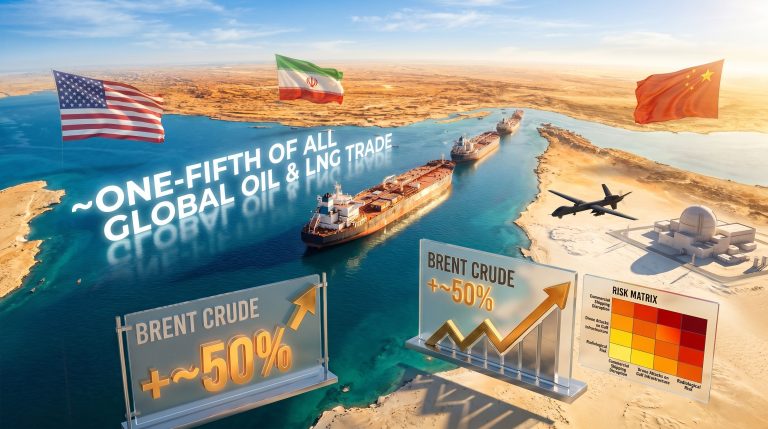
Fujairah occupies a unique position in the global energy system. Located on the UAE's eastern coastline, it sits outside the Strait of Hormuz, meaning vessels loading at Fujairah can access open ocean routes without transiting the strait that handles roughly 20% of global oil trade. The Fujairah terminal complex is one of the largest oil storage hubs in the world, with tank storage capacity exceeding 14 million cubic metres across commercial and strategic facilities.
For India, maintaining a portion of its strategic reserves at Fujairah would serve multiple purposes simultaneously:
- Reducing the proportion of India's emergency crude that is physically held onshore and therefore vulnerable to domestic infrastructure disruptions
- Positioning reserves at a hub directly accessible to the global tanker fleet, enabling rapid drawdown and delivery
- Creating a financial arrangement in which ADNOC's commercial use of the stored barrels during normal periods helps offset storage costs for India
The geopolitical dimension is also worth noting. India's supply security strategy has long emphasised supplier diversification, but diversification of storage geography is an equally valid instrument. Maintaining reserves across multiple jurisdictions reduces single-point vulnerability, even if the political risk of offshore reserves in a partner nation's territory introduces its own set of considerations.
The Shipping Risk Context: Why 2025-2026 Accelerated Infrastructure Thinking
The timing of these agreements is not coincidental. The 2024-2026 period saw sustained disruption to key maritime corridors, with tensions in the Red Sea significantly affecting the economics and reliability of energy shipments between the Gulf and Asian markets. Insurance costs surged, voyage times lengthened as vessels rerouted around southern Africa, and the unpredictability of delivery windows created planning headaches for refiners and utilities.
In this environment, the logic of pre-positioning crude and LNG reserves closer to end-markets shifted from a theoretical risk management concept to an operational priority. Long-term bilateral storage agreements of the kind ADNOC and ISPRL are pursuing directly address this vulnerability by ensuring that India's emergency and near-term operational reserves are held onshore, reducing the dependency on uninterrupted maritime supply in any given period. Furthermore, movements in global oil benchmarks during periods of shipping disruption have consistently demonstrated the price premium that supply uncertainty introduces into spot markets.
The Diplomatic Architecture: Why State Witnessing Elevates Commercial Agreements
When major commercial agreements are exchanged during a head-of-government visit and witnessed by a head of state, the diplomatic signal is deliberate and meaningful. It signals that the agreement carries political commitment at the highest level, making it substantially more durable than a purely commercial contract that might be renegotiated under changed market conditions.
The pattern of UAE-India high-level engagement has intensified markedly since CEPA came into force in 2022, with energy cooperation serving as both a practical deliverable and a symbolic expression of the bilateral relationship's depth. As reported by Arabian Business, these agreements signal a new chapter in the strategic energy partnership between the two nations. For ADNOC, operating as an instrument of Abu Dhabi's economic statecraft as well as a commercial enterprise, agreements witnessed at this level carry a form of institutional endorsement that reinforces their strategic weight.
Key Metrics at a Glance
| Metric | Detail |
|---|---|
| Target crude storage capacity (India) | Up to 30 million barrels |
| Existing storage anchor | Mangalore, India |
| Prospective new storage sites | Vishakhapatnam, Chandikol |
| Cross-border storage location | Fujairah, UAE |
| LPG supply agreement foundation | IOC term contract since 2023 |
| Prior LNG agreement (IOC) | 15-year sales and purchase agreement |
| Prior LNG agreement (HPCL) | 10-year preliminary supply agreement |
| CEPA entry into force | 2022 |
| Agreement announcement date | May 15, 2026 |
The Longer Arc: Infrastructure Deals as the New Template for Energy Security
Perhaps the most significant implication of the ADNOC India energy storage and LNG agreements is what they signal about the direction of global energy trade more broadly. The era of spot-market dependency as a primary procurement strategy for energy-importing nations appears to be giving way to a preference for long-term bilateral arrangements that embed supply security into physical infrastructure. However, the India LNG import tax structure will also play a meaningful role in determining how commercially attractive these long-term arrangements ultimately prove for Indian counterparties.
This shift reflects a hard-learned lesson from the energy market volatility of the early 2020s: price optimisation through flexible spot purchasing comes with supply security costs that are not always visible until a disruption occurs. Long-term bilateral frameworks with infrastructure components redistribute that risk, trading some price flexibility for substantially greater supply certainty. The National News notes that these arrangements reflect a broader Gulf producer trend of deepening physical and commercial ties with Asian demand centres.
For Gulf producers, this trend is equally attractive. Embedding storage capacity and long-term supply contracts into key consumer markets creates revenue predictability, protects market share against competition from emerging LNG exporters in North America and East Africa, and builds diplomatic capital that serves broader national interests. The ADNOC India energy storage and LNG agreements, consequently, may well prove to be an early template that other producer-consumer pairs seek to replicate in the years ahead.
Disclaimer: This article is intended for informational purposes only and does not constitute financial or investment advice. Projections, forward-looking statements, and assessments of future energy market dynamics involve inherent uncertainty and should not be relied upon as the basis for investment decisions.
Want to Stay Ahead of the Resource Discoveries Reshaping Global Energy Markets?
As Gulf producers and Asian energy importers forge deeper infrastructure ties, the flow-on effects for mineral and resource exploration are significant — and Discovery Alert's proprietary Discovery IQ model scans ASX announcements in real time, instantly identifying high-potential mineral discoveries across more than 30 commodities before the broader market catches on. Explore historic discovery returns on Discovery Alert's discoveries page and begin your 14-day free trial to position yourself at the forefront of the next major find.