May 18, 2026
The World's Most Expensive Bottleneck: Inside the US-Iran Hormuz Deadlock
Energy markets operate on a principle of systemic vulnerability: a single geographic constraint, if disrupted long enough, can reprice every barrel of oil, every LNG cargo, and every inflation forecast on the planet simultaneously. No chokepoint illustrates this principle more starkly than the Strait of Hormuz, and no geopolitical impasse has tested it more severely than the ongoing standoff that makes a US Iran Hormuz deal so critically urgent for global stability.
When big ASX news breaks, our subscribers know first
Why 33 Kilometres Holds the Global Economy Hostage
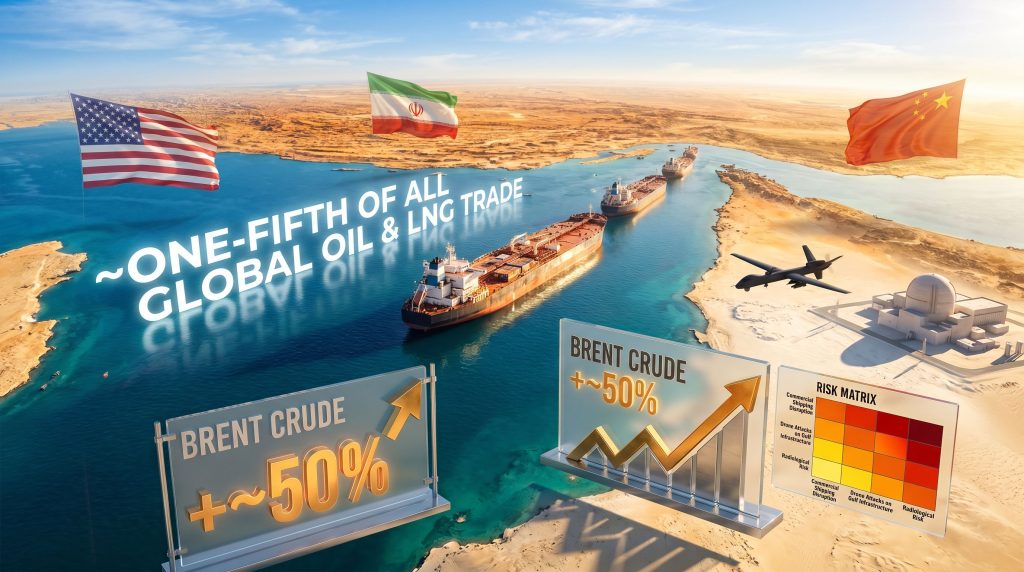
The Strait of Hormuz is the world's most consequential stretch of navigable water. At its narrowest, it measures roughly 33 kilometres across, yet it serves as the primary export corridor for approximately one-fifth of all global oil and LNG trade. Persian Gulf producers including Saudi Arabia, Iraq, Kuwait, the UAE, and Iran itself depend on this passage to deliver energy to markets across Asia, Europe, and beyond.
The volume of commodities transiting Hormuz is staggering in economic terms:
| Commodity | Estimated Share of Global Trade via Hormuz |
|---|---|
| Crude Oil | ~17-20% of global supply |
| Liquefied Natural Gas (LNG) | ~25-30% of global LNG exports |
| Refined Petroleum Products | Significant regional volumes |
| Combined Energy Value | Trillions of USD annually |
Note: Figures represent pre-conflict baseline estimates based on historical shipping data. Current flows are materially reduced from these levels.
What makes Hormuz uniquely dangerous as a chokepoint is not merely the volume it carries, but the absence of fully scalable alternatives. While Saudi Arabia operates the East-West Pipeline and the UAE has the Abu Dhabi Crude Oil Pipeline as partial bypass routes, neither has the capacity to replace full Hormuz throughput.
The gap between what these alternatives can move and what Hormuz normally handles represents a structural supply ceiling that cannot be rapidly expanded, regardless of investment or political will. Furthermore, crude oil price trends have reflected this vulnerability consistently over recent months, with sustained upward pressure directly attributable to Hormuz uncertainty.
"When Hormuz is disrupted, the economic consequences are not confined to the Persian Gulf. Fuel prices, inflation trajectories, and central bank policy decisions in economies thousands of kilometres away are materially affected within days of sustained disruption."
Four Structural Walls Blocking the US-Iran Hormuz Deal
The current diplomatic deadlock between the United States and Iran is not the result of a single policy disagreement. It reflects the accumulation of compounding failures across multiple administrations, each of which has left a layer of unresolved tension. Understanding what is actually blocking a US Iran Hormuz deal requires examining four distinct and self-reinforcing structural barriers.
1. Nuclear Enrichment Sovereignty
Iran has signalled conditional willingness to cap uranium enrichment at agreed levels and to export highly enriched stockpiles under a supervised framework. What Tehran categorically rejects is any demand to dismantle its domestic enrichment infrastructure or surrender its sovereign right to enrich uranium on Iranian soil.
This is not merely a technical dispute — it is a foundational question of national identity and regime legitimacy within Iran's domestic political framework. Consequently, questions of nuclear energy geopolitics have become increasingly intertwined with the broader negotiating calculus.
2. Sanctions Relief Sequencing
The sequencing question is deceptively simple but diplomatically toxic. Iran insists on verifiable, front-loaded sanctions relief before making substantive concessions. Washington has historically demanded demonstrated Iranian compliance before delivering relief.
Neither side trusts the other to honour commitments made in advance, creating a classic verification deadlock that has defeated multiple prior negotiating frameworks. Iranian Foreign Minister remarks following recent talks in Russia reinforced that this sequencing dispute remains firmly unresolved.
3. Maritime Security Architecture
Iranian restrictions on commercial shipping and ongoing US naval operations near Iranian ports have created a self-reinforcing escalation cycle. Each side's security posture provides justification for the other's countermeasures, making any maritime transit agreement contingent on resolving the broader political relationship first.
4. Post-Conflict Political Conditions
Broader demands tied to Iran's regional posture, its proxy network relationships across the Middle East, and the shape of any postwar political settlement represent the most contested dimension of current negotiations. Iranian state-affiliated media has reported that these conditions remain firmly unresolved. In addition, the US-China trade war has further complicated the diplomatic environment surrounding these talks.
What the Oil Price Is Actually Telling Investors
Brent crude has risen approximately 50% since the onset of the current conflict. This is not simply a supply-disruption response — it is a structured risk premium that traders have embedded into pricing to reflect sustained uncertainty about Hormuz's operational status.
"Oil markets are not pricing in a resolution. They are pricing in a protracted stalemate. A 50% price increase does not reflect what traders think will happen tomorrow — it reflects what they believe the distribution of possible outcomes looks like over the next 12 to 24 months."
The inflation transmission mechanism from a sustained Hormuz restriction operates across multiple economic channels simultaneously:
| Economic Channel | Impact Pathway |
|---|---|
| Consumer fuel prices | Direct pass-through at the pump within days of price moves |
| Freight and logistics | War-risk insurance premiums elevating shipping costs globally |
| LNG spot markets | Supply tightness driving European and Asian energy costs higher |
| Central bank policy | Energy-driven inflation complicating rate-cut timing decisions |
| US domestic politics | Elevated pump prices increasing midterm election pressure on the White House |
Partial vessel traffic has cautiously resumed in recent weeks, with Iranian authorities reportedly working toward a controlled transit framework for selected commercial shipping. However, analysts note several important caveats:
- Selective transit permissions function as a negotiating instrument rather than a genuine concession toward normalisation.
- Traffic volumes remain materially below pre-conflict baselines, meaning the supply disruption premium in oil prices has not meaningfully dissipated.
- War-risk insurance premiums continue to deter many commercial operators from committing vessels to Hormuz routes, creating a de facto restriction even when formal permission exists.
The China Variable: Why Beijing May Hold the Key
No analysis of the US Iran Hormuz deal landscape is complete without examining Beijing's structural role. China is Iran's largest crude oil customer, absorbing a substantial portion of Iranian export revenue that sanctions have redirected away from Western buyers. This creates a three-way dynamic that fundamentally complicates bilateral US-Iran diplomacy.
From Beijing's perspective, the strategic calculus is layered:
- Maintaining Iranian oil flows serves China's energy security interests directly.
- Opposing US sanctions on Chinese buyers of Iranian crude is consistent with Beijing's broader resistance to extraterritorial US economic enforcement.
- A prolonged Hormuz disruption simultaneously hurts China by restricting the flow of Gulf oil it purchases from multiple producers, not just Iran.
This complexity created a rare point of partial US-China alignment. A White House readout confirmed that Chinese leadership acknowledged the Strait of Hormuz must remain open for global commerce — a position that represents unusual convergence with Washington's stated objectives. Furthermore, the oil market trade risks associated with deteriorating US-China relations add another layer of complexity to this trilateral dynamic.
President Trump confirmed he discussed potential sanctions against Chinese companies purchasing Iranian crude during meetings with President Xi Jinping, adding that a decision on sanctions relief was expected within days. The implications of that decision branch sharply:
- Sanctioning Chinese buyers would reduce Iranian oil revenues and intensify economic pressure on Tehran, potentially improving Washington's negotiating leverage.
- However, such a move risks triggering retaliatory economic measures from Beijing at a particularly fragile moment in US-China trade relations.
- Chinese purchases represent a structurally significant share of Iranian export revenue, meaning any disruption to that flow would have measurable consequences for global oil supply volumes.
"The Hormuz crisis has inadvertently created a diplomatic opening where US and Chinese interests partially converge on the question of open maritime transit. Whether that convergence can be translated into coordinated diplomatic pressure on Tehran remains one of the most consequential open questions in global energy geopolitics."
The Barakah Drone Strike: A Qualitative Shift in Regional Risk
A drone attack that caused a fire at an electrical generator near the Barakah nuclear power plant in the UAE represents a meaningful escalation in the regional security environment that extends well beyond the Hormuz shipping lane itself. Two additional drones were intercepted before reaching the facility.
Authorities confirmed no injuries occurred, no radiological risk was present, and the International Atomic Energy Agency verified that radiation levels remained normal throughout. Despite the absence of catastrophic consequences, the incident carries strategic significance that the headline numbers alone do not capture. BBC reporting on the wider regional escalation has highlighted how incidents like this are reshaping the security calculus across Gulf states.
- The Barakah plant is the Arab world's first operational nuclear power station, making any attack in its vicinity diplomatically explosive regardless of physical damage caused.
- The incident confirms that Gulf infrastructure, including civilian nuclear facilities, now sits within the operational targeting range of hostile drone campaigns active in the region.
- The conflict's geographic perimeter has demonstrably expanded beyond the Strait of Hormuz itself, raising the ceiling on potential escalation scenarios.
Gulf Security Risk Matrix
| Risk Category | Current Status | Escalation Potential |
|---|---|---|
| Commercial shipping disruption | Ongoing, partial resumption | High |
| Drone attacks on Gulf infrastructure | Active | Medium-High |
| Radiological risk from nuclear facility proximity | Low (confirmed) | Extreme if escalated |
| Regional proxy conflict expansion | Elevated | High |
| US-Iran direct military confrontation | Contained | Medium |
The next major ASX story will hit our subscribers first
Why Coercive Pressure Alone Cannot Reopen Hormuz
A critically underappreciated dimension of the current impasse is the structural limitation of military pressure as a negotiating instrument in this specific geographic and political context. Iran retains a formidable asymmetric military toolkit that makes conventional force a poor solution to what is fundamentally a political problem:
- Naval mining capabilities that can rapidly restrict vessel transit through narrow passages.
- Anti-ship missile systems with sufficient range to threaten commercial and naval vessels throughout the Gulf.
- Drone warfare infrastructure that has demonstrably been deployed against regional targets, including infrastructure far beyond the strait itself.
- Proxy network activation across multiple regional theatres that can expand conflict costs well beyond the Persian Gulf.
Energy security analysts broadly agree that any kinetic approach to reopening Hormuz carries escalation risks that would likely produce a more severe and prolonged supply disruption than the current partial restriction. Former nuclear negotiators with direct experience of US-Iran diplomacy have consistently emphasised that durable reopening of the strait is structurally dependent on a negotiated political settlement, not a unilateral enforcement action.
This assessment is analytical in nature and reflects the consensus view among publicly available independent analysis. It does not constitute investment advice.
What a Viable US-Iran Hormuz Deal Would Actually Require
Analysts studying the structural requirements of a durable Hormuz reopening agreement have identified a minimum viable framework. In addition, the the global LNG supply outlook underscores how urgently markets require a resolution to these transit uncertainties. Any successful deal would need to address:
- A phased sanctions relief schedule with clearly defined, verifiable triggers linked to Iranian nuclear compliance benchmarks at each stage.
- A maritime transit protocol establishing internationally monitored safe-passage corridors for commercial shipping, likely requiring neutral third-party verification.
- Uranium stockpile management covering agreed enrichment caps and supervised export arrangements for excess highly enriched material.
- Chinese participation as a diplomatic guarantor or monitoring party, given Beijing's direct economic stake in Iranian oil flows and its unique leverage with Tehran.
- A regional security framework addressing the legitimate security concerns of Gulf states, particularly the UAE and Saudi Arabia, whose infrastructure has now been directly targeted.
Scenario Modelling: Three Pathways Forward
Scenario A: Phased Diplomatic Settlement (12-24 months)
Moderate probability. Gradual Hormuz reopening tied to nuclear compliance milestones produces a 20-30% retreat in Brent crude from peak levels. Key catalyst: US-China diplomatic alignment unlocks Iranian flexibility on enrichment caps.
Scenario B: Prolonged Stalemate (2+ years)
Currently the highest probability scenario as priced by energy markets. Sustained elevated oil prices accelerate investment in alternative transit infrastructure and strategic petroleum reserve drawdowns globally. Key obstacle: Failure to resolve the sanctions sequencing dispute.
Scenario C: Escalatory Breakdown
Lower probability but non-trivial. A military incident triggers retaliatory full closure of the strait, producing a Brent crude spike beyond current elevated levels and materially elevating global recession risk. Key trigger: Miscalculation during a naval confrontation or infrastructure attack.
Scenario projections are speculative and represent analytical frameworks only. They are not investment recommendations. Energy markets are subject to rapid change based on geopolitical developments that cannot be reliably forecast.
Long-Term Structural Consequences: Rewiring Global Energy Logistics
A prolonged Hormuz restriction would not function as a temporary supply shock that normalises once diplomacy succeeds. It would catalyse structural changes to global energy infrastructure with consequences lasting decades:
- Alternative pipeline investment would accelerate across the Gulf, with Saudi Arabia's East-West Pipeline and the UAE's Abu Dhabi Crude Oil Pipeline becoming priority expansion targets.
- Strategic petroleum reserve policy would face fundamental reassessment across major consuming nations, with pressure to expand both reserve capacity and supply relationship diversification.
- LNG market restructuring would accelerate as Asian importers fast-track long-term contract diversification away from Gulf-dependent supply chains toward Australian, American, and East African sources.
- Maritime insurance reform would become unavoidable if war-risk premiums remain structurally elevated, forcing changes to how shipping insurance is priced, structured, and backed at the global level.
The deeper implication is that the longer a US Iran Hormuz deal remains elusive, the more permanently the world's energy logistics architecture adapts to its absence — potentially reducing the economic significance of any eventual agreement precisely because the market will have already partially rerouted around the constraint.
Frequently Asked Questions: US-Iran Hormuz Deal
What is the Strait of Hormuz and why does it matter so much?
The Strait of Hormuz is a narrow maritime passage linking the Persian Gulf to the Arabian Sea. It serves as the primary export corridor for roughly one-fifth of global oil and LNG trade, making it the single most strategically significant energy chokepoint on Earth. Any sustained disruption directly impacts fuel prices, inflation rates, and energy security across the global economy.
What are the main obstacles blocking a US-Iran Hormuz deal?
The four primary barriers are: disagreements over sanctions relief sequencing, Iran's refusal to dismantle domestic nuclear enrichment infrastructure, unresolved maritime security arrangements, and contested post-conflict political conditions. Each barrier is structurally complex and has resisted resolution across multiple rounds of diplomacy. Reuters reporting on recent Iranian proposals confirms that significant gaps remain despite ongoing back-channel engagement.
How much have oil prices risen due to the Hormuz crisis?
Brent crude has risen approximately 50% since the onset of the current conflict, reflecting both actual supply disruption and a sustained risk premium embedded by energy traders anticipating prolonged uncertainty.
What role does China play in the Hormuz negotiations?
China is Iran's largest crude oil customer and has opposed US sanctions targeting Chinese buyers of Iranian oil. Beijing has acknowledged that the Strait of Hormuz must remain open, creating a partial alignment with Washington's position. Chinese participation as a diplomatic guarantor is considered by many analysts to be among the most viable catalysts for unlocking Iranian negotiating flexibility.
Could military action reopen the Strait of Hormuz?
The broad analytical consensus is that military force alone cannot reliably or durably reopen Hormuz. Iran's asymmetric capabilities create escalation risks that make kinetic solutions likely to produce worse supply outcomes than the current partial restriction. A negotiated political settlement is considered the most viable path to durable normalisation.
What is Iran's current position on nuclear enrichment?
Iran has signalled conditional willingness to cap enrichment levels and export highly enriched stockpiles under a supervised framework. However, Tehran has firmly rejected demands to dismantle its domestic enrichment infrastructure or abandon the sovereign right to enrich on Iranian soil — positions that remain core obstacles to any comprehensive agreement.
Want to Stay Ahead of the Commodity Shifts Driving the Next Major ASX Discovery?
Geopolitical flashpoints like the Hormuz deadlock ripple directly through commodity markets — and the most significant mineral discoveries on the ASX often emerge precisely when market conditions are most volatile. Discovery Alert's proprietary Discovery IQ model delivers real-time alerts the moment significant ASX mineral discoveries are announced, transforming complex market signals into actionable investment opportunities — begin your 14-day free trial today, or explore Discovery Alert's discoveries page to see how historic finds have generated extraordinary returns for early movers.