August 5, 2026
The Anatomy of a Global Energy Chokepoint: Why Every Tanker Counts
Global energy markets are built on assumptions of continuity. Decades of infrastructure investment, long-term supply contracts, and pricing frameworks all presuppose that hydrocarbons can move freely from extraction point to end user. When that assumption breaks down at a single geographic location, the consequences ripple across every benchmark, every contract, and every import-dependent economy on the planet. The Strait of Hormuz is precisely that kind of single-point vulnerability, and the confirmed transit of an ADNOC LNG tanker Strait of Hormuz crossing in late April 2026 has forced markets to reassess just how fragile, or perhaps how resilient, that assumption actually is.
When big ASX news breaks, our subscribers know first
Why the Strait of Hormuz Functions as the World's Energy Pressure Valve
Understanding the significance of the ADNOC LNG tanker Strait of Hormuz crossing requires first appreciating the sheer scale of what moves through this narrow passage on any given day. Approximately 20 to 21% of global petroleum liquids transit the strait annually, along with a substantial share of the world's liquefied natural gas exports. The physical geography is sobering: at its narrowest point, the strait measures just 33 kilometres across, with navigable shipping lanes of only 3 kilometres in each direction. These are not wide corridors with redundancy built in. They are precision channels through which the fuel security of dozens of nations passes daily.
For Gulf-based LNG producers, Hormuz is not one route among many. It is the only viable route. Unlike crude oil, which has at least partial bypass infrastructure in the form of the Fujairah terminal and the East-West Pipeline network across Saudi Arabia, LNG has no comparable alternative routing from Gulf production facilities. There are no overland LNG pipelines. There are no alternative deepwater channels. If Hormuz closes to loaded LNG tankers, Gulf LNG simply stops moving. The LNG supply outlook for 2025 and beyond had already incorporated a degree of geopolitical risk, but the February 2026 escalation exposed the limits of that modelling.
Iran's geographic position along the strait's northern shoreline gives it significant asymmetric leverage over commercial shipping. This is not a theoretical risk that energy planners occasionally model. It is a structural vulnerability that has shaped Gulf energy geopolitics for decades, and which became an acute operational reality when conflict broke out in late February 2026. Furthermore, the broader geopolitical landscape affecting metals and mining had already signalled intensifying instability across resource-dependent corridors well before the conflict commenced.
Reconstructing the Timeline: Eight Weeks of Disruption
The sequence of events from late February through late April 2026 illustrates how rapidly a theoretical chokepoint risk can translate into measurable supply disruption:
| Period | Development | Market Significance |
|---|---|---|
| February 28, 2026 | Iran war commences; loaded LNG tanker transits cease | Immediate spot price spike across LNG benchmarks |
| March 30, 2026 | ADNOC-managed vessel last tracked in the Gulf | AIS signal goes dark; supply uncertainty escalates |
| Early April | Empty Omani LNG tanker crosses successfully | Ballast crossing only; no cargo significance |
| Mid-April | Two Qatari loaded tanker attempts both fail | Market concern deepens; Qatar supply locked out |
| April 24 | Two Iranian oil tankers transit carrying approximately 4 million barrels | Suggests enforcement inconsistency |
| April 27 | Eight vessel crossings recorded across vessel types | Non-LNG corridor beginning to see activity |
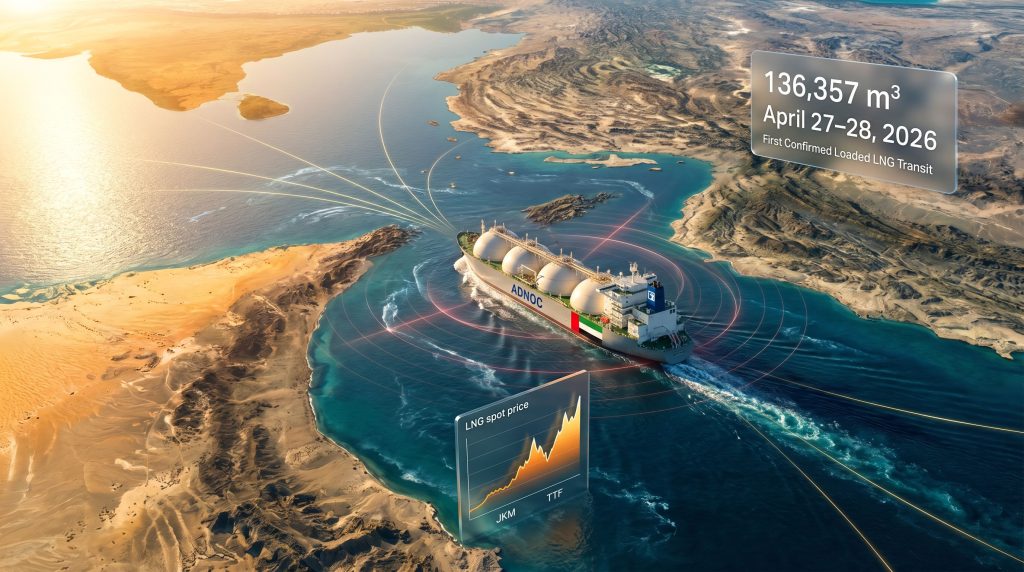
| April 27-28 | ADNOC-managed vessel reappears off India's west coast | First probable loaded LNG crossing since conflict began |
The distinction that matters most in this timeline is not how many vessels crossed, but what type of cargo they were carrying. An empty ballast crossing carries no commercial consequence whatsoever. A loaded LNG crossing of 136,357 cubic metres of liquefied natural gas represents a meaningfully different signal for global supply chains. According to Reuters reporting on the ADNOC transit, the vessel's reappearance was the first of its kind since the outbreak of hostilities.
What the Ship-Tracking Data Actually Tells Us
The vessel involved is managed by ADNOC Logistics and Services, the maritime and logistics subsidiary of Abu Dhabi National Oil Company. Its reappearance off India's west coast was captured simultaneously by three independent maritime intelligence platforms: ICIS LNG Edge, MarineTraffic, and LSEG. The convergence of data across three separate tracking systems is analytically significant because it substantially reduces the likelihood of a single-source error.
Senior LNG market analysts reviewing the position data noted that the vessel's indicated coordinates did not display the obvious hallmarks of AIS manipulation. Specifically, analysts assessed the data against three known categories of signal unreliability:
- AIS spoofing – broadcasting false coordinates to mask actual location, commonly used to circumvent sanctions or evade detection in conflict zones
- MMSI duplication – using another vessel's maritime identity number to create a false position signature in tracking databases
- Signal noise and data gaps – legitimate positional errors arising from satellite coverage limitations in certain geographic areas
None of these anomaly patterns were immediately evident in the reported position data. That said, analysts were careful to note that the absence of obvious manipulation indicators is not the same as confirmed transit. Official acknowledgment from ADNOC remained outstanding at the time of reporting, and the practical reality of the situation is that a single data point, however credible, does not establish a pattern.
The distinction between a hopeful early signal and structural normalisation of transit conditions is precisely the interpretive gap that markets must navigate carefully. One crossing raises probability estimates. It does not reset them.
The Loaded vs. Ballast Problem: Why Cargo Status Is Everything
One of the less widely understood aspects of LNG tanker transit analysis is how dramatically the risk calculus differs between a loaded vessel and one travelling in ballast. An empty tanker represents minimal financial exposure for the operator and insurer. A loaded vessel carrying over 136,000 cubic metres of LNG represents significant cargo value, insurance liability, and delivery obligation pressure.
This is why the failed Qatari loaded tanker attempts in April carry such analytical weight. Qatar is the world's largest LNG exporter, with annual export volumes in the range of 77 to 80 million tonnes per annum. The inability of Qatari vessels to successfully complete a loaded crossing in April means the world's single most important LNG supply node remained effectively cut off from its buyers for weeks.
The ADNOC crossing, if confirmed, may reflect a different set of conditions specific to UAE-flagged or UAE-operated vessels, potentially including diplomatic arrangements or security protocols that do not extend uniformly to Qatari or other Gulf operators. This asymmetry is speculative but analytically plausible, and it matters because it cautions against extrapolating a single successful ADNOC transit into a generalised reopening of the corridor for all Gulf LNG producers.
AIS Darkness as an Intelligence Problem
The ADNOC vessel's weeks-long signal gap raises a broader point about the limitations of commercial ship-tracking data in conflict environments. AIS operates as a mandatory broadcast system under international maritime law for vessels above a certain size threshold. In peacetime, it provides near-real-time global vessel positioning data accessible to commercial platforms, port authorities, and market participants. In conflict zones, however, it becomes unreliable in ways that are difficult to detect from the outside.
Signal loss in conflict environments can arise from several distinct causes:
- Deliberate deactivation by the vessel operator for security or evasion purposes, a legal grey area but a common practice in high-risk waters
- Electronic warfare interference that disrupts AIS transmission without the vessel's knowledge or consent
- Satellite coverage gaps in areas where ground-based AIS receivers are absent and low-earth orbit satellite coverage is intermittent
- Intentional spoofing designed to place the vessel at a false location while it moves through restricted waters
The ADNOC vessel's reappearance at a position geographically consistent with a completed Hormuz transit, after weeks of darkness, is the most plausible explanation for the signal gap. Maritime analysts assessed the trajectory against realistic transit times from the vessel's last confirmed Gulf position to its reappearance near India's west coast, finding the timeline consistent with a Hormuz crossing rather than an extended anchorage or course deviation. Kpler's analysis of LNG tanker movements from Das Island during the ceasefire period further corroborates this assessment.
The next major ASX story will hit our subscribers first
Three Scenarios for What Comes Next
The ADNOC LNG tanker Strait of Hormuz crossing exists within a broader uncertainty framework that has not been resolved. Consequently, markets should be thinking across multiple scenario pathways rather than anchoring to a single outcome:
Scenario A: Managed Corridor Reopening (Base Case)
A gradual, negotiated or de facto reopening sees LNG tanker crossings increase incrementally over four to eight weeks. Spot prices retreat from conflict-era premiums but remain structurally elevated. ADNOC, Qatar Energy, and Oman LNG resume partial delivery against contracted obligations.
Scenario B: Sporadic Permeability With Persistent Risk (Elevated Probability)
Isolated crossings continue without a systematic reopening. War risk insurance premiums surge to levels that make some voyages commercially unviable. Asian buyers accelerate diversification toward US, Australian, and East African LNG sources. The IEA has stated that recovery of Middle East energy output under these conditions is likely to require approximately two years, a timeline that would fundamentally reshape long-term supply contracting across the sector.
Scenario C: Escalation and Corridor Closure (Tail Risk)
A maritime incident triggers full enforced closure of the strait. Global LNG markets enter acute shortage conditions, strategic reserve releases are activated, and long-duration infrastructure investment outside the Gulf accelerates significantly. In addition, oil market disruption of this magnitude would send shockwaves through pricing benchmarks far beyond the Gulf region.
The Downstream Consequences for Asia's Energy Security
The geographic destination of the ADNOC vessel, India's west coast, is itself a data point worth examining. India has been among the most active Gulf LNG importers, and an India-bound cargo trajectory aligns with ADNOC's existing supply relationships in the subcontinent. If confirmed, India may be among the first Asian importers to receive physical Gulf LNG cargo post-disruption.
For other major Asian buyers, the supply picture remains more complicated:
- Japan and South Korea carry the highest exposure, given their heavy reliance on long-term Gulf LNG contracts and limited spot market flexibility at scale
- China has been diversifying toward Russian Arctic LNG, Australian volumes, and US exports, providing partial insulation from Gulf disruption but not immunity to spot market price contagion
- India appears positioned to benefit early from any partial reopening of Hormuz LNG flows, given established ADNOC supply relationships
Alternative supply sources, including US LNG terminals operating near capacity and Australian Pacific Basin production, cannot fully substitute Gulf LNG volumes in the near term. East African LNG from Mozambique and Tanzania remains years away from meaningful production scale. Furthermore, the global crude steel outlook is itself sensitive to energy cost escalation, meaning the disruption's downstream effects extend well beyond gas markets into industrial production chains. The supply gap is structural and has no quick fix.
What Market Participants Should Take Away
The reappearance of an ADNOC-managed LNG tanker near India's west coast is the most consequential signal for Gulf LNG supply chains since the onset of conflict in February 2026. The vessel's 136,357 cubic metre cargo capacity represents real commercial volume, and the corroboration of position data across three independent tracking platforms lends credibility to the transit hypothesis. Moreover, WTI and Brent futures had already been pricing in elevated risk premiums throughout the disruption period, underscoring how broadly the Hormuz closure has affected global energy benchmarks.
However, several critical caveats apply:
- Official ADNOC confirmation of the transit had not been issued at the time of reporting
- Prior Qatari loaded tanker crossing attempts in April failed, demonstrating that Hormuz permeability is inconsistent across operators and vessel types
- A single crossing establishes neither a safe corridor nor a pattern of normalised transit conditions
- The IEA's assessed two-year timeline for Middle East energy output recovery underscores the structural depth of the disruption even under optimistic transit scenarios
This article contains analysis of geopolitical and market developments. Scenario probabilities, market trajectory assessments, and supply chain projections are analytical frameworks, not investment recommendations. Readers should conduct independent due diligence before making any financial or operational decisions based on the information contained herein.
Want to Stay Ahead of Energy and Commodity Market Shifts?
Discovery Alert's proprietary Discovery IQ model delivers real-time alerts on significant ASX mineral discoveries — turning complex market signals into actionable investment insights the moment they hit the exchange. Explore how historic discoveries have generated substantial returns on Discovery Alert's dedicated discoveries page, and begin your 14-day free trial today to position yourself ahead of the broader market.