August 7, 2026
ADNOC Murban Crude Selling Price May 2026: What a 59% Surge Reveals About Middle East Oil Markets
The global crude oil market has never operated on simple supply-and-demand logic alone. Embedded within its pricing architecture are layers of geopolitical signalling, contractual mechanics, and sovereign strategy that most market participants never directly observe. Nowhere is this more apparent than in the monthly official selling price cycles set by Middle Eastern state producers, where a single number carries enormous downstream consequences for Asian refiners, European energy traders, and sovereign fiscal planners alike. The ADNOC Murban crude selling price for May 2026 is a case study in just how rapidly these forces can converge, particularly when considering broader geopolitical oil price dynamics at play across global energy markets.
When big ASX news breaks, our subscribers know first
Murban OSP at a Glance: May 2026 Key Figures
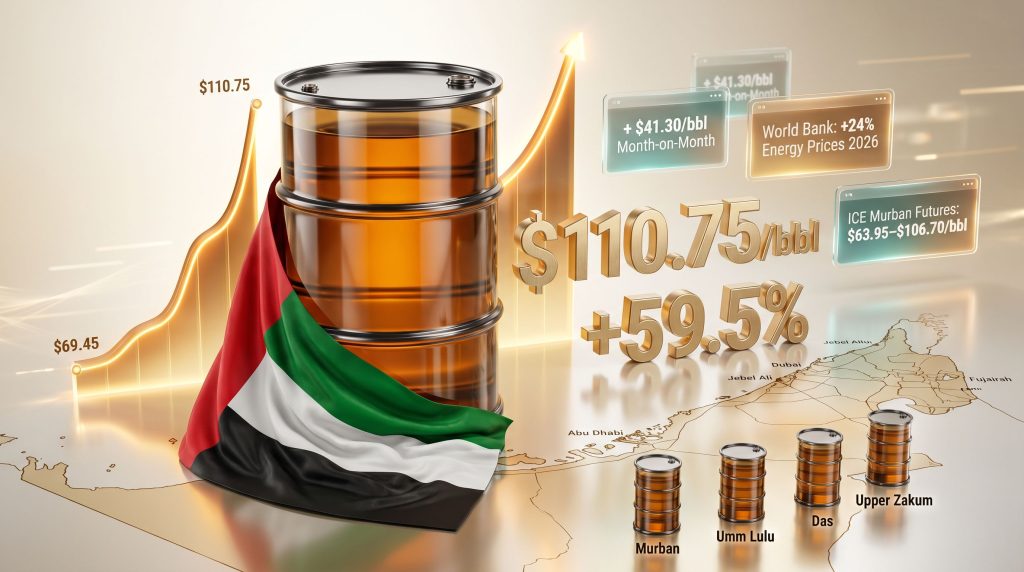
On April 29, 2026, the Abu Dhabi National Oil Company confirmed its official selling price for Murban crude at $110.75 per barrel for May delivery, as reported by Reuters. This represented an increase of $41.30 per barrel compared to the April 2026 OSP of $69.45 per barrel, translating to a month-on-month rise of approximately 59.5%.
Notably, ADNOC applied a zero differential across all four of its primary crude grades for the May 2026 cycle, meaning each grade was priced identically at $110.75 per barrel. For a broader perspective on where prices currently stand, the current crude oil market overview provides additional context on prevailing conditions.
| Crude Grade | May 2026 OSP (USD/bbl) | April 2026 OSP (USD/bbl) | Month-on-Month Change | Differential to Murban |
|---|---|---|---|---|
| Murban | $110.75 | $69.45 | +$41.30 (+59.5%) | 0.00 |
| Umm Lulu | $110.75 | — | — | 0.00 |
| Das | $110.75 | — | — | 0.00 |
| Upper Zakum | $110.75 | — | — | 0.00 |
Source: Reuters, April 29, 2026 (reporting by Anmol Choubey, editing by Chris Reese). April OSP figures for Umm Lulu, Das, and Upper Zakum were not specified in the original dispatch.
Disclaimer: This article is for informational purposes only and does not constitute financial or investment advice. Price data is sourced from Reuters via Zawya as of April 29, 2026. Forecasts and projections cited are from third-party institutions and are subject to change. Readers should conduct independent research before making any investment or commercial decisions based on crude oil pricing data.
How ADNOC's Official Selling Price Mechanism Works
The OSP is not a spot market transaction price and understanding this distinction is essential for anyone following Middle Eastern crude markets. It is a contractually binding monthly reference rate that ADNOC applies to pre-committed cargo volumes under term supply agreements with refiners across Asia, Europe, and beyond.
The Core Architecture of OSP Pricing
Several structural features define how the OSP functions in practice:
-
Monthly cadence: ADNOC publishes OSPs once per month, typically toward the close of the prior month, covering all liftings scheduled for the upcoming delivery period. The May 2026 OSP was confirmed on April 29, 2026.
-
Differential-based structure: OSPs are frequently expressed as a premium or discount relative to a benchmark, historically the Dubai/Oman average published by S&P Global Commodity Insights (formerly S&P Global Platts), rather than as standalone absolute figures.
-
Grade-unified pricing: In some monthly cycles, ADNOC aligns all primary crude grades at identical price levels. The May 2026 cycle exemplifies this, with all four grades carrying a zero differential to Murban.
-
Retroactive revision capacity: ADNOC reserves the right to adjust OSPs retroactively under certain market conditions, which can produce discrepancies between initially reported figures and final settlement values that term buyers must account for in their contract management.
OSP vs. Futures vs. Government Selling Price: Critical Distinctions
Three separate pricing constructs apply to Murban crude and are frequently conflated in market commentary. Understanding the differences between them is fundamental for analysts, traders, and procurement teams:
OSP (Official Selling Price): A monthly contractually fixed price applying to ADNOC's term contract buyers. Set unilaterally by ADNOC and communicated at the end of the preceding month.
GSP (Government Selling Price): A distinct reference used for domestic or government-related crude transactions, quoted on a Free on Board (FOB) Abu Dhabi basis. This figure can diverge materially from the term buyer OSP.
ICE Murban Futures: Real-time spot and forward market prices traded on the Intercontinental Exchange under a physically deliverable contract structure launched to position Murban as a regional benchmark. These futures prices reflect live supply-demand sentiment and can diverge significantly from the monthly OSP, particularly during periods of rapid price movement or geopolitical stress.
What makes this three-tier structure particularly important for sophisticated market participants is the arbitrage window it creates. When ICE Murban futures trade at a substantial premium or discount to the OSP, term contract holders gain or lose relative to spot buyers, creating incentives to adjust lifting schedules, seek spot alternatives, or renegotiate term conditions. Live Murban crude futures pricing provides a useful real-time reference for tracking these divergences.
The Monthly OSP-Setting Process: A Step-by-Step Breakdown
Understanding the mechanics behind how ADNOC arrives at each month's figure helps contextualise why prices can move as dramatically as they did between April and May 2026.
-
Benchmark monitoring: ADNOC's pricing team tracks the Dubai/Oman crude average throughout the prior month to establish prevailing market reference levels.
-
Supply-demand assessment: Internal analysis evaluates forward cargo commitments, refinery demand signals from term buyers, and competing grade availability from other Gulf producers.
-
Geopolitical and macro overlay: Broader market factors are incorporated into the pricing model, including OPEC+ production dynamics, regional conflict risk premia, currency movements, and global demand forecasts.
-
Differential calibration: ADNOC determines whether to express the OSP as an absolute dollar figure or as a differential to the Dubai/Oman benchmark, depending on market conditions and transparency objectives.
-
Official announcement: The OSP is published and communicated to term buyers, typically in the final days of the preceding month.
-
Retroactive adjustment window: A review period may follow, during which ADNOC can revise the OSP if material changes in market conditions or underlying data inputs occur.
Why Did the Murban OSP Surge Nearly 60% Between April and May 2026?
A month-on-month increase of more than $41 per barrel is an extraordinary pricing event by virtually any historical measure. Several converging forces explain the scale of this adjustment, and each deserves careful examination.
Middle East Supply Disruption and the Risk Premium Effect
Regional conflict escalation has materially disrupted Middle Eastern crude and energy supply chains throughout this period. According to the International Energy Agency, ongoing Middle East conflict conditions carry the potential to cause LNG supply losses of up to 120 billion cubic metres between 2026 and 2030 (Zawya/Reuters, April 2026). This is not merely a gas market problem. When regional energy infrastructure faces uncertainty, buyers of all hydrocarbon grades pay an elevated risk premium to secure reliable non-disrupted supply.
Simultaneously, Europe has been confronting jet fuel shortages directly linked to halted Middle East supply flows (Zawya, April 2026), amplifying the urgency of supply security across both crude and refined product markets. The World Bank, in a forecast reported in April 2026, projected a 24% surge in energy prices during 2026, attributing this trajectory explicitly to Middle East war conditions (Zawya/World Bank, April 2026).
The UAE's Structural Departure from OPEC+
The UAE's relationship with the OPEC+ production management framework underwent a fundamental shift during this period. The UAE formally announced its decision to exit both OPEC and OPEC+, a move that analysts at HSBC assessed as having limited near-term impact on OPEC+ group cohesion, according to reporting via Zawya (April 2026). However, the longer-term market share and pricing implications are considerably more complex.
Furthermore, removing itself from the OPEC+ quota framework theoretically gives ADNOC the freedom to pursue unconstrained volume expansion. In a supply-disrupted environment, this paradoxically supports elevated OSPs rather than undermining them. Buyers seeking reliable, non-sanctioned crude from a politically stable producer are willing to pay a premium, and ADNOC can now capture that premium without being constrained by collective production ceilings. Separate Zawya reporting confirms that sources familiar with the situation noted the UAE exit weakens OPEC's global oil influence over global oil markets, even if the group itself remains intact.
Geopolitical Risk Premium: Quantifying the Converging Drivers
| Macro Driver | Price Impact Direction | Assessed Magnitude |
|---|---|---|
| Middle East conflict supply disruption | Upward | High |
| IEA 120 BCM LNG supply loss risk (2026-2030) | Upward (energy complex-wide) | High |
| World Bank 24% energy price forecast (2026) | Upward (demand-side validation) | Moderate-High |
| UAE OPEC+ exit (production freedom gained) | Mixed (volume potential up, price dynamics complex) | Moderate |
| US Iran blockade extension reports | Upward | High |
| Europe jet fuel shortage from halted ME supply | Upward (refined product pressure) | Moderate |
Note: The table above represents analytical synthesis of concurrent market reporting and should be treated as directional context rather than quantified causal modelling.
Murban's Position in the Global Crude Pricing Architecture
Murban occupies a distinctive tier within the global crude hierarchy that shapes both its pricing behaviour and its strategic importance to buyers.
Crude Quality and Refinery Appeal
Murban is classified as a light, sweet crude, carrying an API gravity of approximately 40 degrees and a low sulphur content profile. These qualities place it in direct competition with Brent and West Texas Intermediate for refinery preference among Asian and European buyers.
Light sweet crudes yield higher proportions of premium refined products per barrel, including jet fuel, diesel, and gasoline, making them disproportionately attractive during periods of refined product shortages — precisely the conditions present in European jet fuel markets in April and May 2026. In addition, OPEC demand forecast revisions for light sweet grades have reinforced this preference among regional buyers.
The ICE Murban Futures Benchmark Challenge
When ICE launched the Murban Futures contract as a physically deliverable instrument, it created a direct challenge to the long-dominant Dubai/Oman benchmark as the regional pricing reference for Middle Eastern crude. The physical delivery mechanism is a key differentiating feature: unlike many paper benchmarks, ICE Murban futures settle against actual cargo deliveries in Abu Dhabi, providing price discovery anchored to real supply conditions rather than financial positioning alone.
This benchmark evolution matters for understanding the ADNOC Murban crude selling price for May. As ICE Murban futures gain liquidity and regional acceptance, the divergence between futures prices and the monthly OSP becomes a more visible signal of market stress or supply tightness — one that sophisticated buyers and sellers actively monitor and trade around.
The next major ASX story will hit our subscribers first
Downstream Consequences: What $110.75/bbl Means for Refiners and Energy Markets
A Murban OSP at $110.75 per barrel carries material consequences across the energy value chain.
Asian Refinery Economics Under Pressure
The majority of ADNOC's term volumes flow to East Asian refiners in Japan, South Korea, China, and India, making the OSP a critical input cost for regional refining margins. At elevated OSP levels, several dynamics emerge simultaneously:
-
Crack spread compression: Unless refined product prices move in parallel with crude input costs, refinery margins narrow, reducing profitability and potentially incentivising run-rate reductions.
-
Spot market evaluation: At sufficiently elevated OSP levels relative to alternatives, some Asian buyers may evaluate spot market alternatives or accelerate long-term supply diversification strategies.
-
Switching economics: Refineries configured for light sweet crude face higher switching costs when seeking alternatives to Murban, as reconfiguring processing units to handle heavier or sourer grades involves capital expenditure and yield trade-offs.
Sovereign Revenue and Strategic Capital Implications for Abu Dhabi
For ADNOC and Abu Dhabi's sovereign financial position, each incremental dollar on the OSP translates directly into enhanced per-barrel revenue across the full volume of term contract liftings. A sustained OSP in excess of $110 per barrel:
-
Materially strengthens Abu Dhabi's fiscal position and the capital deployment capacity of the Abu Dhabi Investment Authority (ADIA).
-
Reinforces ADNOC's negotiating leverage in long-term supply contract renegotiations with buyers across Asia and Europe.
-
Provides accelerated capital availability to fund ADNOC's reported multi-billion-dollar investment ambitions in US gas infrastructure, with the Financial Times reporting plans requiring tens of billions in committed capital (Zawya, April 2026).
However, trade war effects on oil markets represent a counterbalancing risk, as escalating tariff tensions could dampen Asian demand growth and, consequently, put downward pressure on term pricing power in future OSP cycles.
Speculative note: If the UAE's post-OPEC+ production expansion strategy proceeds alongside sustained elevated OSP levels, ADNOC could simultaneously grow market share in volume terms and maintain premium pricing power over competing Gulf grades. This dual outcome would represent a significant shift in the regional competitive balance, though it remains contingent on conflict dynamics, global demand trajectory, and the responses of other producers.
Frequently Asked Questions: ADNOC Murban Crude OSP
What is the ADNOC Murban crude selling price for May 2026?
ADNOC set the Murban crude official selling price at $110.75 per barrel for May 2026, announced on April 29, 2026, as reported by Reuters. Further detail on this announcement is available via ADNOC's confirmed Murban price reporting from Zawya.
How much did the Murban OSP increase from April to May 2026?
The May 2026 OSP of $110.75 per barrel represents an increase of $41.30 per barrel compared to April 2026's OSP of $69.45 per barrel, a month-on-month rise of approximately 59.5%.
Does the May 2026 Murban OSP apply to all ADNOC crude grades?
Yes. For May 2026, ADNOC applied a zero differential across all four primary grades, meaning Murban, Umm Lulu, Das, and Upper Zakum all carry the same $110.75 per barrel OSP.
Why is the Murban OSP different from ICE Murban futures prices?
The OSP is a contractually fixed monthly price for term supply buyers, while ICE Murban futures reflect real-time spot and forward market trading sentiment. These two pricing constructs serve different functions and can diverge materially, particularly during rapid price movements or geopolitically driven supply disruptions.
How does the UAE's OPEC+ exit affect future Murban pricing?
The UAE's departure removes quota constraints, potentially enabling volume expansion. In a supply-disrupted environment, this may allow ADNOC to grow market share while maintaining premium pricing, though longer-term OSP trajectory depends on global demand conditions, conflict resolution, and competing producer responses.
Key Takeaways: ADNOC Murban May 2026 OSP Summary
| Metric | Value |
|---|---|
| May 2026 Murban OSP | $110.75/bbl |
| April 2026 Murban OSP | $69.45/bbl |
| Month-on-Month Change | +$41.30/bbl (+59.5%) |
| Grades at Same OSP | Murban, Umm Lulu, Das, Upper Zakum |
| Announcement Date | April 29, 2026 |
| Differential to Benchmark (all grades) | 0.00 |
| IEA LNG Supply Risk (2026-2030) | Up to 120 BCM loss |
| World Bank 2026 Energy Price Forecast | +24% (Middle East war attributed) |
| ADNOC US Gas Investment (reported) | Tens of billions USD |
Sources: Reuters via Zawya (April 29, 2026); Zawya related article coverage of World Bank, IEA, HSBC, and UAE OPEC+ exit reporting (April 2026). All forecasts and projections are third-party estimates subject to material revision. This article does not constitute investment advice.
Want to Track the Next Major Resource Discovery Before the Market Moves?
While sovereign crude pricing signals like ADNOC's 59.5% Murban OSP surge reveal how rapidly energy markets can reprice, similar transformative opportunities emerge in the mineral discovery space — and timing is everything. Discovery Alert's proprietary Discovery IQ model delivers real-time ASX mineral discovery alerts, turning complex resource data into actionable insights for both short-term traders and long-term investors. Explore historic discovery returns to understand the scale of opportunity, then begin your 14-day free trial to position yourself ahead of the broader market.