July 21, 2026
The Architecture of a Long-Game Gas Strategy
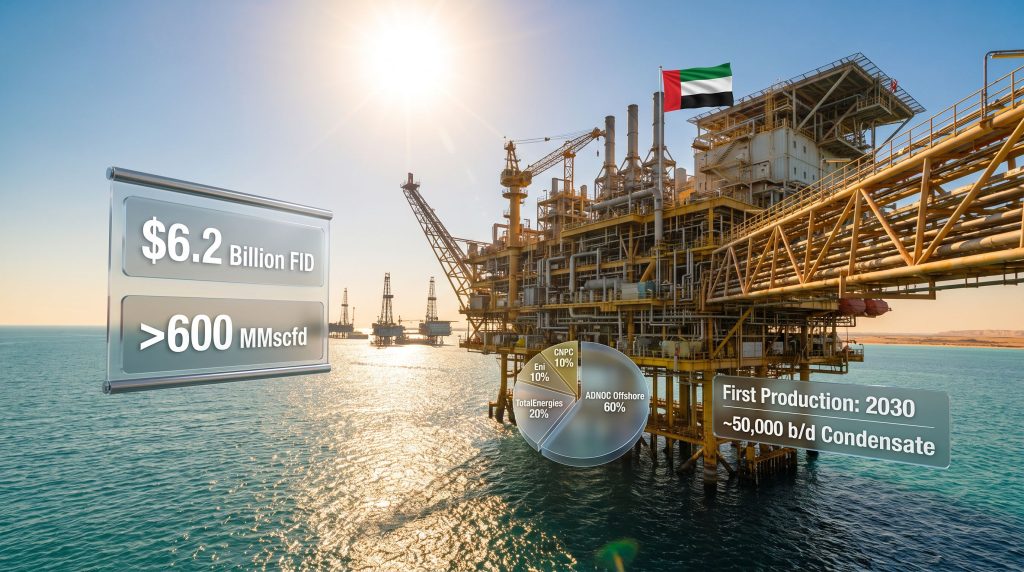
Across the global energy landscape, a quiet but consequential shift is underway. National oil companies and international majors alike are no longer treating natural gas purely as a byproduct of oil development. Instead, gas has become a first-order strategic asset, one that governments are willing to deploy significant capital to control, develop, and monetise on their own terms. Nowhere is this reorientation more visible than in Abu Dhabi, where the ADNOC Umm Shaif Gas Cap development FID, valued at $6.2 billion (AED 22.6 billion), represents not merely a single project decision but the architectural expression of a multi-decade gas growth ambition.
Understanding why this particular FID matters requires looking beyond the headline capital figure. It requires examining the structural logic of gas cap development, the capital efficiency mechanisms embedded in the project design, the geopolitical signal carried by the partnership structure, and how the Umm Shaif development fits within a broader UAE gas supply stack that is being deliberately assembled, layer by layer.
When big ASX news breaks, our subscribers know first
Why Gas Cap Resources Demand a Separate Development Logic
A gas cap is not simply an extension of a conventional gas field. It refers to a body of free gas that sits above an oil reservoir, held in structural traps by the same geological seals that contain the oil below. In reservoir management terms, this creates a fundamental tension: producing from the gas cap prematurely or without careful pressure management can compromise oil recovery by destabilising the reservoir drive mechanism.
For decades, operators across the Middle East deliberately avoided or delayed gas cap production precisely because protecting oil recovery rates was the higher-value priority. As oil fields mature and reservoir pressures evolve, however, the calculus shifts. Gas cap resources that were once held in reserve become technically and economically viable to develop, provided the operator can sequence the extraction without damaging residual oil production.
The Umm Shaif field, which has been producing oil continuously since 1962, sits squarely within this category. As Abu Dhabi's oldest active offshore field, it carries more than six decades of reservoir data, production history, and subsurface characterisation. This accumulated knowledge base is not incidental. It is one of the core reasons the gas cap development can proceed with a brownfield-first capital model rather than the expensive greenfield exploration and appraisal campaigns required for entirely new gas provinces.
What makes the subsurface geology of Umm Shaif particularly compelling for investors and industry observers is the co-production opportunity it unlocks. Gas cap development here is expected to yield approximately 50,000 barrels per day of condensate alongside the primary gas volumes. Condensate, a light hydrocarbon liquid that condenses out of the gas stream as pressure drops, commands pricing close to or above light crude benchmarks. This dual-revenue profile fundamentally improves the project economics compared to dry gas developments where the entire return depends on gas pricing alone. Furthermore, the LNG supply outlook for the region makes this condensate-rich production profile even more strategically attractive.
Deconstructing the $6.2 Billion Capital Allocation
The structure of the approved capital reveals deliberate choices about where ADNOC is willing to spend and where it has engineered cost out of the project entirely.
| Capital Component | Allocation | Share of Total |
|---|---|---|
| EPC infrastructure (three contract packages) | $5.1 billion (AED 18.8 billion) | ~82% |
| Drilling and integrated drilling services | $365 million (AED 1.3 billion) | ~5.9% |
| Remaining project costs | ~$735 million | ~11.9% |
The drilling programme budget is particularly instructive. At $365 million for 14 wells over 18 months, the per-well cost works out to approximately $26 million, a figure that reflects the efficiency gains from using three existing offshore rigs already operating within the concession area. In typical offshore drilling markets, mobilising new rigs from elsewhere adds both time and significant upfront cost. By committing to existing assets, ADNOC Drilling avoids that overhead entirely.
What Capital Efficiency Mechanisms Are Built Into the Project?
The broader capital efficiency framework built into the ADNOC Umm Shaif Gas Cap development FID includes several interlocking mechanisms:
- Brownfield infrastructure integration: New offshore facilities tie into existing Umm Shaif infrastructure rather than requiring entirely new platforms and pipeline networks from scratch.
- UAE national grid power supply: Rather than installing dedicated offshore power generation, the project draws electricity from the UAE's onshore grid. This eliminates the capital cost of gas turbines or dedicated power barges while simultaneously reducing the carbon intensity of operations.
- Three consolidated EPC contract packages: Packaging the offshore construction work into three major contracts rather than fragmenting it across dozens of smaller agreements improves contractor coordination, reduces interface risk, and creates procurement leverage.
- No new rig procurement: The 18-month drilling campaign proceeds without mobilising additional offshore drilling units.
The deliberate stacking of these cost levers reflects an operator philosophy that treats capital efficiency as an engineering problem, not merely a financial target. Each mechanism has both a cost dimension and an emissions dimension, making the project design internally consistent with ADNOC's broader sustainability commitments.
Partnership Structure and What Each Stake Actually Signals
The concession ownership across the Umm Shaif and Nasr offshore block reveals a carefully balanced international consortium. In addition, the oil price geopolitics shaping 2025 and beyond make the composition of this partnership all the more significant.
| Partner | Equity Interest | Strategic Rationale |
|---|---|---|
| ADNOC Offshore | 60% | Operational control, sovereign resource ownership |
| TotalEnergies | 20% | LNG commercialisation expertise, energy transition positioning |
| Eni | 10% | Offshore technical capabilities, Abu Dhabi portfolio participation |
| CNPC | 10% | Long-term Gulf gas supply security for China |
TotalEnergies' 20% stake is the most strategically layered of the international positions. The company has framed its participation in terms of adding low-cost, lower-emissions production to its upstream portfolio beyond 2030, language that carries specific meaning within the context of how European majors are managing their energy transition narratives. By securing barrels and gas volumes from a grid-powered, brownfield development in a stable jurisdiction, TotalEnergies can point to upstream growth that scores relatively well on carbon intensity metrics.
CNPC's 10% interest reflects a pattern that has become structurally significant across Middle East upstream concessions. Chinese national oil companies have steadily built equity positions in Gulf gas assets over the past decade, motivated not by near-term trading opportunities but by the desire to secure long-term supply visibility as China's gas import dependence continues to grow. A 10% stake in a project targeting more than 600 MMscfd of gas production is, in effect, an option on several decades of supply relationship with Abu Dhabi.
Production Targets, Scalability, and the 2030 Timeline
The headline output target of more than 600 MMscfd of natural gas and associated gas liquids by 2030 is significant not only in absolute volume terms but in what it represents as a proportion of current UAE domestic gas consumption. At roughly 10% of the UAE's daily gas requirement, the Umm Shaif Gas Cap development meaningfully shifts the domestic supply balance and, by extension, frees up associated gas volumes from other fields for export monetisation via ADNOC's LNG growth programme. Consequently, monitoring natural gas price trends will be essential for gauging the commercial returns of this production ramp-up.
Critically, 600 MMscfd is not the ceiling. The project has been publicly associated with a scalability potential of up to 1.5 billion cubic feet per day in subsequent development phases, representing more than double the initial production target. This optionality is a structural feature of gas cap projects in mature fields: once the primary infrastructure is in place and reservoir behaviour under production is better understood, incremental expansion can proceed at a fraction of the original per-unit development cost.
This scalability logic connects directly to the recently awarded Bab Gas Cap concession, which independently targets an additional 1.5 Bcfd of gas and associated liquids. Together, these two projects form the backbone of a UAE gas supply growth platform that, when combined with ADNOC's LNG capacity ambitions, creates a vertically integrated value chain from wellhead to international markets.
| Production Metric | Target |
|---|---|
| Initial gas output | >600 MMscfd |
| Condensate production | ~50,000 b/d |
| Future scalability ceiling | Up to 1.5 Bcfd |
| First production target | 2030 |
| ADNOC LNG capacity target | 47 million tpy by 2035 |
How Umm Shaif Compares Within the Regional Upstream Investment Landscape
Positioning the ADNOC Umm Shaif Gas Cap development FID against other major regional gas developments provides useful perspective on scale, ambition, and competitive dynamics.
| Project | Country | Approx. Investment | Target Output | Timeline |
|---|---|---|---|---|
| Umm Shaif Gas Cap | UAE | $6.2 billion | >600 MMscfd | 2030 |
| Bab Gas Cap (concession awarded) | UAE | TBD | ~1.5 Bcfd | TBD |
| North Field Expansion | Qatar | ~$29 billion (total programme) | 126 mtpa LNG | 2026-2030 |
Note: Figures reflect publicly available data as of mid-2026 and are subject to revision.
What distinguishes the Umm Shaif approach from Qatar's North Field model is the underlying development philosophy. Qatar's expansion is fundamentally a greenfield LNG liquefaction scale-up built around one of the world's largest conventional gas reservoirs. The UAE's strategy, by contrast, is characterised by brownfield intensification of existing offshore assets, a model that delivers faster time-to-market, lower per-unit capital cost, and a smaller development footprint.
This brownfield-first approach also carries a less obvious strategic advantage: it avoids the long lead times and financing complexity associated with building entirely new LNG trains, allowing ADNOC to grow its gas supply base incrementally while LNG infrastructure is developed in parallel. However, oil and gas drilling conditions in other regions serve as a useful contrast, underscoring just how efficiently the UAE model has been structured.
The next major ASX story will hit our subscribers first
The ESG and Emissions Dimension: Design Features, Not Retrofit Measures
One of the more technically significant but underreported aspects of the project is how emissions reduction has been incorporated as a structural design feature rather than a compliance overlay. The decision to power offshore operations from the UAE national electricity grid instead of dedicated gas turbines is not cosmetic. Offshore gas turbines running on field gas are a consistent source of both CO2 and methane emissions in conventional development projects. Grid electrification removes this emissions source from the project boundary entirely.
Combined with condensate recovery optimisation, which reduces the volume of hydrocarbons that might otherwise be vented or flared, the project's emissions intensity profile is materially lower than a conventionally designed equivalent. This matters for international partners like TotalEnergies, whose own ESG reporting and investor scrutiny creates real demand for upstream assets that can be characterised as lower-carbon.
Furthermore, it matters for ADNOC's positioning as it seeks to compete for long-term LNG supply contracts with buyers in Europe and Asia who are increasingly incorporating carbon intensity into procurement criteria. The commodity price impacts of lower-emissions production profiles are becoming an increasingly tangible factor in long-term contract negotiations.
Key Metrics at a Glance
| Metric | Value |
|---|---|
| Total FID value | $6.2 billion (AED 22.6 billion) |
| EPC infrastructure packages | $5.1 billion (AED 18.8 billion) |
| Drilling programme budget | $365 million |
| Number of wells | 14 |
| Drilling duration | 18 months |
| Rigs deployed | 3 (existing offshore rigs) |
| Target gas output | >600 MMscfd |
| Condensate uplift | ~50,000 b/d |
| Future scalability | Up to 1.5 Bcfd |
| First production target | 2030 |
| ADNOC Offshore equity | 60% |
| TotalEnergies equity | 20% |
| Eni equity | 10% |
| CNPC equity | 10% |
Three Structural Implications for the Broader Energy Industry
The ADNOC Umm Shaif Gas Cap development FID carries implications that extend well beyond Abu Dhabi's continental shelf.
-
Brownfield gas cap monetisation is becoming a replicable upstream template. As conventional offshore fields across the Middle East, North Africa, and Southeast Asia mature, the combination of known reservoir geology, existing infrastructure, and trapped gas cap volumes creates a reproducible development model. Operators sitting on analogous assets will study Umm Shaif closely.
-
International majors are actively using Middle East upstream equity to satisfy competing pressures simultaneously. A position in a grid-powered, condensate-rich, brownfield gas development allows companies like TotalEnergies to grow production volumes, improve portfolio carbon intensity metrics, and maintain exposure to long-cycle gas supply, all within a single asset.
-
The UAE is constructing a multi-project gas supply stack that will give it genuine competitive relevance in the LNG market. By combining Umm Shaif, Bab Gas Cap, and its LNG capacity expansion programme, Abu Dhabi is assembling the upstream volume base needed to support a credible long-term LNG export strategy. This positions the UAE as a structurally important alternative to Qatar for buyers seeking geographic and counterparty diversification.
For a deeper understanding of the project's technical scope and contractor award timeline, upstream field development reporting provides detailed insight into how ADNOC has structured the procurement process for this landmark investment.
Disclaimer: This article is intended for informational and analytical purposes only. It does not constitute financial advice or investment recommendations. Projections, timelines, and production targets referenced herein are based on publicly available announcements and are subject to revision. Readers should conduct independent research before making any investment decisions.
Want to Spot the Next Major Resource Discovery Before the Market Does?
Discovery Alert's proprietary Discovery IQ model scans ASX announcements in real time, instantly identifying significant mineral discoveries across more than 30 commodities — from gas-linked plays to major brownfield opportunities — and converting complex data into clear, actionable insights for investors at every level. Explore how historic discoveries have generated substantial returns on Discovery Alert's discoveries page, and begin your 14-day free trial today to position yourself ahead of the broader market.