July 21, 2026
The Economics Behind America's Aluminum Crisis and the Case for Conditional Tariff Relief
Few industrial sectors illustrate the long-term consequences of policy neglect as starkly as primary aluminum production. Across most developed economies, the twentieth century saw aluminum smelting treated as a strategic asset, embedded in national energy grids and protected through deliberate industrial planning. In the United States, that era quietly ended decades ago, and the country has been slowly reckoning with the consequences ever since. What has emerged in 2026 is a US aluminum tariff discount for firms building plants in the US — a conditional incentive structure tied directly to domestic capital commitment.
Understanding why this framework matters, and whether it can actually work, requires moving through several layers of industrial economics, energy market dynamics, and trade policy history that rarely surface in mainstream coverage.
When big ASX news breaks, our subscribers know first
Why the US Primary Aluminum Sector Collapsed Over 25 Years
From 23 Smelters to 4: A Structural, Not Cyclical, Decline
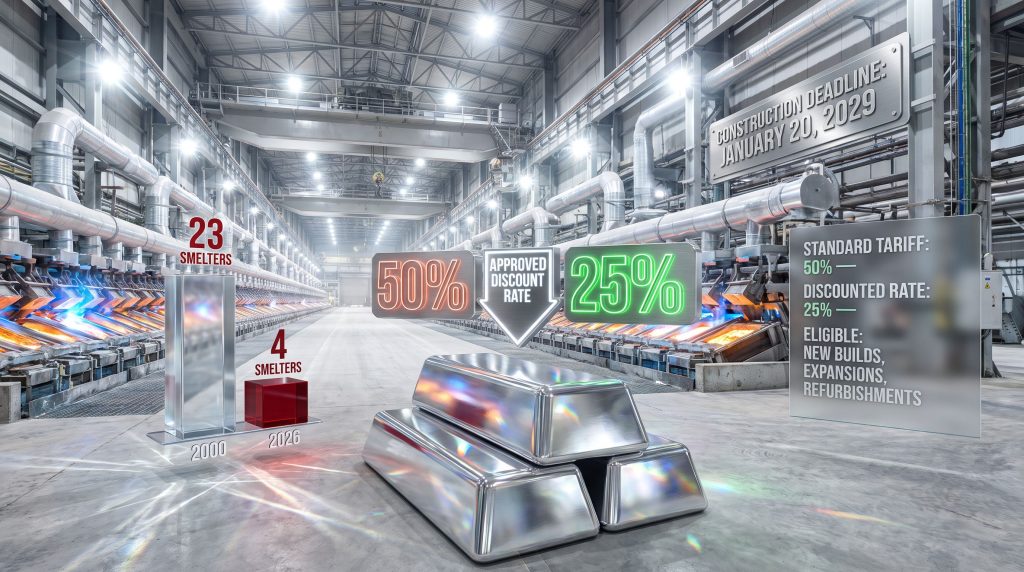
At the turn of the millennium, the United States operated 23 active primary aluminum smelters, supporting a domestic production base capable of meaningful self-sufficiency. By 2026, that number has contracted to just four operating facilities, a reduction of more than 80% that cannot be explained by temporary demand softness or normal market cycles.
The collapse was structural. Two forces drove it above all others: the globalisation of aluminum trade and the fundamental energy cost disadvantage baked into US grid electricity pricing relative to competing production regions. Furthermore, the top aluminium companies operating globally have increasingly concentrated investment in regions with cheaper energy access.
What makes this particularly striking from an industrial policy perspective is the timeline: the last greenfield aluminum smelter commissioned in the United States was built more than four decades ago. This is not a gap measured in years. It is a generational absence that has eroded engineering expertise, supply chain infrastructure, and institutional knowledge about how to build and operate these facilities at scale.
The Energy Cost Barrier That Tariffs Cannot Fix Alone
Aluminum smelting is among the most electricity-intensive industrial processes in existence. The Hall-Heroult electrolysis process, which converts alumina into primary aluminum metal, consumes roughly 14 to 16 megawatt-hours of electricity per metric tonne of aluminum produced. At scale, a single modern smelter can consume as much electricity as a mid-sized city.
This is the core reason why approximately half of all aluminum consumed in the United States is produced in Canada. Canadian hydroelectric power delivers electricity at costs that US grid-connected industrial facilities cannot approach. Middle Eastern producers benefit from state-subsidised energy pricing that creates an equally profound structural advantage.
The data makes the dependency visible at a glance:
| Metric | Figure |
|---|---|
| Active US primary aluminum smelters (2026) | 4 |
| Active US smelters in 2000 | 23 |
| Share of US consumption sourced from Canada | ~50% |
| Years since last new US smelter was built | 40+ |
| Standard Section 232 tariff on aluminum imports | 50% |
| Electricity consumption per tonne of aluminum | 14-16 MWh |
"Without addressing the energy cost gap, any tariff regime, regardless of its magnitude, functions as a tax on domestic manufacturers rather than a genuine industrial development tool. The 50% Section 232 tariff, introduced in mid-2025, demonstrated this dynamic in real time."
How the US Aluminum Tariff Discount for Firms Building Plants in the US Actually Works
Conditional Architecture: Why This Is Not Standard Tariff Relief
The program announced by the Trump administration in July 2026 does not offer blanket tariff reduction to any importer. It introduces a performance-linked conditional discount that requires verifiable domestic investment commitments before any benefit is granted. In addition, Trump mining policy more broadly reflects this shift toward conditional, investment-linked industrial incentives across multiple resource sectors.
The mechanism is built around a formal onshoring plan submitted to the Department of Commerce. This document must contain:
- A detailed capital expenditure commitment with projected investment volumes
- A verified construction or refurbishment timeline with defined milestones
- Expected annual output capacity upon facility completion
- A commercial viability assessment reviewed by Commerce Department analysts
- Evidence of land acquisition and construction commencement pathways
This is meaningfully different from a tariff exemption or a blanket rate reduction. The benefit is earned incrementally through demonstrated progress, not granted upon application. For further context, the White House presidential action on adjusting aluminum and steel imports outlines the foundational regulatory basis for these measures.
Program Parameters: The Numbers That Define Eligibility and Limits
| Program Feature | Specification |
|---|---|
| Standard Section 232 tariff rate | 50% |
| Discounted tariff rate for approved firms | 25% |
| Effective tariff reduction | 50% cut to the standard duty |
| Eligible activities | New builds, capacity expansions, refurbishments |
| Import volume allowance | Equivalent to anticipated annual facility output |
| Refurbishment import cap | Capped at total dollar value of investment |
| Construction commencement deadline | January 20, 2029 |
| Administering authority | US Secretary of Commerce |
The January 20, 2029 commencement deadline is a critical feature of the framework. It creates a defined decision window for corporate capital allocation, concentrating investment pressure into a roughly two-and-a-half year horizon from announcement.
Compliance Mechanisms and the Retroactive Clawback Risk
The program includes a provision that is frequently underappreciated in early coverage: tariff discounts already received can be retroactively rescinded if a company fails to meet its stated milestones. This is not a prospective penalty applied to future imports. It is a clawback of financial benefits already realised.
Key compliance checkpoints that companies must satisfy include:
- Confirmation of land acquisition for the designated facility
- Verification of construction commencement within the deadline
- Output milestone reporting tied to anticipated annual production capacity
- Ongoing compliance reviews conducted by the Commerce Department
"The retroactive clawback mechanism transforms the program from a straightforward discount into a performance bond. Companies that bank tariff savings early but fail to execute their construction commitments face the prospect of repaying those savings in full, creating a meaningful financial risk that must be modelled into any investment decision."
The US Midwest Aluminum Premium: Understanding the Hidden Manufacturing Cost
What the Midwest Premium Measures and Why It Has Surged
The US Midwest aluminum premium is a concept that sits at the intersection of trade policy and physical commodity logistics, yet remains poorly understood outside specialist circles. It represents the additional cost above the London Metal Exchange benchmark price that US manufacturers must pay to take physical delivery of primary aluminum in the Midwest region.
This premium reflects several components stacked together: shipping and logistics costs, financing costs associated with warehouse queuing, and, critically, the structural supply-demand imbalance created by import restrictions. When tariffs reduce the volume of competitively priced aluminum entering the US market, the Midwest premium expands to reflect the scarcity premium domestic buyers must pay.
Since the 50% Section 232 tariff came into effect in June 2025, the Midwest premium has surged sharply. The broader consequences of US aluminium tariffs on domestic pricing have been significant, with a secondary supply shock related to geopolitical conflict contributing to an increase in the regional aluminum premium of approximately 100%. LME aluminum prices themselves have climbed significantly, with the global benchmark settling near $3,140 per metric tonne in the period immediately before the tariff discount program was announced.
How Manufacturers Have Responded to Record-High Input Costs
The downstream consequences for US manufacturers operating in automotive, appliance, and beverage can sectors have been significant. Faced with the highest raw material costs for primary aluminum of any industrialised nation, domestic producers have adopted a just-in-time purchasing strategy that minimises inventory exposure.
This behavioural shift carries its own embedded risks:
- Reduced buffer against supply disruptions: Minimal inventory means any logistics shock translates directly into production stoppages
- Reduced negotiating leverage: Buying in small volumes for immediate needs eliminates the bulk purchasing advantages that larger inventory strategies enable
- Amplified price volatility exposure: Spot market purchasing means manufacturers absorb the full daily price fluctuation rather than averaging costs over a forward purchasing horizon
The just-in-time adaptation is rational under current conditions but, however, represents a fragile equilibrium rather than a sustainable industrial strategy.
Can a 25% Tariff Rate Actually Trigger Meaningful Smelter Investment?
The Investment Calculus: Variables That Determine Commercial Viability
The honest answer to whether a 25% tariff rate for approved firms is sufficient to catalyse genuine domestic smelter construction is: it depends. The conditional discount reduces the import duty burden, but it does not address the fundamental structural economics that made US smelting uncompetitive in the first place. Consequently, the impact on aluminum and alumina markets will depend heavily on how many firms genuinely commit to construction.
The key variables that any serious investment model must address include:
- Power purchase agreement pricing: Without long-term electricity contracts at competitive rates, the operating cost structure of a US smelter remains challenged relative to Canadian or Middle Eastern competitors
- Capital expenditure recovery timelines: Greenfield primary aluminum smelters require multi-billion dollar construction investments with payback horizons typically measured in decades, not years
- Policy durability risk: Investors must assign probability weights to the tariff framework surviving future administrations, a non-trivial risk in an environment where trade policy has undergone significant revision across successive governments
- Workforce and skills availability: Four decades without new smelter construction has substantially eroded the domestic workforce skills base required for commissioning and operating these facilities
- Permitting and environmental approval timelines: Large industrial facilities face extended regulatory review processes that can add years to construction schedules
Three Pathways: How Industry Is Likely to Respond
| Scenario | Likelihood | Outcome |
|---|---|---|
| Major producers commit to new greenfield smelters | Low to Medium | Long-term capacity growth; 5-10 year lead time before production |
| Existing operators refurbish or restart idled smelters | Medium to High | Faster capacity recovery; lower capital intensity and permitting complexity |
| Companies submit onshoring plans but delay construction | Medium | Short-term tariff savings realised without structural capacity addition |
The third scenario — where companies use the onshoring plan mechanism primarily to capture the 25% tariff rate while deferring genuine construction commitments — represents the primary risk the clawback mechanism was designed to prevent. Whether the Commerce Department's enforcement regime proves robust enough to deter this behaviour will be a critical determinant of the program's real-world impact.
"Refurbishment of previously idled US smelter capacity represents the most commercially accessible pathway under the current framework. Lower capital requirements, established site infrastructure, and more navigable permitting processes make restarts significantly faster to execute than greenfield alternatives. The EGA and Century Aluminum partnership announced earlier in 2026 to develop the first new US smelter in roughly 50 years illustrates the scale of ambition that genuinely new construction requires."
The next major ASX story will hit our subscribers first
How This Program Fits Within the Broader US Industrial Policy Shift
Section 232 Evolving from Trade Barrier to Investment Incentive
The original Section 232 tariff imposed under the Trade Expansion Act was framed primarily as a national security measure, protecting domestic capacity from being eliminated entirely by lower-cost foreign competition. The conditional discount program announced in July 2026 represents a meaningful conceptual evolution of that framework.
Rather than functioning as a static barrier designed to exclude imports, the modified structure uses tariff architecture as a performance-based investment incentive. Companies that demonstrate genuine capital commitment to domestic production receive a meaningful cost reduction on the imports they need to supply customers during the construction period. Furthermore, the evolution of aluminum and steel tariffs under Section 232 reflects a broader philosophical shift in how trade barriers are being deployed as industrial development instruments. Companies that do not invest receive no benefit.
Comparing Design Principles Across Major US Industrial Incentive Programs
The conditional architecture of the aluminum discount is not unique to trade policy. It mirrors the design philosophy that has emerged across multiple recent US industrial reinvestment initiatives. For instance, Bloomberg's reporting on firms halving their aluminium duties through domestic investment commitments highlights how this approach is gaining traction across the broader industrial policy landscape.
| Program | Mechanism | Conditionality |
|---|---|---|
| Inflation Reduction Act tax credits | Production-linked clean energy tax credits | Benefits tied to verified domestic output |
| CHIPS and Science Act | Semiconductor fabrication subsidies | Requires committed US-based construction before funding access |
| Section 232 aluminum discount | Tariff reduction from 50% to 25% | Requires approved onshoring plan with verified milestones |
The common thread across all three frameworks is conditional access to benefits linked to verifiable domestic investment actions. This represents a genuine shift in US industrial policy philosophy away from blanket protectionism and toward incentive-aligned capital formation strategies.
Whether the US aluminum tariff discount for firms building plants in the US achieves the domestic capacity additions it targets will depend heavily on whether energy market conditions evolve to support smelter economics, and whether the policy framework proves durable enough to justify the long-horizon capital commitments that new production capacity requires. Neither outcome is guaranteed, and investors and manufacturers weighing participation should model multiple scenarios accordingly.
Disclaimer: This article contains forward-looking analysis and scenario projections based on publicly available information. Nothing in this article constitutes financial or investment advice. Readers should conduct independent research and seek professional guidance before making any investment decisions.
Want to Track the ASX Mineral Discoveries Shaping the Materials Supply Chain?
Discovery Alert's proprietary Discovery IQ model delivers real-time alerts on significant ASX mineral discoveries — instantly converting complex data across 30+ commodities into clear, actionable insights for investors at every level. Explore how historic discoveries have generated substantial returns and begin your 14-day free trial at Discovery Alert to position yourself ahead of the market.