June 28, 2026
Advanced Composite Manufacturing Drives Scandium's Strategic Importance
Manufacturing sectors worldwide face increasing pressure to develop materials that simultaneously reduce weight while enhancing structural performance. This engineering challenge has positioned scandium as one of the most strategically valuable elements in modern industrial applications, with scandium mining in New South Wales emerging as a critical solution for global supply chain security.
The unique metallurgical properties of scandium transform conventional aluminum alloys through grain refinement mechanisms that dramatically improve strength-to-weight ratios. When added to aluminum at concentrations of just 0.1-0.2%, scandium creates thermally stable precipitates that prevent recrystallization during high-temperature operations, enabling aerospace components to maintain structural integrity under extreme conditions.
Critical Performance Enhancements in Aluminum-Scandium Alloys:
- Tensile strength increases from 180 MPa (pure aluminum) to 280-350 MPa in Al-Sc compositions
- Operating temperature capability extends from 200°C to 350°C+ without structural degradation
- Fatigue resistance improvements of 25-30% in high-cycle applications
- Weld zone strength retention exceeding 90% compared to 60-70% in conventional alloys
According to recent industry analysis, more than 90% of global scandium demand originates from civilian and defense applications in the United States, highlighting the metal's concentration in high-performance sectors where material properties directly impact operational capabilities.
Specialized Applications Driving Industrial Demand
Beyond aerospace applications, scandium enables breakthrough technologies in solid oxide fuel cells through scandium-stabilized zirconia electrolytes. These components operate at temperatures of 750-850°C while maintaining ionic conductivity essential for efficient energy conversion in stationary power generation systems.
Furthermore, the 3D printing sector represents an emerging growth market for scandium-aluminum powders, where the metal's grain-refining properties enable complex geometries with superior mechanical characteristics compared to traditional manufacturing methods. Current market pricing for scandium-enhanced additive manufacturing materials ranges from $500-$800 per kilogram, reflecting both performance premiums and supply constraints.
Table: Scandium Application Sectors and Performance Metrics
| Application Sector | Scandium Content | Performance Improvement | Market Premium |
|---|---|---|---|
| Aerospace Structures | 0.1-0.2% by weight | 25-30% strength increase | 15-20x base aluminum |
| Solid Oxide Fuel Cells | 8-12% Sc2O3 in zirconia | 40% conductivity improvement | $3,500-$5,000/kg |
| 3D Printing Powders | 0.15-0.25% by weight | 20% fatigue resistance | $500-$800/kg |
| High-Performance Alloys | 0.05-0.15% by weight | 10-15% weight reduction | 25-35x base aluminum |
When big ASX news breaks, our subscribers know first
NSW's Geological Advantages in Scandium Mining
The concentration of economically viable scandium resources in New South Wales stems from unique geological processes that occurred over millions of years. Ultramafic rock formations within the Fifield Igneous Complex underwent extensive lateritization, creating surface-accessible deposits where scandium concentrates in iron-rich clay minerals through supergene enrichment processes.
NSW hosts approximately 60% of the world's economically extractable scandium resources, with ore grades typically ranging from 200-600 parts per million in laterite horizons. This concentration represents a 20-50 fold enrichment relative to background crustal abundance, achieved through deep weathering cycles that preferentially dissolved and reconcentrated scandium in oxidized zones.
Comparative Global Scandium Resource Quality:
- NSW Laterite Deposits: 200-600 ppm scandium, soft oxidized ore suitable for hydrometallurgical processing
- Madagascar Resources: 150-300 ppm scandium, similar laterite geology but higher processing complexity
- Chinese Production: Primarily by-product recovery from rare earth processing at 10-50 ppm concentrations
- Russian Sources: Hard rock deposits requiring energy-intensive comminution and flotation
The geological advantages extend beyond grade considerations to include mining methodology and processing requirements. NSW laterite deposits consist of soft, weathered clays that require minimal crushing and grinding, directly feeding into hydrometallurgical extraction circuits without complex beneficiation stages required for hard rock alternatives.
Infrastructure and Regulatory Framework Advantages
NSW's position as the global centre for potential primary scandium production benefits from established mining infrastructure and regulatory frameworks developed through decades of mineral resource development. In addition, the state's proximity to major export ports, skilled workforce availability, and proven environmental management systems create competitive advantages for scandium project development.
Key Infrastructure Assets Supporting NSW Scandium Development:
- Port of Newcastle: Existing specialty metal concentrate handling facilities with Asian market access
- Established power grid: Reliable electricity supply essential for energy-intensive HPAL processing
- Mining services sector: Local expertise in laterite processing from nickel-cobalt operations
- Research institutions: University of NSW and CSIRO facilities providing metallurgical R&D support
Supply Chain Disruption Reshapes Global Scandium Markets
The implementation of export controls on scandium and other rare earth elements by China in 2025 fundamentally altered global supply dynamics for Western manufacturing sectors. With China controlling over 80% of global production and essentially all refining capacity, the policy shift created immediate strategic concerns for aerospace and defence contractors requiring secure, long-term supply arrangements.
Current global scandium production capacity approximates 15-20 tonnes of refined oxide annually, with Chinese operations contributing 12-16 tonnes through by-product recovery from rare earth processing facilities. This concentrated supply base creates systemic vulnerabilities for industries where scandium represents a critical input for high-performance applications, making the critical minerals energy transition more urgent than ever.
Impact Timeline of Chinese Export Restrictions:
- Q2 2025: Initial export permit requirements implemented for scandium shipments
- Q3 2025: Licensing quotas established, reducing available export volumes by 30-40%
- Q4 2025: Scandium oxide prices increased 35-40% to $3,500-$4,200 per kilogram
- 2026 Projections: Additional 15-20% price volatility expected due to supply uncertainty
Western Strategic Response and Investment Acceleration
The supply disruption triggered coordinated responses from allied nations, with particular emphasis on developing alternative sources within secure supply chains. Government initiatives now prioritise critical mineral projects through expedited permitting processes, export finance assistance, and research partnerships between mining companies and end-user industries.
"The concentration of scandium refining capacity in a single geographic region represents an unacceptable strategic vulnerability for Western aerospace and defence manufacturing capabilities."
Government Support Mechanisms for Alternative Scandium Supply:
- Fast-track environmental approvals: Reduced timeline from 3-5 years to 12-18 months for strategic mineral projects
- Export finance backing: Government guarantees for project debt financing and off-take agreements
- Defence contractor partnerships: Direct procurement commitments from military aerospace programs
- Research and development funding: Technology advancement grants for processing efficiency improvements
The aerospace industry has responded by compressing normal supply chain diversification timelines from 3-5 year development cycles to 12-18 month acceleration targets, creating unprecedented urgency for NSW scandium project advancement. This acceleration aligns with broader mining innovation trends reshaping the industry.
Syerston Project: Engineering a Global Scandium Supply Solution
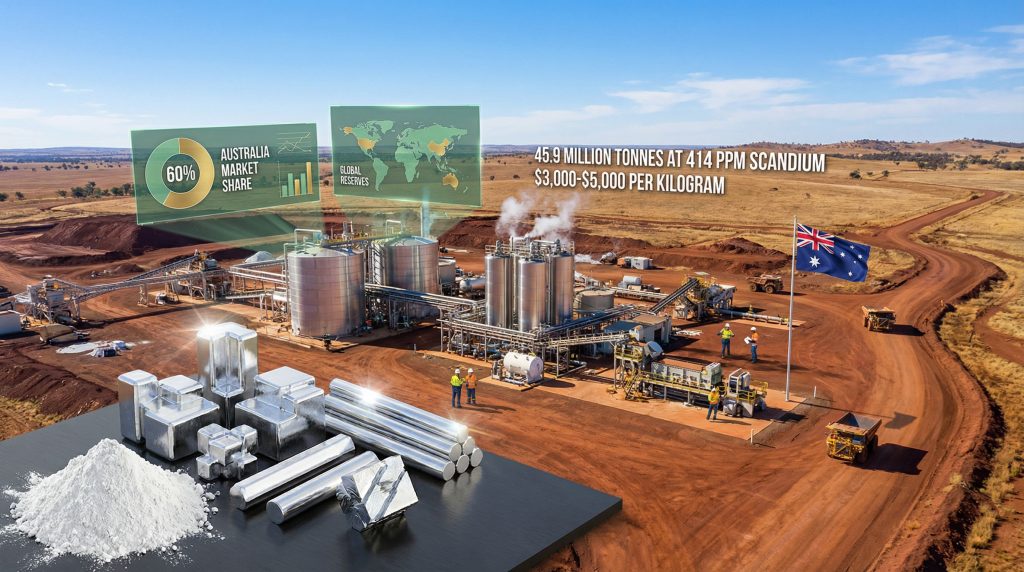
The Syerston project represents the world's largest and highest-grade primary scandium resource, containing 45.9 million tonnes at 414 ppm scandium within laterite formations 450 kilometres west of Sydney. This massive resource base supports an estimated 32-year mine life with contained scandium metal exceeding 19,000 tonnes, positioning the project as a foundational element in global scandium supply diversification.
Recent resource updates have confirmed the deposit's exceptional grade consistency, with upper laterite zones reaching 500+ ppm scandium content suitable for selective mining operations. However, the resource's geological characteristics enable high-pressure acid leach processing to extract scandium alongside valuable nickel and cobalt by-products, creating multiple revenue streams that enhance project economics.
Syerston Project Technical Specifications:
- Resource Category: Measured and Indicated Resources totalling 45.9 million tonnes
- Average Grade: 414 ppm scandium, 0.75% nickel, 0.04% cobalt
- Strip Ratio: 1.2:1 waste to ore, reflecting minimal overburden requirements
- Processing Method: High-pressure acid leach with scandium, nickel, and cobalt recovery
- Production Target: 75-100 tonnes scandium oxide annually (estimated)
Advanced Development Status and Construction Timeline
The Syerston scandium project has progressed through comprehensive feasibility studies and environmental approvals, with construction targeting commencement by mid-2026. Development funding of $46 million has been secured for detailed engineering and early construction activities, while an updated feasibility study expected in Q1 2025 will provide refined capital cost estimates and production schedules.
Development Milestones and Critical Path Activities:
- Q1 2025: Updated feasibility study completion with refined economics
- Q2 2025: Project financing finalisation and detailed engineering contracts
- Q3 2025: Long-lead equipment ordering and site preparation activities
- Mid-2026: Construction commencement following permit finalisation
- 2028-2029: Production ramp-up and commercial operations target
The project's strategic partnerships with Western aluminium manufacturers provide natural demand integration, potentially enabling long-term supply agreements that support project financing and ensure market access for scandium production.
Nyngan Project: Shovel-Ready Production Capability
While Syerston represents the largest scandium resource globally, the Nyngan scandium project positions itself as the most advanced development, with completed feasibility studies, secured environmental approvals, and established processing technology ready for immediate implementation. Located 500 kilometres northwest of Sydney, Nyngan contains 16.9 million tonnes at 235 ppm scandium, supporting annual production of 37.7 tonnes scandium oxide over a 20-year mine life.
The project's economic analysis demonstrates robust financial returns with projected after-tax cash flows of US$629 million and a net present value of US$177 million at 10% discount rates. Operating cost advantages emerge through co-product revenue streams from nickel and cobalt recovery, creating natural hedges against scandium price volatility, whilst incorporating data-driven mining operations to optimise efficiency.
Nyngan Project Financial Metrics:
- Capital Cost Estimate: $150-200 million for integrated mining and processing
- Operating Costs: $1,850 per tonne scandium oxide (net of by-product credits)
- Payback Period: Approximately 6 years from production commencement
- Internal Rate of Return: 23% post-tax over 20-year mine life
- Annual Revenue: $185 million at $4,500/kg scandium oxide pricing
Technology Risk Mitigation and Operational Readiness
The Nyngan project's operational readiness stems from comprehensive pilot plant testing and technology validation programmes completed over multiple years. High-pressure acid leach processing has been demonstrated at semi-commercial scale, with scandium recovery rates consistently exceeding 85% and product quality meeting aerospace specification requirements.
Process Technology Validation Results:
- Scandium Recovery: 85-95% extraction efficiency from laterite feed
- Product Purity: >99.9% scandium oxide meeting aerospace specifications
- By-product Recovery: 75% nickel and 65% cobalt extraction rates
- Environmental Performance: Acid consumption and waste generation within permitted limits
The project's technology de-risking positions it as the most likely candidate for near-term scandium production globally, providing Western markets with their first reliable primary supply source independent of Chinese processing facilities.
HPAL Technology Enables Economic Extraction
High-pressure acid leach technology represents the breakthrough that transforms NSW's laterite resources from geological curiosities into economically viable mining operations. Operating at temperatures of 250-270°C and pressures of 45-55 atmospheres, HPAL processing efficiently dissolves scandium from iron-rich clays while simultaneously recovering valuable nickel and cobalt.
The technology's effectiveness stems from the aggressive chemical environment that breaks down laterite mineral structures, releasing scandium ions into solution for subsequent purification stages. Recovery rates typically exceed 85% for scandium, with co-product metals providing additional revenue streams that significantly improve overall project economics.
HPAL Processing Technical Parameters:
- Operating Temperature: 250-270°C in pressurised autoclaves
- Operating Pressure: 45-55 atmospheres (4.5-5.5 MPa)
- Residence Time: 45-90 minutes depending on ore characteristics
- Acid Consumption: 180-220 kg sulfuric acid per tonne of ore processed
- Energy Requirements: 150-200 kWh per tonne, primarily for heating and pressure maintenance
Processing Circuit Design and Optimisation
Modern HPAL circuits incorporate heat recovery systems and optimised reactor configurations that minimise energy consumption while maximising metal extraction rates. Furthermore, the technology's proven track record in nickel-cobalt operations provides operational confidence for scandium applications, with modifications focusing on scandium-specific purification requirements.
HPAL Circuit Configuration for Scandium Recovery:
- Feed Preparation: Ore slurrying and acid pre-treatment to 40% solids concentration
- Pressure Leaching: Multi-compartment autoclaves with staged acid addition
- Solid-Liquid Separation: Counter-current decantation for solution clarification
- Purification: Solvent extraction and precipitation for individual metal recovery
- Product Finishing: Calcination and packaging to customer specifications
The integration of scandium recovery into existing HPAL flowsheets represents a significant competitive advantage for NSW projects, leveraging decades of operational experience in laterite processing while adding high-value product streams.
The next major ASX story will hit our subscribers first
Market Dynamics and Investment Considerations
Scandium pricing exhibits significant volatility due to limited supply sources and concentrated demand from specialised applications. Current pricing ranges from $3,500-$4,200 per kilogram for scandium oxide, representing a 35-40% increase from pre-restriction levels of approximately $2,600 per kilogram in early 2025.
The market's price sensitivity reflects both supply constraints and the metal's high-value applications where cost represents a minimal component of final product value. Aerospace components using scandium alloys typically see material costs representing less than 5% of finished component value, enabling price premiums that support mining project development. This trend supports the Australia critical minerals reserve strategy.
Scandium Pricing Drivers and Market Dynamics:
- Supply Disruptions: Chinese export restrictions creating immediate price pressure
- Technology Adoption: Expanding aerospace and automotive sector utilisation
- Research Development: Patent activity and application expansion driving demand growth
- Inventory Management: Limited strategic stockpiles amplifying price volatility
- Quality Specifications: Premium pricing for aerospace-grade purity levels
Capital Investment Requirements and Return Profiles
NSW scandium projects require substantial upfront capital investment, typically ranging from $150-400 million for integrated mining and processing operations. However, high product values and long mine lives generate attractive returns for successful developments, with payback periods of 6-8 years and internal rates of return exceeding 20% in most scenarios.
Investment Risk Assessment for NSW Scandium Projects:
- Technology Risk: HPAL processing proven but requires skilled operation and maintenance
- Market Risk: Limited number of qualified buyers and potential demand volatility
- Regulatory Risk: Environmental permitting complexity for acid processing operations
- Capital Risk: Large upfront investment with extended development timelines
- Operational Risk: Remote location logistics and skilled workforce requirements
Despite these challenges, the strategic importance of supply chain diversification and government support for critical mineral projects create favourable investment conditions for well-positioned scandium developments.
Supply Chain Transformation and Strategic Benefits
NSW scandium production will fundamentally transform global supply chains for Western manufacturing sectors, providing critical diversification away from Chinese sources while enabling more resilient production planning. This geographic redistribution particularly benefits aerospace and defence contractors requiring secure, long-term supply agreements backed by allied nation sources.
The development of Australian scandium capacity creates opportunities for regional supply chain optimisation, reducing transportation costs and delivery times for Asia-Pacific manufacturers while simplifying customs and regulatory compliance procedures compared to Chinese sourcing arrangements.
Supply Chain Optimisation Benefits:
- Reduced Transit Times: 7-14 days versus 21-30 days from Chinese sources to key markets
- Simplified Logistics: Direct port access eliminating inland transportation requirements
- Currency Stability: Australian dollar transactions reducing foreign exchange volatility
- Quality Assurance: Allied nation quality standards and certification processes
- Strategic Security: Secure supply arrangements supporting defence and aerospace applications
Technology Transfer and Innovation Partnerships
The emergence of NSW as a primary scandium supplier creates opportunities for technology transfer and innovation partnerships between Australian mining companies and international manufacturers. These collaborations accelerate both mining efficiency improvements and new application development, expanding market opportunities for scandium utilisation.
Innovation Partnership Opportunities:
- Advanced Alloy Development: Collaborative research with aerospace manufacturers on next-generation compositions
- Processing Technology: Joint development of improved extraction and purification methods
- Application Engineering: Material testing and certification for new industrial uses
- Circular Economy: Recycling technology development for end-of-life scandium recovery
- Quality Systems: Advanced analytical and quality control methodology development
These partnerships create competitive advantages for NSW producers through enhanced customer relationships and accelerated market development for emerging scandium applications.
Environmental Stewardship and Sustainable Development
NSW scandium mining operations must navigate complex environmental requirements while maintaining social licence to operate in rural communities. Modern mining practices emphasise comprehensive environmental management systems that protect water resources, conserve biodiversity, and ensure sustainable post-mining land use, aligning with broader mining sustainability transformation initiatives.
Environmental management strategies for scandium projects focus on water recycling systems that minimise fresh water consumption and prevent contamination of local water supplies. Acid neutralisation and waste containment systems ensure that processing residues meet long-term stability requirements for permanent disposal.
Environmental Management Priorities:
- Water Resource Protection: Closed-circuit processing with 85% water recycling rates
- Waste Management: Neutralised tailings disposal in engineered containment facilities
- Air Quality Control: Dust suppression and emission monitoring systems
- Biodiversity Conservation: Habitat preservation and post-mining ecosystem restoration
- Cultural Heritage: Indigenous site protection and consultation protocols
Community Engagement and Regional Development
Successful scandium mining developments create significant regional economic benefits through direct employment, local procurement opportunities, and community investment programmes. Projects typically employ 200-400 people during construction and 150-250 during operations, with preference for local hiring and training programmes.
Community Benefit Delivery Mechanisms:
- Local Employment: Skills training and apprenticeship programmes for regional residents
- Business Development: Procurement opportunities for regional service providers
- Infrastructure Investment: Road upgrades and community facility improvements
- Education Partnerships: University research collaborations and student placement programmes
- Economic Diversification: Reduced dependence on traditional agricultural activities
These community engagement strategies ensure that scandium mining contributes to sustainable regional development while maintaining strong relationships with local stakeholders throughout the project lifecycle.
Future Market Development and Technology Innovation
The global scandium market remains in early development stages with significant expansion potential as new applications emerge and existing uses scale up. Market growth drivers include expanding aerospace industry adoption, electric vehicle lightweighting requirements, and renewable energy infrastructure development requiring advanced materials.
Current annual global demand approximates 10-15 tonnes of scandium oxide, growing at 7-10% annually as technology adoption accelerates across multiple industrial sectors. This growth trajectory supports multiple NSW projects reaching production simultaneously without oversupplying the market.
Emerging Application Sectors for Scandium:
- Electric Vehicle Batteries: Thermal management systems requiring lightweight, heat-resistant materials
- Renewable Energy: Wind turbine components and solar panel frames using scandium alloys
- Electronics Manufacturing: High-performance heat sinks and electromagnetic shielding applications
- Medical Devices: Implantable components requiring biocompatible, high-strength materials
- Sports Equipment: Premium bicycles, golf clubs, and performance equipment using scandium alloys
What Technologies Are Driving Cost Reduction?
Continued technological advancement will drive cost reductions and efficiency improvements across NSW scandium operations through automation, energy recovery systems, and process optimisation. Innovation priorities include digital monitoring systems, predictive maintenance programmes, and waste minimisation technologies.
Technology Development Priorities:
- Process Automation: Advanced control systems reducing labour costs and improving consistency
- Energy Integration: Renewable power systems and waste heat recovery reducing operating costs
- Digitalisation: Real-time monitoring and optimisation using artificial intelligence and machine learning
- Sustainability: Circular economy approaches maximising resource utilisation and minimising waste
- Innovation Networks: Collaborative research programmes with universities and technology companies
These technological advances will position NSW scandium operations at the forefront of sustainable mining practices while maintaining competitive cost structures in global markets.
NSW's emergence as the world's primary scandium supplier represents a convergence of exceptional geological resources, proven processing technologies, and favourable geopolitical circumstances that create compelling investment opportunities while addressing critical supply chain security requirements for Western manufacturing industries. Consequently, the state's scandium mining projects offer the potential to establish Australia as a dominant force in this strategic market, contributing to both economic growth and national security objectives while supporting the global transition toward advanced manufacturing technologies.
As these developments progress toward production, scandium mining in New South Wales will likely become a cornerstone of Australia's critical minerals strategy, demonstrating how resource advantages can be transformed into sustainable competitive advantages in high-technology markets. The success of these projects will establish precedents for critical mineral development whilst providing essential materials for next-generation aerospace, automotive, and energy applications.
Looking to Capitalise on Critical Minerals Opportunities?
Discovery Alert's proprietary Discovery IQ model delivers instant notifications on significant ASX mineral discoveries, including critical metals like scandium that are reshaping global supply chains. With NSW positioning itself as a dominant scandium supplier and Chinese export restrictions creating unprecedented opportunities, stay ahead of major mineral discoveries that could generate substantial returns for early investors. Begin your 30-day free trial today to secure your competitive advantage in this rapidly evolving market.