June 26, 2026
The Hidden Energy Crisis That Mining Can No Longer Ignore
Every tonne of copper, gold, or critical mineral extracted from the earth carries an invisible energy debt — one that is rarely discussed outside of processing plant engineering circles. Before a single gram of metal reaches a smelter or refinery, the rock encasing it must be broken, again and again, until individual mineral grains are small enough to separate from the surrounding waste. This process, known in the industry as comminution, is not a minor operational footnote. It is the single largest consumer of electrical energy across the entire mining value chain, routinely accounting for 30 to 40 percent of a mine site's total energy budget.
The problem is not static. As the world's richest ore bodies are progressively depleted, miners are forced to process increasing volumes of lower-grade rock to maintain output. A copper deposit that once yielded 2 percent metal per tonne may now return less than 0.5 percent, meaning four times the rock must be crushed and ground to produce the same quantity of metal. The energy mathematics of this trend are deeply uncomfortable for an industry simultaneously being asked to decarbonise its operations.
Furthermore, the mining decarbonisation benefits of addressing comminution directly are substantial, making this context precisely why lightning that breaks rocks mining research is not merely an interesting scientific curiosity, but a genuine strategic imperative.
When big ASX news breaks, our subscribers know first
Why Conventional Comminution Technology Is Reaching Its Limits
The fundamental engineering of mineral grinding has changed remarkably little over the past century. Ball mills, rod mills, and semi-autogenous grinding circuits apply mechanical force to rock indiscriminately, pulverising valuable ore and barren waste alike until the target particle size is achieved. This approach is energy-intensive precisely because it does not distinguish between the rock worth processing and the rock that is not.
Existing pre-concentration technologies offer only partial solutions:
- Dense media separation removes coarse gangue early but requires significant infrastructure and is limited by particle size constraints
- Sensor-based ore sorting can divert low-grade material before it enters the mill, but works at the rock fragment level rather than the mineral grain level
- Flotation and leaching circuits achieve mineral separation with chemical selectivity, but only after the energy of grinding has already been spent on the entire feed mass
The critical gap in all of these approaches is timing. Energy is consumed on barren rock before any separation takes place. What the industry has long needed is a mechanism capable of selectively targeting mineralised material before the grinding circuit, at the grain boundary level, using a fundamentally different physics.
That mechanism now exists in the form of High Voltage Pulse technology.
What Lightning That Breaks Rocks Actually Means: The Physics of HVP
The phrase lightning that breaks rocks is more than a vivid metaphor. It describes a precise physical mechanism that researchers have spent decades working to replicate at industrial scale.
When a natural lightning bolt contacts rock, an enormous current passes through the material almost instantaneously. The resistive heating effect, described mathematically as I²R heating (where I represents current and R represents resistance), causes any moisture present within the rock's micro-fracture network to flash-vaporize into steam. This phase transition is effectively instantaneous at the energy densities involved, and the resulting volumetric expansion generates internal pressure that far exceeds the tensile strength of the surrounding rock matrix.
The failure mode this produces is called spallation — an explosive internal fracturing that radiates outward from the point of maximum energy concentration. Critically, the fractures follow the paths of least mechanical resistance, which in a mineralised rock correspond to the natural boundaries between different mineral phases. Research published on ResearchGate exploring lightning rock destruction using impulse high-current generators has helped validate these fracture mechanics at the laboratory level.
This grain boundary preference is not incidental. It is the central engineering advantage of High Voltage Pulse technology over every conventional comminution method currently in operation.
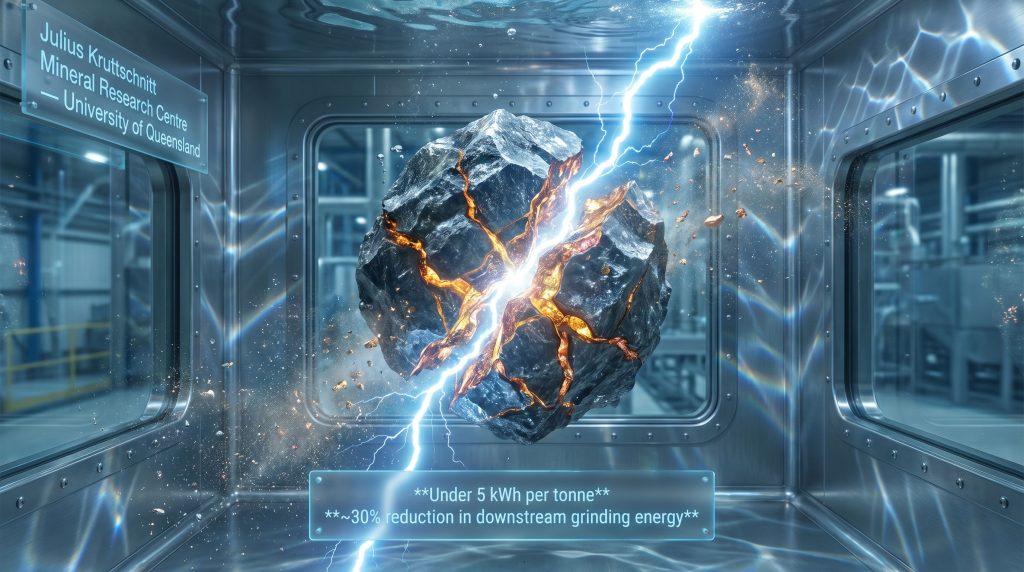
High Voltage Pulse technology replicates this mechanism by discharging extremely brief electrical pulses of up to 200 kilovolts through rock fragments submerged in water. The pulse duration is measured in nanoseconds, far shorter than any conventional electrical switching event in industrial machinery. The water medium serves a dual purpose: it contains the explosive energy release and channels the pulse through the rock rather than allowing it to dissipate into the surrounding environment.
The selectivity of the process arises from a fundamental difference in electrical properties between mineralised and non-mineralised rock. Conductive mineral phases, including copper sulphides such as chalcopyrite and gold-associated sulphide minerals, present lower electrical resistance pathways through the rock. The HVP pulse automatically concentrates its energy within these conductive zones, fracturing preferentially along the mineral grain boundaries while leaving resistive barren gangue largely intact.
Step-by-Step: How the HVP Process Operates in Practice
Understanding the operational sequence helps clarify how this technology integrates into an existing processing flowsheet:
- Feed introduction: Crushed run-of-mine ore is loaded onto an electrified grizzly — a processing platform constructed from parallel conductive bars submerged in a water medium
- Pulse discharge: Nanosecond-duration electrical pulses at voltages reaching 200 kV are discharged across the grizzly bars and through the submerged rock
- Selective energy concentration: The electrical pulse follows the path of lowest resistance, concentrating energy within conductive, mineralised rock particles
- Grain boundary fracture: Internal fracturing occurs preferentially along natural mineral grain boundaries, liberating individual mineral grains in a substantially intact condition
- Barren rock bypass: Non-conductive or low-grade gangue material absorbs minimal pulse energy and passes over the grizzly bars, enabling early diversion before grinding
- Pre-weakened ore delivery: The selectively fractured ore stream enters the conventional grinding circuit in a significantly weakened condition, requiring substantially less energy to achieve target particle sizes
Quantifying the Efficiency Advantage: HVP vs. Conventional Grinding
The performance gap between High Voltage Pulse technology and conventional comminution becomes starkest when expressed in quantitative terms.
| Performance Metric | Conventional Grinding | HVP Technology |
|---|---|---|
| Energy consumption | 30-40% of total site energy | Under 5 kWh per tonne |
| Downstream grinding energy saving | Baseline | Approximately 30% reduction |
| Mineral selectivity | None (processes all material) | High (targets conductive phases) |
| Grain preservation | Poor (grains frequently shattered) | Excellent (fractures at boundaries) |
| Barren rock processing | All material enters mill | Barren rock diverted pre-grinding |
| Renewable energy compatibility | Partial | Full (electrically driven) |
The combination of direct energy reduction and downstream mill energy savings creates a compounding efficiency gain that is operationally significant at scale. When a processing plant handles tens of thousands of tonnes of ore per day, even a modest improvement in energy intensity per tonne translates into substantial reductions in both operating costs and carbon emissions.
An equally important but less discussed benefit is what happens to the ore's metallurgical character after HVP treatment. Because fractures follow grain boundaries rather than cutting through mineral grains, individual copper or gold-bearing particles arrive at flotation circuits in a more liberated state. In addition, the copper processing benefits of improved liberation extend well beyond grinding alone, improving the statistical probability that valuable grains will report correctly to the concentrate rather than being lost to tailings — a recovery improvement that compounds the economic benefit of the energy savings.
Where This Research Is Being Conducted: The Role of JKMRC and UQ
The primary institutional home for lightning that breaks rocks mining research in Australia is the Julius Kruttschnitt Mineral Research Centre (JKMRC), operating within the University of Queensland's Sustainable Minerals Institute (SMI). The JKMRC has been a global reference point for comminution research for several decades, and its expertise in characterising rock breakage mechanisms gives it a distinctive capability to advance HVP from laboratory curiosity to commercial technology.
The institutional context matters. UQ's Mineral and Mining Engineering program was ranked fifth in the world in the 2026 QS World University Rankings by Subject — a result that reflects both the depth of research expertise at the JKMRC and the broader strength of Queensland's minerals research ecosystem. PhD-level researchers at the centre, including Joy Maniaul whose work has attracted recent attention, are investigating the fundamental fracture mechanics, operational parameters, and scale-up engineering challenges associated with deploying HVP in commercially realistic conditions.
Australian Government funding has been committed to support a Phase 2 scale-up from laboratory validation to a pilot plant capable of processing 5 to 10 tonnes of ore per hour. This represents a critical step in the commercialisation pathway, as pilot-scale data is required to underpin the engineering designs and techno-economic models that mining companies need before committing to full-scale integration.
The next major ASX story will hit our subscribers first
Target Commodities and Emerging Applications Beyond Primary Mining
Current HVP research and commercialisation efforts are concentrated on metalliferous ores, particularly copper and gold. The rationale is straightforward: both metals are associated with electrically conductive mineral phases that respond most strongly to the selectivity mechanism of the technology.
- Copper is primarily hosted in sulphide minerals including chalcopyrite, bornite, and chalcocite, all of which are substantially more conductive than the silicate gangue surrounding them in typical porphyry and skarn deposits
- Gold is frequently associated with pyrite and arsenopyrite in orogenic and epithermal systems, creating conductive sulphide networks that HVP energy can selectively target even when native gold grains are too fine to detect with conventional sorting equipment
Beyond primary ore processing, researchers at the JKMRC have identified a second category of application that carries significant long-term potential: the recycling of composite manufactured materials. Printed circuit boards and photovoltaic solar panels both contain high-value metallic components bonded to non-conductive substrates. The conductivity contrast between these phases mirrors the ore-gangue contrast in natural rock, making HVP theoretically well-suited to liberating copper, silver, and rare earth elements from end-of-life electronics without the chemical dissolution processes that currently dominate e-waste recycling. Furthermore, advanced minerals processing techniques continue to evolve alongside HVP, broadening the toolkit available to processing engineers.
This cross-sector applicability is a speculative but scientifically grounded extension of the core technology. It remains at an early research stage and has not yet been validated at pilot scale for recycling applications.
The Decarbonisation Dimension: Why This Technology Matters for Net-Zero Mining
Comminution's disproportionate share of mine site energy consumption makes it the highest-priority target for any credible mining decarbonisation strategy. Grid-scale renewable energy in mining deployments reduce the carbon intensity of the power consumed, but they do not reduce the quantity of power required. That reduction can only come from more efficient processing technology.
HVP addresses this challenge at the source by:
- Reducing total grinding energy requirements by approximately 30% through ore pre-weakening before mill entry
- Eliminating the energy cost of grinding barren rock that is diverted by the pre-concentration step
- Operating entirely on electrical energy, meaning the technology integrates directly with renewable power sources without combustion-related losses or emissions
- Reducing the total mass of material requiring downstream processing, compounding efficiency gains across flotation, thickening, and tailings management circuits
Global copper demand projections consistently identify a structural supply gap emerging in the 2030s as electrification infrastructure, electric vehicle production, and renewable energy systems scale up simultaneously. Meeting that demand from lower-grade ore bodies using conventional processing economics will be commercially and environmentally difficult. However, energy-efficient, high-recovery processing technologies like HVP represent a meaningful part of the solution architecture.
A Paradigm Shift in How the Industry Thinks About Breaking Rock
The deeper significance of lightning that breaks rocks mining research extends beyond any single technology metric. It represents a conceptual break from the foundational assumption of modern mineral processing: that rock must be broken by applying external mechanical force to the entire feed mass.
Precision comminution — the idea that energy delivery should be targeted at specific mineral phases based on their physical properties — opens an entirely new design space for processing engineers. Consequently, as ore bodies become progressively more geometallurgically complex, with variable mineralogy, fine grain sizes, and intimate intergrowths between valuable and gangue phases, technologies that can adapt their energy delivery to the specific character of the feed material will hold an increasing competitive advantage. The AI-powered mining efficiency tools emerging in parallel further amplify this advantage, enabling smarter decisions across the entire processing chain.
Pilot-scale validation at 5 to 10 tonnes per hour will generate the engineering datasets needed to design full-scale HVP circuits capable of integration into the flowsheets of new and existing copper and gold processing operations. The Institute of Materials, Minerals and Mining has also documented HVP's lightning-like mechanics in detail, providing additional peer-reviewed context for the technology's commercial pathway. If that validation proceeds as laboratory results suggest it should, the implications for processing plant capital costs, operating cost profiles, and life-of-mine carbon footprints could be substantial.
The mining industry has long known that comminution needed to change. The physics of lightning may finally be showing it how.
This article contains forward-looking statements and assessments of technology at various stages of development. Readers should note that laboratory and pilot-scale results may not translate directly to commercial outcomes. Independent technical and financial assessment is recommended before drawing investment conclusions.
Want to Stay Ahead of the Next Major ASX Mineral Discovery?
As processing technologies like High Voltage Pulse comminution reshape the economics of lower-grade ore bodies, the most significant returns often flow to investors who identify transformative discoveries earliest — Discovery Alert's proprietary Discovery IQ model delivers real-time alerts on significant ASX mineral discoveries, turning complex mineral data into actionable insights for traders and long-term investors alike. Explore historic examples of exceptional discovery returns and begin your 14-day free trial today to position yourself ahead of the broader market.