June 26, 2026
The Biological Imperative: Why Mining's Future May Lie Beneath the Forest Floor
For most of industrial history, metal extraction has been defined by force: blasting, crushing, roasting, and dissolving ore with aggressive chemicals at extreme temperatures and pressures. This approach has delivered enormous volumes of copper, gold, cobalt, and rare earths to global markets, but it carries an escalating cost in energy consumption, toxic waste generation, and environmental damage that is increasingly difficult to justify against tightening regulatory standards and declining ore grades.
The critical question now facing the mining industry is not whether conventional methods will eventually reach their practical limits, but how quickly alternative technologies can bridge the gap. One of the most scientifically compelling answers comes not from metallurgy or chemical engineering, but from biology — specifically from the kingdom of fungi. The use of fungi for metal extraction in mining is transitioning from a fringe concept to a legitimately funded, actively researched field with real commercial prospects.
When big ASX news breaks, our subscribers know first
The Supply Pressure That Makes Biology Commercially Relevant
Global critical minerals demand is accelerating at a pace that most conventional supply chains are structurally ill-equipped to handle. The energy transition is not an abstract policy aspiration; it is a physical reality measured in tonnes of copper wiring, cobalt cathode material, vanadium for grid-scale redox flow batteries, scandium for aluminium alloys used in aerospace and transport, and rare earth elements powering the permanent magnets in electric vehicle motors and wind turbines.
The challenge is compounded by several converging pressures:
- Average copper ore grades at operating mines have declined from roughly 1.5% to below 0.6% over the past four decades, meaning more rock must be processed for the same metal output
- Permitting timelines for new mines in many jurisdictions now average 16 to 20 years from discovery to first production
- Tailings storage facilities represent one of the mining industry's most significant environmental liabilities, yet they contain substantial residual metal values that conventional processing cannot economically recover
- Chemical leaching reagents including sulphuric acid and sodium cyanide face increasingly restrictive regulation in multiple jurisdictions
Against this backdrop, biological extraction methods are no longer a curiosity. Furthermore, declining cut-off grades across operating mines are making biological alternatives increasingly attractive for processing low-grade ores, mine tailings, industrial waste streams, and legacy contaminated land where conventional methods are either uneconomic or environmentally prohibited.
What Biological Mechanisms Allow Fungi to Extract Metals?
Organic Acid Secretion: The Primary Dissolution Engine
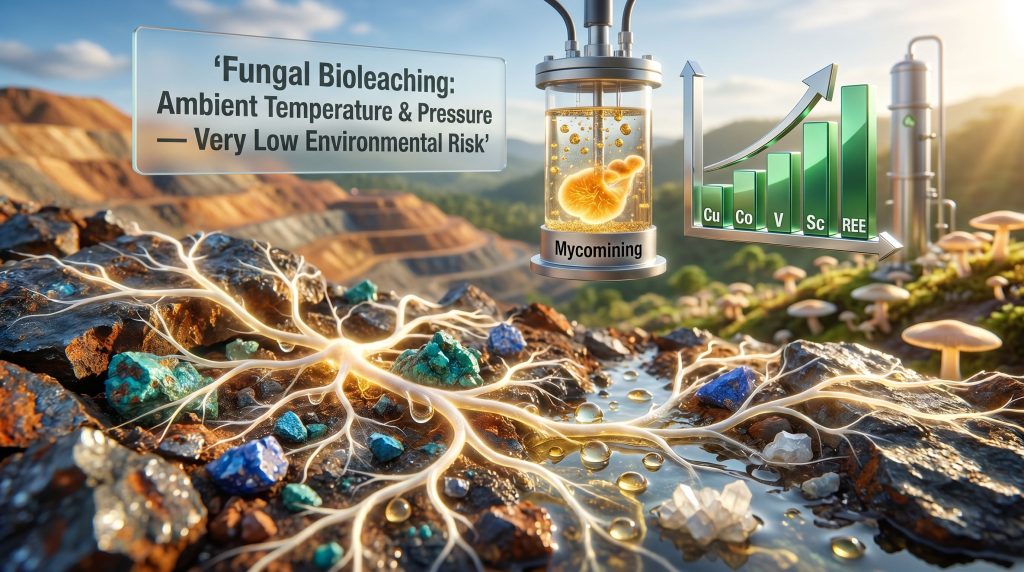
The foundational mechanism behind fungal bioleaching is deceptively straightforward. Certain fungal species, most notably Aspergillus niger, naturally produce organic acids including oxalic acid and citric acid as metabolic by-products. When these organisms colonise mineral surfaces, the localised reduction in pH chemically destabilises the crystalline lattice structures binding metal ions within the rock matrix, dissolving those ions into solution where they can be captured and concentrated through downstream processing.
What makes this mechanism particularly attractive is its operating profile. Unlike conventional hydrometallurgical processes that require elevated temperatures, pressurised reactors, and continuous synthetic chemical inputs, fungal acid secretion occurs under ambient temperature and pressure conditions. The energy footprint is dramatically lower, and the organic acid residues produced are biodegradable rather than persistently toxic.
The table below illustrates how fungal bioleaching compares to established extraction chemistries across key performance dimensions:
| Leaching Method | Primary Agent | Metals Targeted | Environmental Risk | Operating Conditions |
|---|---|---|---|---|
| Fungal Bioleaching | Oxalic / Citric Acid | Cu, Co, V, Sc, REEs | Very Low | Ambient temperature and pressure |
| Bacterial Bioleaching | Bio-generated Sulphuric Acid | Cu, Au, Fe | Low to Medium | Ambient, pH-sensitive |
| Conventional Acid Leaching | Sulphuric Acid | Cu, Zn, Ni | Medium to High | Elevated temperature |
| Cyanide Leaching | Sodium Cyanide | Au, Ag, Pt | Very High | Controlled, toxic waste risk |
Biosorption and Bioaccumulation: Capturing Metals at the Cellular Level
Beyond acid-driven dissolution, certain fungal species possess a second, equally remarkable capability. Species within the Cladosporium genus can bind dissolved metal ions directly to structural components of their cell walls through a process called biosorption. Once ionic metals are bound to the fungal surface, enzymatic reduction converts them into elemental metal nanoparticles, effectively precipitating the target metal from solution without any additional chemical input.
Research findings indicate that some fungal strains operating through this biosorption mechanism can remove up to 80% of dissolved gold from solution. This figure is particularly significant because it points toward a viable biological alternative to cyanide-based gold recovery, one of the most environmentally controversial processes in modern mining. Beyond gold, bioaccumulation extends this principle further: metals are absorbed and concentrated within the fungal biomass itself, allowing batch recovery through straightforward biomass processing.
Mycelial Networks: Nature's Metal Scavenging Infrastructure
A third and often underappreciated mechanism is structural rather than chemical. Fungal mycelial networks extend across very large surface areas relative to their biomass, making simultaneous contact with dispersed mineral particles across a heterogeneous substrate. This architecture is particularly well-suited to the challenges posed by mine tailings, slag heaps, and contaminated soils, where target metals are distributed unevenly through complex matrices.
Unlike conventional leaching circuits that require continuous chemical inputs and produce hazardous effluents, fungal bioleaching systems generate biodegradable organic by-products and can be configured as closed-loop bioreactors, significantly reducing site contamination risk and long-term environmental liability.
The passive, low-energy character of mycelial metal scavenging means that once a culture is established, the biological system continues working without mechanical agitation or continuous reagent addition — a fundamentally different economic model from conventional heap leaching operations.
Which Metals Can Fungi Extract?
Base and Transition Metals
The most extensively documented applications of fungal bioleaching target copper, cobalt, and zinc. Copper recovery via Aspergillus niger acid secretion has been studied in both laboratory and pilot-scale settings, with ongoing optimisation work focused on improving acid yield per unit of fungal biomass and maximising metal recovery from low-grade feedstocks. Cobalt and zinc extraction from polymetallic tailings represent a growing area of applied research, driven by the strategic importance of cobalt in battery chemistry.
Critical and Strategic Metals: Vanadium and Scandium
One of the most technically significant developments in fungal bioleaching research involves work conducted at the University of Queensland, where researchers have developed engineered fungal strains with enhanced tolerance to the toxic chemical environment found in mining tailings. These engineered strains are capable of selectively capturing vanadium and scandium — two metals with limited conventional recovery pathways — from highly contaminated substrate environments.
The strategic importance of this capability should not be understated. Scandium commands significant value as an alloying element for high-strength aluminium used in aerospace and transport. Meanwhile, vanadium is central to the redox flow battery systems increasingly deployed for grid-scale energy storage, underpinning the broader energy transition minerals supply chain. The fact that these metals can potentially be recovered while simultaneously contributing to site remediation creates a genuinely compelling dual-value proposition.
Rare Earth Elements: The Mycomining Frontier
Mycomining represents the most ambitious application of fungal biology to metal recovery. The term specifically refers to the targeted deployment of fungal organisms to accumulate, concentrate, and recover metals from waste streams and contaminated land without the need for excavation or aggressive chemical treatment. Researchers at the University of Vienna are leading mycomining programmes focused on recovering rare earth elements including cerium and other lanthanides from industrial waste streams and legacy contaminated sites.
The rare earth processing challenges associated with conventional methods make fungal approaches particularly attractive. Rare earth elements rarely occur in high concentrations even in dedicated deposits; they are dispersed through host rock in ways that make conventional concentration and separation both energy-intensive and chemically complex. Fungal mycelial networks, with their ability to extend through heterogeneous substrates and scavenge metals at very low concentrations, are architecturally well-suited to this challenge.
Precious Metals: A Cyanide-Free Alternative
The application of fungal biosorption to gold, platinum, and palladium recovery is attracting serious research interest precisely because it offers a biological pathway around cyanide chemistry. Pilot projects are currently exploring closed-loop bioreactor systems for precious metal recovery from both low-grade ore residues and electronic waste streams — the latter representing a rapidly growing feedstock category as global e-waste volumes expand.
The Cladosporium gold nanoparticle formation mechanism has been scientifically validated at laboratory scale. The pathway to commercial application depends on demonstrating consistent, reproducible performance in bioreactor environments at sufficient throughput to be economically meaningful.
How Fungal Bioleaching Stacks Up Against Conventional Methods
Environmental Performance
The environmental advantages of fungal extraction over conventional methods are substantial and multi-dimensional:
- Energy consumption: ambient operating conditions eliminate the thermal energy demands of pyrometallurgical smelting and high-temperature leaching circuits
- Carbon emissions: the carbon footprint of biological processing is a fraction of that associated with conventional hydrometallurgy at equivalent scale
- Waste streams: organic acid residues are biodegradable; conventional processes generate tailings dams, acid mine drainage, and in the case of cyanide leaching, acutely toxic impoundments
- Land disturbance: mycomining applied to tailings and waste streams requires no new excavation, contrasting sharply with greenfield mine development
Economic Positioning and the Tailings Opportunity
Current cost-per-tonne economics for fungal bioleaching remain less favourable than mature conventional methods when applied to high-grade primary ore. However, this framing misses the most important economic opportunity. The genuinely transformative application of fungi for metal extraction in mining is not as a replacement for conventional processing of high-grade ore, but as a cost-effective method for extracting value from feedstocks that have no conventional extraction value at all.
Mine tailings represent one of the clearest examples. Globally, there are billions of tonnes of tailings containing residual copper, cobalt, vanadium, scandium, and REEs at concentrations that are uneconomic to process conventionally but potentially viable through low-cost biological methods. For mining companies, tailings are currently environmental liabilities requiring ongoing management expenditure. Consequently, fungal bioleaching could convert those liabilities into revenue-generating assets while simultaneously supporting mine reclamation efforts and reducing the long-term remediation burden.
Scalability and Technology Readiness
Fungal bioleaching currently sits at a technology readiness level that places it firmly in the transition from laboratory proof-of-concept to pilot-scale bioreactor demonstration. The key engineering challenges are not trivial:
- Maintaining fungal culture purity and biological activity at industrial scale without contamination by competing organisms
- Managing organic acid concentrations to optimise leaching performance without inhibiting fungal metabolism
- Integrating biological processing stages with downstream metal separation circuits such as solvent extraction and electrowinning
- Designing bioreactor systems capable of handling heterogeneous waste feedstocks at commercially meaningful throughput rates
Realistic timelines suggest that commercial-scale mycomining operations are 5 to 10 years from widespread deployment, contingent on continued research investment, engineering advances, and the development of fit-for-purpose regulatory frameworks.
The Current Research and Commercial Landscape
University-Led Research Pipeline
Academic institutions are driving the fundamental science underpinning fungal metal extraction. At the University of Queensland, research led by Dr Denys Villa-Gomez has produced engineered fungal strains with exceptional tolerance to toxic tailings environments, opening pathways to vanadium and scandium recovery from previously intractable waste streams. The University of Vienna's mycomining programme is building a scientific foundation for REE recovery from industrial and post-industrial waste at meaningful scale.
Broader academic activity spans institutions across Australia, Europe, and North America, with Aspergillus, Penicillium, and Cladosporium species all under active investigation for diverse metal targets. Each genus brings distinct biochemical capabilities, and the identification of optimal species-substrate combinations for specific ore types and waste materials remains an active area of inquiry.
Early Commercial Development
The commercial landscape for fungi for metal extraction in mining is nascent but gaining momentum. Myco Metals is among the early-stage companies advancing fungal metal extraction from conceptual frameworks toward commercial prototypes, having gained recognition through industry innovation forums. Patent activity around fungal strain engineering, bioreactor design, and metal recovery process integration is increasing — a reliable signal of commercial intent from both startup ventures and established industry players.
Mine Water Remediation: A Parallel Application
Beyond ore and tailings processing, fungi are demonstrating capability in the passive bioremediation of mining-influenced water from legacy mine sites. Research benchmarks in controlled settings have recorded removal of up to 90% of dissolved metals from mine drainage streams through fungal treatment systems. This application addresses a significant, long-term environmental liability for the industry while creating the possibility of recovering residual metal value from water streams that currently represent a net cost.
The next major ASX story will hit our subscribers first
Limitations, Risks, and Honest Constraints
Technical Constraints
Fungal bioleaching is not without genuine technical challenges. Fungal cultures are sensitive to pH extremes, heavy metal toxicity thresholds that vary by species and strain, and temperature fluctuations. These sensitivities limit deployment flexibility in highly variable field environments. Organic acid production rates differ significantly between species and strains, creating variability in leaching performance across different ore types and waste matrices.
Regulatory Ambiguity
Biological mining agents occupy an unclear regulatory position in most jurisdictions. They do not fit neatly into existing categories for chemical reagents or biological control agents, and environmental release of engineered fungal strains raises biosafety questions for which most mining jurisdictions lack established frameworks. This regulatory uncertainty is a non-trivial barrier to commercial deployment and will require proactive engagement between technology developers, regulators, and the broader mining industry to resolve.
Industry Adoption Dynamics
Mining operators are characteristically conservative technology adopters, typically requiring a decade or more of demonstrated operational performance before committing to novel processing technologies at scale. This conservatism is rational given the capital intensity and operational risk of mining projects. However, it does create a structural delay between scientific validation and commercial adoption that technology developers need to account for in their development timelines and funding strategies.
Scenario Analysis: Three Futures for Fungal Metal Extraction
| Scenario | Conditions Required | Projected Outcome by 2035 |
|---|---|---|
| Accelerated Adoption | Breakthrough strain engineering combined with regulatory clarity | Commercial-scale mycomining operations established at more than 10 sites globally |
| Steady Progression | Continued R&D investment with successful pilot-to-commercial scale-up | Fungal bioleaching recognised as standard processing method for tailings and waste streams |
| Stalled Development | Persistent funding gaps and unresolved regulatory barriers | Technology remains confined to academic research and niche pilot applications |
Frequently Asked Questions: Fungi for Metal Extraction in Mining
What is fungal bioleaching and how does it work?
Fungal bioleaching uses organic acids naturally secreted by fungi to chemically dissolve metal ions from ores, tailings, and industrial waste materials, enabling metal recovery without synthetic chemical reagents or extreme processing conditions.
Which fungi species are most effective for metal extraction?
Aspergillus niger is the most studied species for acid-driven dissolution of base and transition metals. Cladosporium species are most associated with gold biosorption. Engineered strains developed for toxic tailings environments represent a newer category optimised for vanadium and scandium recovery.
Can fungi extract gold without cyanide?
Yes. Biosorption mechanisms in certain fungal species, particularly within the Cladosporium genus, have demonstrated removal of up to 80% of dissolved gold from solution in research settings, offering a cyanide-free alternative currently progressing through pilot-stage development.
Is mycomining commercially available today?
Commercial-scale mycomining is not yet available. The technology is in transition from laboratory validation to pilot bioreactor demonstration, with widespread commercial deployment most likely within the next decade, subject to continued engineering advances and regulatory development.
What metals can be recovered using fungi?
Confirmed targets across laboratory and pilot studies include copper, cobalt, zinc, vanadium, scandium, cerium and other rare earth elements, gold, platinum, and palladium.
How does fungal metal extraction benefit the environment compared to conventional methods?
Ambient operating conditions eliminate high-energy thermal requirements. Biodegradable organic acid by-products replace persistent toxic residues. Carbon emissions are substantially lower than pyrometallurgical alternatives. Furthermore, simultaneous site remediation potential means the technology can address environmental liabilities while generating resource value.
A Technology Whose Time Is Approaching
The convergence of accelerating critical mineral demand, tightening environmental regulation, declining ore grades, and the enormous untapped value locked in global tailings stockpiles creates a structural opening for biological extraction technologies that simply did not exist a generation ago. Fungal bioleaching and mycomining are not yet ready to replace conventional mining at scale, nor should they be positioned that way. Their genuine strength lies in addressing the parts of the resource base that conventional methods cannot handle economically or responsibly.
The priority research agenda is clear: strain engineering for extreme environment tolerance, bioreactor scale-up, metal separation optimisation, and proactive regulatory engagement. The investment case, while early-stage, is grounded in a sound structural logic. As tailings increasingly shift from environmental liabilities to recognised resource assets, and as the economics of biological processing continue to improve, the organisms quietly decomposing organic matter on forest floors may turn out to be among mining's most valuable future tools.
Want to Stay Ahead of the Next Major Mineral Discovery?
Discovery Alert's proprietary Discovery IQ model scans ASX announcements in real time, instantly identifying significant mineral discoveries across critical commodities — including the copper, cobalt, vanadium, and rare earths that biological extraction technologies like mycomining are making increasingly viable to recover. Explore how historic discoveries have delivered substantial returns and begin your 14-day free trial at Discovery Alert to position yourself ahead of the market.