June 26, 2026
When Electricity Becomes the Drill: The Physics Reshaping Ore Processing
The global mining industry has spent more than a century refining a fundamentally unchanged idea: if you want to liberate valuable minerals from rock, you apply force. Massive rotating mills, high-pressure crushers, and explosive-laden blast holes have defined comminution for generations. However, as ore grades continue their long structural decline and energy costs climb alongside decarbonisation pressure, the industry is quietly confronting a limit to what brute-force mechanics can deliver. The next frontier in rock fracture does not come from a bigger motor or a stronger steel drum.
It comes from understanding what a lightning bolt does to a rock, and engineering that phenomenon into a repeatable, precision process.
The phrase lightning that breaks rocks in mining research is not metaphor. It describes a category of electropulse technology that mirrors the physics of atmospheric electrical discharge, weaponising those forces for ore liberation in a controlled, industrial setting.
When big ASX news breaks, our subscribers know first
The Energy Crisis Hidden Inside Every Tonne of Ore
Why Conventional Comminution Is No Longer Fit for Purpose
Few mining professionals outside processing circles appreciate just how energy-intensive crushing and grinding really is. Comminution, the collective term for all stages of size reduction from blasting through to fine grinding, accounts for an estimated 30 to 40% of total mine site energy consumption. At the scale of a large copper or gold operation, that figure translates into tens of millions of dollars in annual electricity costs and a correspondingly large carbon footprint.
The structural problem runs deeper than energy prices. Global ore grades are in long-term decline. Copper head grades at many major producing mines have fallen by more than 30% over the past two decades, according to industry data. As grades drop, operators must process progressively more tonnes of rock to recover the same quantity of metal. Every tonne processed through a ball mill or SAG circuit consumes energy regardless of whether it contains copper, gold, or nothing at all.
Conventional mechanical grinding cannot distinguish between mineralised ore and barren gangue. It simply reduces everything to a uniform particle size and lets downstream flotation circuits do the sorting work. Furthermore, this inability to selectively fracture ore is not merely inefficient — it is increasingly incompatible with the economics of processing lower-grade, more complex deposits at scale. The critical minerals demand surge, particularly for copper and gold, demands a processing philosophy that is fundamentally more discriminating. In addition, the mining innovation trends shaping 2025 and beyond are accelerating the search for alternatives.
What Selective Fracture Actually Means
The Core Concept That Changes the Equation
Key Concept: Selective fracture refers to the preferential breakage of mineralised ore particles while leaving barren gangue rock structurally intact, enabling upstream pre-concentration and reducing the total mass of material that must pass through energy-intensive downstream circuits.
Conventional crushers apply mechanical force indiscriminately across all material in their path. The force does not know, and cannot know, whether a particle contains copper or calcium carbonate. Electropulse methods work on an entirely different principle: they exploit the difference in electrical conductivity between mineralised particles and barren rock.
Conductive mineral phases, including sulphide copper minerals such as chalcopyrite and bornite, and native gold, present a low-resistance pathway for electrical discharge. The pulse preferentially follows those pathways, generating rapid thermal stress along mineral grain boundaries rather than through the bulk of the rock. The barren waste matrix, being far less conductive, largely resists the discharge and remains intact. Consequently, the result is a liberated mineral product that arrives at the flotation circuit already partially separated from its host rock.
The Physics Behind Lightning That Breaks Rocks
How a Lightning Strike Fractures Geological Material
Natural lightning delivers an instantaneous, extraordinarily high-voltage electrical discharge that converts electrical energy into heat via resistive heating (the I²R mechanism familiar to electrical engineers). The thermal event is violent and nearly instantaneous. Within porous or moisture-bearing rock structures, including sandstone and many sedimentary formations, residual water or mineral salts vaporise almost instantaneously.
The resulting internal vapour pressure exceeds the tensile strength of the rock matrix, generating explosive fracture from within the material rather than from an external mechanical force applied at the surface. Research into how lightning reshapes rocks at the atomic level has further confirmed the extraordinary forces involved in even a single discharge event. Laboratory experiments using high-voltage discharge equipment have consistently confirmed that lightning-equivalent energy pulses are highly effective at fracturing geological samples across a wide range of rock types.
Engineered Electropulse vs. Natural Lightning: Key Differences
The engineering challenge in High Voltage Pulse (HVP) technology is not replicating lightning's raw power. It is harnessing the same underlying physics in a controllable, repeatable, and safe system that can be integrated into a continuous processing circuit.
| Feature | Natural Lightning | HVP Technology |
|---|---|---|
| Voltage | Up to ~1 billion volts | Up to 200 kV (controlled) |
| Targeting | Random, uncontrolled | Directed at conductive mineral particles |
| Pulse duration | Milliseconds | Nanoseconds (ultra-short pulses) |
| Mining application | Safety hazard | Precision ore liberation tool |
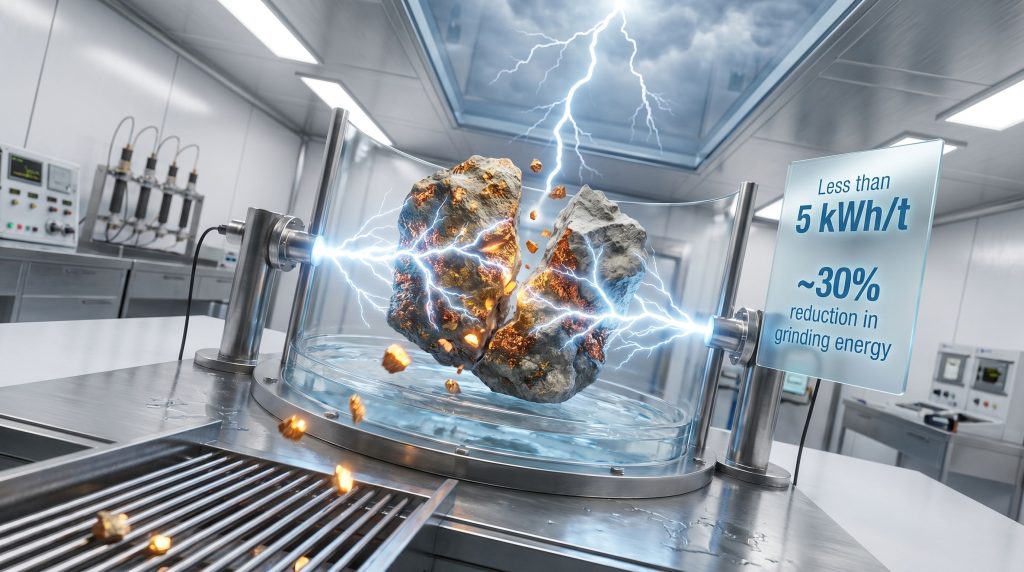
| Energy requirement | N/A | Less than 5 kWh per tonne |
| Commercial status | N/A | Pilot plant scale-up underway |
The shift from millisecond to nanosecond pulse duration is not a minor technical footnote. Ultra-short pulses concentrate the discharge energy into the solid material before the surrounding water medium can conduct the charge away. The aqueous processing environment actually serves as a dielectric insulator at nanosecond timescales, forcing breakdown energy into the rock rather than dissipating it through the liquid. This is a subtle but critical aspect of why the technology works, and why water is a feature rather than a limitation of the process design.
How HVP Processing Works: A Step-by-Step Breakdown
The Operational Sequence From Feed to Liberation
Understanding the processing sequence clarifies why HVP represents a pre-concentration tool rather than a direct replacement for grinding circuits.
- Feed preparation – Run-of-mine ore is sized and fed into the HVP processing unit, typically submerged in a water bath.
- Dielectric insulation – The aqueous environment acts as an insulator at nanosecond timescales, channelling pulse energy into the solid ore rather than through the water.
- Ultra-short discharge – Electrical pulses reaching up to 200 kV are released in nanosecond bursts through the submerged ore bed.
- Selective fracture – Mineralised particles fracture preferentially along conductive grain boundaries; barren gangue remains largely intact.
- Grizzly separation – A grizzly screen, a parallel-bar sorting device electrified by the system, allows liberated finer fragments to fall through while coarser barren material passes over the bars.
- Pre-concentrated feed – The liberated, mineralised fraction feeds into conventional grinding and flotation circuits at substantially reduced mass and improved grade, requiring significantly less downstream energy.
Energy Performance Benchmarks
Efficiency Insight: HVP-based pre-concentration has demonstrated a reduction in downstream grinding energy consumption of approximately 30%, with the HVP processing stage itself operating at under 5 kWh per tonne of material, positioning it as one of the most energy-competitive comminution innovations currently in development.
To contextualise that figure: large-scale ball milling and SAG milling circuits typically consume between 10 and 20 kWh per tonne depending on ore hardness and target grind size. A 30% reduction in grinding energy across an operation processing tens of millions of tonnes annually represents a material operating cost improvement. The copper leaching benefits emerging from parallel processing innovations further underscore just how rapidly this space is evolving.
Where the Research Is Being Conducted
JKMRC and the University of Queensland's Role
The Julius Kruttschnitt Mineral Research Centre (JKMRC), housed within the University of Queensland's Sustainable Minerals Institute (SMI), is among the world's foremost institutions in comminution research and mineral processing innovation. The SMI's credibility in this domain is reinforced by an objective institutional benchmark: UQ's Mineral and Mining Engineering program was ranked fifth globally in the 2026 QS World University Rankings by Subject.
Active PhD-level research at the JKMRC is investigating HVP technology across multiple dimensions, including scale-up parameters, performance variability across different ore types, and circuit integration strategies for existing processing plants. This research pipeline is essential because HVP's performance is not uniform across all geological settings. Variables including ore mineralogy, particle size distribution, moisture content, and the specific conductivity contrast between mineralised and barren phases all influence liberation efficiency.
The commercialisation pathway from laboratory demonstration to pilot plant operations has received Australian Government funding support, with primary application development focused on metalliferous ores, particularly copper and gold. Researchers advancing this lightning-based solution have highlighted that the technology holds genuine promise for reshaping processing economics across multiple ore types.
The Ore Type Challenge: Why Geology Matters
One of the less-discussed complexities in HVP scale-up is ore variability. A technology that performs exceptionally on a sulphide copper ore from one deposit may deliver materially different results on a refractory gold ore or a complex polymetallic feed. The conductivity contrast that drives selective fracture depends entirely on the mineralogical composition and texture of the ore.
Disseminated sulphide deposits with coarse-grained mineralisation present a different electrical environment than fine-grained, interlocked oxide ores. This is why pilot plant validation across multiple ore types is a non-negotiable step in the commercialisation process, and why JKMRC's research program encompasses a broad range of ore characterisation work alongside the electrical engineering parameters of the discharge system itself.
The next major ASX story will hit our subscribers first
HVP Technology and Mining Decarbonisation
The Emissions Reduction Case
Comminution is consistently identified as the single largest contributor to energy-related carbon emissions within mineral processing operations. Reducing grinding energy consumption by approximately 30% at a large copper mine translates directly into scope 1 and scope 2 emissions reductions at meaningful scale. When multiplied across the dozens of large-scale operations that copper and gold production depends upon globally, the aggregate decarbonisation potential of widespread HVP adoption is substantial.
Pre-concentration via selective fracture also compresses energy demand across the entire downstream processing chain, not just in the mill. A pre-concentrated feed reduces reagent consumption in flotation, lowers water usage, reduces tailings generation, and decreases the load on thickening and filtration circuits. The energy and emissions benefits are systemic, not isolated to the comminution stage. The broader mining decarbonisation benefits case reinforces why technologies like HVP are attracting serious commercial and academic attention.
Comparison: HVP vs. Conventional Comminution
| Performance Metric | Conventional Grinding | HVP Electropulse Processing |
|---|---|---|
| Energy consumption | 30–40% of total site energy | Less than 5 kWh/t |
| Selectivity | None – uniform breakage | High – targets mineralised particles |
| Pre-concentration capability | Not applicable | Enabled at early processing stage |
| Downstream grinding reduction | Baseline | ~30% reduction |
| Carbon footprint | High | Significantly reduced |
| Technology maturity | Fully commercial | Pilot plant stage |
Natural Lightning as a Mining Hazard: The Other Side of the Equation
When Lightning Becomes a Safety Risk
The same physical principles that make electropulse technology a compelling ore processing tool make natural lightning one of the most serious hazards in surface mining environments. Historical records document more than 40 incidents of unplanned explosive detonations attributed to lightning strikes between 1978 and 1993 alone. Lightning-induced currents travelling through blasting circuits can initiate explosive charges without any deliberate trigger, creating catastrophic risks for personnel and infrastructure.
Mining operations manage lightning risk through several well-established protocols:
- Real-time lightning detection systems that monitor atmospheric electrical activity and alert site personnel to approaching storm cells.
- Non-electric initiation systems designed to eliminate conductive pathways that stray electrical currents can exploit to trigger explosive circuits.
- Operational exclusion zones that suspend blasting activities and surface work during active electrical storm events.
- Earthing and bonding protocols that dissipate stray electrical currents through grounding systems before they can reach explosive materials.
Safety Note: The physical principles that make lightning capable of fracturing rock are the same ones that create catastrophic blasting hazards on mine sites. The engineering achievement of HVP technology lies precisely in harnessing those forces within a fully controlled, enclosed, and repeatable system that eliminates the uncontrolled variables that make natural lightning so dangerous.
The Broader Innovation Landscape in Comminution
Competing and Complementary Technologies
HVP technology does not exist in isolation. It is part of a broader mining innovation wave driven by the same energy cost and decarbonisation pressures. Understanding how these technologies relate to each other clarifies where HVP fits in the processing innovation hierarchy.
| Technology | Processing Stage | Primary Benefit | Maturity Level |
|---|---|---|---|
| HVP Electropulse | Pre-concentration/liberation | Selective fracture, energy reduction | Pilot plant |
| Microwave-assisted comminution | Pre-weakening before crushing | Reduces mechanical energy input | Research/early commercial |
| Selfrag units | Laboratory-scale liberation | High selectivity, research precision | Commercial (lab scale only) |
| Coarse particle flotation | Flotation circuit | Reduces grinding requirement | Commercially deployed |
| Phytomining | Post-processing/site remediation | Metal recovery from contaminated land | Research stage |
Selfrag units, which are laboratory-scale high-voltage pulse devices, have been available in research settings for some time and are widely used for precise mineral liberation in analytical work. They are expensive and low-throughput, however, making them unsuitable for industrial-scale processing. The JKMRC's work on HVP scale-up is specifically addressing the engineering gap between Selfrag-style laboratory precision and the throughput demands of commercial mining operations.
Coarse particle flotation (CPF) is an increasingly deployed complementary technology that reduces the grinding requirement before flotation, and its combination with HVP pre-concentration represents a potentially powerful circuit integration pathway. Furthermore, the mining electrification trends reshaping the sector suggest that electrified processing approaches like HVP will only grow in strategic importance.
Phytomining, in which hyperaccumulating plant species — including certain leafy vegetables currently under investigation at UQ's SMI — are used to extract metals from contaminated soils, represents a fundamentally different paradigm and sits at the research stage. Its relevance to the HVP story is contextual: both technologies reflect a mining research community actively seeking to move beyond the century-old processing playbook.
Frequently Asked Questions
What is lightning that breaks rocks in mining research?
The phrase describes High Voltage Pulse (HVP) technology, an advanced ore processing method that replicates the physics of a lightning strike through ultra-short, high-energy electrical discharges. Unlike mechanical crushing, the technology selectively fractures mineralised particles by exploiting differences in electrical conductivity between ore and waste rock.
How much energy does HVP technology save?
Research indicates HVP pre-concentration reduces downstream grinding energy by approximately 30%, with the HVP processing stage itself operating at under 5 kWh per tonne, compared to conventional milling benchmarks of 10 to 20 kWh per tonne depending on ore hardness.
What ore types is HVP technology being developed for?
Current pilot plant development is focused on metalliferous ores, particularly copper and gold, both of which are central to critical minerals supply chains and global energy transition infrastructure. Ore variability remains an active research challenge, as HVP performance is influenced by mineralogy, grain texture, and conductivity contrast between ore and gangue.
Where is the leading academic research on HVP being conducted?
The Julius Kruttschnitt Mineral Research Centre (JKMRC) at the University of Queensland's Sustainable Minerals Institute is among the leading institutions in this field, with active PhD research programs and pilot plant commercialisation work underway. UQ's Mineral and Mining Engineering program holds a fifth-place global ranking in the 2026 QS World University Rankings by Subject.
Can natural lightning be used deliberately in mining?
Natural lightning is not controllable and poses a severe safety hazard in mining environments, particularly near explosive materials. More than 40 unplanned detonation incidents linked to lightning have been documented between 1978 and 1993. HVP technology achieves comparable fracture physics through controlled, enclosed engineering systems that eliminate the uncontrolled variables that make natural lightning hazardous.
Want to Identify the Next Major Mineral Discovery Before the Broader Market Does?
Discovery Alert's proprietary Discovery IQ model delivers real-time alerts on significant ASX mineral discoveries the moment they are announced, transforming complex geological and market data into actionable investment insights for both short-term traders and long-term investors — explore historic discoveries and their extraordinary returns to understand what's possible, then begin your 14-day free trial at Discovery Alert to position yourself ahead of the market.