
August 14, 2026
The Geological Scorecard That Redirects Billions in Exploration Capital
Every few years, the U.S. Geological Survey publishes a finding that quietly reshapes how energy companies allocate drilling budgets, how federal land managers approach leasing priorities, and how national energy planners recalibrate long-range supply forecasts. These assessments rarely generate the headlines of a major discovery announcement, but their influence on domestic energy strategy runs far deeper than their understated format suggests.
The USGS Buda Limestone oil and gas assessment is precisely this kind of document. It does not announce a bonanza. Instead, it delivers something arguably more valuable to the broader industry: a scientifically grounded confirmation that a century-old Texas formation has been extensively harvested, with only modest volumes remaining to be found. Understanding what that conclusion means, and why it matters, requires looking well beyond the headline numbers.
When big ASX news breaks, our subscribers know first
What the Buda Limestone Actually Is: Geology Before the Numbers
A Cretaceous Carbonate With a Complicated Reservoir Story
The Buda Limestone is an Early Cretaceous carbonate formation that stretches along the Texas Gulf Coast, deposited in a shallow marine environment roughly 100 million years ago. Its reservoir characteristics are fundamentally different from the shale plays that have dominated U.S. energy headlines over the past two decades. Where unconventional formations rely on hydraulic fracturing to create artificial permeability, the Buda Limestone depends almost entirely on natural fracture networks to move hydrocarbons toward the wellbore.
This distinction carries significant implications for how the formation is drilled and evaluated. Matrix porosity in the Buda Limestone typically falls below 6%, which means the rock itself holds very little producible fluid in interconnected pore spaces. Commercial wells in this formation are fundamentally fracture-dependent: if a wellbore intersects a productive natural fracture corridor, it can flow at economically meaningful rates. If it misses those corridors, the well may be essentially nonproductive regardless of how technically sophisticated the completion design is.
Carbonate diagenesis — the post-depositional alteration of the original limestone through cementation, dissolution, and recrystallisation — has further complicated the reservoir picture. Burial history and fluid interactions over geological time have created significant heterogeneity in fracture density and connectivity across the formation's extent, making fracture prediction one of the central geological challenges for any operator targeting the Buda. Understanding geological logging codes is, consequently, essential for operators working within formations of this complexity.
The Eagle Ford Relationship: A Petroleum Systems Perspective
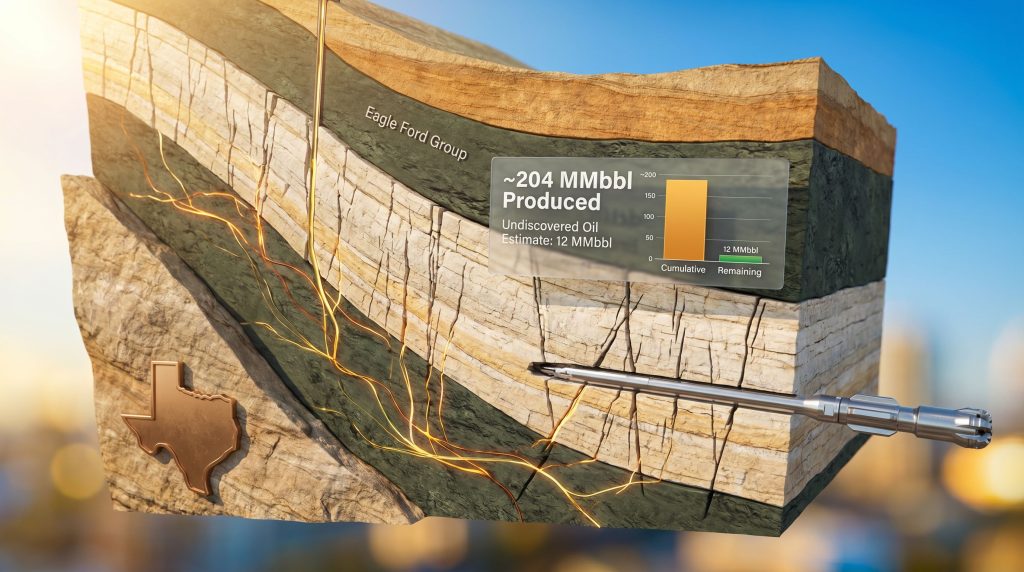
One of the most geologically significant aspects of the Buda Limestone is its position directly beneath the Eagle Ford Group. The Eagle Ford, one of the most intensively drilled unconventional formations in U.S. history, functions as the primary source rock for hydrocarbons found within the Buda Limestone. Organic-rich shales within the Eagle Ford generated oil and gas during burial and thermal maturation, and those hydrocarbons migrated downward through faults, fractures, and stratigraphic pathways into the Buda reservoir below.
This petroleum systems relationship creates an important conceptual framing for interpreting the USGS Buda Limestone oil and gas assessment. The Buda Limestone is not an independent hydrocarbon kitchen; it is a receiver formation whose resource endowment is ultimately constrained by the generative capacity and migration geometry of the Eagle Ford source system above it. Understanding this dependency helps explain why undiscovered resources in the Buda are relatively modest: the most accessible and connected portions of the migration pathway have already been exploited over nearly a century of drilling activity.
A Century of Production and What Remains: The Assessment Numbers in Context
Historical Production Record
Commercial production from the Buda Limestone dates to approximately 1930, making it one of the longer-producing conventional formations in the Texas Gulf Coast hydrocarbon province. Over that roughly 95-year production history, the formation has yielded cumulative volumes that place its remaining resource potential in sharp perspective.
| Metric | Value |
|---|---|
| Production Start Year | ~1930 |
| Cumulative Oil Produced | ~204 million barrels (MMbbl) |
| Cumulative Gas Produced | ~287 billion cubic feet (Bcf) |
| Undiscovered Oil Estimate (Mean) | 12 MMbbl |
| Undiscovered Gas Estimate (Mean) | 184 Bcf |
Key Insight: The undiscovered oil estimate of 12 MMbbl represents less than 6% of the approximately 204 MMbbl already extracted from the formation. This ratio is one of the clearest indicators that the Buda Limestone has been extensively developed over its production history, with the most accessible conventional accumulations already captured.
The gas picture is somewhat more proportional: 184 Bcf of undiscovered gas against 287 Bcf of cumulative production suggests that approximately 39% of the total estimated conventional gas endowment may remain undiscovered. This difference between oil and gas recovery ratios reflects both the migration characteristics of lighter hydrocarbons and the geological heterogeneity of the formation across its productive extent.
What Technically Recoverable Really Means
A critical interpretive point that is frequently misunderstood by non-technical audiences involves the distinction between technically recoverable resources and economically recoverable reserves.
Definition: Technically recoverable resources represent volumes that can be physically extracted using currently available technology and practices, without any requirement that doing so would be commercially profitable at current or projected commodity prices.
This distinction matters enormously for how exploration companies and policymakers read USGS findings. A formation could hold billions of barrels of technically recoverable oil and still be commercially unattractive if extraction costs exceed prevailing market prices. Conversely, even a modest technically recoverable estimate can represent genuine commercial opportunity if the geology is concentrated, infrastructure is nearby, and per-well costs are competitive.
For the Buda Limestone, the combination of low remaining volumes and fracture-dependent reservoir quality means that the gap between technical recoverability and commercial viability is particularly relevant. Operators cannot simply apply a standardised development template; each well carries meaningful geological uncertainty tied to fracture connectivity.
How USGS Conducted the 2025 Assessment: Methodology Unpacked
The Geology-Based Assessment Framework
The USGS employs a structured, geology-first assessment methodology that transforms subsurface data into probabilistic resource estimates. For the Buda Limestone, this process followed a sequence of analytical steps:
- Define assessment unit boundaries using geological province mapping and subsurface data to delineate the formation's productive extent beneath the Eagle Ford along the Texas Gulf Coast.
- Characterise known accumulations by compiling historical production records, well logs, and pressure data from the approximately 95 years of documented Buda production.
- Estimate undiscovered accumulation sizes using probabilistic distributions calibrated to the known size distribution of existing accumulations within the formation.
- Apply analog data from geologically comparable conventional carbonate formations to constrain estimates in areas with limited direct data.
- Aggregate results into mean, F95 (95% probability of exceeding), and F5 (5% probability of exceeding) estimates that capture the statistical range of technically recoverable undiscovered resources.
Importantly, the Buda Limestone was assessed under a conventional resource methodology, which differs from the continuous-resource approach applied to unconventional formations like the Eagle Ford itself. Conventional assessments focus on discrete structural and stratigraphic accumulations rather than basin-wide resource saturation, which is appropriate given the Buda's fracture-controlled, trap-dependent production style.
The findings were formally published as USGS Fact Sheet 2026-3015, titled Assessment of Undiscovered Conventional Oil and Gas Resources in the Buda Limestone of Texas, 2025. USGS Fact Sheets function as peer-reviewed scientific communications within the federal resource assessment programme and carry the methodological rigour of the broader National Oil and Gas Assessment (NOGA) initiative.
Drilling Technology and the Search for Remaining Upside
Modern Techniques Applied to a Mature Carbonate
Despite the formation's advanced production maturity, modern drilling and reservoir characterisation technologies have opened targeted opportunities that conventional vertical drilling programmes historically missed. The mineral exploration importance of applying updated techniques to mature formations is well recognised across the industry. Two techniques are particularly relevant to any residual Buda Limestone development:
- Horizontal drilling allows a wellbore to be oriented along strike or across the dominant fracture trend, dramatically increasing the probability of intersecting multiple natural fracture corridors that a vertical wellbore would contact at only a single point. In a matrix-tight carbonate where fractures carry essentially all producible flow, this geometric advantage can be transformative for individual well economics.
- Underbalanced drilling (UBD) maintains bottomhole pressure below the formation pore pressure during drilling, which prevents drilling fluids from invading and plugging natural fracture apertures. In conventionally drilled Buda wells, fracture damage from overbalanced fluid invasion has historically suppressed initial production rates, meaning some wells may have been prematurely written off as subeconomic when fracture damage, rather than genuine resource absence, was the limiting factor.
Where Residual Opportunity May Concentrate
The practical question for exploration planners is not whether the Buda Limestone holds any remaining undiscovered resources, but where those resources are likely to be concentrated. A well-designed drilling program strategy can, furthermore, make a substantial difference in identifying these residual targets. Several geological settings warrant attention:
- Fracture-controlled sweet spots identified through modern seismic attribute analysis and formation microimager (FMI) log interpretation, which can map fracture density and orientation with considerably greater resolution than legacy wellbore data.
- Stratigraphic trapping mechanisms along the formation's updip margin that may have been geometrically invisible to historical vertical drilling programmes, particularly where diagenetic porosity enhancement intersects structural closure.
- Co-development with Eagle Ford operations, where operators already hold lease positions, have existing surface infrastructure, and can evaluate Buda targets as low-incremental-cost additions to Eagle Ford well programmes through dual-lateral or wellbore re-entry approaches.
| Factor | Implication for Buda Limestone |
|---|---|
| Low remaining undiscovered volumes | Limits scale of new standalone development programmes |
| Proximity to Eagle Ford infrastructure | May improve economics for targeted appraisal wells |
| Natural fracture dependency | High geological risk; fracture prediction remains uncertain |
| Conventional resource classification | Lower per-well cost than unconventional completions |
| UBD technology application | May recover value from historically fracture-damaged wells |
The Strategic Value of Knowing Where Resources Are Not
How Mature Basin Assessments Redirect Exploration Capital
There is a tendency in industry commentary to treat low-resource assessment findings as disappointing. That framing misunderstands how the federal resource assessment system actually functions. The USGS Director's commentary accompanying the 2025 assessment made clear that identifying formations with limited remaining undiscovered potential is itself a productive outcome: it signals to industry where exploration capital should not be concentrated, freeing attention and investment for provinces with greater remaining upside.
Policy Lens: A finding of limited undiscovered resources functions as a data-driven navigation signal. It tells exploration planners, land managers, and federal policymakers that this particular geological address has been substantially exhausted under conventional development paradigms, and that new resource requirements must be sourced elsewhere.
This redirection function is integral to how the Energy Information Administration (EIA) constructs its domestic supply forecasting models. USGS assessment outputs feed directly into EIA resource inventories, which in turn inform the supply-side assumptions embedded in national energy outlooks. A low-resource finding for a mature formation like the Buda Limestone contributes to a more accurate, less optimistic conventional supply baseline, which has downstream implications for infrastructure planning, import dependency modelling, and energy security assessments.
The Buda Limestone in Regional Context
Placing the Buda Limestone alongside other USGS-assessed Texas Gulf Coast formations illustrates just how differentiated the regional resource landscape is, even within a single geological province.
| Formation | Resource Type | USGS Assessment Status | Relative Resource Scale |
|---|---|---|---|
| Buda Limestone | Conventional oil and gas | 2025 Assessment complete | Low (mature) |
| Eagle Ford Group | Unconventional tight oil and gas | Previously assessed | Very high (prolific) |
| Austin Chalk | Unconventional/conventional | Previously assessed | Moderate |
| Woodbine Formation | Conventional oil | Previously assessed | Moderate |
Note: This table provides general comparative context. Individual USGS assessment figures should be verified against official USGS publications at usgs.gov.
The Eagle Ford's position as both the dominant producer in the region and the primary source rock for the Buda Limestone underscores how petroleum systems thinking organises exploration priorities. Formations that sit within productive source-rock kitchen systems but lack the reservoir scale or development economics of the primary target tend to be evaluated as secondary or tertiary opportunities, rarely justifying standalone development programmes at modest resource scales.
The next major ASX story will hit our subscribers first
Frequently Asked Questions: USGS Buda Limestone Assessment
What is the total undiscovered resource estimate for the Buda Limestone?
The USGS Buda Limestone oil and gas assessment estimates a mean of 12 MMbbl of undiscovered technically recoverable oil and 184 Bcf of undiscovered natural gas within the Buda Limestone along the Texas Gulf Coast.
Why is the remaining resource base described as limited?
The characterisation reflects approximately 204 MMbbl of oil and 287 Bcf of gas produced since around 1930. The remaining undiscovered oil estimate is less than 6% of cumulative historical production, confirming the formation's status as a mature, extensively developed conventional play.
What makes the Buda Limestone difficult to produce efficiently?
Matrix porosity below 6% means the rock itself contributes negligible flow. Commercial production depends on intersecting productive natural fracture networks, which are heterogeneously distributed and difficult to predict without advanced seismic and wellbore imaging tools. Interpreting drill results from such formations, however, demands specialist geological understanding that goes well beyond standard reporting metrics.
What is the connection between the Eagle Ford and the Buda Limestone?
The Eagle Ford Group unconformably overlies the Buda Limestone and serves as its primary petroleum source rock. Hydrocarbons generated within the Eagle Ford's organic-rich shales migrated downward into the Buda reservoir through fractures and structural pathways.
Where was the assessment officially published?
The assessment was published as USGS Fact Sheet 2026-3015: Assessment of Undiscovered Conventional Oil and Gas Resources in the Buda Limestone of Texas, 2025, available through the USGS Energy Resources Program.
Does this assessment mean the Buda Limestone has no remaining commercial potential?
Not categorically. Targeted horizontal wells intersecting productive fracture systems, particularly in co-development scenarios with Eagle Ford operations, may retain commercial viability. However, the scale of remaining undiscovered resources limits the formation's relevance as a standalone exploration target.
Key Takeaways for Exploration Planners and Energy Policy Analysts
- The Buda Limestone's undiscovered oil resource of 12 MMbbl represents less than 6% of its cumulative production, confirming it as a mature conventional formation with limited remaining standalone exploration appeal.
- Natural fracture dependency and sub-6% matrix porosity make the Buda a geologically high-risk target where well performance varies substantially based on fracture intersection probability.
- The Eagle Ford Group's dual role as both the region's dominant producing formation and the Buda's primary source rock reinforces the petroleum systems interdependence that shapes exploration targeting across the Texas Gulf Coast stratigraphic column.
- Modern horizontal drilling and underbalanced drilling techniques offer targeted upside potential but do not materially alter the formation's overall resource ceiling.
- USGS assessments of mature formations serve a critical strategic function within the National Oil and Gas Assessment programme: they provide scientifically defensible data on the limits of domestic conventional supply, informing both federal land management priorities and EIA supply modelling.
- The 2025 Buda Limestone finding reinforces a broader trend of declining conventional resource potential in legacy U.S. basins, strengthening the strategic case for continued evaluation of frontier provinces and unconventional plays with greater remaining resource density. In addition, definitive feasibility studies play a complementary role in confirming whether residual targets across mature basins can meet the economic thresholds required for renewed investment.
Readers seeking further context on USGS domestic oil and gas assessments and Texas Gulf Coast geology can access methodology documentation, regional geological reports, and ongoing assessment fact sheets through the official USGS Energy Resources Program at usgs.gov. Industry-level reporting on this assessment is also available via Upstream Online at upstreamonline.com.
Disclaimer: This article is intended for informational and educational purposes only. It does not constitute investment advice, a recommendation to buy or sell securities, or a guarantee of commercial outcomes. Resource estimates cited reflect USGS technically recoverable assessments and do not imply economic viability at any specific commodity price. Forward-looking statements and projections involve inherent uncertainty and should not be relied upon as predictions of future results.
Want to Identify the Next Major Mineral Discovery Before the Broader Market?
While mature formations like the Buda Limestone signal where conventional exploration capital should no longer be concentrated, the real opportunity lies in knowing where significant new discoveries are being made right now — Discovery Alert's proprietary Discovery IQ model delivers real-time ASX mineral discovery alerts, instantly translating complex geological data into actionable investment insights for both short-term traders and long-term investors. Explore historic discovery returns to understand the scale of opportunity that early-stage mineral discoveries can generate, and begin your 14-day free trial today to position yourself ahead of the market.