August 13, 2026
The Data Architecture Behind Critical Minerals Discovery
Exploration geology has always been a discipline shaped by the quality of its information. Long before a drill bit touches the ground, geologists must interpret geochemical patterns, model mineralisation pathways, and draw comparisons between known ore systems and untested ground. The growing critical minerals demand globally has only intensified pressure on the industry to improve how it accesses and applies geological intelligence.
Yet for decades, one of the most persistent constraints on this process has not been the absence of data itself, but the absence of data that can actually be compared across borders, deposit types, and geological survey formats.
This is the fundamental problem that the CMiO-MIN critical minerals database is designed to solve. Built through a trilateral geoscience partnership and released publicly at no cost, it represents a structural upgrade to how the global mining industry accesses, interprets, and applies mineral chemistry intelligence.
When big ASX news breaks, our subscribers know first
Why Fragmented Geoscience Data Has Cost the Industry Decades
The challenge of inconsistent geochemical data is not simply an administrative inconvenience. When national geological surveys collect and store information in incompatible formats, with different classification schemes and varying sample protocols, the result is a fragmented patchwork of intelligence that resists direct comparison.
For exploration geologists attempting to identify deposit analogues in underexplored terranes, this fragmentation compounds at every stage of the targeting process:
-
Bulk geochemical databases held by one jurisdiction cannot be directly cross-referenced with another without manual reformatting, introducing both error risk and time cost.
-
Deposit classification terminology varies between national surveys, meaning a deposit described one way in Australia may have no direct equivalent label in North American datasets.
-
Without standardised mineralogy benchmarks, comparing the mineral chemistry signatures of an established ore system to a prospective greenfields target becomes a largely qualitative exercise.
-
Mine waste and tailings materials, which hold significant value for reprocessing research, are often excluded from national inventory datasets entirely.
The cumulative consequence is that exploration capital is frequently allocated on the basis of incomplete information, increasing discovery risk and extending timelines from early-stage targeting through to resource definition. Understanding the broader mineral exploration importance in this context helps frame why standardised data infrastructure matters so profoundly.
Understanding the Critical Minerals Mapping Initiative
The Critical Minerals Mapping Initiative (CMMI) was established as a multilateral geoscience partnership to address exactly this problem. Rather than operating as a bilateral data-sharing agreement between two nations, the CMMI brought together three of the world's most authoritative geological survey agencies, each contributing distinct institutional strengths.
| Partner Agency | Country | Core Geoscience Role |
|---|---|---|
| Geoscience Australia | Australia | National resource assessment and geospatial data |
| U.S. Geological Survey (USGS) | United States | Federal earth science and mineral resource evaluation |
| Geological Survey of Canada | Canada | National geological mapping and mineral systems research |
The trilateral structure is not incidental. A three-nation framework produces classification outputs that are inherently more transferable across geological and jurisdictional contexts than bilateral arrangements, because any consensus deposit classification must hold across three distinct geological provinces and regulatory traditions. This makes the resulting data more defensible in both scientific and policy settings.
The CMMI's consensus classification framework standardises deposit environments, groups, and deposit types across member nations, providing the taxonomic backbone onto which the CMiO and CMiO-MIN datasets are organised.
What the CMiO-MIN Critical Minerals Database Actually Contains
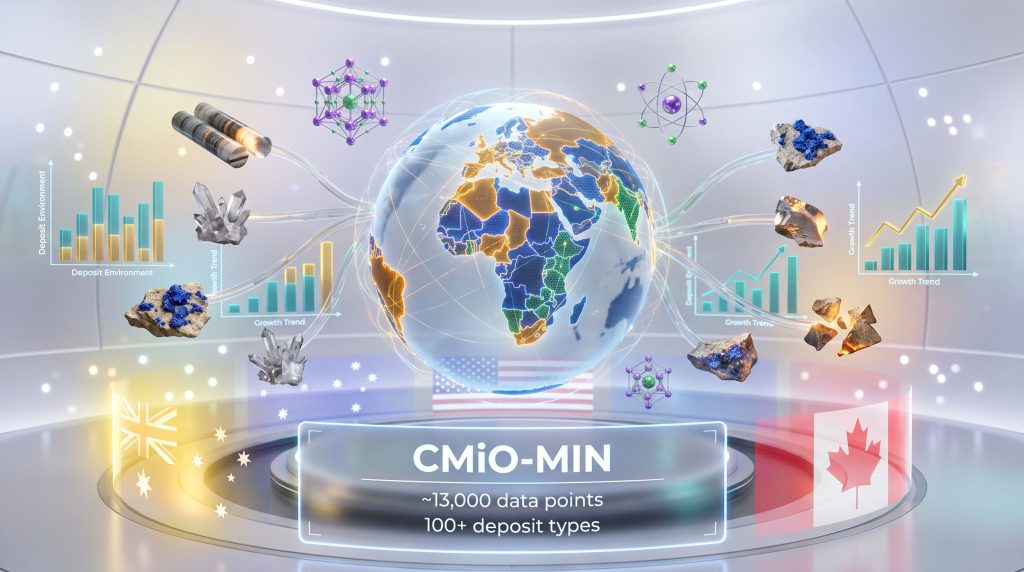
Quick Reference: CMiO-MIN (Critical Minerals in Ores – Mineral Chemistry) is a publicly accessible, standardised global mineral chemistry database developed through the CMMI. It contains approximately 13,000 data points derived from ore-related mineral samples, including mineralised core intervals, surface samples, and mine waste materials, and is designed to support exploration targeting, resource assessment, and mineral potential modelling across more than 100 deposit types worldwide.
How CMiO-MIN Extends the Original CMiO Database
To appreciate what CMiO-MIN adds, it is necessary to understand what it builds upon. The original CMiO database was already a significant achievement, covering bulk geochemical data across more than 20,000 samples spanning more than 100 deposit types within 10 distinct deposit environments. That foundation was sufficient to support critical mineral potential assessments across more than 60 countries.
CMiO-MIN extends this foundation by introducing a dedicated mineral chemistry layer, linking compositional data directly to specific sample characteristics and deposit classification schemes. The distinction between bulk geochemistry and mineral chemistry is technically important and frequently misunderstood outside specialist circles.
| Feature | CMiO (Original) | CMiO-MIN (New) |
|---|---|---|
| Total samples covered | 20,000+ | ~13,000 new data points added |
| Deposit types | 100+ across 10 environments | Linked to same classification framework |
| Data type | Bulk geochemistry | Mineral-scale chemistry |
| Sample sources | Broad deposit inventory | Core intervals, surface samples, mine waste |
| Access format | CMMI portal | Standardised public format via CMMI portal |
| Key function | Global mineral potential mapping | Geological process investigation and processing insight |
Bulk geochemistry tells you the overall elemental composition of a rock sample. Mineral chemistry goes deeper, capturing the compositional variation within individual mineral grains. This grain-level resolution matters because critical minerals such as cobalt, nickel, lithium, and rare earth elements do not occur uniformly within ore systems. Their concentration, substitution behaviour, and deportment across mineral phases directly determines how recoverable they are during processing.
What Sample Types Are Represented
The CMiO-MIN dataset draws on three primary sample categories, each contributing distinct analytical value:
-
Mineralised core intervals: Drill core samples extracted from known ore zones provide the most direct characterisation of in-situ mineral chemistry, capturing compositional variation with depth and across ore boundaries.
-
Surface samples: Outcrop and near-surface soil specimens extend coverage to areas where drilling has not yet occurred, enabling comparison of surface mineralisation signatures against deeper ore chemistry.
-
Mine waste materials: The inclusion of tailings and processing residues is perhaps the most methodologically forward-looking aspect of CMiO-MIN. These materials document the secondary mineral chemistry that results from ore processing, which is directly relevant to reprocessing feasibility assessment and circular economy research.
The deliberate inclusion of mine waste data reflects a growing recognition within the geoscience community that historical processing residues represent a legitimate and undercharacterised resource category, particularly for battery-critical elements that were not economically targeted at the time of original mining.
How CMiO-MIN Advances Exploration Targeting and Mineral Systems Research
Bridging Geological Mapping and Deposit-Scale Resource Evaluation
Traditional geological mapping establishes the broad structural and lithological architecture of a terrane. Deposit-scale resource evaluation then characterises specific mineralisation within that architecture. Between these two scales sits a critical interpretive gap: understanding which geological processes, under which pressure-temperature conditions, and within which host rock assemblages, actually concentrate critical minerals to ore-grade levels.
Mineral chemistry data is the primary tool for closing this gap. By examining the trace element substitution patterns within ore minerals, geologists can reconstruct the temperature, fluid chemistry, and oxidation state of the mineralising system. This process-level intelligence then becomes predictive, enabling geologists to identify which untested geological settings share the conditions that produced known ore systems.
Furthermore, CMiO-MIN provides a standardised, globally comparable dataset of exactly this type of information, referenced against the CMMI deposit classification scheme so that users can identify process analogues across deposit types and geographic regions simultaneously. Appreciating the role of mineral deposit tiers within this framework helps users contextualise where their targets sit within the broader resource landscape.
Practical Applications for Exploration Geologists
The practical workflow implications for exploration geologists are substantial. Consider a targeting scenario where a company is evaluating a structurally prospective terrane in a jurisdiction with limited historical exploration. Using CMiO-MIN, a geologist could:
-
Identify which of the 100+ deposit types most closely matches the geological setting being evaluated.
-
Access the mineral chemistry fingerprints associated with that deposit type from mineralised analogues globally.
-
Compare those chemistry signatures against available data from the target terrane to assess whether prospective mineralisation indicators are present.
-
Use that comparison to prioritise specific drill targets within the broader tenement area.
-
Design geochemical sampling programs that specifically target the indicator minerals most diagnostic for the deposit type in question.
This workflow compresses what would previously have required extensive literature reviews, custom data compilation, and significant interpretive uncertainty into a structured, data-driven process anchored in globally standardised chemistry benchmarks.
Supporting Critical Mineral Processing Research
One aspect of CMiO-MIN that receives less attention than exploration targeting is its value for processing research. Mineral chemistry data directly informs metallurgical test work design in ways that bulk geochemistry cannot.
Understanding the precise mineral hosts of cobalt within a nickel sulphide system, for example, determines whether standard flotation circuits will effectively recover that cobalt or whether additional processing steps are required. Similarly, the rare earth element distribution across different mineral phases in a carbonatite deposit determines whether hydrometallurgical processing will achieve target recoveries for individual elements.
The relationship between ore mineralogy, mineral chemistry, and metallurgical performance is one of the most technically complex and commercially consequential links in the critical minerals value chain. Standardised mineral chemistry databases enable this relationship to be benchmarked at a global scale for the first time.
An often-overlooked dimension is gangue mineral chemistry. The non-ore minerals within an ore system can consume reagents, interfere with separation processes, and generate problematic processing residues. Understanding the chemistry of these gangue phases across different deposit types is as strategically important as characterising the ore minerals themselves, and CMiO-MIN provides data relevant to both.
Who Uses CMiO-MIN and How
The database serves a genuinely broad user community, with distinct applications at each level of the critical minerals value chain.
| User Group | Primary Application | Key Benefit |
|---|---|---|
| Exploration geologists | Deposit analogue identification and drill target generation | Faster, data-driven targeting decisions |
| Government resource agencies | National mineral potential assessment and policy development | Benchmarked, internationally comparable data |
| Academic researchers | Geological process modelling and mineral systems analysis | Standardised dataset for peer-reviewed research |
| Mining companies | Processing pathway evaluation and metallurgical planning | Mineral chemistry context for feasibility studies |
| Supply chain analysts | Global resource distribution and concentration risk assessment | Deposit-type coverage across 60+ countries |
How to Access and Contribute to CMiO-MIN
The database operates on an open-access, open-contribution model, which is critical to its long-term value. The access and contribution pathway is straightforward:
-
Navigate to the CMMI portal, which serves as the primary access point for all CMiO and CMiO-MIN datasets.
-
Download datasets in standardised format, enabling direct cross-jurisdictional comparison without manual reformatting.
-
Apply the CMMI deposit classification framework to contextualise your data within the consensus deposit environment, group, and type scheme.
-
Cross-reference with CMiO bulk geochemistry data to combine mineral chemistry with whole-rock geochemical profiles for integrated analysis.
-
Submit additional data using the submission template available through the CMMI portal and Geoscience Australia's Data and Publications Catalogue, contributing mineral chemistry from your own ore deposit studies to the global knowledge base.
The next major ASX story will hit our subscribers first
The Geopolitical Dimension of Open Geoscience Databases
Why Data Standardisation Is a Strategic Infrastructure Question
The significance of the CMiO-MIN critical minerals database extends beyond its immediate scientific utility. In an environment where critical minerals supply chains have become a central preoccupation of industrial policy across allied nations, the availability of reliable, comparable geological data from multiple producing jurisdictions is itself a form of strategic infrastructure.
Supply chain vulnerability assessments conducted by governments and corporations depend on their ability to compare the geological endowment of different producing nations using consistent methodologies. Without standardised data, these assessments rely on heterogeneous national inventory figures that may reflect different classification standards, sampling protocols, and resource estimation conventions, introducing systematic uncertainty into strategic planning.
Geoscience Australia's leadership in this initiative reflects an understanding articulated by Dr Andrew Heap, the agency's Chief of the Mineral, Energy and Groundwater Division, that consistent, trusted geoscience data is foundational to supporting future discovery and supply as critical minerals become a global strategic priority. (Source: Geoscience Australia, 2026)
Dr Sarah Ryker, USGS Associate Director for Geology, Energy and Minerals, has similarly emphasised that when geological survey agencies pool and share their scientific knowledge, the collective impact on understanding critical mineral potential is substantially greater than what individual agencies can achieve independently. The original CMiO database's reach across more than 60 countries already demonstrates this compounding effect, and CMiO-MIN extends it further by adding mineral-scale resolution. (Source: Geoscience Australia, 2026)
The Leverage Effect of Publicly Funded Geoscience Data
There is a well-established principle in resource economics that publicly funded geoscience data generates disproportionate downstream economic value relative to its production cost. When geological surveys publish standardised datasets, they effectively subsidise the early-stage targeting work that private exploration companies would otherwise need to fund themselves. This reduces the capital required to advance from regional prospectivity assessment to drill-ready targeting, lowering the barrier to exploration investment in undercharacterised jurisdictions.
For Australia specifically, Geoscience Australia's role as a lead contributor to CMiO-MIN has direct implications for how Australian ore deposit data is perceived and utilised by international capital. Better data accessibility reduces due diligence costs for foreign investors evaluating Australian critical minerals projects, improving the competitive positioning of Australian exploration assets relative to equivalent projects in jurisdictions with less accessible geological information. Australia's critical minerals list further reinforces why such data infrastructure matters at a national policy level.
Comparing the CMMI Model to Other International Data-Sharing Frameworks
The CMMI represents a particular model of international geoscience collaboration: a small number of technically authoritative agencies working to a shared classification standard, producing outputs with genuine global transferability. This differs from larger multilateral frameworks where data quality and classification consistency can be difficult to maintain across a heterogeneous group of contributors.
The open-contribution model that CMiO-MIN uses does introduce a quality management challenge as the dataset grows. As additional organisations submit mineral chemistry data, maintaining the classification rigour that makes the database useful for cross-deposit comparison will require robust data validation protocols. This is a known limitation of open-contribution scientific databases and one that the CMMI partnership will need to actively manage as CMiO-MIN scales.
The Next Frontier: AI-Assisted Mineral Potential Modelling
Machine Learning Applications for Mineralisation Signature Recognition
Perhaps the most speculative but technically compelling application of a standardised mineral chemistry dataset like CMiO-MIN involves the use of machine learning algorithms to identify mineralisation signatures that are not immediately apparent through conventional geological interpretation. The role of AI in mineral exploration is evolving rapidly, and standardised chemistry databases of this kind provide the structured training data that makes such applications genuinely viable.
With approximately 13,000 data points spanning more than 100 deposit types, CMiO-MIN is approaching the scale at which supervised machine learning models can be trained to recognise multivariate mineral chemistry patterns associated with specific mineralisation styles. The practical implication is significant: a model trained on CMiO-MIN data could potentially flag prospective chemistry signatures in exploration datasets from terranes where conventional geological interpretation would not identify an obvious targeting rationale.
This remains a developing application rather than a proven workflow. The reliability of machine learning-based mineral potential models depends heavily on the representativeness of training data across deposit types and geological settings, and CMiO-MIN's current coverage, while broad, is not uniform across all deposit environments. However, the trajectory toward AI-assisted targeting using standardised chemistry databases is directionally clear, and CMiO-MIN provides the type of structured, classification-anchored dataset that these applications require.
In addition, advances in 3D geological modelling are increasingly being integrated with mineral chemistry datasets to produce richer, spatially referenced interpretations of ore system architecture, further amplifying the analytical value of platforms like CMiO-MIN.
Expanding the CMMI Partnership
A further consideration for the evolution of CMiO-MIN is the potential expansion of the CMMI partnership to include geological survey agencies from additional critical minerals jurisdictions. Nations including the Democratic Republic of Congo, Chile, Kazakhstan, and Brazil hold substantial critical mineral endowments that are currently underrepresented in global geoscience databases.
Incorporating mineral chemistry data from these jurisdictions would substantially increase both the scientific value and the supply chain intelligence utility of the CMiO-MIN platform. Whether such expansion is achievable within the CMMI's current governance model remains an open question, but the framework's design, with its standardised classification system and open submission template, is at least architecturally capable of accommodating a broader contributor base.
This article is intended for informational purposes only. Statements regarding future applications, technological developments, and database expansion represent forward-looking perspectives based on current trends and should not be construed as confirmed outcomes. Readers should consult primary technical sources and conduct independent research when making decisions informed by geoscience data or exploration intelligence.
Want to Know Which ASX Mineral Discoveries Could Be Worth Watching Right Now?
Discovery Alert's proprietary Discovery IQ model scans ASX announcements in real time, instantly translating complex mineral data across more than 30 commodities into clear, actionable insights — exactly the kind of edge that matters when significant critical mineral discoveries are announced. Explore historic discoveries and their returns, then begin your 14-day free trial to position yourself ahead of the broader market.