August 12, 2026
The Engineering Philosophy Reshaping How Critical Minerals Are Extracted
The mining industry is undergoing a quiet but profound transformation. Across greenfield projects in North America, a new generation of processing facilities is being designed not simply to maximise throughput, but to operate smarter, smaller, and with fewer people on site. This shift is being driven by converging pressures: tighter environmental standards, growing investor scrutiny on carbon intensity, and the operational demands of remote automation. The processing technology decisions made today will define which projects thrive over multi-decade mine lives and which struggle to adapt.
Against this backdrop, South32's approach to its Hermosa critical minerals project in southern Arizona offers a revealing case study in how leading miners are rethinking flotation circuit design from first principles. Furthermore, the critical minerals demand driving this shift continues to accelerate across global markets.
When big ASX news breaks, our subscribers know first
What Is the Hermosa Project and Why Is It Significant?
A Fully Integrated Critical Minerals Operation in Arizona
Hermosa sits within the Patagonia Mountains of southern Arizona and is 100% owned by South32 (ASX: S32). The project targets a suite of minerals that sit at the intersection of industrial demand and energy transition necessity: zinc, lead, manganese, and silver, all of which carry critical mineral classifications.
The core of the operation is the Taylor deposit, which will yield separate zinc and lead concentrates carrying silver credits through a sulphide flotation circuit. A distinct manganese deposit adds further strategic value to the overall resource package.
Construction commenced in 2025, with commissioning of the processing plant targeted for mid-2027. Hermosa represents South32's most significant growth project in the Western Hemisphere and has been engineered to reflect contemporary best practice across environmental management, automation, and processing efficiency.
How Hermosa's Output Aligns With Structural Demand Trends
The minerals Hermosa will produce are not peripheral to the energy transition. Zinc is a critical input for galvanised steel used in wind turbine infrastructure and is gaining traction in zinc-air battery development. Silver carries dual roles as both an industrial and monetary metal, with growing consumption in photovoltaic cell manufacturing. Manganese is fundamental to lithium-ion battery cathode chemistry, particularly in high-manganese formulations increasingly favoured for cost reduction.
Collectively, these commodities place Hermosa in a structurally advantaged position as demand accelerates across:
- Grid-scale energy storage infrastructure
- Electric vehicle battery systems
- Renewable energy construction and hardware
- Electronics and industrial manufacturing
Understanding the South32 Hermosa Jameson Concentrator Selection
What Is the Jameson Cell and How Does It Actually Work?
The Jameson Concentrator, developed and commercialised by Glencore Technology, operates on fundamentally different engineering principles to conventional tank flotation. Where traditional systems rely on mechanically agitated cells and external air injection to generate bubbles, the Jameson Cell uses a self-aspirating downcomer mechanism.
In practical terms, slurry is pumped at high pressure through a nozzle at the top of a vertical downcomer tube. This creates a high-shear zone that draws in air naturally, generating extremely fine bubbles without any external compressor or blower requirement. The mineralised froth separates in a lower tank section, producing a clean concentrate stream with high recovery efficiency.
The process advantages this creates are significant:
- Residence times of just 5 to 10 minutes, compared to 40 to 60 minutes in conventional tank cell circuits
- Superior recovery of fine and ultrafine mineral particles, which are notoriously difficult to capture in conventional systems
- Elimination of external air compression equipment, reducing both capital cost and ongoing maintenance obligations
- A compact, modular cell architecture that simplifies both installation and future reconfiguration
Jameson Concentrator vs. Conventional Flotation: A Direct Comparison
The performance differential between these two approaches becomes stark when laid out side by side:
| Parameter | Jameson Concentrator | Conventional Tank Cell Circuit |
|---|---|---|
| Residence Time | 5 to 10 minutes | 40 to 60 minutes |
| Number of Cells Required | ~11 cells | ~22 cells |
| Relative Footprint | ~60% of conventional | 100% (baseline) |
| Estimated Energy Savings | ~30% reduction | Baseline |
| Automation Compatibility | High | Moderate |
| Fine Particle Recovery | Superior | Variable |
| Scale-Up Complexity | Low | Moderate to High |
For a project operating under tight surface space constraints in a sensitive mountain environment, this comparison is not academic. It is the foundation of South32's technology selection rationale.
Five Engineering Reasons Behind the Technology Decision
Reason 1: Surface Footprint Reduction in a Constrained Environment
The Patagonia Mountains location presents real physical constraints on surface infrastructure. Hermosa's underground configuration means available surface area for processing facilities is limited, and any expansion of that footprint carries both environmental and regulatory implications.
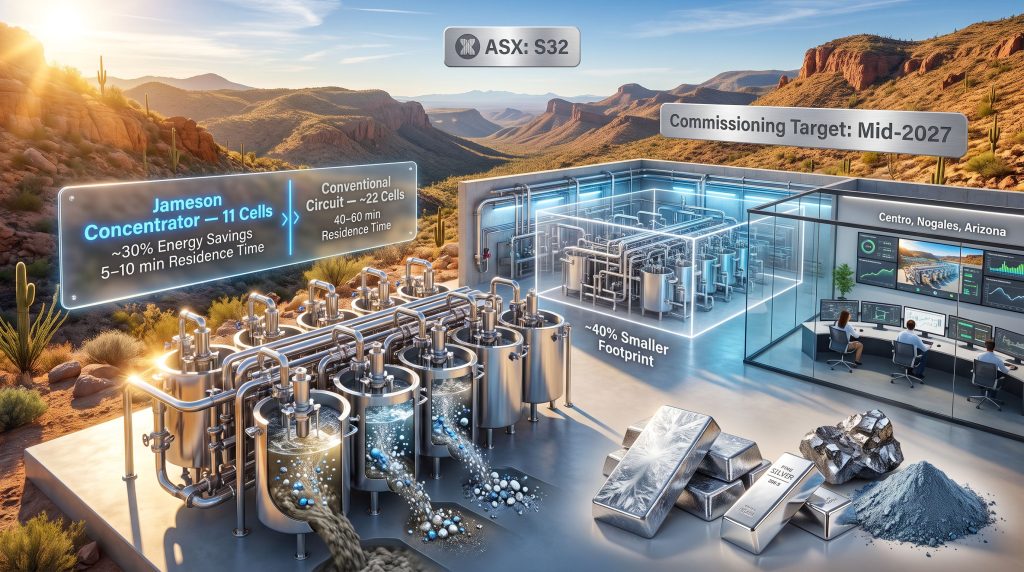
By selecting the South32 Hermosa Jameson Concentrator configuration, South32 reduced the flotation circuit from approximately 22 conventional cells to just 11 Jameson Cells, achieving a surface footprint of roughly 60% of what a conventional circuit would require. This is not a marginal improvement. It represents a meaningful reduction in land disturbance, civil construction cost, and long-term site rehabilitation liability.
Reason 2: Energy Efficiency Over a Multi-Decade Operational Life
Glencore Technology's engineering projections indicate approximately 30% lower energy consumption for the Jameson circuit compared to an equivalent conventional tank cell configuration. Over a mine life that could span several decades, this differential compounds into a substantial operating cost advantage.
The energy savings arise from two distinct sources: the elimination of external air compression equipment, and the smaller number of cells requiring mechanical drive systems. Together, these reductions lower both direct power consumption and the associated maintenance burden.
Reduced power draw also translates directly into lower Scope 2 carbon emissions, supporting South32's broader decarbonisation commitments and the ESG reporting obligations that institutional investors increasingly scrutinise. In addition, renewable mining solutions are increasingly being integrated alongside efficient processing technologies to further reduce the overall carbon footprint of operations like Hermosa.
Reason 3: Remote Operability and Automation Architecture
Perhaps the most forward-looking aspect of Hermosa's design is its operational model. The processing plant will be managed remotely from Centro, South32's dedicated operations centre in Nogales, Arizona. This remote-first design philosophy has profound implications for technology selection.
In a remotely operated environment, the ability to observe and respond to process changes quickly is not a convenience. It is a fundamental operational requirement. Conventional flotation circuits, with their 40 to 60 minute residence times, create long feedback delays that complicate remote process control significantly.
The Jameson Concentrator's 5 to 10 minute residence time compresses this feedback window dramatically. According to Scott Martin, Sales Director for the Americas at Glencore Technology, this rapid process feedback is particularly well suited to automation-focused operations, enabling faster optimisation, more frequent control actions, and laying the groundwork for advanced process control systems and future AI-driven operational improvements.
Consequently, AI mining efficiency tools are increasingly being layered on top of architectures like this, further enhancing the speed and accuracy of remote process decisions.
This rapid feedback loop provides the technical foundation for:
- Advanced Process Control (APC) deployment from commissioning
- Machine learning optimisation as operational data accumulates over time
- Reduced on-site personnel requirements, improving both cost efficiency and worker safety
- Digital twin integration, enabling predictive process modelling from the remote operations centre
Reason 4: Circuit Flexibility Across Evolving Ore Characteristics
No ore body is static. Feed grades, mineralogy, and particle size distributions shift as mining progresses through different zones of a deposit. For a project designed to operate for multiple decades, a flotation circuit that cannot adapt to these changes without significant capital expenditure creates a long-term risk.
The Jameson Cell architecture addresses this directly. Individual cells can be reassigned between roughing and cleaning duties without major circuit modifications, allowing the processing plant to be reconfigured as ore characteristics evolve. Scott Martin of Glencore Technology has noted that this operational flexibility represents a meaningful advantage for a project designed to operate remotely over an extended period.
For investors, this translates into lower life-of-mine capital reinvestment risk and greater confidence in recovery rate sustainability across commodity price cycles.
Reason 5: Testwork Validation and Commissioning Risk Reduction
Before any major processing technology commitment, rigorous laboratory and pilot-scale testwork is essential. Glencore Technology's testwork programme for the Hermosa application demonstrated:
- Low fines loss during flotation, preserving the recovery of valuable fine-grained mineral fractions
- High concentrate grade output, reducing complexity and cost in downstream processing and smelting
- Reliable and straightforward bench-to-plant scale-up, minimising the technical uncertainty that typically increases commissioning timelines and costs
This last point carries particular weight given Hermosa's mid-2027 commissioning target. Commissioning delays are among the most value-destructive events in a mining project's lifecycle. A technology with a well-understood and predictable scale-up pathway materially reduces this risk. Indeed, data-driven mining operations are increasingly being used during commissioning phases to identify and resolve process inefficiencies before they compound.
The Broader Shift Toward Intelligent, Low-Impact Mine Design
Remote Operations Centres Are Becoming the Industry Standard
South32's Centro facility in Nogales is part of a wider trend reshaping how major mining operations are managed. The mining electrification trends underpinning this shift are reinforcing the case for remote-first, low-carbon operational models across the sector. By concentrating technical expertise in an off-site operations hub, mining companies achieve several strategic objectives simultaneously:
- Enhanced worker safety through reduced underground and on-site personnel exposure
- Improved talent attraction and retention by offering professionals urban working environments
- Faster, data-driven decision-making through integrated digital monitoring and control dashboards
- Operational continuity during disruptions that would otherwise require on-site presence
The Jameson Concentrator's architecture is particularly compatible with this model. Its rapid process feedback loop, combined with its modular cell configuration, makes it well suited to centralised digital control environments.
Critical Minerals Processing as a Competitive Moat
As global demand for zinc, manganese, silver, and related transition metals grows, processing efficiency is becoming a genuine competitive differentiator among project developers. Operations that achieve superior recovery rates at lower energy cost and with greater operational agility will sustain stronger margins across commodity price cycles.
Projects built around intelligent, low-footprint processing technology are increasingly positioned as benchmark operations, attracting favourable attention from offtake partners, institutional investors, and technical collaborators alike.
The decision to deploy the South32 Hermosa Jameson Concentrator configuration reflects a deliberate commitment to building processing infrastructure that improves over time rather than simply performing at a fixed design point. Furthermore, South32's Hermosa project is broadly regarded as one of the most strategically significant critical minerals developments in the Western Hemisphere, a status that this technology decision helps to reinforce.
Key Project Metrics at a Glance
| Metric | Detail |
|---|---|
| Location | Patagonia Mountains, Southern Arizona, USA |
| Owner | South32 (ASX: S32), 100% ownership |
| Primary Commodities | Zinc, Lead, Manganese, Silver |
| Processing Technology | Jameson Concentrator by Glencore Technology |
| Flotation Circuit Size | 11 Jameson Cells (vs. ~22 conventional cells) |
| Footprint Reduction | ~40% smaller than conventional circuit |
| Energy Savings (Flotation) | ~30% vs. conventional tank cell circuit |
| Construction Start | 2025 |
| Commissioning Target | Mid-2027 |
| Remote Operations Hub | Centro, Nogales, Arizona |
The next major ASX story will hit our subscribers first
Frequently Asked Questions
What makes the Jameson Concentrator more energy-efficient?
The self-aspirating downcomer mechanism eliminates the need for external air blowers, which represent a significant power draw in conventional tank cell circuits. Combined with a smaller total number of cells requiring mechanical drive systems, the Jameson configuration delivers approximately 30% lower energy consumption per unit of throughput.
How does rapid process feedback support AI integration at Hermosa?
Because the Jameson Cell produces observable downstream results within 5 to 10 minutes of any process adjustment, control systems receive high-frequency, reliable data. This data density is a prerequisite for deploying advanced process control algorithms and machine learning optimisation models, which require rapid feedback to function effectively in dynamic ore processing environments.
Why does flotation circuit flexibility matter for long-life mines?
Ore characteristics evolve continuously as mining progresses through a deposit. A circuit that requires significant capital expenditure to reconfigure in response to these changes creates ongoing financial risk. The ability to reassign individual Jameson Cells between roughing and cleaning duties without major modifications preserves recovery performance and reduces life-of-mine reinvestment requirements.
What is the significance of low fines loss in flotation testwork?
Fine-grained mineral particles are among the most difficult to recover in flotation circuits. High fines loss reduces overall recovery rates and can meaningfully impact project economics over a multi-decade mine life. Testwork confirming low fines loss in the Jameson circuit at Hermosa provides confidence that the processing plant will achieve design recovery rates consistently. Additionally, Hermosa's innovative approach to zinc processing has been publicly outlined by South32 as a cornerstone of the project's long-term value proposition.
This article contains forward-looking statements and projections based on publicly available project information and engineering estimates. Actual project outcomes, timelines, and performance metrics may differ materially from those described. This content does not constitute financial or investment advice. Investors should conduct their own due diligence and seek independent advice before making investment decisions.
Want to Track the Next Major Critical Minerals Discovery Before the Market Does?
Discovery Alert's proprietary Discovery IQ model delivers real-time alerts on significant ASX mineral discoveries — instantly translating complex geological data into actionable investment insights for both short-term traders and long-term investors. Start your 14-day free trial today, or explore Discovery Alert's discoveries page to see how historic mineral discoveries have generated exceptional market returns.